
After accounting archives are digitized, are paper vouchers still needed? These conditions allow no printing | Kailing Technology AI electronic accounting archives solution
"After accounting archives are digitized, do paper vouchers still need to be printed?" This is the most agonizing question for many finance teams when advancing paperless operations: not printing risks non-compliance, while continuing to print means maintaining two sets, paper and electronic, and wasting effort. The answer is: it is neither always permissible to skip printing nor always mandatory to print; it depends on whether the prescribed conditions are met. Articles 8 and 9 of the Measures for the Administration of Accounting Archives (Order No. 79 of the Ministry of Finance and the National Archives Administration), together with the Notice on Standardizing the Reimbursement, Booking and Archiving of Electronic Accounting Vouchers (Cai Kuai [2020] No. 6) issued by the Ministry of Finance and the National Archives Administration, set out clear conditions for "retention in electronic form only." This article interprets these conditions one by one, explains which materials may skip printing and which must still be kept on paper, and how the Kailing Technology AI electronic accounting archives solution helps enterprises implement the conditions in their systems.
▍Conclusion first: those meeting the conditions may retain a single electronic set
According to Article 8 of Order No. 79, electronic accounting materials formed internally by a unit that simultaneously meet the prescribed conditions may be preserved only in electronic form to form electronic accounting archives; Article 9 provides that electronic accounting materials received from outside that bear electronic signatures complying with the Electronic Signature Law of the People's Republic of China and meet the Article 8 conditions may also be archived and preserved only in electronic form.
Cai Kuai [2020] No. 6 further clarifies that legally sourced and authentic electronic accounting vouchers have the same legal effect as paper accounting vouchers; if a unit uses paper printouts of electronic accounting vouchers as the basis for reimbursement, booking, and archiving, it must simultaneously preserve the electronic accounting vouchers from which the printouts were made. In other words, printouts cannot replace electronic originals, and when conditions are met, the electronic original itself can serve as the archive.
| "Whether printing can be skipped depends not on whether software exists, but on whether the conditions are met." |
▍How to understand the six conditions of Article 8, one by one
The conditions in Article 8 of Order No. 79 can be summarized into six items; the table below gives the gist of each and the enterprise self-check points. The original text of the regulations prevails.
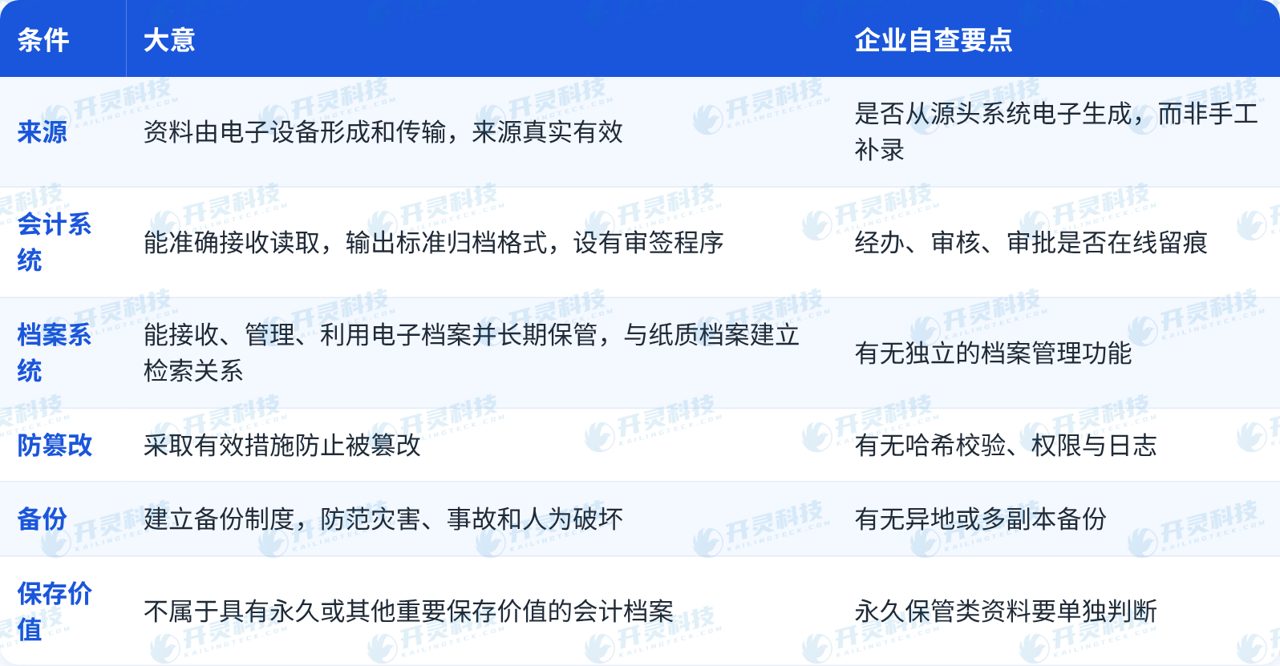
Article 8 of Order No. 79 conditions self-check table
As can be seen from the table, four of the six conditions are directly related to system capabilities: audit trail of review and approval in the accounting system, long-term preservation and retrieval in the archives system, tamper-proof measures, and a backup system. The last condition, "preservation value," requires enterprises to judge for themselves based on the type of material and cannot be applied mechanically.
▍Which materials may skip printing and which must still be kept on paper
Based on the above conditions, common materials can be viewed in three categories.
- Usually eligible for single-set electronic preservation: Fully digitalized e-invoice PDF, OFD, and XML source files obtained from the electronic tax bureau or source systems, bank electronic receipts, reimbursement forms and approval records formed through online approval, and accounting vouchers and ledgers generated by the system, provided that the conditions of Articles 8 and 9 are met.
- Items requiring careful judgment: Materials with permanent preservation value or other important preservation value, such as annual financial accounting reports, accounting archives retention registers, and destruction registers, should have their preservation form determined according to regulations and the unit's own rules.
- Originals that cannot be destroyed due to scanning: Images formed by scanning paper original vouchers are digital copies of paper archives; scanning itself does not automatically authorize destruction of paper originals, and disposal of originals should follow applicable regulations.
The misunderstanding of many enterprises is equating "electronification" with "scanning." Scanning solves convenience of reference, while single-set electronic preservation solves "the electronic original is the archive"; the two have different legal significance.
▍Externally received e-invoices: focus on source files and signatures
For externally obtained electronic accounting materials, Article 9 emphasizes being accompanied by an electronic signature that complies with the Electronic Signature Law. Taking fully digitalized e-invoices as an example, enterprises should retain the invoice source files obtained from official channels and keep their verification records, rather than only saving screenshots or printouts.
The Kailing Technology AI electronic accounting archives solution is directly connected to expense control and tax invoice systems, synchronously receiving invoice PDF, OFD, and XML source files during reimbursement or booking, and retaining verification status; source files, reimbursement forms, accounting vouchers, and bank receipts are linked by business association and can be retrieved at once during audits.
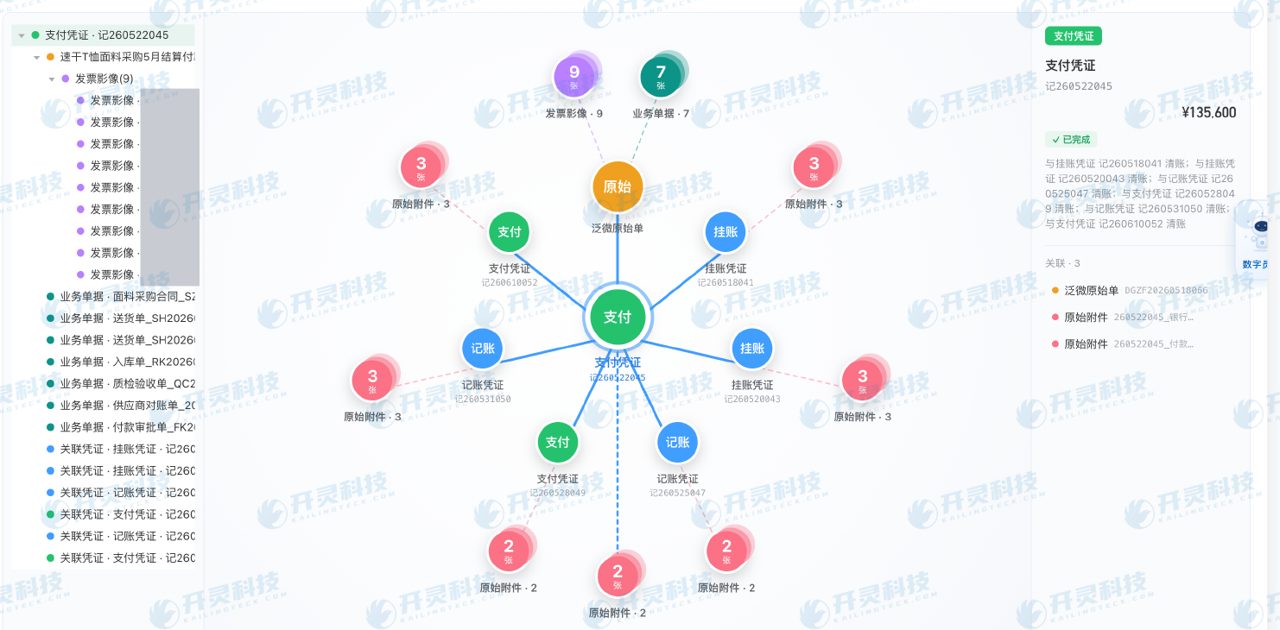
Kailing Technology business star-chain diagram: invoice source files attached under vouchers (system screenshot)
▍How the system embeds the conditions into daily operations
The conditions are written in the regulations, but implementation depends on daily operations. The Kailing Technology AI electronic accounting archives solution provides support at several key stages: first, automatically retrieving data from source systems such as finance, expense control, treasury, and OA, with materials electronically generated and transmitted by the system; second, performing a four-property check before archiving, with failures entering an exception pool for handling; third, after archiving, calculating and storing verification values, with full traceability of access and operations and role-based permission control; fourth, supporting multi-copy storage and backup policy configuration; fifth, establishing catalogs and retrieval relationships for retained paper archives and linking them to electronic archives.
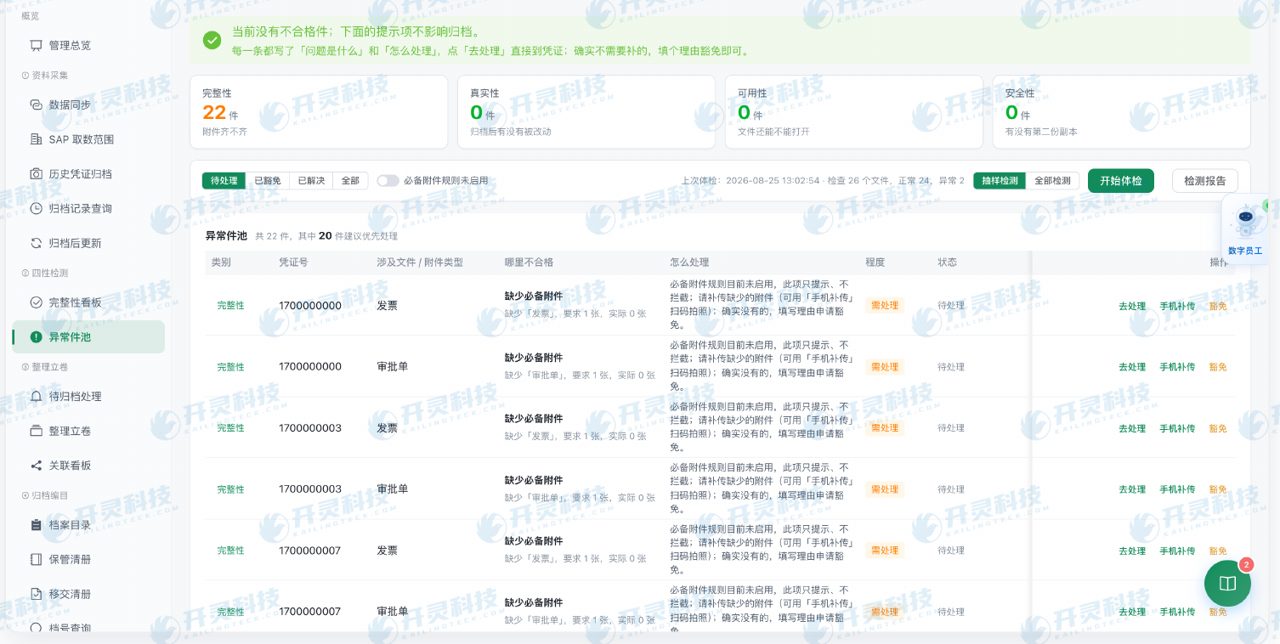
Kailing Technology four-property check: anomalies state the reason and handling suggestion (system screenshot)
It should be emphasized that the system provides technical means that meet the conditions; the organization also needs to establish corresponding management systems, such as electronic accounting archive management measures, backup and recovery systems, and retention schedules, and clarify which materials are managed under a single-copy system and which still retain paper copies.
▍From "two sets" to "one set": recommended three-step approach
Step one, inventory data sources. List which system vouchers, invoices, receipts, and approval forms come from, which are already electronic originals, and which are still paper. Step two, start single-set archiving with materials having a high proportion of electronic originals, such as fully digitalized e-invoices and bank electronic receipts, and stop the process of printing paper copies. Step three, after improving systems and configurations, gradually expand the single-set scope and regularly review backups, permissions, and four-property check results.
During implementation, if it is unclear whether a certain type of material can be kept without printing, it is advisable to communicate and confirm with the competent finance department or archives department, with the written conclusion prevailing.
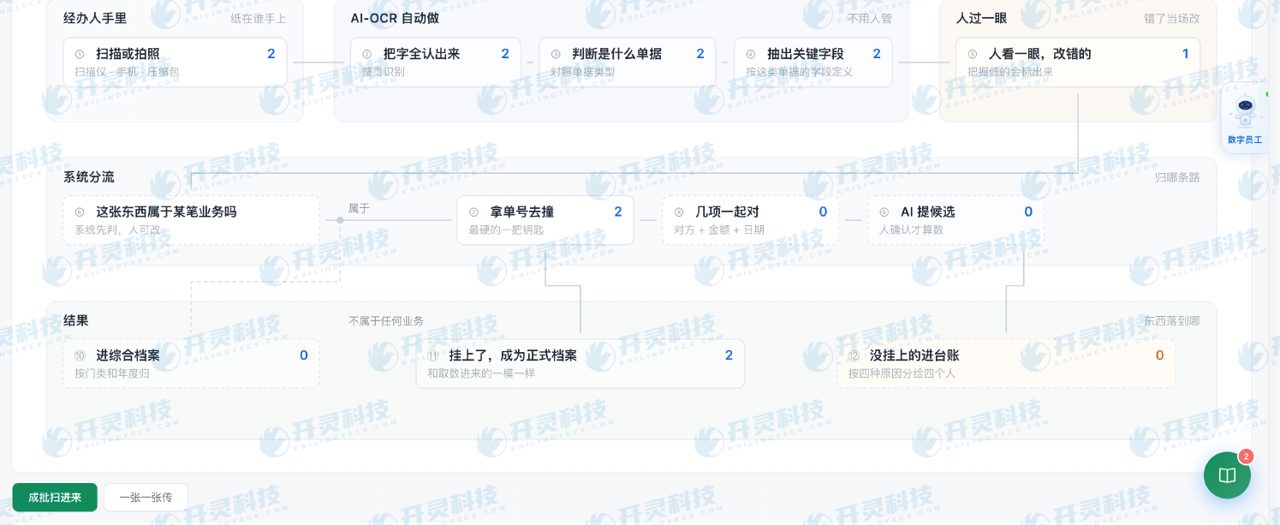
Kailing Technology AI OCR recognizes paper documents and routes them
▍FAQ
Q: Have paper accounting archives been abolished?
A: No, it is not a full cancellation. Electronic accounting materials that meet the conditions of Articles 8 and 9 of the Measures for the Administration of Accounting Archives may be retained in electronic form only; in other cases, paper or paper-electronic corresponding materials must still be retained as required.
Q: Can e-invoices be printed out and booked?
A: A printout may be used as the basis for reimbursement and booking, but according to Cai Kuai [2020] No. 6, the corresponding source electronic accounting voucher file must be retained at the same time.
Q: Can the original be destroyed after paper vouchers are scanned?
A: A scanned image is a digital copy; scanning itself does not automatically authorize destruction of the paper original, and disposal of the original should follow the applicable regulations.
Q: Can the Kailing Technology AI electronic accounting archives solution support the single-set system?
A: The system provides capabilities such as direct source data retrieval, four-property testing, tamper-proof verification, permission audit trails, multi-copy backup, and paper-electronic retrieval linkage, supporting enterprises in advancing single-set electronic archiving according to conditions.
To move from two sets, paper and electronic, to one set without crossing compliance lines, learn about the Kailing Technology AI electronic accounting archives solution: https://www.kailingteck.com/eaa/ .
As a national high-tech enterprise, Kailing Technology focuses on the digital and intelligent transformation of enterprise business-finance-tax and operations management, providing software products, system integration, implementation and delivery, and operational services for various government agencies, institutions, group enterprises, and SMEs.
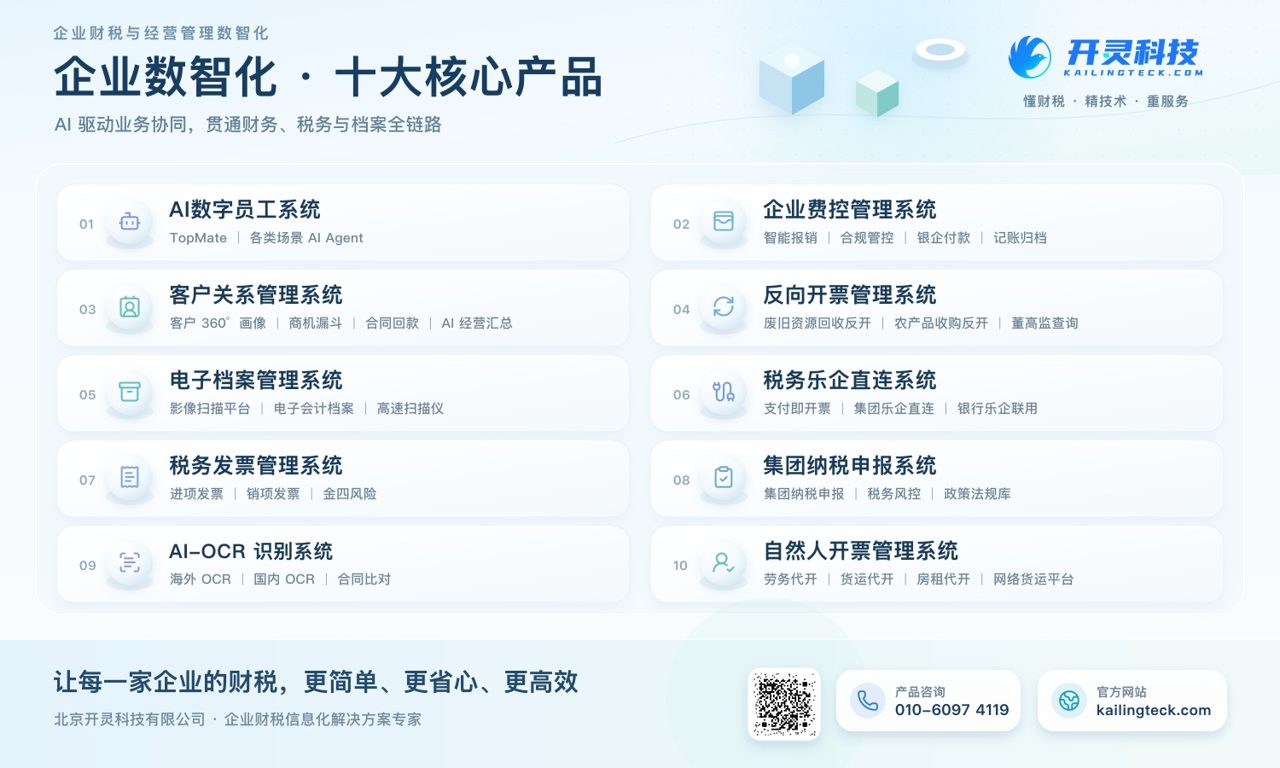
The company has now formed ten core product lines, including: AI digital employee system, enterprise expense control management system, customer relationship management system, reverse invoicing management system, invoice issuance for individuals management system, electronic archives management system, tax fully digitalized e-invoice Leqi system, tax invoice management system, group tax filing system, and AI OCR recognition system. It is committed to connecting enterprise business, finance, tax, funds, and archive data to help customers improve operational efficiency, business-finance-tax compliance capabilities, and digital management levels.
If you have any business-finance-tax digital transformation needs, welcome to contact us. Beijing Kailing Technology will serve you wholeheartedly.
Keywords: Do paper vouchers still be needed after accounting archives are digitized, have paper accounting archives been abolished, conditions for not printing electronic accounting archives, single-set archiving, Article 8 of the Measures for the Administration of Accounting Archives, Kailing Technology AI electronic accounting archives solution, electronic accounting voucher archiving
As a comprehensive business-finance-tax digitalization solution service provider, Kailing Technology provides business-finance-tax management digital transformation products and operational services for various government agencies, institutions, and large, medium, and small enterprises. The product line includes: solutions for sales contract management system, procurement contract management system, fully digitalized Leqi interface project, automatic output invoicing system, reverse invoicing system, invoice issuance for individuals system, employee expense control and reimbursement system, input VAT invoice management system, supply chain collaborative reconciliation system, image AI OCR recognition system, automatic financial bookkeeping system, electronic accounting archives system, etc., comprehensively driving the digitalization process across various fields.
Consultation Hotline: 18513895936 / 010-60974119 Location: Beijing