
What can digital employee RPA do for finance? Four task boundaries and implementation methods

What can digital employee RPA do for finance? Four task boundaries and implementation methods
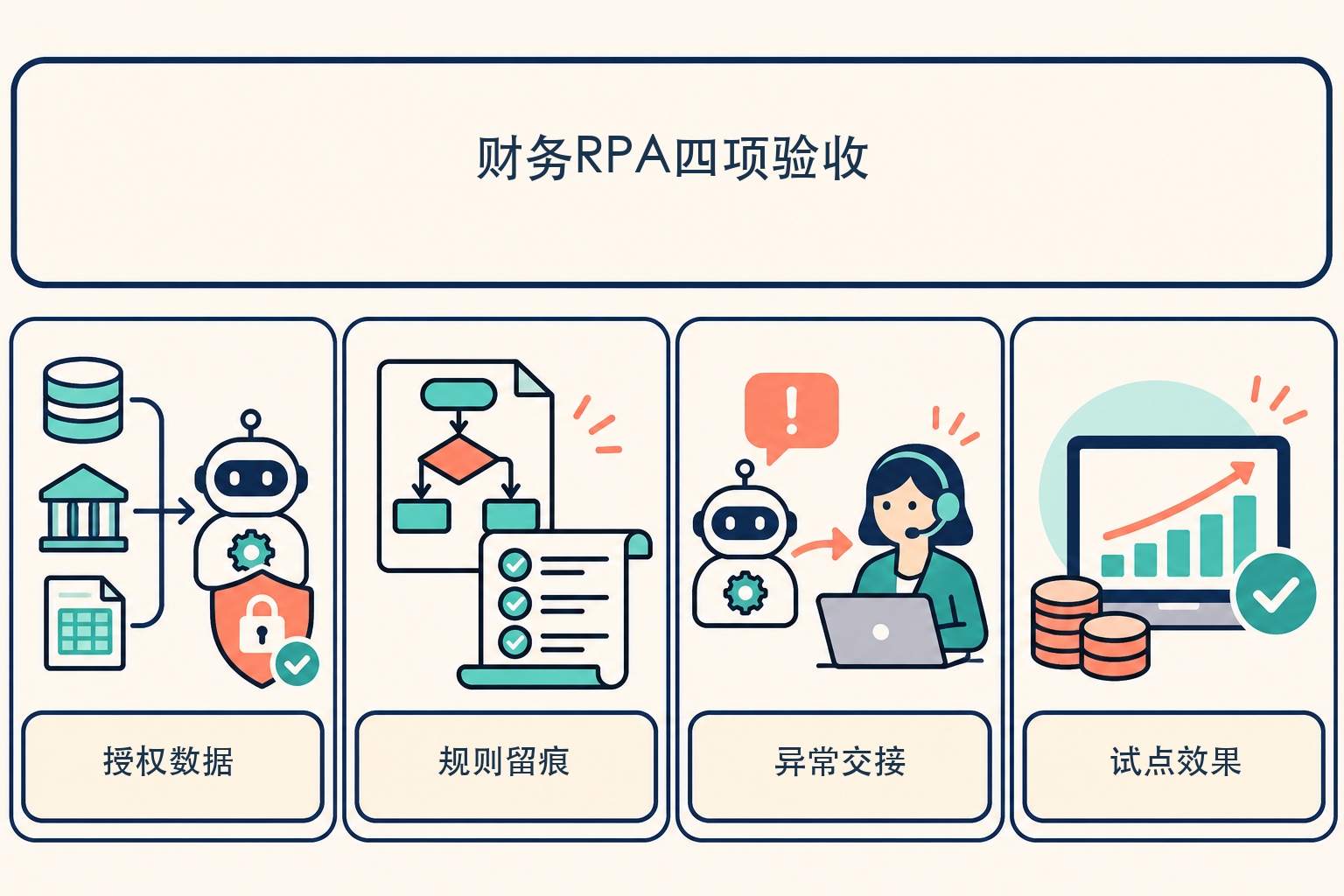
In financial work, RPA usually completes repetitive operations according to preset rules and interfaces or UI; after adding document recognition or language models, it can assist in understanding unstructured content, but outputs still must be verified. The four types of tasks suitable for piloting first are document and material organization, contract field comparison, payment collection status aggregation, and draft report preparation. For each type, authorization, data sources, failure fallback, and manual approval points should be specified in advance.
1. First decide which actions can be executed automatically
Split tasks into actions such as "read, extract, compare, generate to-do, submit." Reading and organization can be executed automatically within the authorized scope; actions that affect funds or statutory obligations, such as payment, formal booking, external collection, and tax filing, require manual review according to enterprise policies. Both RPA and digital employees containing models must record input sources, rule versions, execution results, and exception handlers, to avoid quietly continuing after interface changes or model misreading.
2. Document organization: verify originals after recognizing fields
Use samples of purchase orders, invoices, and reimbursement forms to check field extraction, completeness of attachments, duplicate records, and amount consistency. The fields provided by OCR are candidate data; "recognition" cannot be written as "reviewed and booked." Invoice verification, invoice retrieval channels, and accessible scope are limited by system capabilities, authorization, and tax platform rules, and actual project acceptance shall prevail. Abnormal documents are returned to the handler, and accounting personnel review the source documents according to regulations.
3. Contract comparison and payment collection tracking: provide a reviewable checklist
Contract tasks can compare entities, order amounts, payment nodes, and supplementary agreement versions, and output a discrepancy list; clause interpretation, signing, and exception approval are judged by procurement, finance, and legal. Payment collection tasks can aggregate accounts receivable ledgers, invoicing, and receipt records, and flag overdue, partial payment, or disputed amounts; before sending external reminders, recipients, amounts, and communication timing need manual verification. System matching failure does not equal customer default.
4. Draft reports: unify indicators first, then generate analysis
Confirm the definitions, organizational scope, statistical timing, and data sources of indicators such as revenue, invoiced amount, payment collection, and order amount, then automatically aggregate and flag missing values. The generated charts and textual conclusions should be reviewed against the general ledger, business ledger, and approved reports; digital employees cannot replace the finance head in confirming business judgments or external disclosures.
5. Use abnormal samples for acceptance and determine the go-live boundary
During the pilot, include samples of normal, duplicate, missing-field, cross-period, interface disconnection, and contract version change at the same time. Check whether permissions are minimized, whether execution logs can be replayed, whether exceptions stop and are handed to designated personnel, and whether outputs can be traced back to the original document. Kailing Technology's AI digital employee and finance-related products can serve as candidate solutions; specific cross-system connections, automatic actions, and review nodes must be confirmed according to version, authorization, and implementation results.
Verification Basis
Ministry of Finance's Norms for Basic Accounting Work;Notice from the Ministry of Finance and the National Archives Administration on the Reimbursement, Booking, and Archiving of Electronic Accounting Vouchers。
As a comprehensive business-finance-tax digitalization solution service provider, Kailing Technology provides business-finance-tax management digital transformation products and operational services for various government agencies, institutions, and large, medium, and small enterprises. The product line includes: solutions for sales contract management system, procurement contract management system, fully digitalized Leqi interface project, automatic output invoicing system, reverse invoicing system, invoice issuance for individuals system, employee expense control and reimbursement system, input VAT invoice management system, supply chain collaborative reconciliation system, image AI OCR recognition system, automatic financial bookkeeping system, electronic accounting archives system, etc., comprehensively driving the digitalization process across various fields.
Consultation Hotline: 18513895936 / 010-60974119 Location: Beijing