
How to issue a grain purchase invoice and can it be deducted? 2026 grain purchase invoicing guide | Kailing Technology agricultural product purchase compliance solution
In the autumn grain purchase season, finance staff at grain trading enterprises, flour mills and feed mills most often search two questions: "How to issue a grain purchase invoice" and "Can a grain purchase invoice be deducted". The direct answer: when purchasing self-produced grain from individual grain farmers, the purchasing enterprise may issue an agricultural product purchase invoice itself and calculate input tax at a 9% deduction rate based on the purchase price stated on the invoice; when purchasing from business entities such as cooperatives and family farms, the other party issues the invoice, and the purchaser does not issue a purchase invoice. After the implementation of the Value-Added Tax Law of the People's Republic of China in 2026, the agricultural product deduction policy has a new connection approach. This article organizes a 2026 grain purchase invoicing guide according to "whether it can be issued, to whom, how to deduct, and what evidence to keep", and introduces the approach of the Kailing Technology agricultural product purchase compliance solution.
▍Can it be issued: first look at who is selling the grain
Whether a grain purchase invoice can be issued depends on the seller's identity. Agricultural producers selling self-produced agricultural products are exempt from VAT, which is the basis for the existence of purchase invoices: individual grain farmers sell grain they grew themselves and have no invoicing capability, so the purchasing enterprise, as the payer, issues the purchase invoice.
Different sellers correspond to different invoice acquisition methods. The table below summarizes them, and the competent tax authority's interpretation shall prevail.
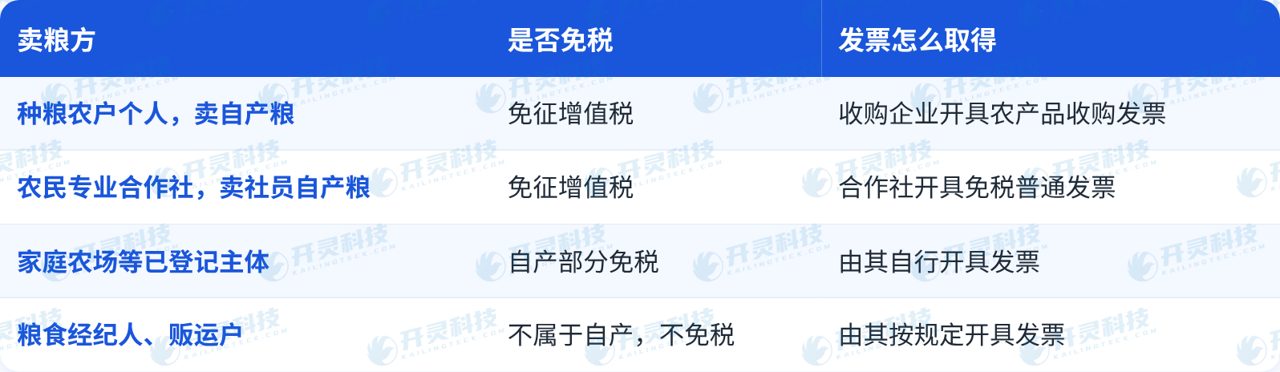
Invoice acquisition methods for different grain sellers
The most important category to watch out for is the last one: brokers and dealers who buy grain and resell it are not selling self-produced grain, so the purchasing enterprise may not issue purchase invoices for them. In practice, many deduction disputes stem from treating dealers as farmers.
▍Can it be deducted: 9% deduction rate in 2026
The agricultural product purchase invoice issued by a purchasing enterprise is a lawful voucher for a general VAT taxpayer to calculate input tax. According to the Announcement of the Ministry of Finance and the State Taxation Administration on Matters Concerning the Connection of VAT Preferential Policies After the Implementation of the VAT Law (Ministry of Finance and State Taxation Administration Announcement No. 10 of 2026) and the 12366 reply, starting from January 1, 2026, when a general VAT taxpayer purchases agricultural products and obtains or issues an agricultural product sales invoice or purchase invoice, the input tax shall be calculated at the purchase price stated on the invoice and a deduction rate of 9%; tax-exempt agricultural products purchased from farmers' professional cooperatives may also be calculated at 9%.
Note that, according to the 12366 response interpretation, the previous provision that "agricultural products purchased for production or commissioned processing of goods subject to the 13% tax rate are deducted at 10%" no longer applies after Announcement No. 10 of 2026 takes effect. Grain processing enterprises should use the new interpretation as the basis when calculating costs, and specific implementation is subject to the competent tax authority.
| " From 2026, grain purchase invoicing and deduction follow 9%, provided the seller is genuinely a grain-growing farmer. |
▍How to issue: one grain purchase from weighing to invoicing
A compliant grain purchase invoicing process generally goes through five steps. Step one, farmer file creation: verify the ID card and bank card, and upload the planting certificate issued by the village committee or land contracting materials to prove self-production. Step two, quality inspection and weighing: sample to test moisture and impurities, weigh, and price by quality with quantity deductions. Step three, farmer confirmation: after the purchase order is generated, the farmer scans the code with their own phone to check the product name, quantity, and unit price and confirm. Step four, payment: pay to the farmer's own bank card. Step five, invoicing: issue the agricultural product purchase invoice at the same time as payment.
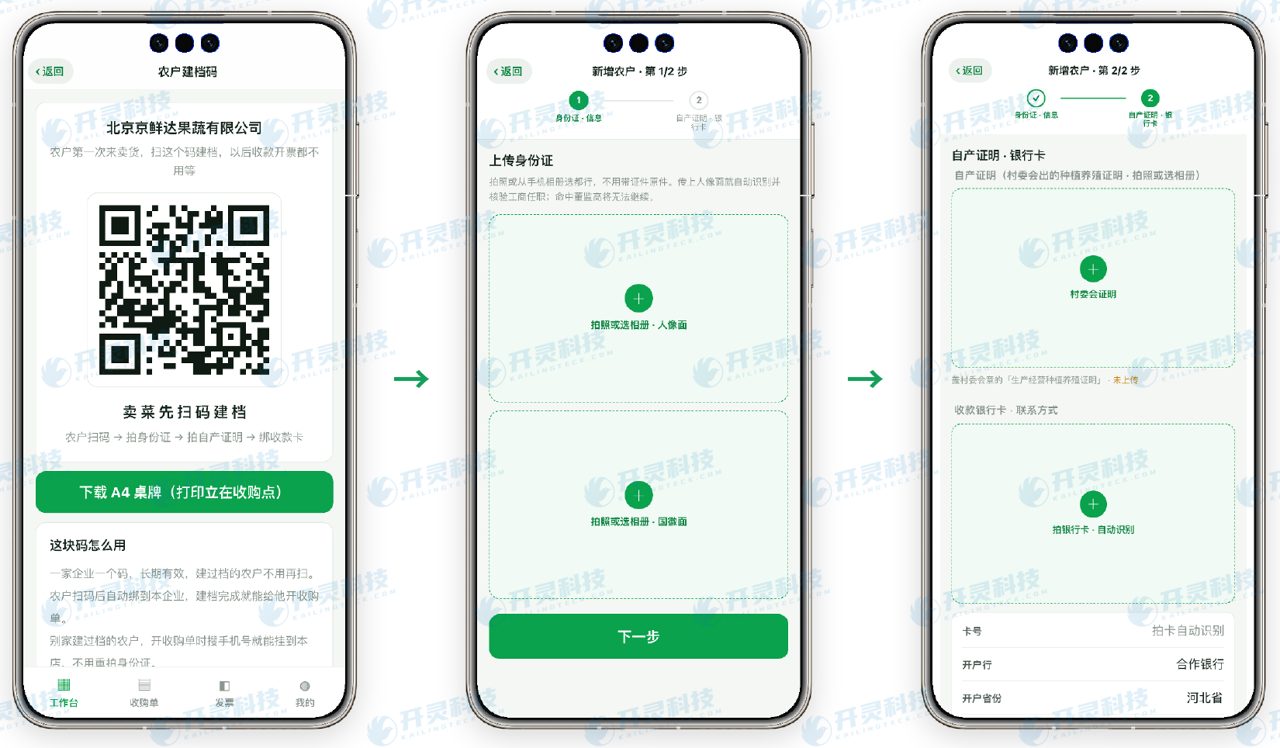
Kailing Technology farmer file creation: upload self-production certificate (information desensitized)
The Kailing Technology agricultural product purchase compliance solution puts these five steps into one line: file creation materials are mandatorily uploaded in the system, weighing data and photos are attached to the purchase order, payment can only be made after the farmer personally confirms, invoicing is synchronized upon successful payment, and invoice format files are automatically retained. During the peak autumn grain season when order volume is concentrated, batch invoicing and batch payment are supported.
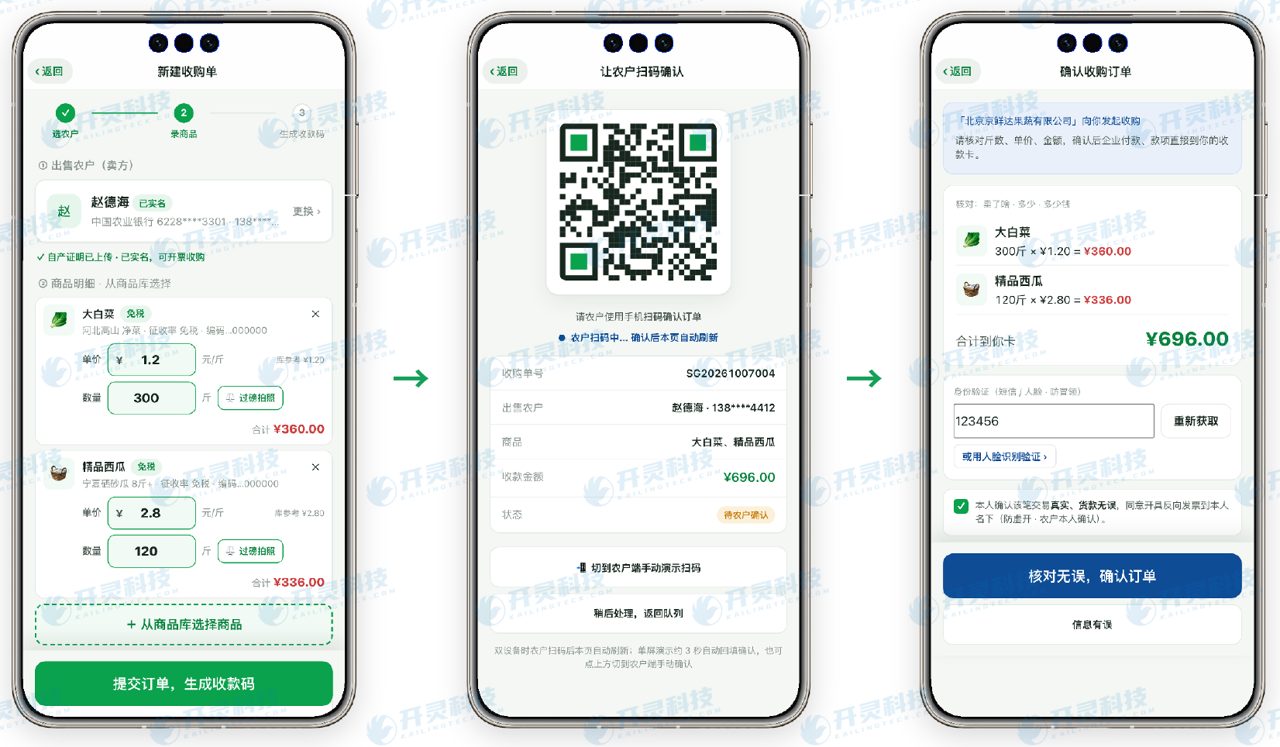
Kailing Technology purchase confirmation: farmer personally checks on mobile phone (information desensitized)
▍What evidence to keep: deduction stability depends on the unity of five flows
Purchase invoices are issued by the enterprise itself, so tax audits place more emphasis on the evidence behind the invoice. The Kailing Technology agricultural product purchase compliance solution is organized around five evidence flows: the self-certification flow, namely farmer identity and planting proof; the contract flow, namely the purchase contract or the purchase order confirmed by the farmer; the business flow, namely inspection, weighing and warehousing records; the tax flow, namely the purchase invoice; and the funds flow, namely the payment receipt. The five flows are linked under the same purchase, one file per invoice.
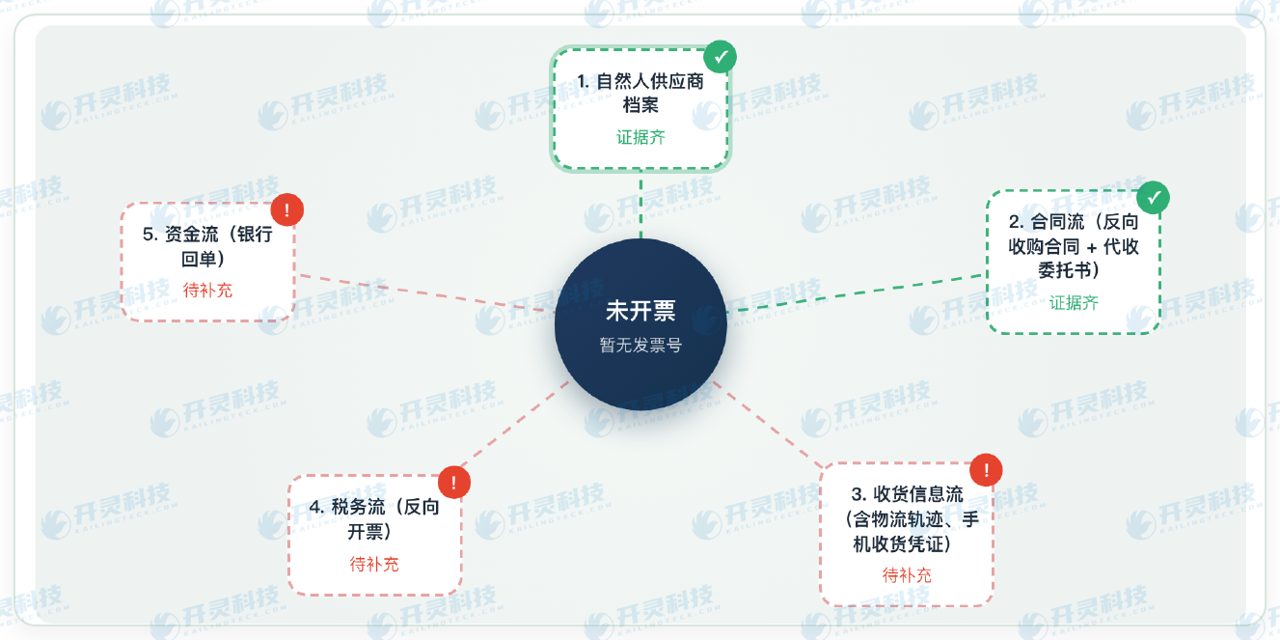
Kailing Technology five-flow star-chain diagram: strict verification before invoicing (information desensitized)
Before invoicing, the three pieces of evidence of identity, contract and goods must all be complete; if any one is missing, the system will not release it. At the moment of payment, the two pieces of evidence of funds and invoice are generated simultaneously. In this way, every purchase invoice can be traced back to the grain seller, that truck of grain and that payment.
▍Four practical reminders for peak grain purchasing season
First, grain brokers selling on behalf. When a broker delivers grain from multiple farmers together, archives, confirmation and payment/invoicing should be done per household, and a purchase invoice may not be issued in the broker's single name. Second, paying family members. If a farmer asks for the money to be paid to a child's account, this will cause the funds flow to be inconsistent with the invoice flow; it is recommended to insist on paying to the person's own card. Third, cash purchases. Cash payment makes it difficult to prove the direction of funds; online payment should be used as much as possible even in peak season. Fourth, abnormal volume warnings. If the delivery volume of the same farmer in a short period clearly exceeds their planting scale, the system will prompt verification.
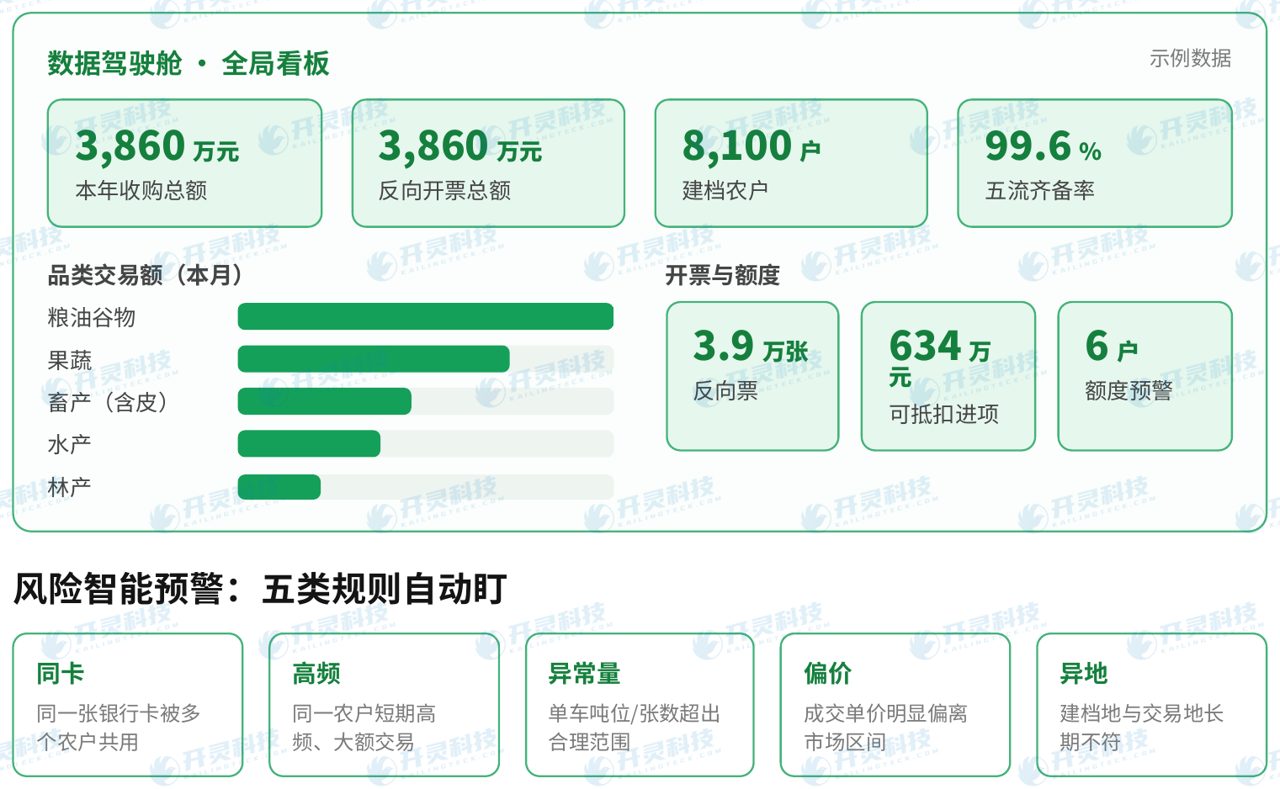
Kailing Technology purchase cockpit and five types of risk alerts (sample data)
▍System preparation checklist for grain purchasing enterprises
Before the autumn grain purchase, enterprises can prepare against the following items: a farmer archive template specifying the identity, bank card and self-production proof materials that need to be uploaded; grain categories and tax classification codes preset by variety; inspection and deduction rules, with moisture and impurity deduction standards written into the system; payment channels, confirming that bank-enterprise direct connection or cooperative channels are enabled; invoicing quota and red-letter reversal process, confirmed before the peak season. Implementation consultants of the Kailing Technology agricultural product purchase compliance solution will assist enterprises before the purchase season to complete the configuration item by item and run through the whole process with a batch of simulated data.
During the peak season, it is recommended to check the five-flow completeness rate and the risk warning list daily, and complete purchase orders lacking evidence on the same day to avoid backlog until the end of the month.
▍What farmers care about: do they need to pay tax when selling grain?
What grain farmers care about most is "if I sell grain and an invoice is issued, do I have to pay tax". According to regulations, agricultural producers selling self-produced agricultural products are exempt from VAT; when farmers deliver self-produced grain and the purchasing enterprise issues a purchase invoice, no VAT is payable. When mobilizing farmers to create archives, the purchasing enterprise can explain this clearly and explain that archive creation and QR code confirmation are only to prove that this truck of grain was indeed grown by the farmer, so as to eliminate farmers' concerns.
▍FAQ
Q: How are grain purchase invoices issued?
A: When purchasing self-produced grain from individual grain-growing farmers, the purchasing enterprise verifies the farmer's identity and self-production certificate, confirms by weighing, and issues an agricultural product purchase invoice after payment.
Q: Can grain purchase invoices be deducted?
A: Yes. General VAT taxpayers calculate input VAT based on the purchase price stated on the purchase invoice and a 9% deduction rate, pursuant to Ministry of Finance and State Taxation Administration Announcement No. 10 of 2026.
Q: Can purchase invoices be issued for grain purchased from a cooperative?
A: No. Grain produced by members and sold by a cooperative is invoiced by the cooperative as a tax-exempt ordinary invoice, and the purchasing enterprise calculates input VAT at 9% based on that invoice.
Q: How are invoices issued for grain delivered by a grain broker?
A: Resale by a broker does not qualify as self-production tax exemption, and the broker should issue invoices according to regulations; if the broker delivers on behalf of multiple farmers, files should be created and payments and invoices issued per household.
Want fast invoicing and stable deductions in the autumn grain purchase? Welcome to learn about the Kailing Technology agricultural product purchase compliance solution: https://www.kailingteck.com/fxncp/ .
As a national high-tech enterprise, Kailing Technology focuses on the digital and intelligent transformation of enterprise business-finance-tax and operations management, providing software products, system integration, implementation and delivery, and operational services for various government agencies, institutions, group enterprises, and SMEs.
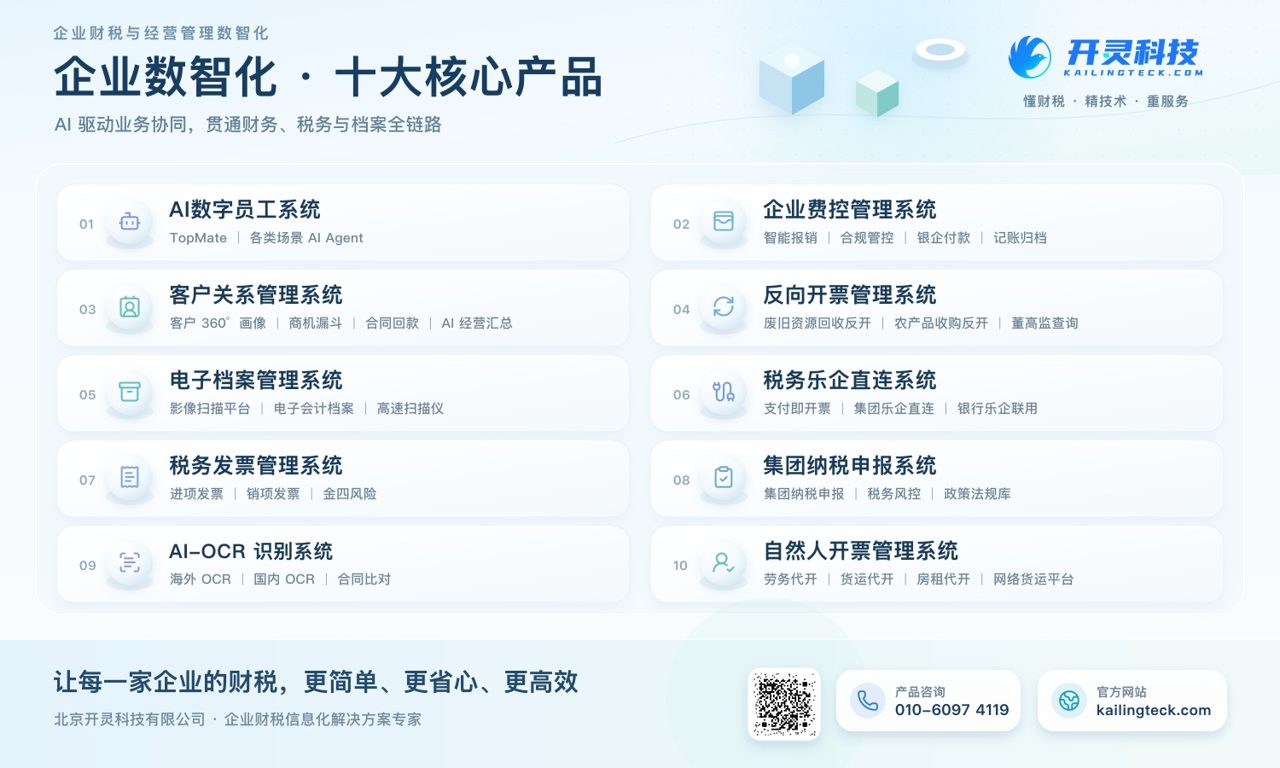
The company has now formed ten core product lines, including: AI digital employee system, enterprise expense control management system, customer relationship management system, reverse invoicing management system, invoice issuance for individuals management system, electronic archives management system, tax fully digitalized e-invoice Leqi system, tax invoice management system, group tax filing system, and AI OCR recognition system. It is committed to connecting enterprise business, finance, tax, funds, and archive data to help customers improve operational efficiency, business-finance-tax compliance capabilities, and digital management levels.
If you have any business-finance-tax digital transformation needs, welcome to contact us. Beijing Kailing Technology will serve you wholeheartedly.
Keywords: How to issue a grain purchase invoice, can a grain purchase invoice be deducted, grain purchase invoice tax rate, 2026 grain purchase invoicing, agricultural product purchase invoice, Kailing Technology agricultural product purchase compliance solution, five-flow integration
As a comprehensive business-finance-tax digitalization solution service provider, Kailing Technology provides business-finance-tax management digital transformation products and operational services for various government agencies, institutions, and large, medium, and small enterprises. The product line includes: solutions for sales contract management system, procurement contract management system, fully digitalized Leqi interface project, automatic output invoicing system, reverse invoicing system, invoice issuance for individuals system, employee expense control and reimbursement system, input VAT invoice management system, supply chain collaborative reconciliation system, image AI OCR recognition system, automatic financial bookkeeping system, electronic accounting archives system, etc., comprehensively driving the digitalization process across various fields.
Consultation Hotline: 18513895936 / 010-60974119 Location: Beijing