
What is needed to issue a special VAT invoice at a gas station? The fuel-up invoicing process explained in one go | Kailing Technology Leqi integrated solution
"What is needed to issue a special VAT invoice at a gas station?" Drivers of corporate fleets, finance staff and gas station cashiers all frequently ask this question. After the full rollout of "transaction-based invoicing" in the refined oil retail sector, the answer has become simpler: a unit buyer provides its name and taxpayer identification number, and after fueling is completed a special VAT invoice can be issued based on the actual transaction; sales to individual consumers are issued ordinary invoices. The Announcement of the State Taxation Administration on Matters Concerning the Full Promotion of "Transaction-Based Invoicing" in the Refined Oil Retail Sector (State Taxation Administration Announcement No. 11 of 2026) requires gas stations to implement transaction-based invoicing before November 1, 2026. This article, from the perspectives of both the buyer and the gas station, explains what needs to be prepared to issue a special VAT invoice, how to issue under different payment methods, and how the Kailing Technology Leqi integrated solution helps gas stations connect this process.
▍What the buyer needs to prepare: name, tax number and the correct title
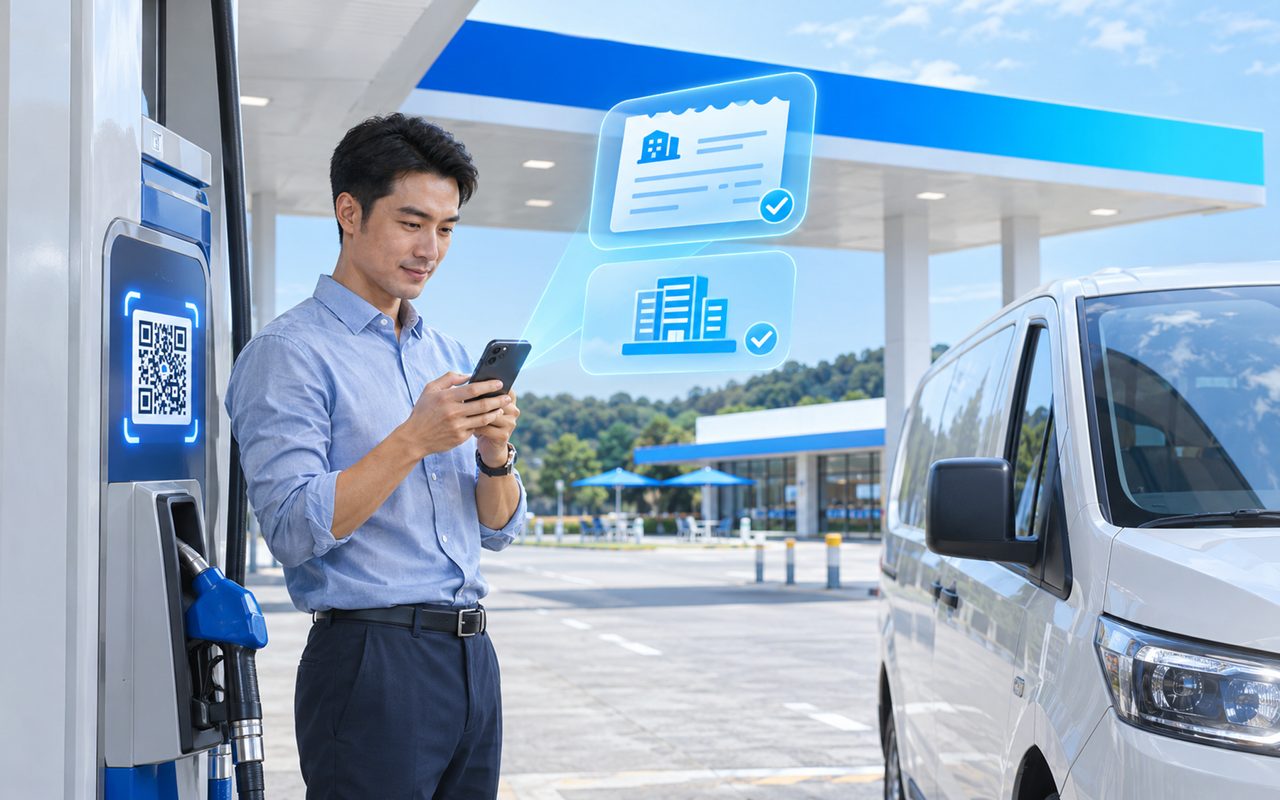
To issue a special VAT invoice for a unit, the buyer's name and taxpayer identification number (unified social credit code) must be provided to the gas station, and other buyer information must also be filled in as required for a special VAT invoice. In practice, a fleet or enterprise can save the invoicing title on a phone in advance and select it directly when paying for fuel, avoiding on-site manual entry errors.
Two points to note: first, special VAT invoices can only be issued to corporate buyers; VAT special invoices are not issued for refined oil sold to individual consumers; second, refined oil invoices have special management requirements, and all refined oil invoices must be issued through the refined oil invoice issuance module, with the unit column selecting "ton" or "liter" and the quantity filled in truthfully. These are handled by the gas station's invoicing system; buyers only need to provide accurate title information.
| "To issue a special VAT invoice, the buyer only needs to do one thing: provide the correct title and tax number." |
▍Different payment methods have different invoicing timing
According to Announcement No. 11 of 2026 and its interpretation, transaction-to-invoice covers various transaction scenarios such as cash, third-party payment, internet platforms, and fuel cards, but the invoicing timing differs by payment method.
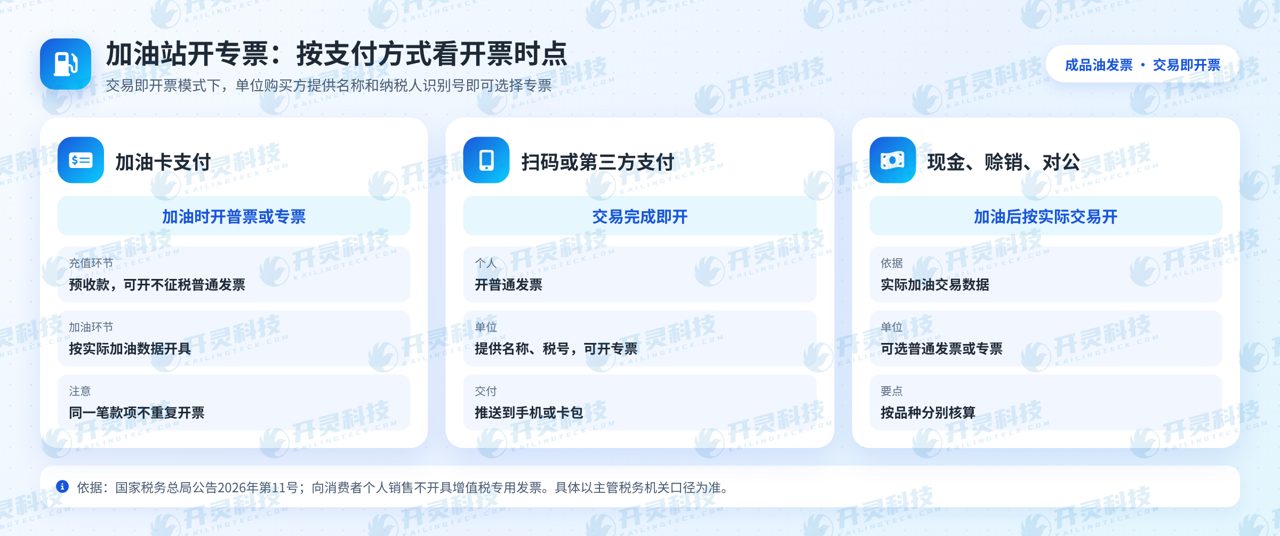
Invoicing timing for different payment methods at gas stations
- Scan code or third-party payment: Issued based on transaction data upon completion of payment; individuals receive ordinary invoices, units providing a title can receive special VAT invoices, and the invoice is pushed to the mobile phone.
- Fuel card payment: Recharge is a prepayment and a non-taxable ordinary invoice may be issued; at actual fueling, an invoice is issued based on fuel-up data, and units may choose a special VAT invoice; the same payment is not invoiced twice.
- Cash, credit sales, corporate transfer: After the actual fuel-up transaction is completed, an ordinary invoice or a special VAT invoice is issued based on the actual transaction data.
For corporate fleets that make centralized top-ups with fuel cards, it is recommended to issue special VAT invoices at the time of actual refueling, so that deductions can be made based on actual refueling volume; non-taxable invoices obtained at the time of top-up serve only as prepayment vouchers. Specific operations are subject to the practices of the gas station and the competent tax authority.
▍Fuel-up invoicing: how a single transaction proceeds
Under the transaction-based invoicing model, a fuel-up transaction goes from the fuel nozzle to the invoice in roughly five steps: the fuel dispenser generates transaction data; the cashier or retail management system confirms payment; the transaction data is used to instantly issue a fully digitalized e-invoice through the Leqi platform; the invoice is pushed to the buyer; the invoicing result is written back to the gas station system. Throughout the process, the basis for invoicing is the real fuel-up transaction data, not after-the-fact entry.
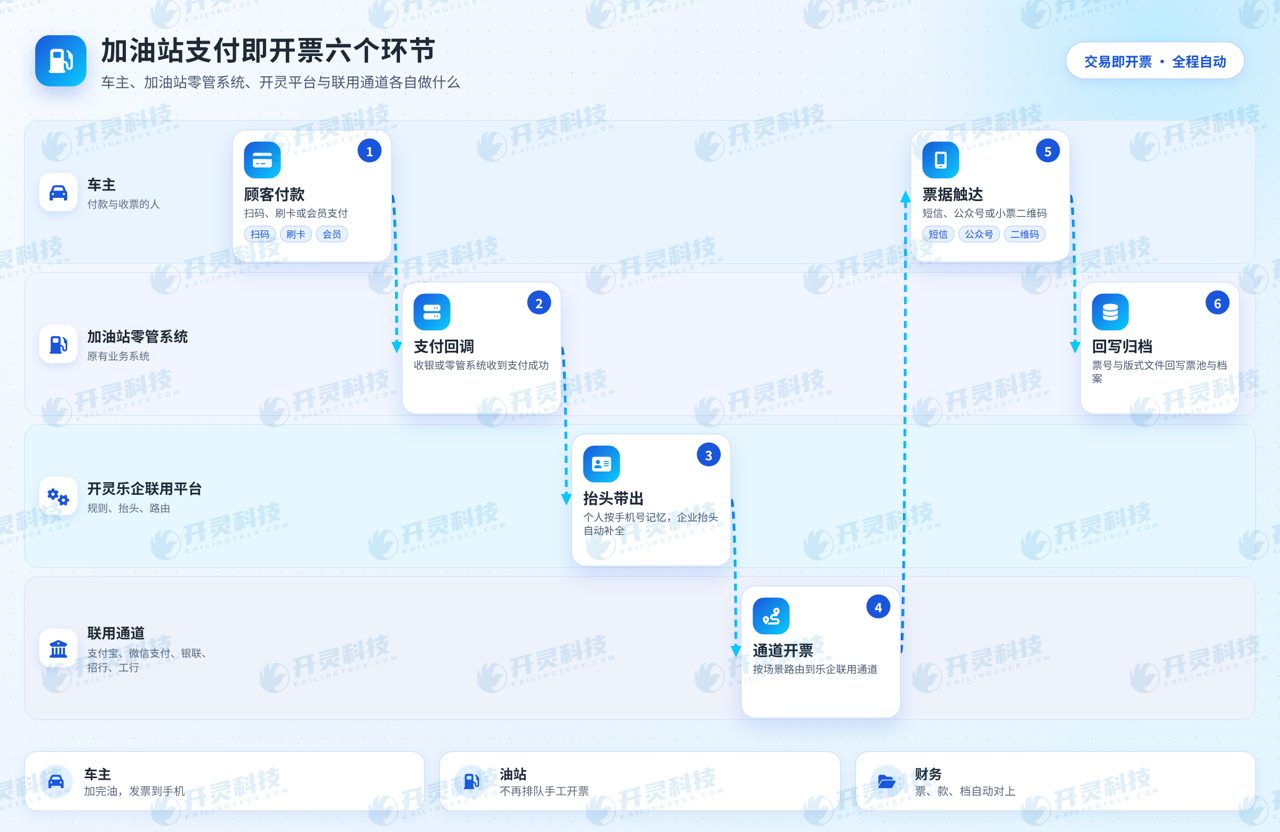
Diagram of division of responsibilities for transaction-based invoicing at gas stations
For gas stations, there are two invoicing methods: Leqi self-use, where qualifying enterprises, after confirmation by the competent tax authority, directly connect to the Leqi platform themselves; and Leqi joint use, where invoicing relies on a payment institution or bank holding joint-use qualifications. Most small and medium-sized gas stations and chain stations choose the joint-use method, which is faster to integrate.
▍Gas station integration: what the Kailing Technology Leqi integrated solution does
The pain point for gas stations is often not "whether invoicing is possible" but "how to connect": the retail management system, cashier system and fuel card system are each independent, and payment channels include WeChat, Alipay, bank cards and fuel cards. The Kailing Technology Leqi integrated solution is positioned as an integration hub: a gas station's business system connects only once to link multiple payment institutions and banks holding integrated-use qualifications, automatically triggers invoicing by payment method, and writes the results back to the retail management system.
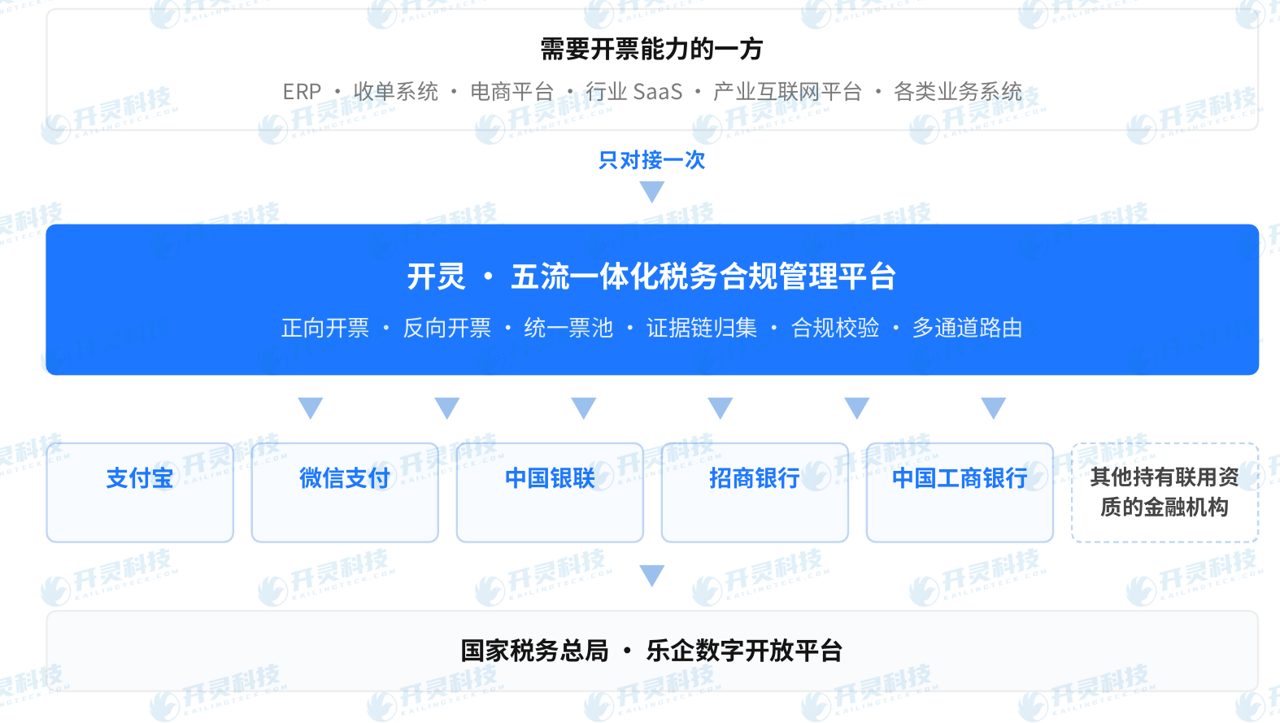
Kailing Technology Leqi Joint-Use Hub: integrate once, connect to multiple channels
The solution has built-in refined oil invoicing rules: tax classification codes correspond to oil products, quantity units are automatically converted, fuel card top-ups and consumption are handled separately, and red reversals are linked to the original invoice as required. The title of corporate buyers can be remembered by mobile number or license plate and automatically brought up at the next refueling. Kailing Technology is not a payment institution; the invoicing channel is provided by qualified partners.
▍FAQ: what to do if a special VAT invoice is issued incorrectly or issued twice
First, the title or tax ID is filled in incorrectly. Issued invoices must be red-reversed as required and reissued, and the system should link the original invoice and the original transaction to avoid duplication. Second, a fuel card top-up has already been invoiced and an invoice is issued again at refueling. This causes duplicate invoicing; the system should identify the card's invoicing status at the refueling stage and handle it as required. Third, fleet customers on monthly credit settlement. They can be invoiced in a centralized manner based on actual refueling details after monthly settlement confirmation, with details consistent with refueling records.
The table below summarizes the items a buyer needs to confirm before a special VAT invoice is issued.
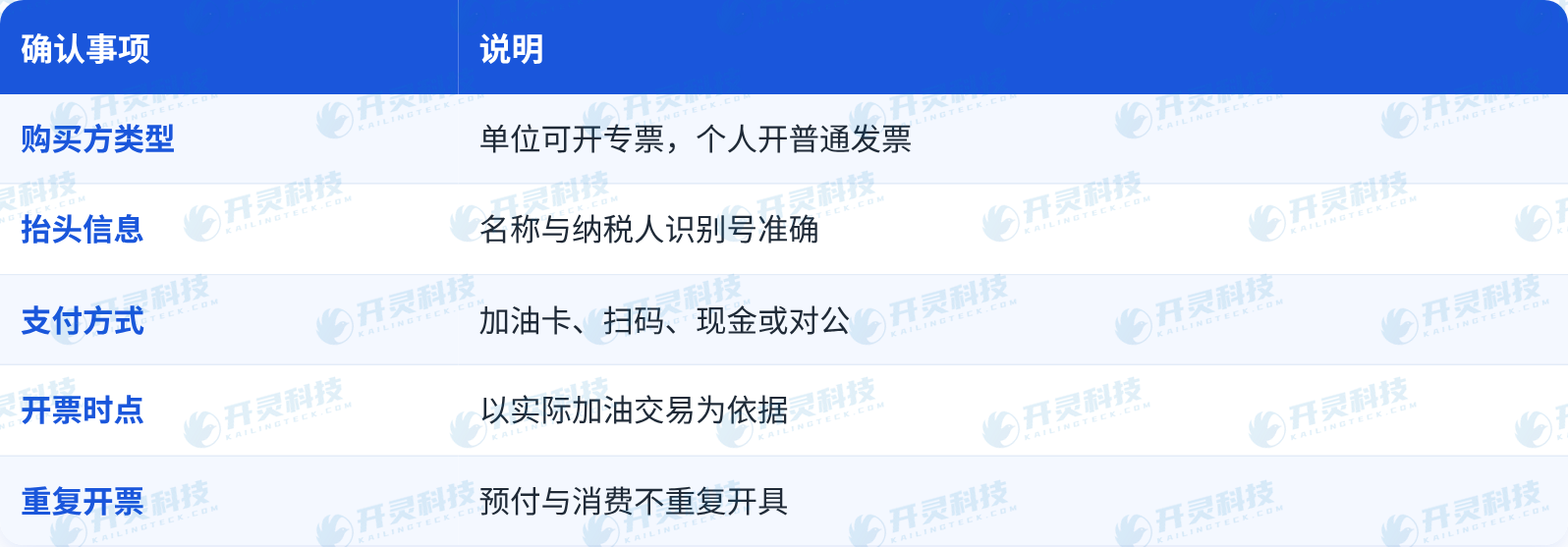
Checklist before a gas station issues a special VAT invoice
▍Unified management for chain gas stations
Chain gas stations often belong to multiple invoicing entities, and the retail management system versions and payment channels of each station are not entirely consistent. Kailing Technology's Leqi joint-use solution configures invoicing rules and channels separately by invoicing entity, and headquarters can view the invoicing volume, failure records, and red reversals of each station in a unified manner, following up promptly on abnormal stations. For fleet customers refueling at multiple stations, title information is shared and invoicing practices are consistent.
For gas stations that have already completed the transaction-to-invoice transformation before November 1, 2026, the subsequent focus is to keep invoicing data consistent with transaction data and regularly check whether the number of transactions and the number of invoices for each payment channel match.
▍Practical reminders for drivers and fleet finance staff
For drivers, save the company title in the phone before refueling and select it directly at payment, which is more accurate than stating the tax ID on site. For fleet finance, it is recommended to standardize the invoicing method: for settlements via fuel card, issue special VAT invoices at the time of actual refueling; for credit sales via corporate transfer, issue invoices monthly based on actual refueling details. With a unified approach, month-end reconciliation only requires checking whether the refueling details match the invoice details.
▍FAQ
Q: What information is needed to issue a special VAT invoice at a gas station?
A: A unit buyer must provide its name and taxpayer identification number (unified social credit code); the special VAT invoice is filled in with the buyer's information as required; no special VAT invoice is issued for sales to individual consumers.
Q: Can a special VAT invoice be issued under transaction-based invoicing?
A: Yes. According to State Taxation Administration Announcement No. 11 of 2026, a unit buyer may, after the transaction, have a special VAT invoice issued based on the actual transaction data.
Q: Can a special VAT invoice be issued for fuel card recharge?
A: Recharge is a prepayment and a non-taxable ordinary invoice may be issued; if a unit needs a special VAT invoice, it is issued based on fuel-up data at the time of actual fueling, and the same payment is not invoiced twice.
Q: How does a gas station connect to transaction-based invoicing?
A: You can choose Leqi self-use or Leqi integrated use; the Kailing Technology Leqi integrated solution helps a gas station's business system connect once to multiple integrated-use channels.
If a gas station wants to streamline transaction-based invoicing and special VAT invoice issuance in one go, you are welcome to learn about the Kailing Technology Leqi integrated solution: https://www.kailingteck.com/leqi-lianyong/ .
As a national high-tech enterprise, Kailing Technology focuses on the digital and intelligent transformation of enterprise business-finance-tax and operations management, providing software products, system integration, implementation and delivery, and operational services for various government agencies, institutions, group enterprises, and SMEs.
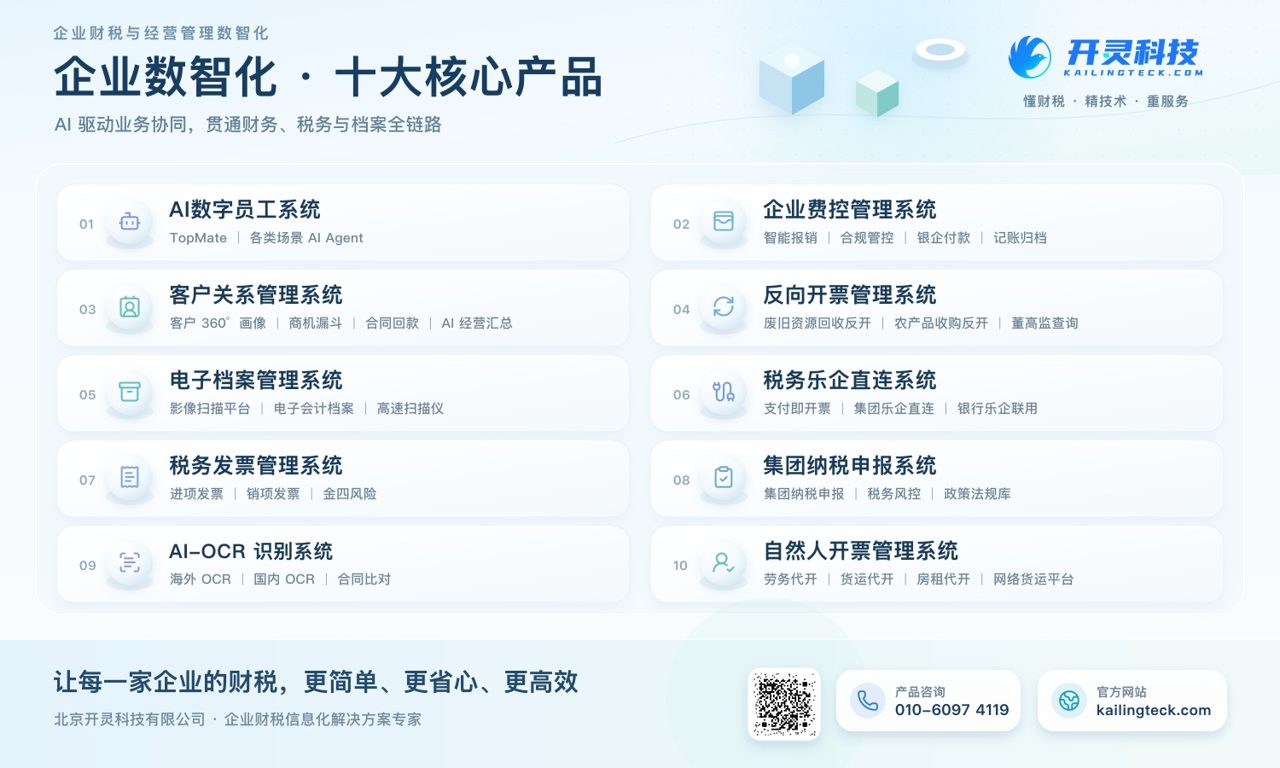
The company has now formed ten core product lines, including: AI digital employee system, enterprise expense control management system, customer relationship management system, reverse invoicing management system, invoice issuance for individuals management system, electronic archives management system, tax fully digitalized e-invoice Leqi system, tax invoice management system, group tax filing system, and AI OCR recognition system. It is committed to connecting enterprise business, finance, tax, funds, and archive data to help customers improve operational efficiency, business-finance-tax compliance capabilities, and digital management levels.
If you have any business-finance-tax digital transformation needs, welcome to contact us. Beijing Kailing Technology will serve you wholeheartedly.
Keywords: what is needed to issue a special VAT invoice at a gas station, can a special VAT invoice be issued under transaction-based invoicing at gas stations, fuel-up invoicing, refined oil special invoice, fuel card invoicing, Kailing Technology Leqi integrated solution, Leqi integrated use
As a comprehensive business-finance-tax digitalization solution service provider, Kailing Technology provides business-finance-tax management digital transformation products and operational services for various government agencies, institutions, and large, medium, and small enterprises. The product line includes: solutions for sales contract management system, procurement contract management system, fully digitalized Leqi interface project, automatic output invoicing system, reverse invoicing system, invoice issuance for individuals system, employee expense control and reimbursement system, input VAT invoice management system, supply chain collaborative reconciliation system, image AI OCR recognition system, automatic financial bookkeeping system, electronic accounting archives system, etc., comprehensively driving the digitalization process across various fields.
Consultation Hotline: 18513895936 / 010-60974119 Location: Beijing