
How to create a supplier reconciliation detail sheet? Handling six types of discrepancies by category

How to create a supplier reconciliation detail sheet? Handling six types of discrepancies by category
The goal of the supplier reconciliation detail sheet is to explain the relationship between each transaction and the supplier's settlement statement, and to record the reasons for discrepancies and handling evidence. Do not directly alter source data just to make the totals equal, and do not promise that the six types of discrepancies can definitely be "reconciled in one pass." First verify orders, receipts, returns, invoices, and payments, then handle discrepancies according to business facts.
1. At minimum, which fields the detail sheet should retain
It is recommended to use the purchase order line or receipt batch as the reconciliation unit, recording supplier, contract or order number, material, specification, unit of measure, ordered quantity, received quantity, unit price, tax-inclusive and tax-exclusive amounts, receipt date, invoice number and status, payment or prepayment amount, discrepancy type, responsible person, handling deadline, and closure evidence link. For partial deliveries, consolidated invoicing, and partial payments, retain one-to-many relationships; do not force them into a single row. The reconciliation basis and cutoff point should be confirmed with the supplier first.
2. Start from document relationships; do not treat unmatched items as amount errors
Link orders, delivery or logistics notes, acceptance and warehousing, returns, supplier settlement statements, invoices, and payment records item by item. When numbers are inconsistent, batches are not written back, or invoices have not arrived, first mark them as "pending match," then check the original documents and business status. Compare physical quantity, unit price, tax amount, and settlement amount separately, and record at which stage the discrepancy occurred. Original vouchers should be reviewed according to regulations; fields recognized by OCR are only candidate data and must not be directly regarded as reviewed or automatically booked.
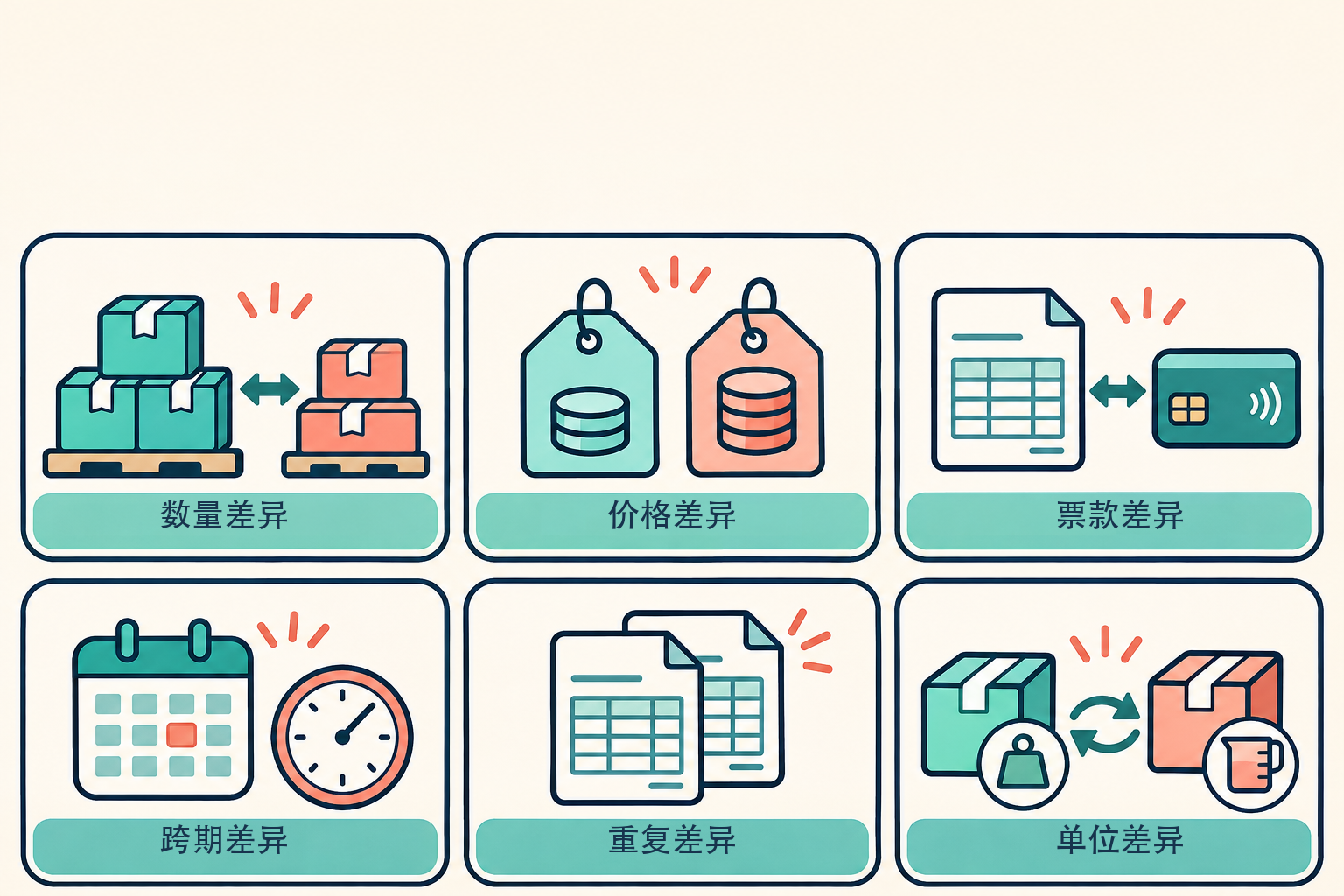
3. How to verify the six common types of discrepancies
For quantity discrepancies, check short shipments, over-receipts, rejections, returns, and partial deliveries; for price discrepancies, check contract price adjustments, discounts, and settlement basis; for invoice-payment discrepancies, check partial invoicing, red-letter invoices, prepayments, and warranty deposits; for cross-period discrepancies, check the timing of receipt, invoicing, and booking; for duplicate discrepancies, check whether the same transaction or the same invoice was imported repeatedly; for unit discrepancies, check conversions among procurement, warehousing, and settlement units. The six types are only practical categories, not exhaustive or statutory classifications. Each discrepancy should state the responsible person, handling action, and verifiable closure materials.
4. After closing discrepancies, verify payments and archiving
For confirmed discrepancies, decide on supplementary documents, settlement adjustments, returns, or accounting corrections according to contracts, acceptance results, and accounting policies; where supplier confirmation is needed, retain correspondence records. Payment approval should verify the confirmed settlement amount and payment terms, and unresolved matters should be tracked separately. Original vouchers, reconciliation sheets, handling records, and electronic attachments should be organized and retained according to the entity's archiving system; scanned copies or automatic linking alone do not equal compliance with all conditions for electronic accounting archives.
5. What software can help with, and what still requires review
Kailing Technology's AI OCR, input VAT invoice management, and electronic accounting archives related products can serve as candidate tools for document extraction, duplicate checking, linking, and audit trails. The data sources that can actually be connected, invoice verification, system integration, and degree of automation must be confirmed according to product version, authorization, region, interfaces, and project acceptance. Accounting personnel still need to review original vouchers, determine the causes of discrepancies, and approve accounting treatment.
First create a detail sheet that can trace back to original documents, then arrange handling by the six discrepancy types. The standard for completing reconciliation is that both parties confirm the basis, discrepancy handling has evidence, and balances can be explained, not that all cells turn green.
Verification Basis
Ministry of Finance's Norms for Basic Accounting Work;Ministry of Finance "Measures for the Management of Accounting Archives";Ministry of Finance accounting treatment for material warehousing and accounts payable。
As a comprehensive business-finance-tax digitalization solution service provider, Kailing Technology provides business-finance-tax management digital transformation products and operational services for various government agencies, institutions, and large, medium, and small enterprises. The product line includes: solutions for sales contract management system, procurement contract management system, fully digitalized Leqi interface project, automatic output invoicing system, reverse invoicing system, invoice issuance for individuals system, employee expense control and reimbursement system, input VAT invoice management system, supply chain collaborative reconciliation system, image AI OCR recognition system, automatic financial bookkeeping system, electronic accounting archives system, etc., comprehensively driving the digitalization process across various fields.
Consultation Hotline: 18513895936 / 010-60974119 Location: Beijing