
HR manually handles social insurance additions and removals and issues payslips? Kailing Technology AI digital employee automatically handles social insurance additions and removals and payslips
At the beginning of every month, many enterprises' HR departments open a familiar "to-do list": who joined this month and needs social insurance added, who left and needs to be removed, whether the housing fund base needs adjustment, and dozens or hundreds of payslips to be checked and distributed one by one. The tasks are not difficult, yet each must be done manually, switching back and forth across several systems, and cannot be wrong, missed, or late. Month after month, year after year. In fact, these standardized, repetitive processing tasks are exactly Kailing Technology's AI digital employee The part it is best at taking on—it is an "operations-processing" AI digital employee that can act and get things done, automatically running through the repetitive items on the HR checklist month by month.
▍First lay out HR's monthly "repetition list"
Consider listing, one by one, the manual tasks an HR specialist cannot avoid each month. You will find they share common characteristics: clear rules, fixed steps, cross-system flows, high volume, and repetition—this is exactly where digital employees excel.
Social insurance and housing fund enrollment/termination: New hires must be added to the social insurance system, departures must be removed promptly, and during base adjustment periods each person's figures must be changed one by one; a one-day delay may affect contributions and employee rights.
Onboarding and offboarding procedures: From file creation, contract signing, permission granting, and item collection to final headcount reduction, insurance suspension, and settlement, one chain must be run separately through HR, OA, and finance systems.
Batch distribution of payslips: Export from the payroll system, split by person, verify individual income tax and five social insurances and one housing fund, then push to each person one by one. Hundreds of people means hundreds of repetitive actions.
Ledger and vouchers synchronized: Employee addition/removal results and payroll details still need to be backfilled into ledgers and connected to financial bookkeeping; a moment of carelessness can lead to "the systems not matching the books".
None of these tasks is complex on its own, but stacked together, they firmly pin a considerable portion of HR's monthly energy on "moving data, filling forms, verifying, and sending." What's worse is their extremely high requirements for timeliness and accuracy: late enrollment or termination affects employees' social insurance rights, and incorrect or missed payslips easily cause disputes. So the busier HR gets, the more they dare not let go, and the closer to month-end, the more it feels like racing against time, while recruitment, training, and employee care that truly require thinking are repeatedly pushed back.
▍Item one: social insurance and housing fund enrollment/withdrawal, handled automatically person by person across systems
After receiving the monthly onboarding and offboarding list and base adjustment criteria, AI digital employees log in to social insurance, housing fund, and other handling systems themselves, complete and submit the entry, exit, and base change filings person by person, and then write the results back to the HR ledger. What they span is not only Kailing's own systems - for an enterprise's existing social insurance and HR systems not developed in-house, AI digital employees can likewise read forms and file and handle them according to rules. Real people only need to confirm at key nodes, instead of manually entering one person at a time.
▍Item two: onboarding and offboarding procedures, run end-to-end in one chain
On onboarding, the AI digital employee triggers and synchronizes across systems the steps of file creation, information entry, system account opening and social insurance enrollment in sequence according to the preset process; on offboarding, it conversely prepares all the data needed for headcount reduction, insurance suspension, permission recovery and settlement. The "one-stop" process that originally required HR to switch back and forth among several systems and advance step by step manually is handed to the AI digital employee to automatically string together according to the standard process, with people responsible for review and control, and responsibility still in the hands of real people.
▍Item three: batch distribution of payslips, split and pushed to each person with one click
At the payroll node, the digital employee retrieves the monthly details from the payroll system, automatically splits them into individual payslips per person, verifies the individual income tax, five social insurances and one housing fund, and other criteria, then pushes them to each employee in batches and accurately, avoiding the "wrong person, missed person" that is most feared in manual item-by-item operations. For hundreds of people, distribution changes from half a day of manual work to an automatic batch process that can be reviewed and traced. When encountering individual criteria anomalies, it flags them first for HR confirmation rather than silently sending them out—leaving differences for people to see and handing repetition to it.
▍Traditional manual vs. AI digital employee automation: see it clearly in one comparison table

▍Why can it run automatically every month
Ultimately, this type of digital employee is the kind that "can get things done":Kailing Technology's AI digital employee Encapsulate the forms, processes, and pages of an enterprise's existing HR, OA, finance, social insurance, and other systems into tools it can call; after understanding intent, it directly operates the systems to complete handling, with zero-code modification of the original systems and no touching of the underlying layer. Run cycles can be flexibly set as "scheduled (e.g., a fixed day each month), event-based (e.g., upon receiving onboarding or offboarding forms), or manual," automatically taking up the post on time and completing repetitive items on the checklist one by one, with the entire operation process traceable and auditable.
Moreover, it is not a lone robot. Around the enterprise's entire process, there can be a team of digital employees each with their own duties—some handling processing, some handling review, some handling Q&A—collaborating within permission boundaries to uniformly take over repetitive manual work scattered across various positions. For HR positions, this means that fixed workflows such as onboarding/offboarding, entry/exit, and payslip distribution can be configured once and reused monthly over the long term, without having to start over from scratch every month.
The benefits are also very direct: it works 24/7 without stopping, and is especially effective for repetitive and monthly tasks; for handling the same batch of employee additions and reductions or issuing the same batch of payslips, it is several times faster than manual work and less prone to errors; the HR team can therefore save considerable repetitive work hours and shift to work that requires more human judgment. Let it handle places with clear rules, and leave places outside the rules that require communication and decision-making to real people - this is precisely the most suitable division of labor between digital employees and real people.
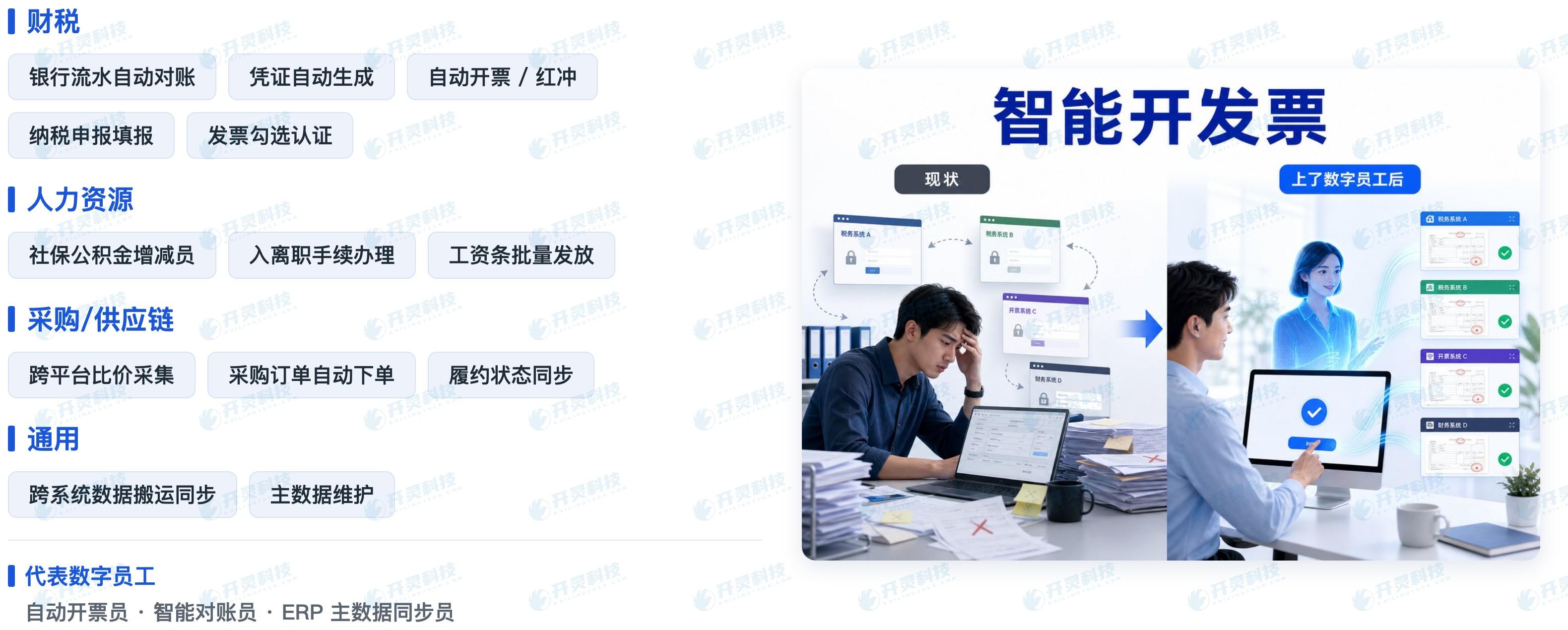
▍The energy freed up by HR should be used on "people"
Tasks such as adding or removing employees and issuing payslips should not consume HR's most valuable judgment. Hand standardized, repetitive processing actions to AI digital employees to run automatically on a monthly basis. The time saved for HR specialists can return to where people are truly needed: recruiting, developing and retaining people, building corporate culture and employee experience, and handling matters that require communication, warmth and decision-making. AI digital employees handle "doing the work", while real people handle "checking and deciding"—human-in-the-loop with clear responsibilities. This is the division of labor that makes the HR team more valuable.
▍FAQ
Q: To adopt AI digital employees, do we need to transform our existing HR and social security systems?
A: No. Digital employees adopt non-invasive access, encapsulating the forms and processes of existing systems into callable tools, with zero-code modification of the original systems and no touching of the underlying layer, so the enterprise's past IT investment is not wasted.
Q: Adding or removing employees and issuing payslips involve sensitive information; how are security and permissions guaranteed?
A: The digital employee executes within the permission boundaries granted by real people, supports private deployment, keeps data within the domain, and desensitizes and encrypts sensitive fields. Every step of processing is traced and auditable, and high-risk actions can also be set to require secondary manual confirmation.
Q: What if the list changes in a certain month or something is handled incorrectly?
A: Key nodes are confirmed by real people. Anomalies automatically trigger alerts and can be transferred to manual takeover. The entire handling process is traceable for review and retrospective analysis. Responsibility always remains with real people, and digital employees only perform standardized execution.
Q: How long does it generally take to get it running automatically on a monthly basis?
A: Standardized HR processing positions can usually go live after one or two weeks of trial operation, with rapid response and fine-tuning during the period; once running smoothly, they can automatically take over repeated items on the list monthly by schedule/event.
Want to free HR from repetitive manual work every month? Welcome to learn about Kailing Technology AI digital employee: www.kailingteck.com .
As a comprehensive business-finance-tax digitalization solution service provider, Kailing Technology provides business-finance-tax management digital transformation products and operational services for various government agencies, institutions, and large, medium, and small enterprises. The product line includes:
Solutions for businesses including sales contract management system, procurement contract management system, fully digitalized Leqi interface project, output automatic invoicing system, reverse invoicing system, invoice issuance for individuals system, employee expense control and reimbursement system, input VAT invoice management system, supply chain collaborative reconciliation system, image OCR recognition system, automatic financial bookkeeping system, and electronic accounting archives system, comprehensively driving the digitalization process across various fields.
If you have any business-finance-tax digital transformation needs, welcome to contact us. Beijing Kailing Technology will serve you wholeheartedly.
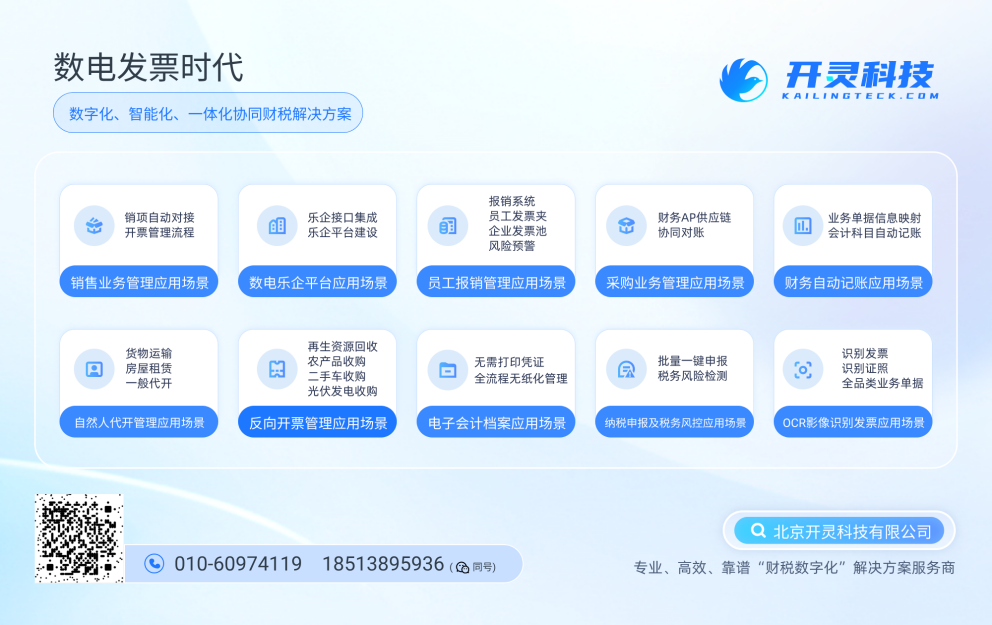
As a comprehensive business-finance-tax digitalization solution service provider, Kailing Technology provides business-finance-tax management digital transformation products and operational services for various government agencies, institutions, and large, medium, and small enterprises. The product line includes: solutions for sales contract management system, procurement contract management system, fully digitalized Leqi interface project, automatic output invoicing system, reverse invoicing system, invoice issuance for individuals system, employee expense control and reimbursement system, input VAT invoice management system, supply chain collaborative reconciliation system, image AI OCR recognition system, automatic financial bookkeeping system, electronic accounting archives system, etc., comprehensively driving the digitalization process across various fields.
Consultation Hotline: 18513895936 / 010-60974119 Location: Beijing