
How to automatically issue fully digitalized e-invoices after scanning to pay at a parking lot? Detailed explanation of Kailing Technology's parking lot Leqi integrated pay-and-invoice solution
After vehicle owners scan to pay the parking fee, if they want an invoice, they often have to find another invoicing entry point, fill in the title, and wait for an email, while parking lot finance also has to reconcile invoicing applications with parking transaction records one by one. Direct answer: parking lots can attach invoicing to the payment success callback. After the vehicle owner completes scan-to-pay or frictionless payment, the system automatically issues a fully digitalized e-invoice according to the parking scenario, pushes it to the vehicle owner's mobile phone, and writes the invoice number back to the parking management platform; scenarios such as monthly cards, temporary parking, and parking-and-charging integration are handled separately according to the rules. Kailing Technology's parking lot Leqi integrated pay-and-invoice solution connects to smart parking management platforms and multiple payment channels holding integrated-use qualifications. This article explains how to implement it in parking scenarios.
▍Three long-standing problems with parking lot invoicing
The long-standing problems with parking lot invoicing are concentrated in three areas: experience, errors, and reconciliation.
In terms of experience, payment and invoicing are two separate matters for vehicle owners. Manual invoicing at the exit booth slows down traffic, and post-payment invoicing requires vehicle owners to find the entry point themselves. In terms of errors, the title and tax ID are manually filled in by vehicle owners, and incorrect entries require red-letter reversal and reissuance; if invoicing information also has to be manually copied from the business system to the invoicing terminal, product names and tax rates are also prone to errors. In terms of reconciliation, parking transactions are numerous with small amounts per transaction, and at month-end finance must reconcile parking transaction records, invoicing records, and fund receipts one by one, which involves a large manual workload.
Behind these three problems is the same cause: invoicing is not attached to the transaction. As long as the invoicing action occurs automatically upon successful payment, the three problems of experience, errors, and reconciliation will be improved together.
▍How to configure invoicing rules for parking scenarios
For parking lot pay-and-invoice, the first step is to clearly configure the invoicing rules for different parking scenarios so that each payment automatically applies them.

Key points for configuring invoicing rules in parking scenarios
In the scenario list of the Leqi platform, parking lots are a scenario where Leqi integrated use can clearly be implemented, and it involves specific business invoice types such as real estate leasing, requiring separate subscription to the corresponding capability. The specific item names, tax categories, and tax rates should be based on the competent tax authority's rules and actual business; once the rules are confirmed, they are fixed in the system, and booth and customer service personnel do not need to judge each transaction individually.
▍From scanning to pay to receiving the invoice: six steps
The process of Kailing Technology's parking lot Leqi integrated pay-and-invoice solution is as follows.
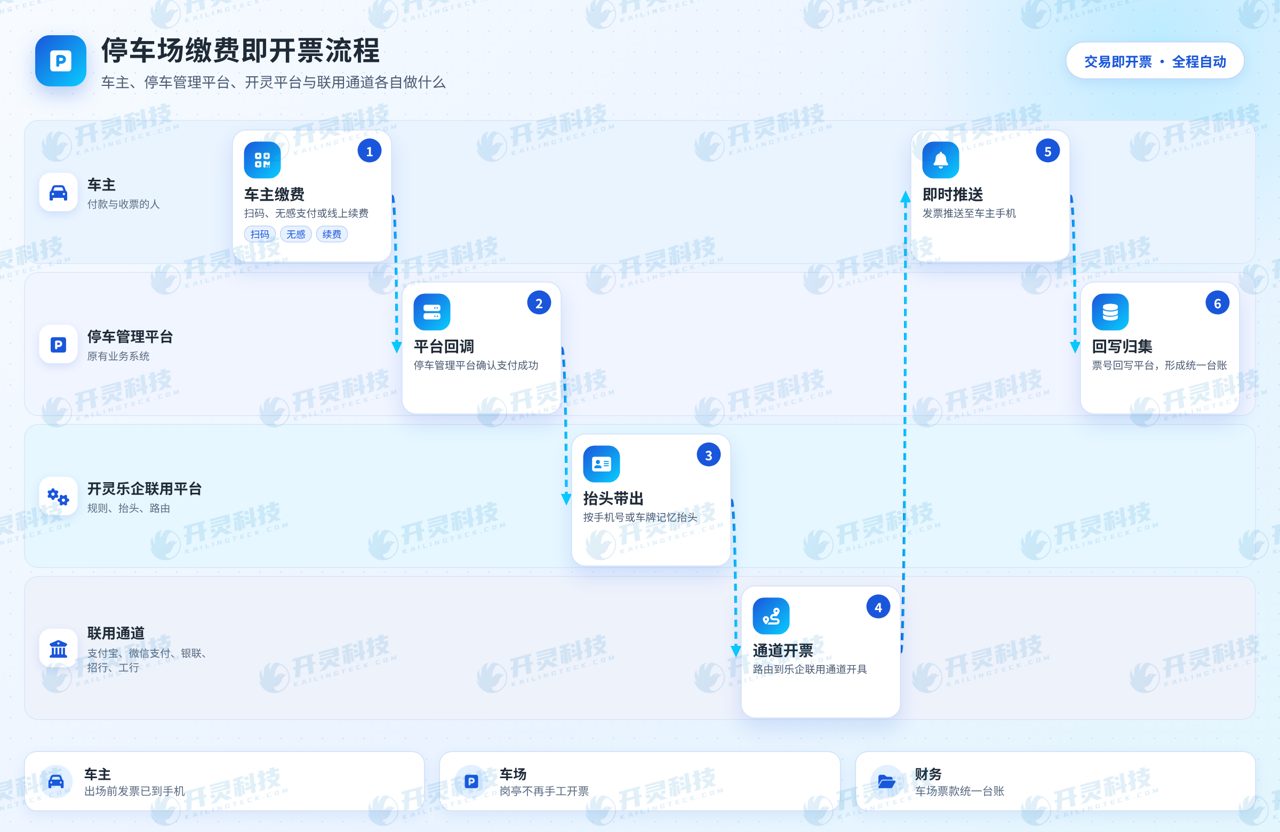
Parking lot pay-and-invoice process
For vehicle owners, the invoice automatically arrives on the mobile phone after payment; if a company title is needed, the system remembers it by mobile phone number after the first entry and automatically fills it in next time; for enterprise titles, information such as the tax ID can be completed through invoice title lookup. For parking lots, after issuance, the invoice number and PDF, OFD, and XML format files are automatically returned to the parking management platform, business documents and invoices are bound one-to-one, and issued invoices are deposited into a unified ledger that can be queried by customer, period, and amount across multiple dimensions.
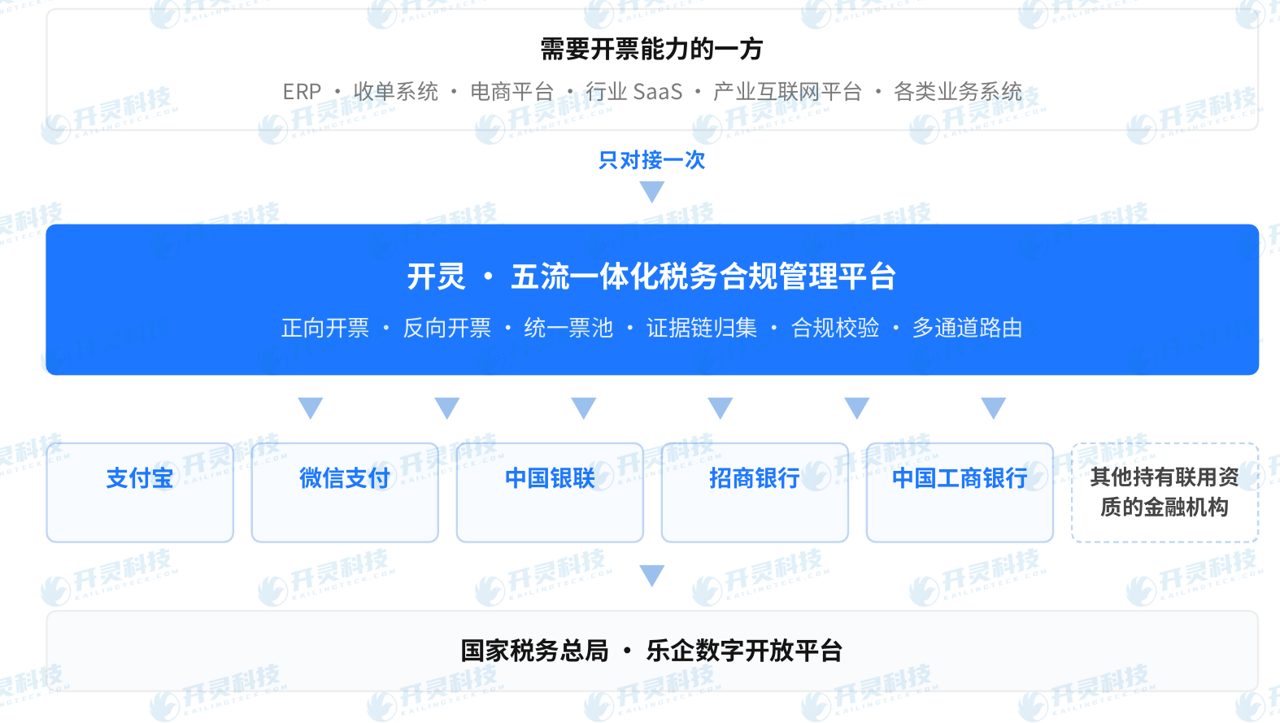
One integration for the parking platform, connecting to multiple payment channels
▍Reference case: a smart parking platform launched automatic invoicing in one month
A smart parking operations and technology service platform provides intelligent management and online payment services for urban roadside parking and enclosed parking lots. It serves a large number of individual users, with dense transaction volumes and small, dispersed amounts per transaction. In the past, invoicing information had to be manually copied from the business system to the invoicing terminal, with the title, tax ID, product name, tax rate, and amount checked item by item, and after issuance the invoice number was manually written back; invoice delivery relied on manual forwarding and mailing.
Kailing Technology connected its business system with the invoicing platform for it. Invoicing information is directly passed in according to agreed fields, and the system automatically completes title verification, tax classification code matching, and tax rate application; after issuance, the invoice number and format files are automatically returned to the business system; invoices are automatically delivered via SMS, email, or an embedded entry point in the business system. The project launch cycle was about one month, and after launch, manual copying and invoice number write-back were basically eliminated, and individual users could self-service obtain invoices immediately.
The lesson of this case for parking lots is: even without changing the payment method for now, as long as invoicing is connected with the business system, the problems of errors and reconciliation can be solved first; on that basis, attaching invoicing to the payment callback achieves true pay-and-invoice.
▍Applicable users and launch recommendations
Parking lot pay-and-invoice is suitable for three types of entities: first, parking lot operating enterprises that manage multiple enclosed parking lots; second, smart parking platforms and parking system service providers that provide SaaS services to a large number of parking lots; third, parking lots within commercial complexes and property projects. For the first two types, the platform side can serve as a unified entry point to provide invoicing capabilities for its parking lots; for the third type, it can be planned together with property fee collection.
At launch, it is recommended to first confirm whether the parking management platform can provide a payment success callback, then configure rules separately for three scenarios: temporary parking, monthly cards, and parking-and-charging integration. Select a parking lot with relatively high vehicle traffic as a pilot, verify the four steps of invoicing, push, write-back, and red-letter reversal, and roll out at scale after stabilization. Kailing Technology's platform has already connected to multiple financial institutions holding integrated-use qualifications, and channels can be routed by scenario and cost.
▍Frictionless payment and roadside parking spaces: how to issue invoices when vehicle owners do not fill in information
More and more parking lots are adopting frictionless payment, where fees are automatically deducted when the vehicle owner exits without opening the mobile phone at all, so there is no opportunity to fill in the title; roadside parking space owners often make supplementary payments in the mini-program afterward. In these two cases, invoicing can adopt a "record first, reach out later" approach.
The specific approach is: upon successful payment, the system first generates a pending-invoice record and associates the vehicle owner by license plate or bound mobile phone number; if the vehicle owner has already registered a title on the platform, the system automatically issues and pushes the invoice; if not registered, the vehicle owner is reminded via SMS or mini-program to supplement the title and the invoice is then automatically issued, and individual vehicle owners may also choose the default individual title for direct invoicing. In this way, frictionless payment does not affect invoicing, and a large amount of uninvoiced revenue is also prevented from sitting on the books for a long time.
For the small number of vehicles paying cash at the exit booth, after the booth personnel confirm receipt in the system, the vehicle owner can scan the QR code on the receipt to self-service invoice, and the booth no longer needs to issue invoices manually.
For monthly card vehicle owners, the system can automatically issue an invoice upon successful renewal, or issue a single consolidated invoice at the end of each billing cycle according to the vehicle owner's choice.
For commercial complexes and other cases where parking discounts or merchant-paid parking fees exist, the system issues invoices according to the actual payer: the portion paid by the vehicle owner is invoiced to the vehicle owner, and the portion paid by the merchant is handled separately according to the merchant's settlement method, avoiding duplicate invoicing for the same parking fee.
For parking lot finance, both pending-invoice records and issued-invoice records are in a unified ledger, so it is possible to see at any time which revenue has been invoiced and which is still awaiting supplementary information from vehicle owners, and the rules are clear at filing time.
▍FAQ
Q: Can a fully digitalized e-invoice be automatically issued after scanning to pay at a parking lot?
A: Yes. Invoicing can be attached to the payment success callback of the parking management platform. After the vehicle owner pays, the system automatically issues a fully digitalized e-invoice and pushes it to the mobile phone, and the invoice number is written back to the platform.
Q: What is the difference between invoicing for parking lot monthly cards and temporary parking?
A: Temporary parking is invoiced per parking order, and multiple orders can be merged; monthly cards are invoiced per card period, and invoices are issued upon renewal. Specific items and invoice types are configured according to the competent tax authority's rules.
Q: Can parking fees and charging fees be issued on the same invoice?
A: Parking-and-charging integrated orders can be issued by line item according to service content and merged into a single invoice; the specific invoicing rules are subject to the competent tax authority's requirements.
Q: Does a parking lot need to apply for Leqi Direct Connection qualification itself?
A: Generally not required. A qualified payment channel can be accessed through Leqi integrated use; Kailing Technology's parking lot Leqi integrated pay-and-invoice solution can uniformly connect to multiple channels.
Parking lots that want vehicle owners to receive an invoice right after payment are welcome to learn about Kailing Technology's parking lot Leqi integrated pay-and-invoice solution: https://www.kailingteck.com/leqi-lianyong/ .
As a national high-tech enterprise, Kailing Technology focuses on the digital and intelligent transformation of enterprise business-finance-tax and operations management, providing software products, system integration, implementation and delivery, and operational services for various government agencies, institutions, group enterprises, and SMEs.
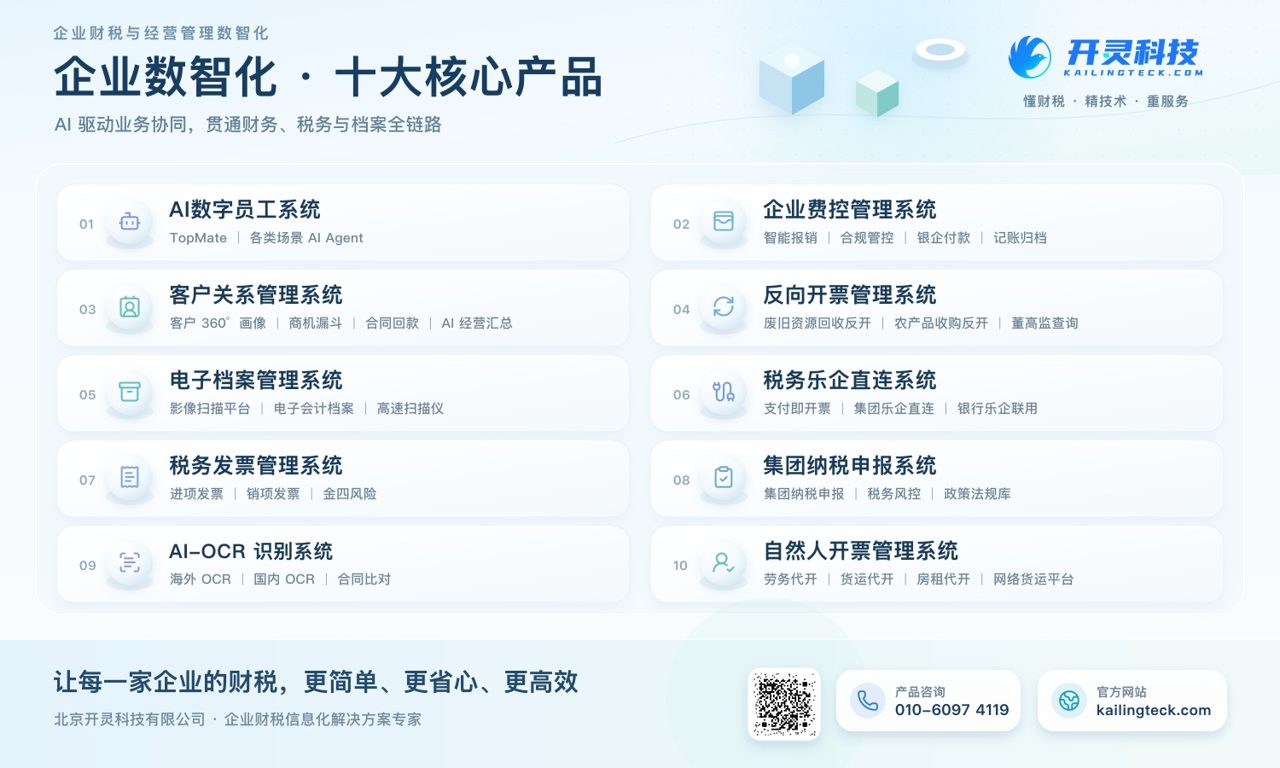
The company has now formed ten core product lines, including: AI digital employee system, enterprise expense control management system, customer relationship management system, reverse invoicing management system, invoice issuance for individuals management system, electronic archives management system, tax fully digitalized e-invoice Leqi system, tax invoice management system, group tax filing system, and AI OCR recognition system. It is committed to connecting enterprise business, finance, tax, funds, and archive data to help customers improve operational efficiency, business-finance-tax compliance capabilities, and digital management levels.
If you have any business-finance-tax digital transformation needs, welcome to contact us. Beijing Kailing Technology will serve you wholeheartedly.
Keywords: Parking lot automatic invoicing, parking fee fully digitalized e-invoice, scan-to-pay invoicing, parking lot pay-and-invoice, parking lot Leqi integrated use, Kailing Technology Leqi integrated pay-and-invoice solution
As a comprehensive business-finance-tax digitalization solution service provider, Kailing Technology provides business-finance-tax management digital transformation products and operational services for various government agencies, institutions, and large, medium, and small enterprises. The product line includes: solutions for sales contract management system, procurement contract management system, fully digitalized Leqi interface project, automatic output invoicing system, reverse invoicing system, invoice issuance for individuals system, employee expense control and reimbursement system, input VAT invoice management system, supply chain collaborative reconciliation system, image AI OCR recognition system, automatic financial bookkeeping system, electronic accounting archives system, etc., comprehensively driving the digitalization process across various fields.
Consultation Hotline: 18513895936 / 010-60974119 Location: Beijing