
How to automatically issue invoices after payment of property fees, parking fees, and utility fees? Kailing Technology's property Leqi Direct Connection pay-and-invoice solution
Property companies have many fee items: property fees, parking fees, utility fees, and sometimes parking space rent and public facility usage fees, and owners pay via WeChat, Alipay, the property App, or bank direct debit, yet finance has to issue invoices one by one by item and by owner at month-end, and a single wrong invoice requires a red-letter reversal and reissue. Direct answer: property companies can attach invoicing to the payment success node; after the owner pays, the system automatically matches invoicing rules by fee item, issues a fully digitalized e-invoice, pushes it to the owner, and writes the invoice number back to the fee system. Kailing Technology's property Leqi Direct Connection pay-and-invoice solution connects the property fee system and multiple payment channels holding the direct connection qualification, and this article explains how to implement it by fee item.
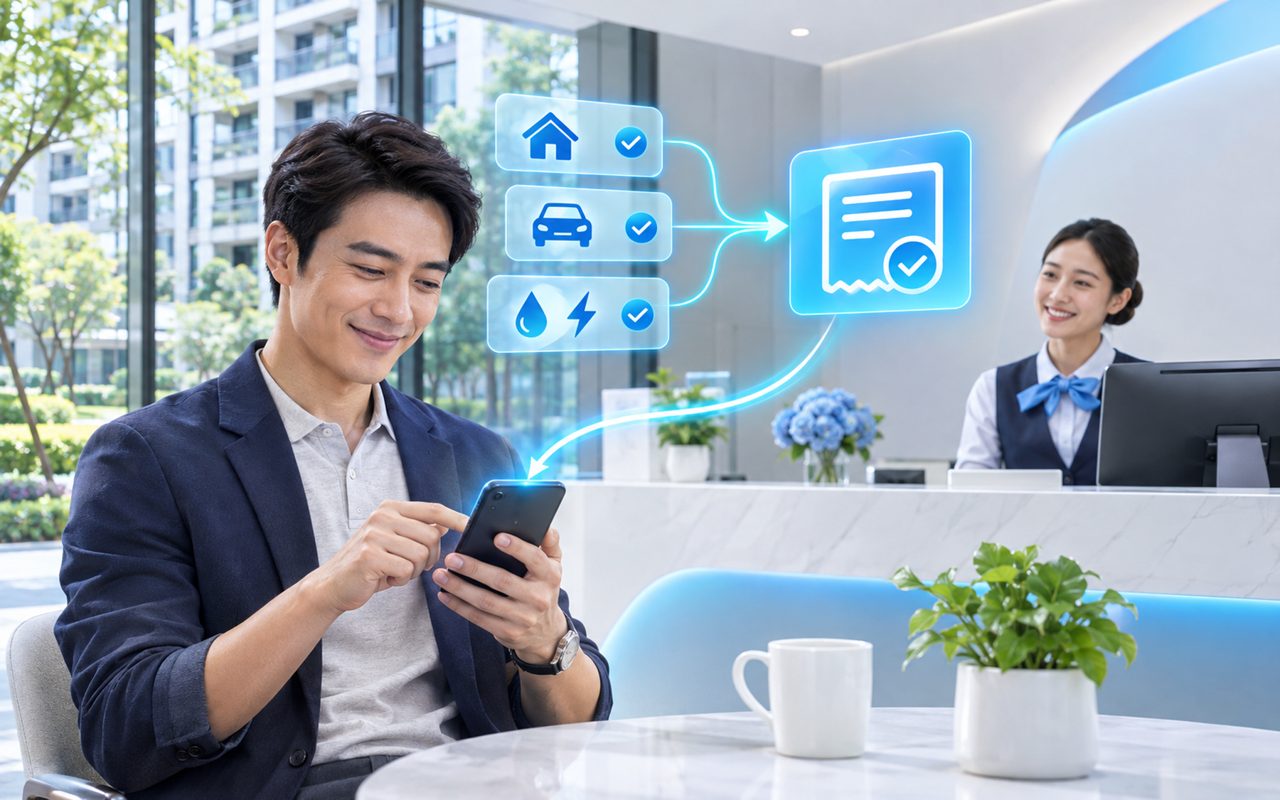
▍Where property invoicing is hard: many items, many channels, many rules
Property invoicing is hard because of the 'three manys': many fee items, many payment channels, and many invoicing rules.
On fee items, property fees, parking fees, utility fees, and parking space rent differ in nature: some are property services, some are real estate leasing, and some are collection on behalf of others, so the invoice item name, invoice type, and even invoicing entity may differ. On payment channels, owners may pay via the property App, official account, Alipay utility payment, bank direct debit, or front-desk POS, and each channel's record format is different. On invoicing rules, some owners want a personal title, some want a company title for reimbursement, some want combined invoicing, and some want invoicing by item.
The traditional approach is for finance to export records from the fee system each month and then issue invoices one by one in invoicing software. The invoicing volume grows linearly with the number of households and payments, and more red-letter reversals caused by incorrect titles may even trigger risk warnings.
▍Configure rules by fee item: one payment, the correct invoice automatically
The key to pay-and-invoice in property scenarios is to first configure invoicing rules by fee item, so that each payment automatically applies the correct rule upon payment success.

Key points for configuring property fee items and invoicing rules
The 'business nature note' column in the table is only used to distinguish rules; the specific tax categories, tax rates, and invoicing entities should be based on the competent tax authority's standards and the enterprise's actual business. Once rules are confirmed, they are fixed in the system, and cashiers do not need to judge each time. It should be noted that property management and parking lots may involve specific business invoice types such as real estate leasing on the Leqi platform, which require separate subscription to the corresponding capabilities; Kailing Technology's Leqi Direct Connection pay-and-invoice solution uniformly encapsulates the validation rules and formats of these invoice types on the platform side.
▍How pay-and-invoice runs in property scenarios
Kailing Technology's property Leqi Direct Connection pay-and-invoice solution attaches the invoicing action to the payment success callback, and the whole process requires no manual initiation.
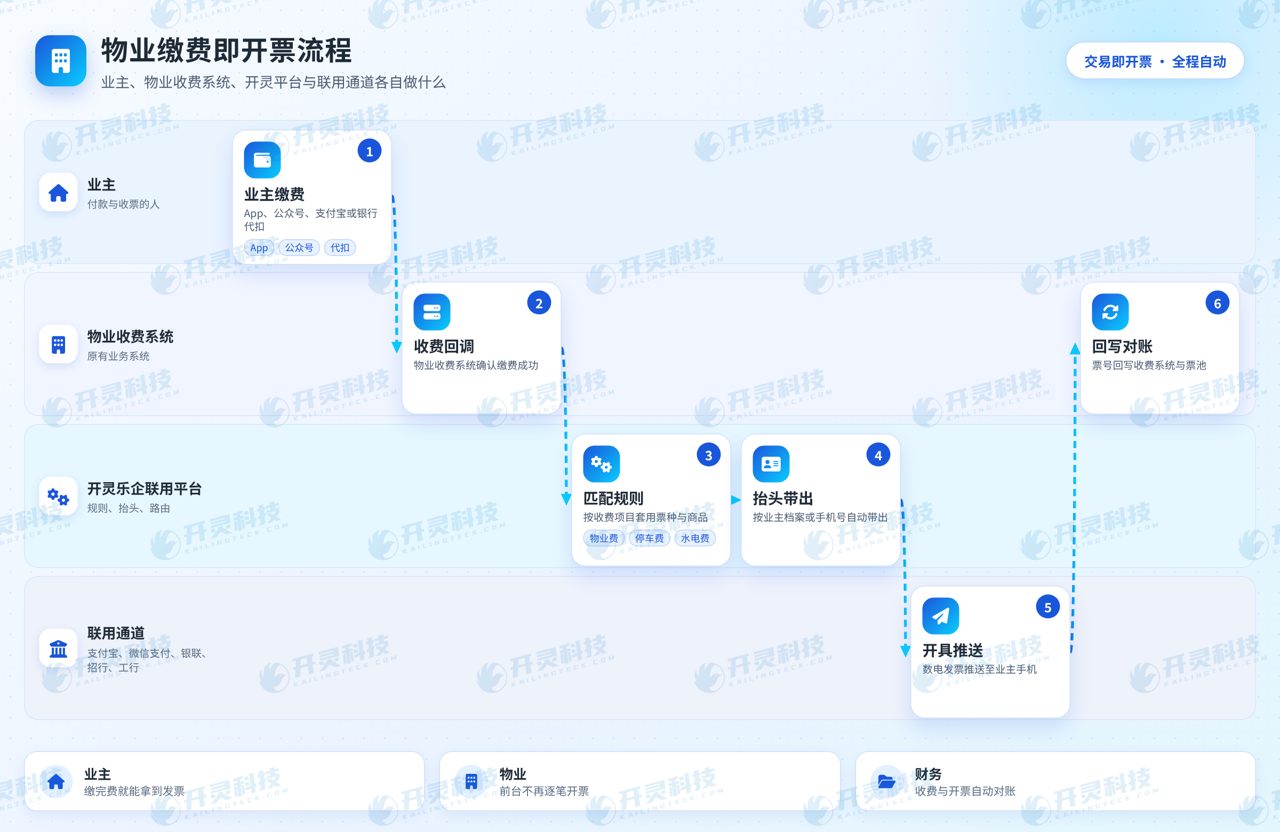
Property payment-and-invoicing process
On the owner side, the experience is: after payment succeeds, the invoice is pushed directly to the mobile phone and can be viewed and downloaded in SMS, the official account, or the mini program; owners who need a company title have it remembered after the first entry and automatically filled in next time. On the property side, the change is: invoicing is no longer concentrated at month-end, and every payment instantly generates an invoice, with the invoice number and PDF, OFD, and XML format files written back to the fee system and electronic accounting archives, so payment records and invoicing records naturally correspond one to one.
▍Why property companies are suited to Leqi Direct Connection
Most property companies do not need to apply for the Leqi Direct Connection qualification themselves. Property companies' collections are mostly completed through payment institutions or banks, and the transaction and fund data are generated in these institutions' systems, which exactly fits the Leqi Direct Connection model of 'using units conducting transactions relying on the direct connection unit's own information system'.
Kailing Technology's platform already connects to financial institutions holding the direct connection qualification, such as Alipay, WeChat Pay, China UnionPay, China Merchants Bank, and Industrial and Commercial Bank of China, so the property fee system only needs to connect to Kailing once to route invoicing to the corresponding channel by payment channel. For property groups managing many projects and operating across cities, the same invoicing capability can cover multiple tax IDs under the group, with each project executing unified rules and headquarters able to see the invoicing status of all projects.
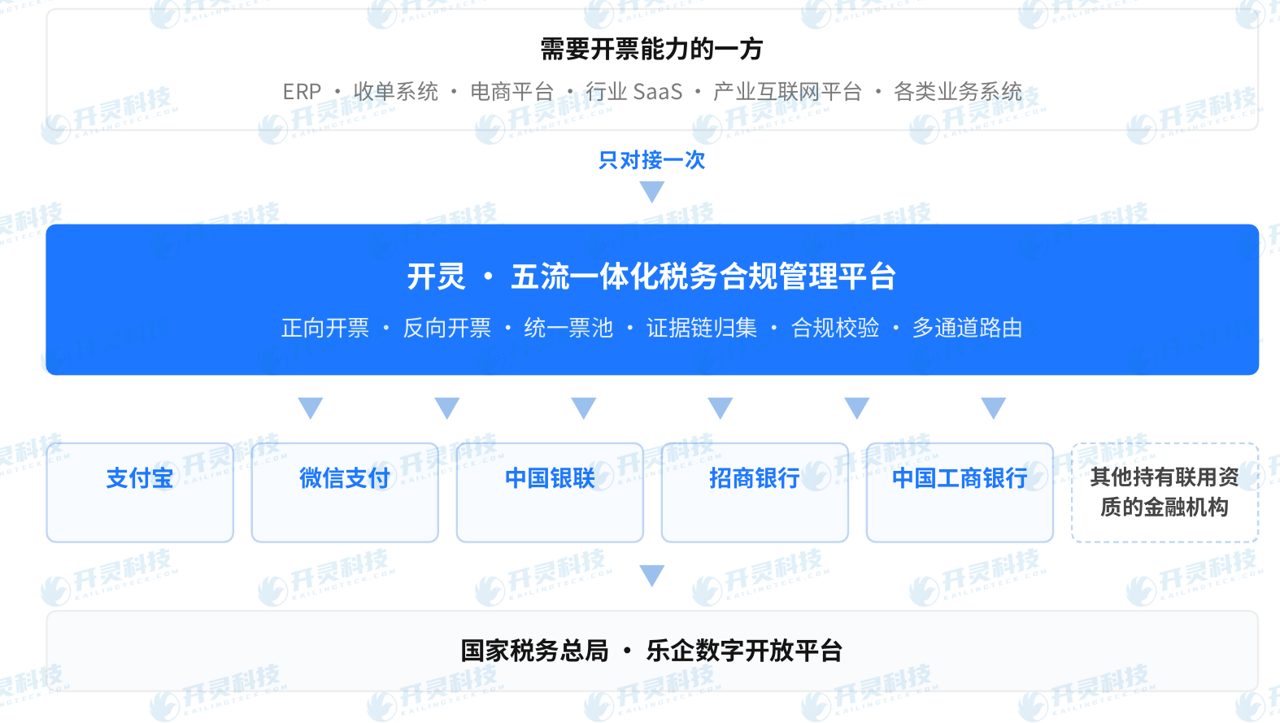
One connection to the property fee system, linking multiple payment channels
▍Go-live advice: first sort out fee items, then pilot in one residential community
For property companies going live with pay-and-invoice, it is advisable to make two preparations first: first, sort out all fee items and their invoicing standards, and confirm questionable items with the competent tax authority; second, confirm whether the fee system can provide a payment success callback or record interface. Once ready, pilot in a residential community with relatively concentrated payment channels, verify automatic invoicing and write-back for the two high-frequency items of property fees and parking fees, and after stabilization roll out to all items.
For projects still using paper receipts in place of invoices, after pay-and-invoice goes live, receipts can be gradually eliminated, and owners receive compliant fully digitalized e-invoices. For owners requesting historical invoices, they can be reissued in the system based on payment records and brought into unified invoice pool management.
▍After go-live: how finance and customer service work changes
After property pay-and-invoice goes live, the most noticeable changes are in the two roles of finance and customer service.
On the finance side, the past work of centralized invoicing each month and checking payment transaction records against invoicing records line by line has largely disappeared, replaced by reviewing exceptions: which payments failed to be invoiced because the title information was incomplete, and which refunds require a red-letter reversal. At month-end closing, invoicing data and payment data are naturally consistent and can be used directly for filing and reconciliation. On the customer service side, inquiries from property owners such as "Where is my invoice?" and "The title was entered incorrectly" have noticeably decreased, and owners can self-service view and download invoices on their phones.
For owners paying by front-desk POS card swipe or cash, the cashier confirming receipt in the fee system likewise triggers automatic invoicing, and the front desk no longer needs to log in to invoicing software.
For batch payment methods such as bank direct debit and collection, the system generates invoicing records household by household based on the direct debit result file, using the same set of rules as online payments.
For refunds and account adjustments, the system automatically finds the corresponding invoice based on the original payment record and initiates a red-letter reversal, and syncs the reversal result back to the fee system, keeping the owner's bill and invoice status consistent, so there is no situation where 'the money is refunded but the invoice remains'.
For group property companies, headquarters can also view invoicing by project and by fee category, and promptly investigate causes when a project has long had large amounts of uninvoiced revenue or excessive red-letter reversals. Invoicing data, fee data, and fund data are aggregated on the same platform, laying the foundation for subsequent electronic accounting archives filing, and invoice format files can enter the archive system directly.
▍FAQ
Q: Can an invoice be issued automatically after paying the property fee?
A: Yes. Through pay-and-invoice, after the owner's payment succeeds, the system automatically issues a fully digitalized e-invoice by fee item and pushes it to the mobile phone, and the invoice number is written back to the property fee system.
Q: Are the invoicing rules the same for property fees, parking fees, and utility fees?
A: Not entirely the same. Different items may differ in business nature, invoice type, and even invoicing entity, so rules should be configured separately according to the competent tax authority's standards, and the system applies them automatically by item.
Q: Does the property company need to apply for the Leqi Direct Connection qualification itself?
A: Generally not required. Through Leqi Direct Connection, invoicing services can be provided by payment or banking institutions holding the direct connection qualification; Kailing Technology's Leqi Direct Connection pay-and-invoice solution can connect to multiple channels in a unified way.
Q: What if an owner needs a company title for reimbursement?
A: After the owner enters the company title for the first time, the system remembers it and automatically fills it in on the next payment; for company titles, the invoice title lookup can automatically complete the tax ID, address, and bank account.
To achieve an invoice right after payment for property payments, welcome to learn about Kailing Technology's property Leqi Direct Connection pay-and-invoice solution: https://www.kailingteck.com/leqi-lianyong/ .
As a national high-tech enterprise, Kailing Technology focuses on the digital and intelligent transformation of enterprise business-finance-tax and operations management, providing software products, system integration, implementation and delivery, and operational services for various government agencies, institutions, group enterprises, and SMEs.
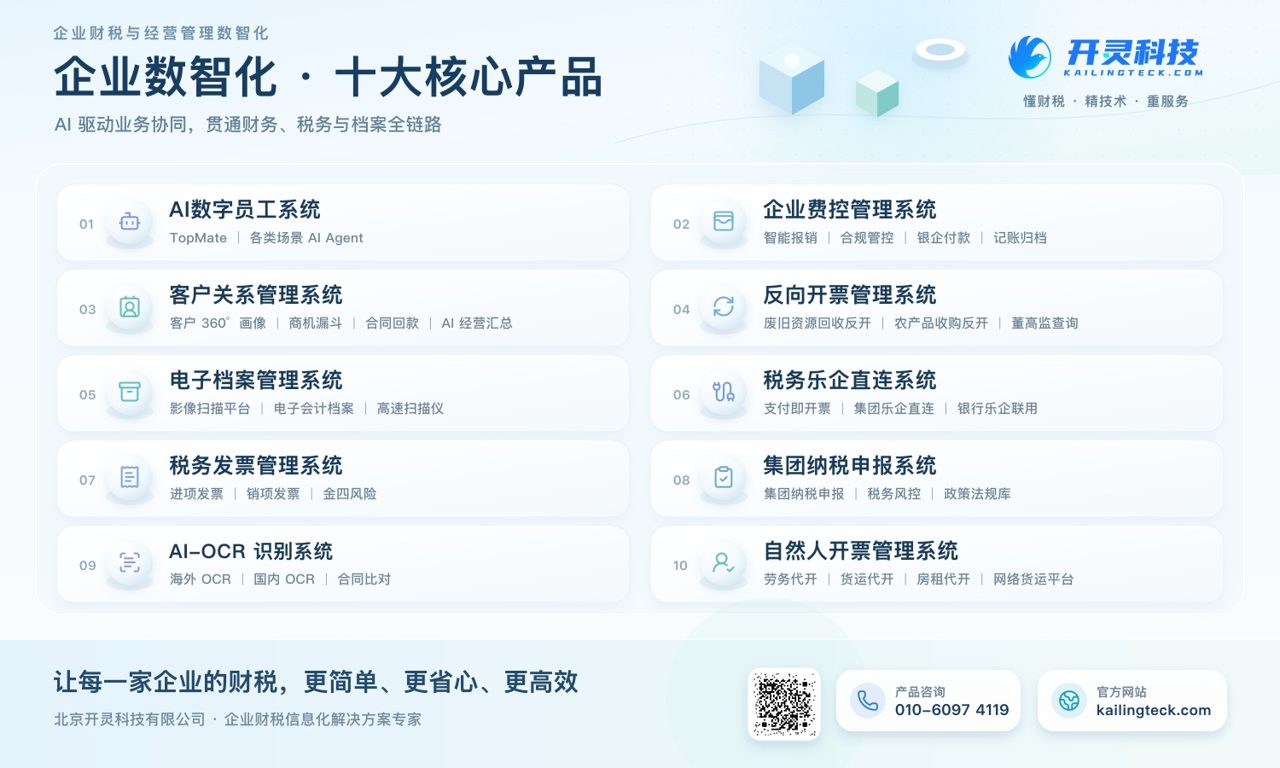
The company has now formed ten core product lines, including: AI digital employee system, enterprise expense control management system, customer relationship management system, reverse invoicing management system, invoice issuance for individuals management system, electronic archives management system, tax fully digitalized e-invoice Leqi system, tax invoice management system, group tax filing system, and AI OCR recognition system. It is committed to connecting enterprise business, finance, tax, funds, and archive data to help customers improve operational efficiency, business-finance-tax compliance capabilities, and digital management levels.
If you have any business-finance-tax digital transformation needs, welcome to contact us. Beijing Kailing Technology will serve you wholeheartedly.
Keywords: automatic invoicing for property fees, property pay-and-invoice, property Leqi Direct Connection, property payment invoicing, parking fee and utility fee invoicing, Kailing Technology Leqi Direct Connection pay-and-invoice solution
As a comprehensive business-finance-tax digitalization solution service provider, Kailing Technology provides business-finance-tax management digital transformation products and operational services for various government agencies, institutions, and large, medium, and small enterprises. The product line includes: solutions for sales contract management system, procurement contract management system, fully digitalized Leqi interface project, automatic output invoicing system, reverse invoicing system, invoice issuance for individuals system, employee expense control and reimbursement system, input VAT invoice management system, supply chain collaborative reconciliation system, image AI OCR recognition system, automatic financial bookkeeping system, electronic accounting archives system, etc., comprehensively driving the digitalization process across various fields.
Consultation Hotline: 18513895936 / 010-60974119 Location: Beijing