
Can illegible handwritten delivery notes also be automatically recognized? Kailing Technology delivery note AI OCR recognition connects to ERP for automatic reconciliation
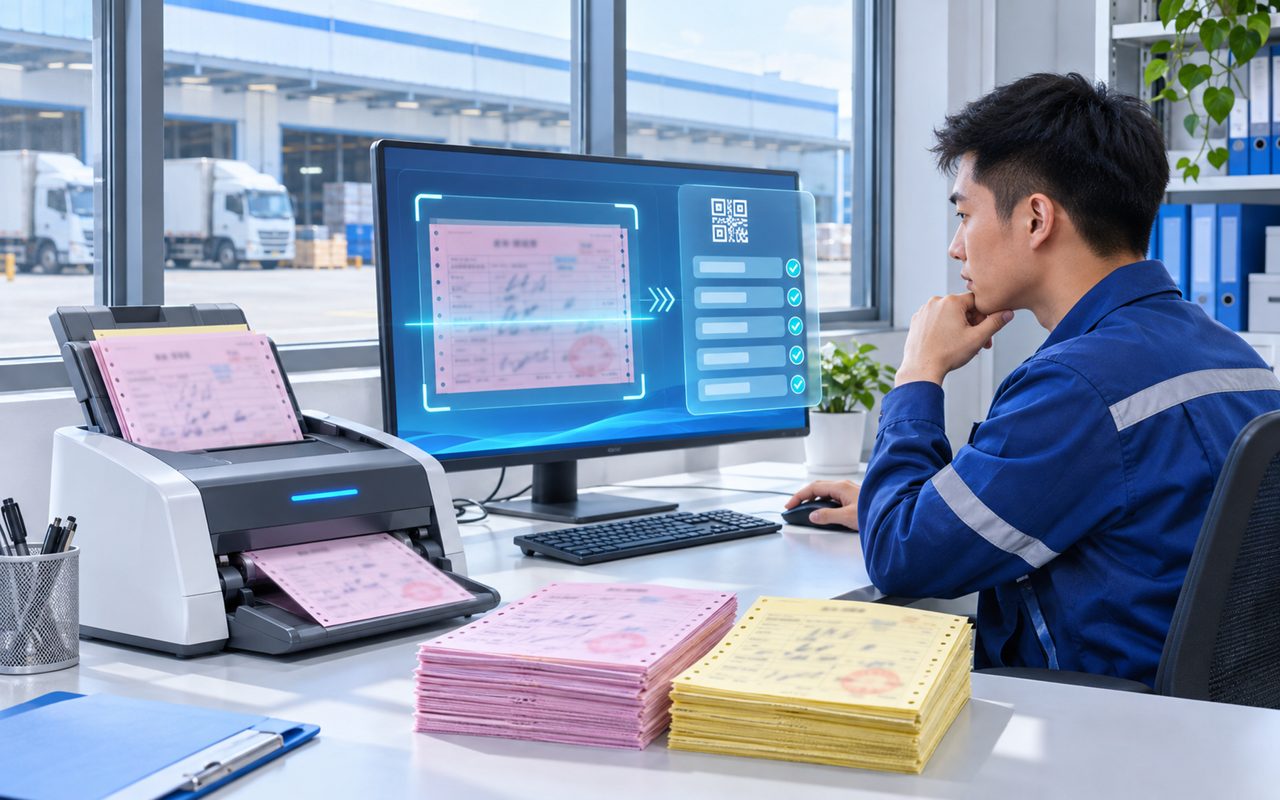
Manufacturing, packaging, and FMCG enterprises have hundreds or thousands of delivery notes brought back after customer signing every day: carbon paper ink is faint, order numbers are handwritten or blurry, and customer signatures are scribbled. Storage and transport staff must find each order number in the ERP one by one and tick "receipt confirmed" one by one; orders not ticked cannot be reconciled by finance. Direct answer: handwritten and carbon paper delivery notes can be recognized automatically; the key is to distinguish "what to recognize" — order numbers use four-level recognition with QR code first and OCR and AI vision as fallback, while handwritten remarks, signatures, and tables use AI OCR's handwriting and layout understanding capabilities; after the order number is recognized, the ERP interface is called automatically for receipt confirmation, and the signed original is attached to the corresponding document and retrieved together during financial reconciliation. Kailing Technology's AI OCR and delivery note receipt confirmation solution has been running in a packaging enterprise for one year. This article explains how it recognizes, how it connects to ERP, and how it supports reconciliation.
▍Why delivery notes are hard to recognize: three hurdles of carbon paper, handwriting, and layout
Delivery notes are difficult to recognize mainly because of three issues. First, carbon paper: delivery notes are generally multi-part carbon copies, and the copies signed and stamped by customers are often the last few, with the faintest ink and lowest contrast; misreading one digit of the order number leads to the wrong order being matched. Second, handwriting: order numbers are sometimes filled in by hand, remarks such as quantities, shortages, and damage are almost all handwritten, and signatures vary widely. Third, layout: delivery note templates differ across customers and periods, field positions are not fixed, and traditional template-based OCR struggles to handle them all.
These three hurdles determine that delivery note recognition cannot rely on a single OCR engine from start to finish, but must be designed in the order of "first secure the order number, then understand the content." The order number is the sole basis for ERP write-back and must be handled so that it is better to hold back than to misrecognize; handwritten content focuses on understanding and prompting, with exceptions left for human confirmation.
| "The first principle of delivery note recognition: an order number may be held back rather than misrecognized." |
▍How to secure the order number: QR code first, four-level fallback
The Kailing Technology delivery note return-signing solution uses four-level recognition for document numbers: the first level reads the QR code on the delivery note directly in the browser; if it cannot be read, the second level enlarges and binarizes the image on the server for forced decoding; if that still fails, the third level uses OCR to read the printed document number digits, with automatic orientation fallback; and finally the fourth level is handed to AI vision. Documents that cannot be read at any of the four levels are stored as "pending number completion," and the system automatically retries recognition every two minutes, with manual entry for those that truly cannot be read.
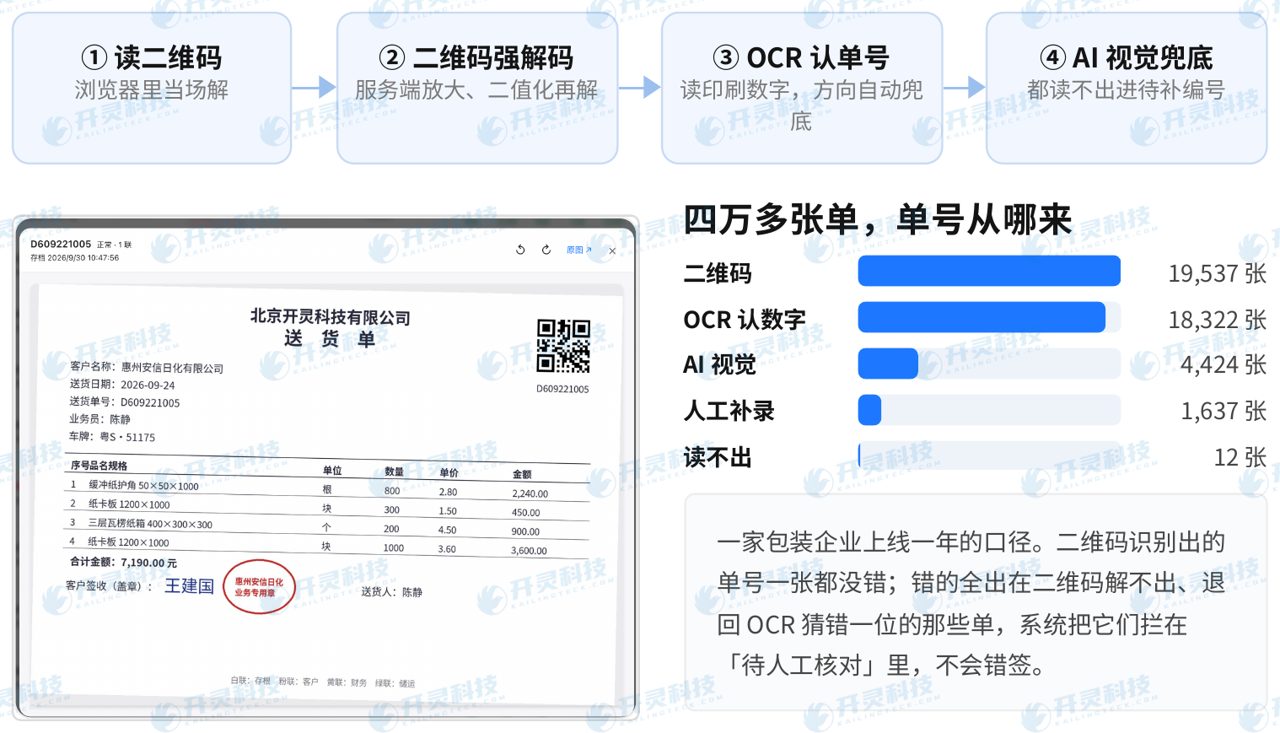
Kailing Technology four-level delivery note recognition and document number source statistics
Recognized order numbers must first pass a validation against the enterprise's order number rules, for example a prefix plus a fixed number of digits; those that do not conform are not sent to ERP and go directly to pending supplementation. Each record indicates the recognition channel, so if a problem occurs it can be traced to which level recognized it. During implementation, enterprises are also advised to scan the white stub copy, because the QR code on the white copy has a significantly higher decoding rate.
Statistics from a paper packaging enterprise one year after launch show: of more than 40,000 delivery notes, 19,537 were recognized by QR code, 18,322 by OCR digit recognition, 4,424 by AI vision, 1,637 were manually supplemented, and 12 could not be read; all order numbers recognized by QR code were correct, and any order numbers that might be misrecognized through other channels were held in "pending manual verification," with no incorrect sign-offs occurring.
▍How to recognize handwritten content: remarks, signatures, and tables handled by AI OCR
Beyond the order number, the handwritten content on delivery notes is equally valuable: whether the receipt column is signed, whether the receipt date is filled in, and whether remarks such as "shortage," "damaged," or "rejected" are written. Kailing Technology's AI OCR has specialized recognition capabilities for handwriting, tables, seals, signatures, and barcodes and QR codes; it can convert handwritten documents and paper forms into structured data and detect image quality to block blurry or re-photographed images.
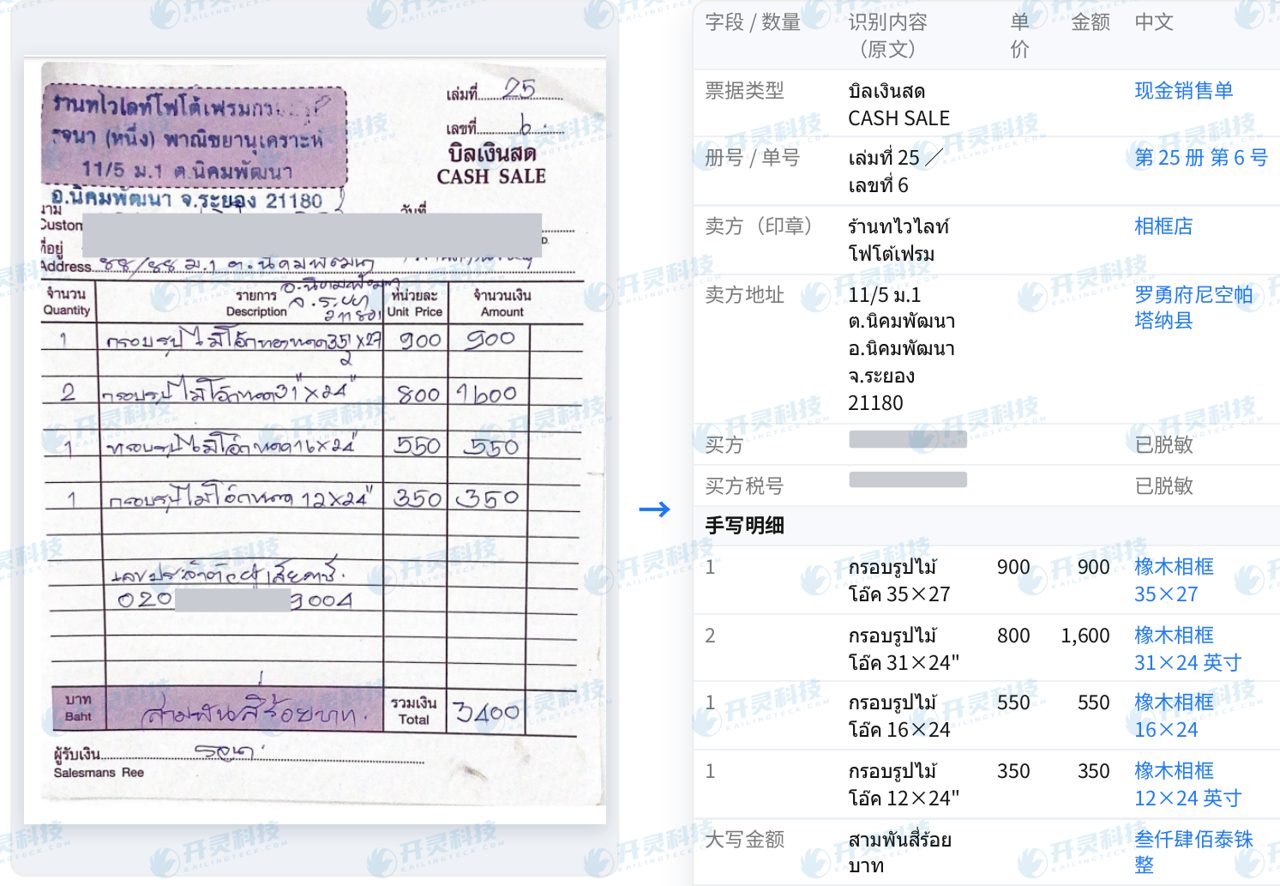
Kailing Technology recognizes handwritten sales notes and automatically verifies amounts
In the delivery note return-signing scenario, these capabilities are used for receipt verification: whether there is a signature, whether only a stamp was applied without a signature, whether the receipt date is abnormal, and whether there are handwritten remarks such as shortages or damage. Verification rules are configured according to enterprise requirements, for example, whether a stamp without a signature counts as an exception; documents with recognized exception remarks are pushed to customer service and operations for follow-up. It should be noted that recognition results of handwritten content are used for prompts and classification, and when key information such as quantity discrepancies is involved, the system hands it to a person for confirmation rather than directly rewriting ERP data.
▍After recognition: automatic receipt confirmation in ERP, with five statuses ensuring no order is lost
At the moment an order number is recognized, the system calls the customer's ERP write-back interface, marks the order as "written back," and fills in information such as customer, salesperson, license plate, and delivery date. The ERP side only needs to provide a "write-back by order number" interface that is idempotent and safe for repeated calls; Kingdee, Yonyou, and self-developed ERPs have all been integrated with similar interfaces, and for ERPs that are inconvenient to open interfaces, write-back lists can also be exported by batch and imported.
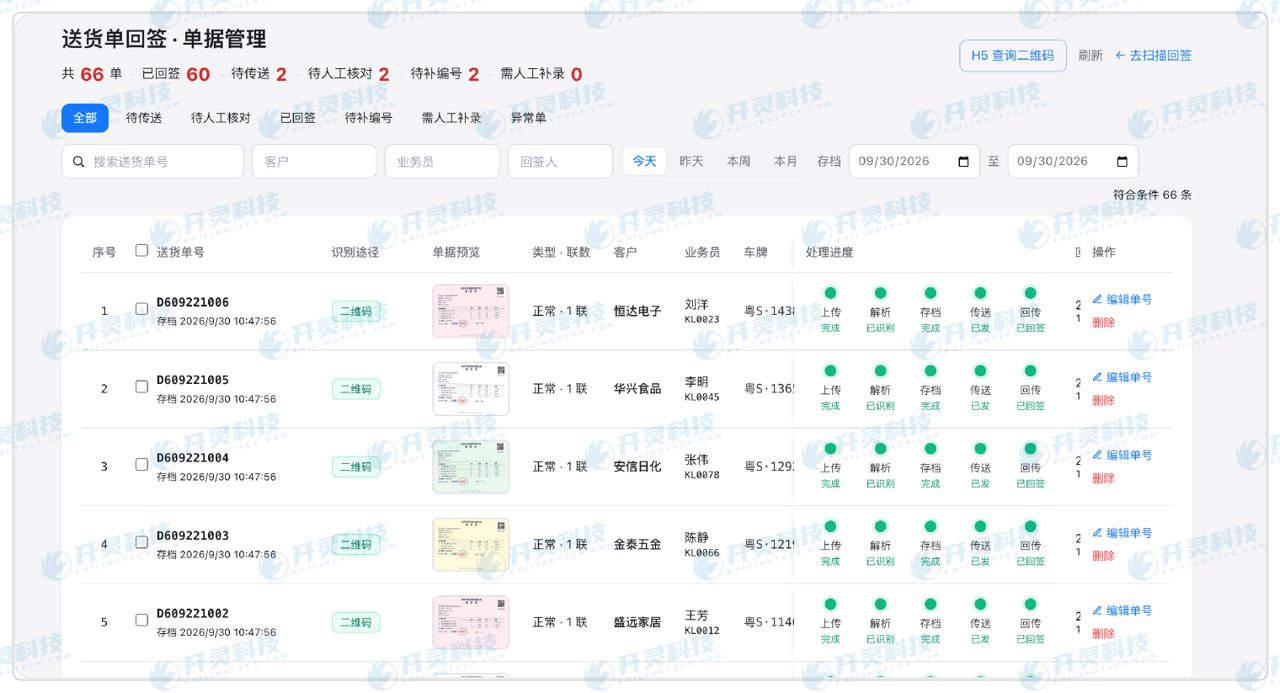
Kailing Technology return-signed document management and recognition progress (information desensitized)
Return-signing results fall into five statuses: signed and returned; pending transmission, meaning a document number exists but is queued or the ERP momentarily timed out, and the system automatically retries every minute; pending manual verification, meaning the ERP reports that the document number does not exist, indicating a recognition error, and a person corrects it by viewing the image before automatic re-signing; pending number completion, meaning none of the four levels could read a document number; and exception documents, meaning an exception was flagged at warehousing and pushed to the salesperson after successful return signing. No document is silently lost.
When multiple copies of the same delivery note are scanned in, only one record is kept and the copy count is incremented by one, so there is no duplicate return signing. Salespeople can look up their own orders in the official account without logging in, while warehousing and finance see all orders, so no one has to call warehousing to ask "has my delivery note been signed and returned yet."
▍Automatic reconciliation: how signed originals enter the reconciliation process
Delivery note write-back answers "whether the customer signed for this batch of goods," while reconciliation must answer "whether the signed goods match the payment to be collected." The Kailing Technology solution connects the two: after the delivery note is written back, the archived image of the original signed receipt can be attached to the corresponding receivable document, and finance can retrieve it together with the original signed receipt during reconciliation; for logistics freight scenarios, qualified signed receipts directly enter freight reconciliation.
In this way, when a customer disputes the quantity during reconciliation, finance can immediately retrieve the original signed receipt and handwritten remarks on the spot, without having to search the warehouse for paper copies. Delivery notes are evidence of goods receipt, and invoices are evidence of settlement; the two sets each handle their own part; if the enterprise also needs three-way matching of invoices with purchase orders and goods receipt notes, this can be further connected on the same platform.
For deployment, the entire solution can be installed on a server in the customer's intranet, so original delivery notes and images do not leave the factory, and the mobile end enters through the customer gateway; a high-speed sheet-fed scanner is sufficient, and positions without a scanner can use mobile phone photos through the same recognition and write-back process. Recognition capabilities can also be called directly by enterprise ERP, expense control, and archive systems through open APIs, returning structured JSON.
▍FAQ
Q: Can scribbled handwritten delivery notes be recognized automatically?
A: Yes, but the recognition targets must be distinguished: for order numbers, four-level recognition with QR code first and OCR and AI vision as fallback; for handwritten remarks, signatures, and tables, AI OCR's handwriting and layout understanding capabilities are used, with key discrepancies left for manual confirmation.
Q: Can it be used if there is no QR code on the delivery note?
A: Yes. The last two recognition levels are designed for documents without a QR code: OCR reads the printed order number digits, and AI vision provides another layer; adding a QR code to the top-right corner of the template is recommended to significantly improve the recognition rate.
Q: We use Kingdee or Yonyou; how do we confirm receipt?
A: On the ERP side, you only need to provide an interface that marks receipt confirmation by order number; the system calls it once the order number is recognized. The interface is idempotent, so repeated calls will not duplicate receipt confirmation. If opening an interface is inconvenient, you can export the receipt confirmation list by batch and import it.
Q: Will delivery note data leave the factory?
A: It can be deployed on the customer's intranet server, with images and data kept within the factory, and the mobile end accessed through the customer's gateway; a SaaS option can also be chosen as needed.
To scan delivery notes for automatic recognition and automatic write-back, you are welcome to learn about Kailing Technology AI-OCR and the delivery note write-back solution: https://www.kailingteck.com/ai-ocr/ .
As a national high-tech enterprise, Kailing Technology focuses on the digital and intelligent transformation of enterprise business-finance-tax and operations management, providing software products, system integration, implementation and delivery, and operational services for various government agencies, institutions, group enterprises, and SMEs.
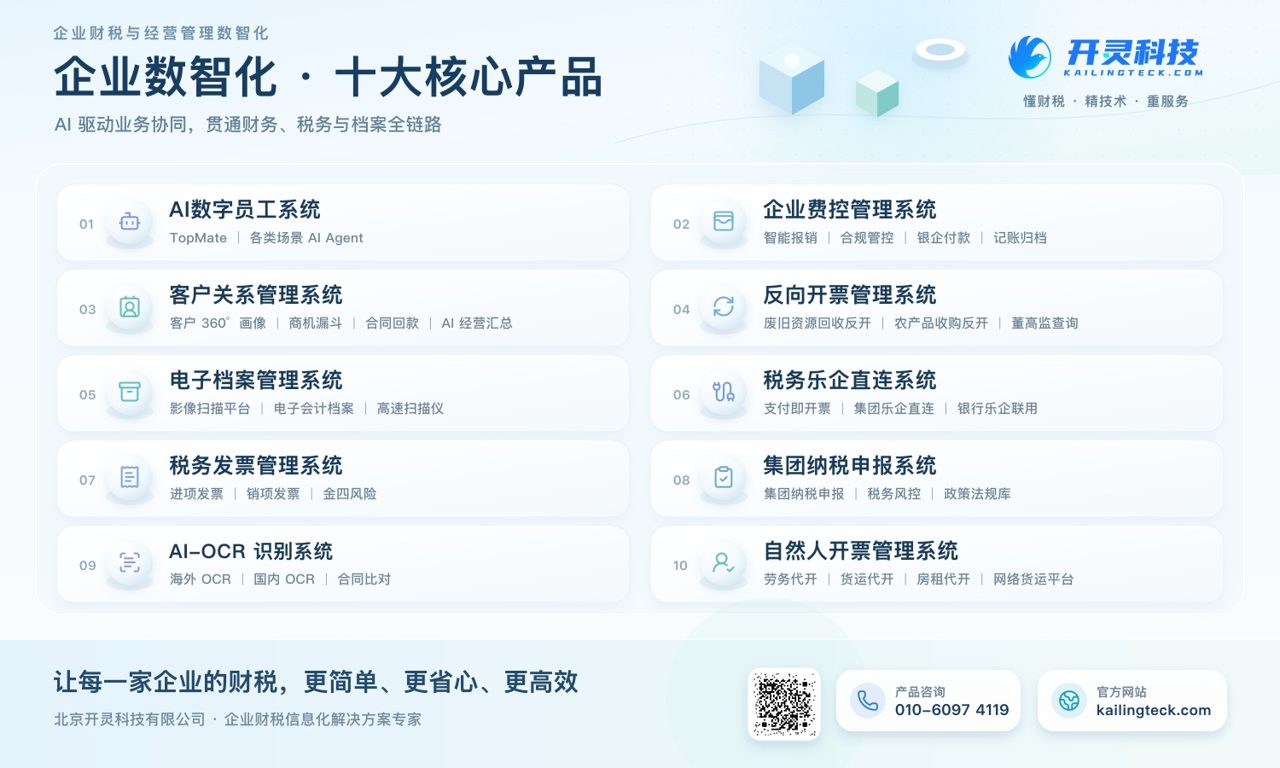
The company has now formed ten core product lines, including: AI digital employee system, enterprise expense control management system, customer relationship management system, reverse invoicing management system, invoice issuance for individuals management system, electronic archives management system, tax fully digitalized e-invoice Leqi system, tax invoice management system, group tax filing system, and AI OCR recognition system. It is committed to connecting enterprise business, finance, tax, funds, and archive data to help customers improve operational efficiency, business-finance-tax compliance capabilities, and digital management levels.
If you have any business-finance-tax digital transformation needs, welcome to contact us. Beijing Kailing Technology will serve you wholeheartedly.
Keywords: delivery note recognition, delivery note OCR, handwritten delivery note recognition, automatic delivery note write-back, delivery note ERP integration, Kailing Technology AI-OCR, delivery note reconciliation
As a comprehensive business-finance-tax digitalization solution service provider, Kailing Technology provides business-finance-tax management digital transformation products and operational services for various government agencies, institutions, and large, medium, and small enterprises. The product line includes: solutions for sales contract management system, procurement contract management system, fully digitalized Leqi interface project, automatic output invoicing system, reverse invoicing system, invoice issuance for individuals system, employee expense control and reimbursement system, input VAT invoice management system, supply chain collaborative reconciliation system, image AI OCR recognition system, automatic financial bookkeeping system, electronic accounting archives system, etc., comprehensively driving the digitalization process across various fields.
Consultation Hotline: 18513895936 / 010-60974119 Location: Beijing