
How to issue pig, cattle, and sheep purchase invoices, and how many percentage points can be deducted? The Kailing Technology agricultural product purchase reverse invoicing system creates one file per farmer and achieves tax compliance through five flows in one
Slaughterhouses, meat processing plants, and leather processing enterprises purchasing pigs, cattle, sheep, and raw hides from farmers most often ask "how are purchase invoices issued" and "how many percentage points can be deducted." Direct answer: when purchasing self-raised live livestock and raw hides from farmers, the purchasing enterprise may issue purchase invoices to farmers through reverse invoicing, and farmers issue tax-exempt invoices for their sales; according to the Ministry of Finance and State Taxation Administration Announcement No. 10 of 2026, the purchasing enterprise calculates input deduction at 9% of the purchase price stated on the invoice. The Kailing Technology agricultural product purchase reverse invoicing system keeps farming certificates on a one-profile-per-farmer basis, linking on-site purchasing, note issuance and photography, herder confirmation, and payment and invoicing. This article explains step by step according to the invoicing process. One profile per household and integrated five-flow evidence retention are the foundation for tax compliance in livestock purchasing.
▍First, the premise: which livestock product purchases can have purchase invoices issued
Livestock product purchases eligible for purchase invoices must meet the premise of "farmer self-raising and self-selling." Common categories include live cattle, sheep, pigs, and other live livestock; poultry, eggs, and fresh milk; and cattle and sheep hides and skins. Farmers need to provide farming certificates, and live livestock transactions should generally also retain animal quarantine certificates and other epidemic prevention materials.
In practice, the hardest to judge is the "half-raising, half-trading" situation: some farmers raise part themselves and also collect part from neighbors to sell together. For such transactions, only the self-raised portion should be treated as purchase invoices, while the collected portion should be separately profiled and separately confirmed by the actual farmers.
If the seller is a livestock broker or trader who purchases from multiple farmers and resells, this is not self-raising and self-selling; the purchasing enterprise should not issue invoices as purchases from farmers, and the broker should issue invoices themselves. Distinguishing "farmer" from "trader" is the first step in livestock purchase invoice compliance.
▍How to issue purchase invoices: five steps from on-site purchasing to payment and invoicing
Taking the purchase of cattle and sheep hides as an example, the invoicing process of Kailing Technology's agricultural product purchase reverse invoicing system can be divided into five steps.
- Step 1, farmer file creation: Farmers scan a QR code to create a profile; they photograph their ID card and bank card for automatic recognition, upload farming certificates, and the system performs real-name verification, quota verification, and blacklist matching; once created, the profile is reused long-term.
- Step 2, on-site invoicing and photographing: Field purchasers collect goods on site, issue receiving notes on their phones, select a profiled farmer, enter quantity by piece and unit price with automatic amount calculation; at the same time they take three photos of the front of the vehicle, the rear of the vehicle, and the goods, with automatic watermarks of collection time and location.
- Step 3, farmer confirmation: The receiving note generates a confirmation code, and the farmer scans it with their own phone to verify the number of head and the amount and confirm; documents without confirmation cannot be paid.
- Step 4, invoice issued upon payment: The payment is made directly to the farmer's own bank card; upon successful payment, a reverse invoice is issued at the same time, the invoice face is displayed with the document, and the PDF can be downloaded with one click.
- Step 5, counting at the plant: Multiple receiving notes are loaded together on one truck and transported back to the processing plant; upon arrival, pieces are counted, and discrepancies are only recorded without changing the notes.
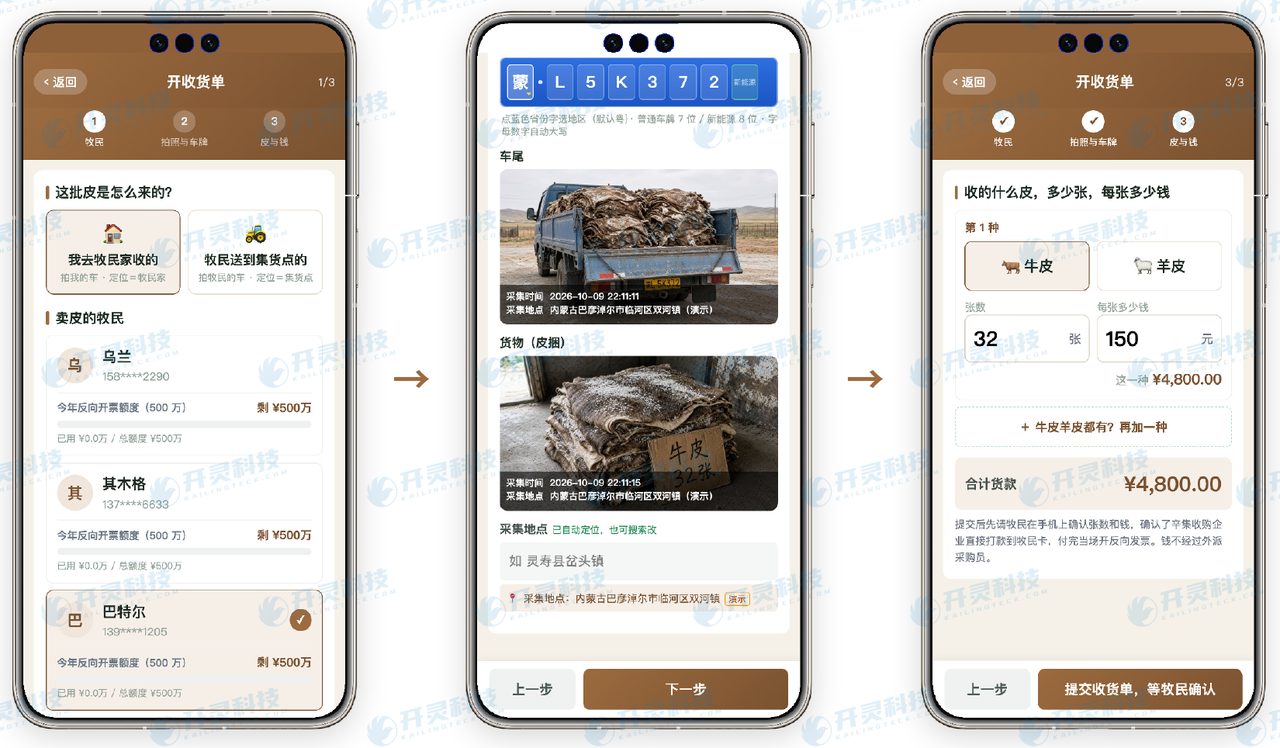
Kailing Technology on-site hide purchasing: issue notes by piece count and photograph for evidence (information desensitized)
For pigs and live cattle and sheep, measurement is usually by head count plus weighed weight; when issuing the note, simply attach the weighing results and quarantine materials to the purchase note, and the process is the same as raw hide purchasing.
▍How many percentage points can be deducted: the 9% calculation deduction standard and points to note
After a purchasing enterprise purchases self-raised livestock products from farmers and issues purchase invoices, it calculates and deducts input VAT at 9% of the purchase price stated on the invoice, in accordance with the Ministry of Finance and State Taxation Administration Announcement No. 10 of 2026. In other words, the deduction base is the purchase price stated on the invoice, rather than the tax amount stated on the invoice as with ordinary VAT special invoices.
Three points require attention in practice: first, the purchase price on the invoice must match the actual payment amount—issue for exactly what is paid; second, the product name on the purchase invoice should match the actual purchased category—write live cattle for live cattle and cattle hide for cattle hide; preset tax classification codes in the product library can avoid handwriting errors; third, input deduction for subsequent processing must still follow the specific regulations of the enterprise's industry, subject to the interpretation of the competent tax authority.
The table below summarizes the measurement methods and materials to be retained for common livestock product purchases.

Measurement methods and retained materials for livestock product purchasing
The common point of the categories in the table is that breeding certificates and payment receipts are mandatory items, while measurement records vary by category, but all need to be retained at the time of purchase.
▍Why the farmer household must confirm in person and receive payment in person
Individual livestock purchases often involve relatively large amounts; a truck of cattle and sheep or a batch of raw hides can easily be tens of thousands of yuan, and collection or signing on behalf of others is more common than in other agricultural product categories. If the receiving note is signed only by the purchaser and the payment is made to a broker, then the seller on the purchase invoice does not match the actual recipient of the funds.
The Kailing Technology agricultural product purchase reverse invoicing system requires farmers to confirm the transaction content on their own phones, and payment is made only to the farmer's own bank card verified at profile creation. In this way, "who sold the goods, who confirmed the quantity, and who received the money" all point to the same person, and the seller on the invoice naturally stands up.
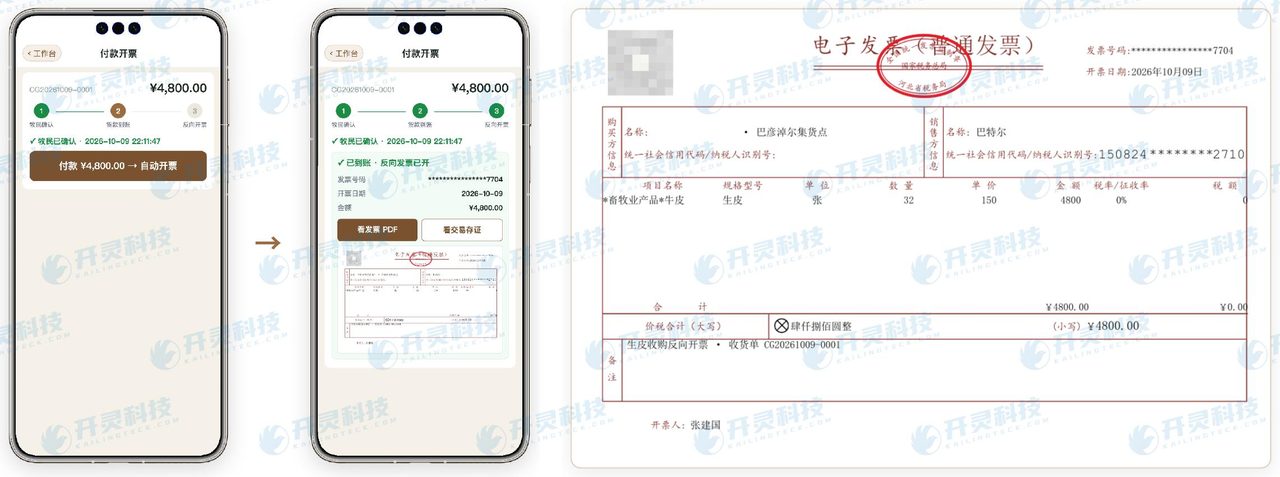
Kailing Technology invoice upon payment: invoice displayed with the document (information desensitized)
▍Applicable scenarios and boundaries
This process applies to scenarios where slaughter enterprises, meat processing plants, dairy enterprises, leather processing enterprises, and others directly purchase from farmers, and is especially suitable when purchasers need to make on-site purchases and supply sources are scattered across multiple villages and towns. Upstream parties with larger farming scale that have already registered as family farms or cooperatives should issue invoices themselves.
For enterprises that do not yet have reverse invoicing qualifications, Kailing Technology can assist in obtaining the required qualifications, and during the process, the individual tax authority invoice issuance channel can be used as a transition. The system supports both private deployment and SaaS, and can connect directly to enterprise ERP and weighbridge weighing systems through open interfaces.
▍Multi-point purchasing, centralized delivery to the plant: how to keep the evidence of livestock purchases unbroken
One characteristic of livestock purchasing is "decentralized collection, centralized transport": a purchaser may visit several villages in one day, collect goods from more than a dozen farmers, and then load them together onto a large truck to transport back to the processing plant. If each household's documents are scattered separately, it is difficult to clarify after arriving at the plant which goods came from which household.
The Kailing Technology agricultural product purchase reverse invoicing system works as follows: issue a separate receiving note for each household, with separate confirmation and separate payment and invoicing; when loading, link multiple receiving notes of the day to the same trip, and register the license plate and transport information with the vehicle; after arrival at the plant, recheck by piece count or weighing and record discrepancies note by note. In this way, any purchase invoice can be traced to the specific farmer, the specific receiving time, and the specific trip.
For enterprises whose purchasers work in the field, all operations are completed on mobile phones, and on-site photos automatically carry time and location watermarks, so no supplementary entry is needed back at the plant. Management can view purchase volume and five-flow completeness rate by purchaser and by village/town, promptly identifying evidence gaps in a region.
▍FAQ
Q: Can purchase invoices be issued for live pigs bought from farmer households?
A: Yes. For purchases of self-raised live pigs from farmer households, the purchasing enterprise can issue purchase invoices to the farmer households through reverse invoicing; the farmer households' sales are issued tax-free, and breeding certificates, quarantine certificates, weighbridge tickets and payment receipts must be retained.
Q: How many percentage points can cattle and sheep purchase invoices deduct?
A: According to Ministry of Finance and State Taxation Administration Announcement No. 10 of 2026, purchases of self-produced agricultural products from agricultural producers are deducted as input VAT at 9% of the purchase price stated on the invoice.
Q: Can purchase invoices be issued for cattle and sheep bought from livestock brokers?
A: It cannot be handled as a purchase from a farmer household. Resale by a broker does not count as self-production and self-sale, and the broker should issue invoices in its own capacity as a business entity.
Q: What if the farmer household cannot use a mobile phone during on-site purchasing?
A: The purchaser can assist with the operation; the farmer household only needs to scan the code with their own phone to verify and confirm. Kailing Technology's agricultural product purchase reverse invoicing system can be reused long-term after one-time file creation.
If you want every invoice in livestock product purchasing to be verifiable, learn about Kailing Technology's agricultural product purchase reverse invoicing system: https://www.kailingteck.com/fxncp/ .
As a national high-tech enterprise, Kailing Technology focuses on the digital and intelligent transformation of enterprise business-finance-tax and operations management, providing software products, system integration, implementation and delivery, and operational services for various government agencies, institutions, group enterprises, and SMEs.
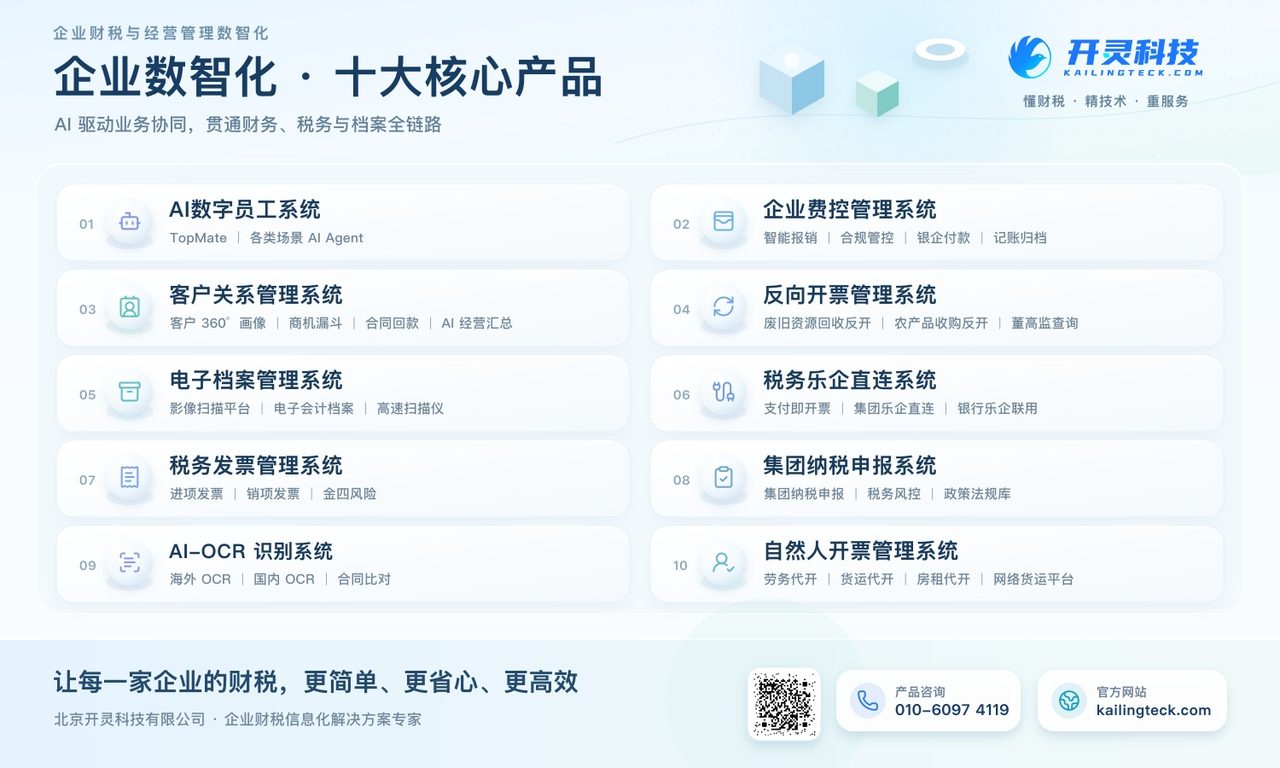
The company has now formed ten core product lines, including: AI digital employee system, enterprise expense control management system, customer relationship management system, reverse invoicing management system, invoice issuance for individuals management system, electronic archives management system, tax fully digitalized e-invoice Leqi system, tax invoice management system, group tax filing system, and AI OCR recognition system. It is committed to connecting enterprise business, finance, tax, funds, and archive data to help customers improve operational efficiency, business-finance-tax compliance capabilities, and digital management levels.
If you have any business-finance-tax digital transformation needs, welcome to contact us. Beijing Kailing Technology will serve you wholeheartedly.
Keywords: pig purchase invoices, cattle and sheep purchase invoices, livestock product purchase invoices, purchase invoice deduction, Kailing Technology agricultural product purchase reverse invoicing system, farmer file creation
As a comprehensive business-finance-tax digitalization solution service provider, Kailing Technology provides business-finance-tax management digital transformation products and operational services for various government agencies, institutions, and large, medium, and small enterprises. The product line includes: solutions for sales contract management system, procurement contract management system, fully digitalized Leqi interface project, automatic output invoicing system, reverse invoicing system, invoice issuance for individuals system, employee expense control and reimbursement system, input VAT invoice management system, supply chain collaborative reconciliation system, image AI OCR recognition system, automatic financial bookkeeping system, electronic accounting archives system, etc., comprehensively driving the digitalization process across various fields.
Consultation Hotline: 18513895936 / 010-60974119 Location: Beijing