
How are forestry tax-exempt invoices and timber purchase invoices deducted? Kailing Technology's agricultural product purchase reverse invoicing system uses forest ownership certificates and scale sheets with five-flow integrated evidence retention, so that deductions can withstand tax compliance inspections
The two questions most frequently asked by wood processing plants and bamboo product enterprises are: 'Can the tax-exempt invoices issued by forestry farmers be deducted?' and 'How are the timber purchase invoices we issue ourselves deducted?' The answer is: as long as the seller is a forestry producer and what is sold is their self-produced forest products, whether it is a tax-exempt agricultural product sales invoice obtained from the other party or a purchase invoice issued by the purchasing enterprise to the forestry farmer, the input VAT can be calculated and deducted based on the purchase price stated on the invoice; in accordance with the Ministry of Finance and State Taxation Administration Announcement No. 10 of 2026, purchases of self-produced agricultural products from agricultural producers are calculated and deducted at 9% of the purchase price. Kailing Technology's agricultural product purchase reverse invoicing system links forest ownership self-certification, scale and timber measurement, and payment and invoicing into one line, so that every timber purchase invoice can clearly explain its source. This article separately explains the deduction basis and evidence retention requirements for the two types of invoices. Only when forest ownership certificates, scale sheets, payments, and invoices are retained as integrated five-flow evidence can deductions withstand tax compliance inspections.
▍Two types of invoices, one premise: the seller must be a forestry producer
Whether forestry tax-exempt invoices and timber purchase invoices can be calculated and deducted both rest on the premise that 'forestry producers sell self-produced forest products.' Forestry producers' self-produced and self-sold forest products enjoy tax exemption, and the invoices obtained are marked as tax-exempt on their face; the purchasing enterprise calculates the input VAT deduction based on the purchase price stated on the invoice.
The difference between the two types of invoices lies in the issuer: tax-exempt agricultural product sales invoices are issued by producers themselves, such as forestry farmers or forestry farms, and are suitable for forestry farms and cooperatives that can already issue invoices on their own; purchase invoices are issued by the purchasing enterprise to individual forestry farmers through reverse invoicing, and are suitable for scenarios of purchasing from dispersed forestry farmers. For wood processing plants that deal with large numbers of individual forestry farmers, the latter is the main day-to-day method.
| "Whether it can be deducted depends not on the word 'tax-exempt' printed on the invoice, but on whether the goods actually grew on the forestry farmer's own mountain." |
▍The three stages where forest product purchases most easily go wrong
When timber purchase invoices are questioned at the deduction stage, the problem usually lies in three stages: self-certification, measurement, and payment.
The first is insufficient self-certification. Timber and bamboo come from forest land, and forestry farmers need to prove that the mountain forest is contracted or transferred by themselves; felled logs also require a timber felling permit. Many purchase orders only record the forestry farmer's name without any forest ownership materials. The second is unclear measurement. Logs are calculated by scaled volume, moso bamboo by culm count, and forest fruits and under-forest medicinal herbs by weighing in jin; if units of measurement are mixed or scale sheets are lost, the invoiced quantity is hard to explain. The third is inconsistent payment. Timber transactions involve relatively large single amounts, and payment to the loading driver or intermediary is not uncommon, causing the fund flow to be inconsistent with the invoice flow.
The table below compares the two types of invoices in terms of issuer, applicable targets, and evidence retention requirements.

Comparison of forestry tax-exempt invoices and timber purchase invoices
As can be seen from the table, the deduction basis for the two types of invoices is the same, but purchase invoices are issued by the enterprise itself, so the enterprise bears a heavier self-certification responsibility, and the forest ownership materials and scale records must be fully retained by the enterprise itself.
For enterprises that purchase from both forestry farms and individual forestry farmers, it is recommended to keep separate ledgers: goods from forestry farms are recorded based on obtained invoices, and goods from forestry farmers are recorded based on purchase invoices; the two types of input VAT each retain corresponding evidence, making the basis clear at month-end deduction.
▍Kailing Technology's agricultural product purchase reverse invoicing system: from forest ownership self-certification to payment and invoicing
Kailing Technology's agricultural product purchase reverse invoicing system has designed a complete process for forestry scenarios: 'scan code to create file - forest ownership self-certification - scale and measure timber - forestry farmer confirmation - payment to card and invoicing - loading and factory inspection.'
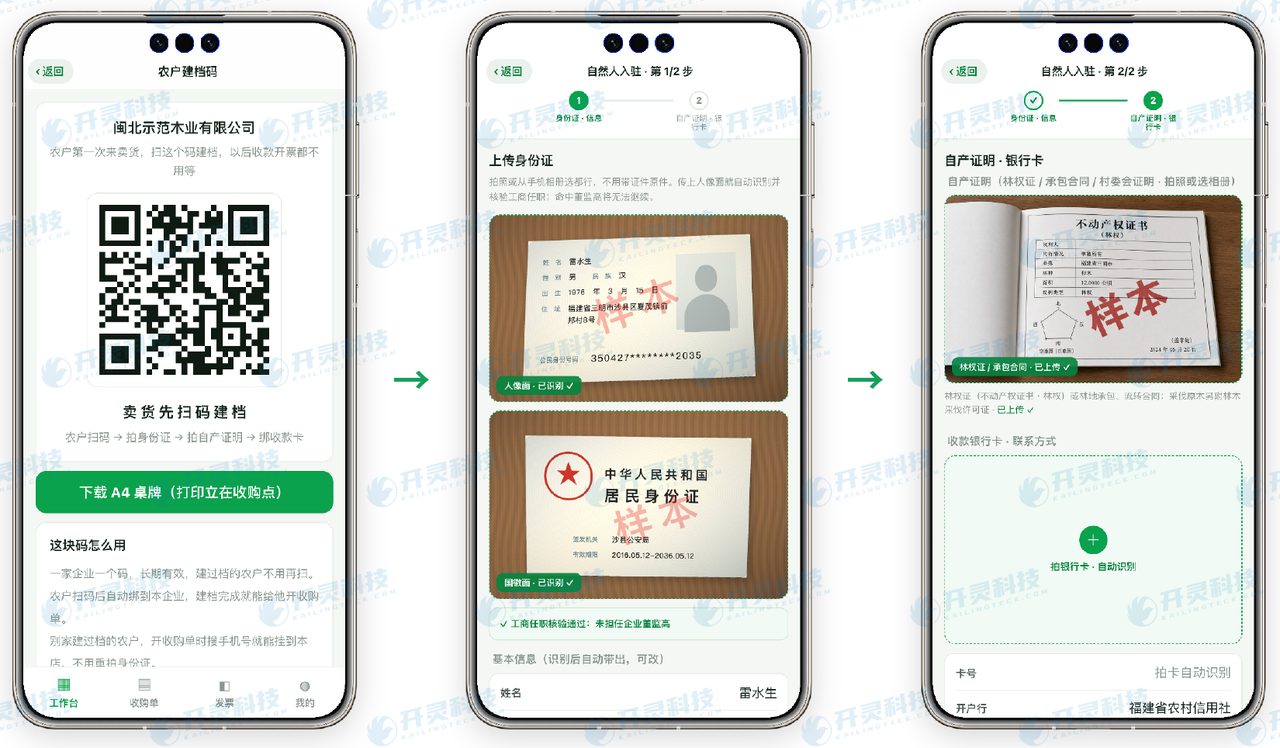
Kailing Technology forestry farmer file creation: forest ownership certificate and felling permit (information desensitized)
- Forest ownership self-certification: When forestry farmers scan the code to create a file, they upload a forest ownership certificate (real estate ownership certificate - forest ownership) or a forest land contracting or transfer contract; felling logs additionally requires a timber felling permit, and the system simultaneously performs real-name verification and quota verification.
- Scale and measure timber: For logs, the scaler measures diameter class and length and looks up the log volume table to obtain the cubic meter count; moso bamboo is counted by culm; forest fruits, forest medicinal herbs, and under-forest fungi are weighed in jin. The unit of measurement follows the product, and the product library presets tax classification codes for logs, raw bamboo, dried fruits, Chinese medicinal materials, and more.
- Forestry farmer confirmation: After the purchase order is generated, the forestry farmer scans the code with their own phone to verify the quantity and amount and confirm; only after confirmation can the enterprise make payment.
- Payment-triggered invoicing: The payment is made directly to the forestry farmer's own bank card, and a reverse invoice is issued at the same time as the payment succeeds; the forestry farmer's sale of self-produced forest products is issued tax-exempt, and the enterprise deducts input VAT at 9% of the purchase price based on the invoice.
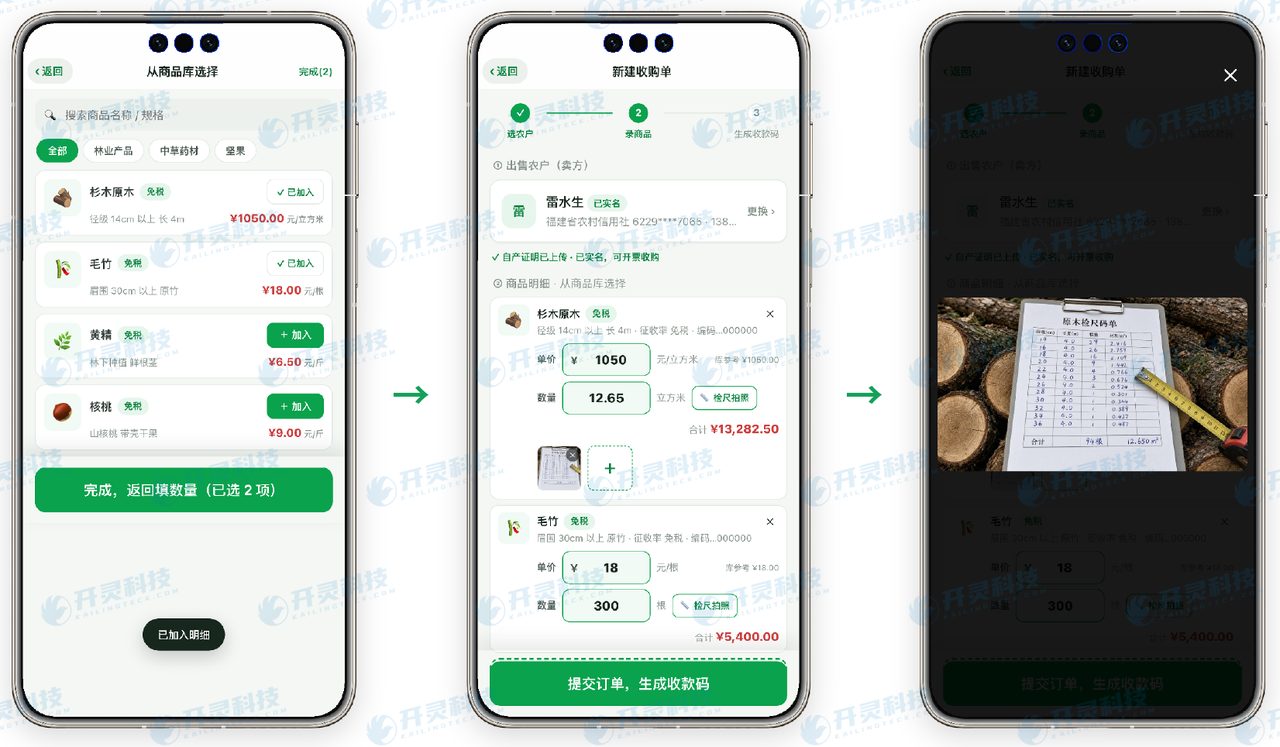
Kailing Technology scale and measure timber: scale sheet photos attached to the purchase order (information desensitized)
▍Multiple purchase orders loaded into one truck: how to reconcile at factory inspection
A common practice in forestry purchases is 'multiple households loaded into one truck': one truck of Chinese fir may come from three or four forestry farmer households, scaled and invoiced separately at the mountain site, then loaded together and transported to the processing plant. Kailing Technology's agricultural product purchase reverse invoicing system supports linking multiple purchase orders to the same trip, recording the license plate and transport trajectory, and inspecting them one by one against the purchase orders after arrival at the factory.
If there is a discrepancy between the quantity inspected at the factory and the quantity scaled at the mountain site, the system only records the discrepancy and does not automatically modify the confirmed purchase order, avoiding invoice-goods inconsistency caused by later order changes. The five evidence flows are ultimately consolidated under the same business order number, forming one file per invoice.
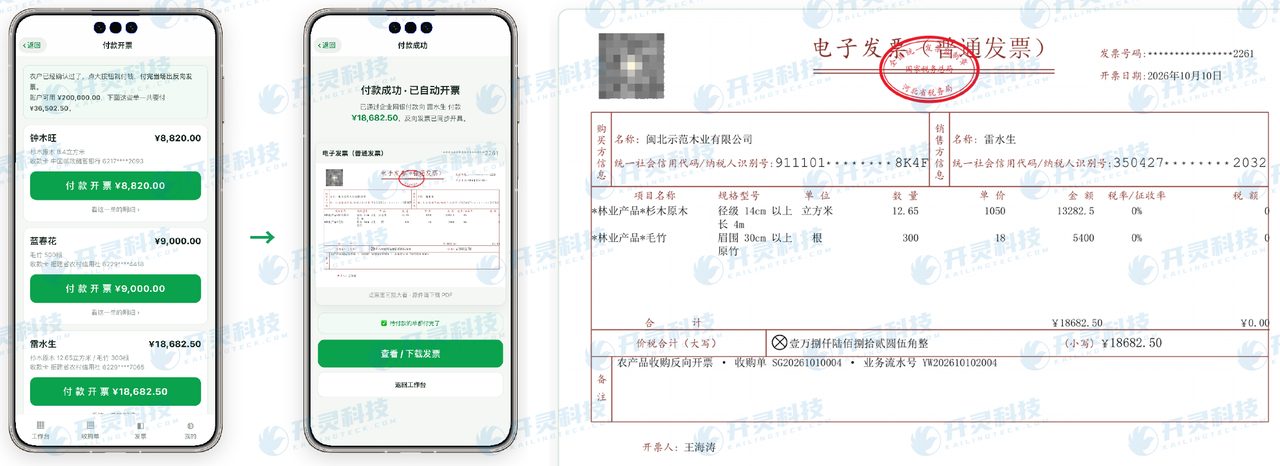
Forest product payment triggers invoicing (test invoice, subject to the Leqi invoice face)
▍Applicable conditions and common misunderstandings
This process is best suited to wood processing plants, bamboo product companies, and forest product processing enterprises that purchase raw logs, bamboo timber, forest fruits, and understory medicinal herbs from dispersed forest farmers. If the upstream party is a state-owned forest farm or a registered cooperative, they can issue tax-exempt invoices themselves, and the enterprise only needs to obtain and retain the contract, acceptance records, and payment records as normal.
There are two common misunderstandings: first, treating goods bought from timber business operators as 'self-produced by forestry farmers' - resale by a business operator does not count as self-production and self-sale; second, retaining only the invoice without forest ownership materials, making it impossible to prove the source of the goods at deduction. Both practices put input VAT that could otherwise be deducted at risk of being transferred out.
▍Under-forest products and dried fruits: equally applicable, but with different self-certification materials
Forestry purchases are not limited to logs and moso bamboo. Bamboo shoots, oil tea fruit, walnuts, chestnuts, Chinese torreya, as well as under-forest planted Huangjing, Poria, and under-forest fungi, are all forest products grown and harvested by forestry farmers in their own contracted or transferred mountain forests, and purchase invoices can likewise be issued for purchases from forestry producers.
The difference lies in the self-certification materials and measurement method: under-forest products and dried fruits generally do not require a felling permit, but still require a forest ownership certificate or forest land contracting or transfer contract to prove mountain forest ownership; measurement is by weighing in jin rather than scaling. The product library of Kailing Technology's agricultural product purchase reverse invoicing system is configured with tax classification codes for dried fruits, Chinese medicinal materials, edible fungi, and forest chemical raw materials respectively; the purchaser selects the product name and the corresponding code is brought up, and the same purchase order can contain both log and dried fruit line items.
▍FAQ
Q: Can forestry tax-exempt invoices be deducted as input VAT?
A: Yes. For tax-exempt invoices issued by forestry producers selling self-produced forest products, the purchasing enterprise may calculate the deduction based on the purchase price stated on the invoice, at 9% in accordance with Ministry of Finance and State Taxation Administration Announcement No. 10 of 2026.
Q: How are timber purchase invoices deducted?
A: After a purchasing enterprise purchases self-produced timber from individual forestry farmers and issues a purchase invoice, it calculates the deduction at 9% of the purchase price stated on the invoice, and must also retain the forest ownership materials, scale records, and payment receipts.
Q: What materials must forestry farmers provide when purchasing logs?
A: A forest ownership certificate (real estate ownership certificate - forest ownership) or a forest land contracting or transfer contract is required; felling logs also requires a timber felling permit. Kailing Technology's agricultural product purchase reverse invoicing system requires these to be uploaded when creating the file.
Q: How are the units of measurement for logs and moso bamboo handled?
A: Logs are measured by scaled volume in cubic meters, moso bamboo by the culm, and forest fruits and forest medicinal herbs by the jin. The product library of Kailing Technology's agricultural product purchase reverse invoicing system makes the unit of measurement follow the product.
To clarify the deduction basis and evidence for forest product purchases in one go, you are welcome to learn about Kailing Technology's agricultural product purchase reverse invoicing system: https://www.kailingteck.com/fxncp/ .
As a national high-tech enterprise, Kailing Technology focuses on the digital and intelligent transformation of enterprise business-finance-tax and operations management, providing software products, system integration, implementation and delivery, and operational services for various government agencies, institutions, group enterprises, and SMEs.
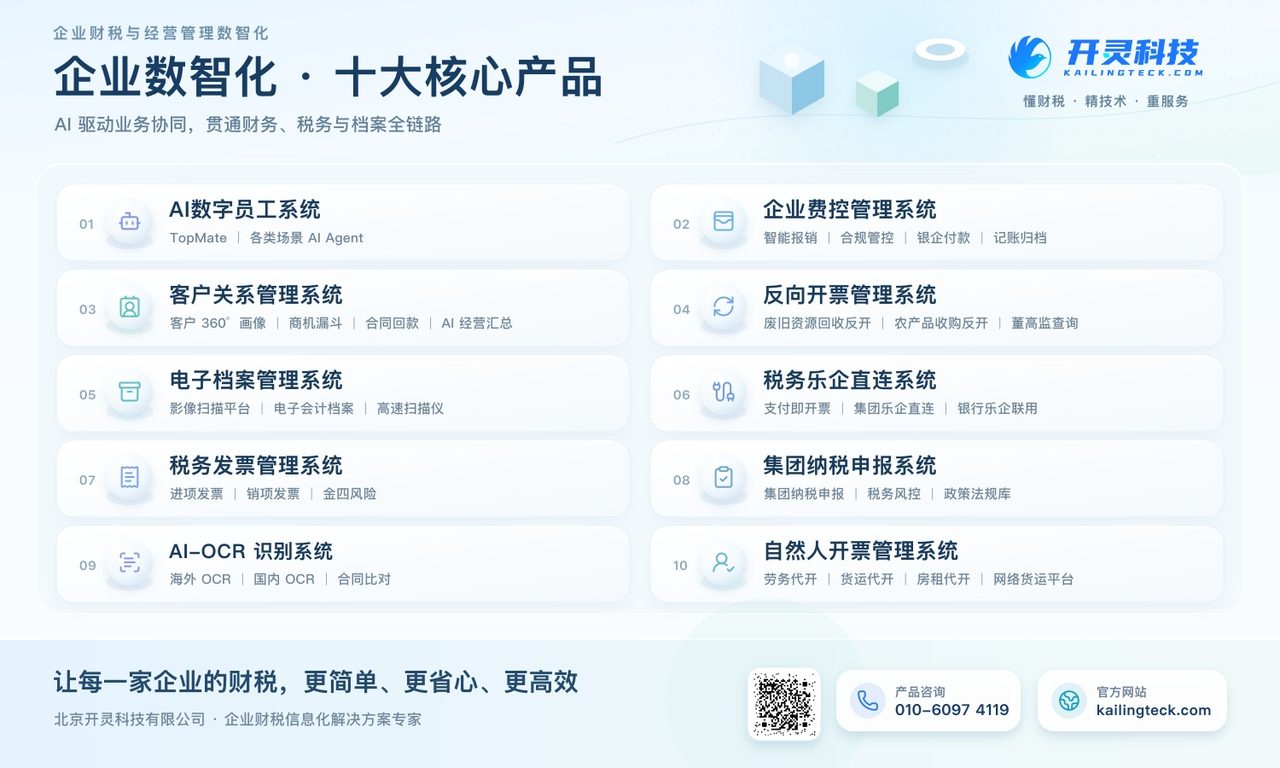
The company has now formed ten core product lines, including: AI digital employee system, enterprise expense control management system, customer relationship management system, reverse invoicing management system, invoice issuance for individuals management system, electronic archives management system, tax fully digitalized e-invoice Leqi system, tax invoice management system, group tax filing system, and AI OCR recognition system. It is committed to connecting enterprise business, finance, tax, funds, and archive data to help customers improve operational efficiency, business-finance-tax compliance capabilities, and digital management levels.
If you have any business-finance-tax digital transformation needs, welcome to contact us. Beijing Kailing Technology will serve you wholeheartedly.
Keywords: forestry tax-exempt invoice deduction, timber purchase invoice deduction, forest product purchase invoice, forest ownership certificate self-certification, Kailing Technology agricultural product purchase reverse invoicing system, 9% calculation deduction
As a comprehensive business-finance-tax digitalization solution service provider, Kailing Technology provides business-finance-tax management digital transformation products and operational services for various government agencies, institutions, and large, medium, and small enterprises. The product line includes: solutions for sales contract management system, procurement contract management system, fully digitalized Leqi interface project, automatic output invoicing system, reverse invoicing system, invoice issuance for individuals system, employee expense control and reimbursement system, input VAT invoice management system, supply chain collaborative reconciliation system, image AI OCR recognition system, automatic financial bookkeeping system, electronic accounting archives system, etc., comprehensively driving the digitalization process across various fields.
Consultation Hotline: 18513895936 / 010-60974119 Location: Beijing