
Is Payment-Based Invoicing at Gas Stations Mandatory? Kailing Technology's Gas Station Leqi Combined-Use Solution Explains Transaction-Based Invoicing and Access Paths
“Is pay-and-invoice at gas stations mandatory?” “When does it start?” “What happens if we don't connect?” These are the questions refined oil retail enterprises care about most recently. A direct answer: according to the Announcement of the State Taxation Administration on Matters Concerning the Nationwide Rollout of Transaction-Based Invoicing in the Refined Oil Retail Sector, transaction-based invoicing will be rolled out nationwide at refined oil retail gas stations from November 1, 2026, and those that fail to implement it on schedule will be ordered to correct and penalized; large group oil stations can use Leqi self-use direct connection invoicing, while small and medium-sized stations without the ability to upgrade can connect to third-party platforms and implement it through Leqi joint use. Kailing Technology's Leqi joint-use pay-and-invoice solution connects to gas station retail management systems and multiple payment channels holding joint-use qualifications. This article explains the policy points, three access paths, and implementation steps.
▍Policy points: what transaction-based invoicing means for gas stations
For gas stations, transaction-triggered invoicing means invoicing is no longer an additional service requested by the customer afterward, but a standard action that occurs automatically when the transaction is completed. After the customer refuels and pays, the invoice is generated together with the transaction, and the data is reported synchronously to the tax authority.
Looking at the policy trajectory, after fully digitalized e-invoices were rolled out nationwide, the State Taxation Administration built the Leqi digital tax-enterprise direct connection platform, opening invoicing and invoice-use capabilities to enterprises' own information systems via standard interfaces. Payment-triggered invoicing and transaction-triggered invoicing are the ultimate forms of this capability applied to business, and are expanding outward from high-frequency livelihood sectors such as parking lots, supermarket retail, agricultural product purchasing, and scrap recycling. Refined oil retail is the only one among them with an explicitly set nationwide rollout timeline.
| “ The question for gas stations is no longer whether to connect, but which path to use and how soon it can be done. |
▍Three access paths: self-use direct connection, joint-use access, third-party platform
There are mainly three paths for implementing transaction-based invoicing at gas stations; which one to choose depends on enterprise scale and system capabilities.
Path one: Leqi self-use direct connection, suitable for large group gas stations
The group builds or transforms its own information system and applies to become a Leqi Direct Connection unit to issue invoices for itself and its subordinate sites under its control. The advantage is full control over data and channels; the difficulty is that qualification application, message adaptation, sandbox integration testing, and subsequent rule tracking all require a professional team, with cycles measured in months.
Path two: Leqi joint-use access, suitable for small and medium-sized stations and single stations
A direct connection unit holding the Leqi joint-use qualification, such as a bank or payment institution, provides invoicing services for gas stations with which it has no controlling relationship, and the gas station's original transaction or fund receipt and payment data is generated in the direct connection unit's system. Small and medium-sized stations do not need to apply for the direct connection qualification themselves, and the amount of modification is small.
Path three: unified access to multiple channels through a third-party platform
A gas station or group can connect to multiple combined-use channels through a single platform, routing invoicing capabilities by scenario and cost without being locked into a single channel. For enterprises still applying for self-use qualification, this is also a transitional path: get the business running before the qualification is in place, then switch once it is.

Comparison of Three Access Paths for Transaction-Based Invoicing at Gas Stations
The comparison shows that the core difference among the three paths lies in "who bears the work of direct connection with the tax platform." Small and medium-sized stations do not need to build direct connections themselves; the key is to choose the right channel and connect the retail management system.
▍Kailing Technology's Leqi joint-use pay-and-invoice solution: connect once, reach many
The positioning of the Kailing Technology Leqi joint-use pay-and-invoice solution in the gas station scenario is as the hub connecting the "gas station retail management system" and "financial institutions holding the joint-use qualification." The Kailing Technology five-flow integrated tax compliance management platform has already connected to Alipay, WeChat Pay, China UnionPay, China Merchants Bank, Industrial and Commercial Bank of China, and other financial institutions holding the Leqi joint-use qualification; gas stations or their system service providers only need to connect to Kailing once to use these channels.
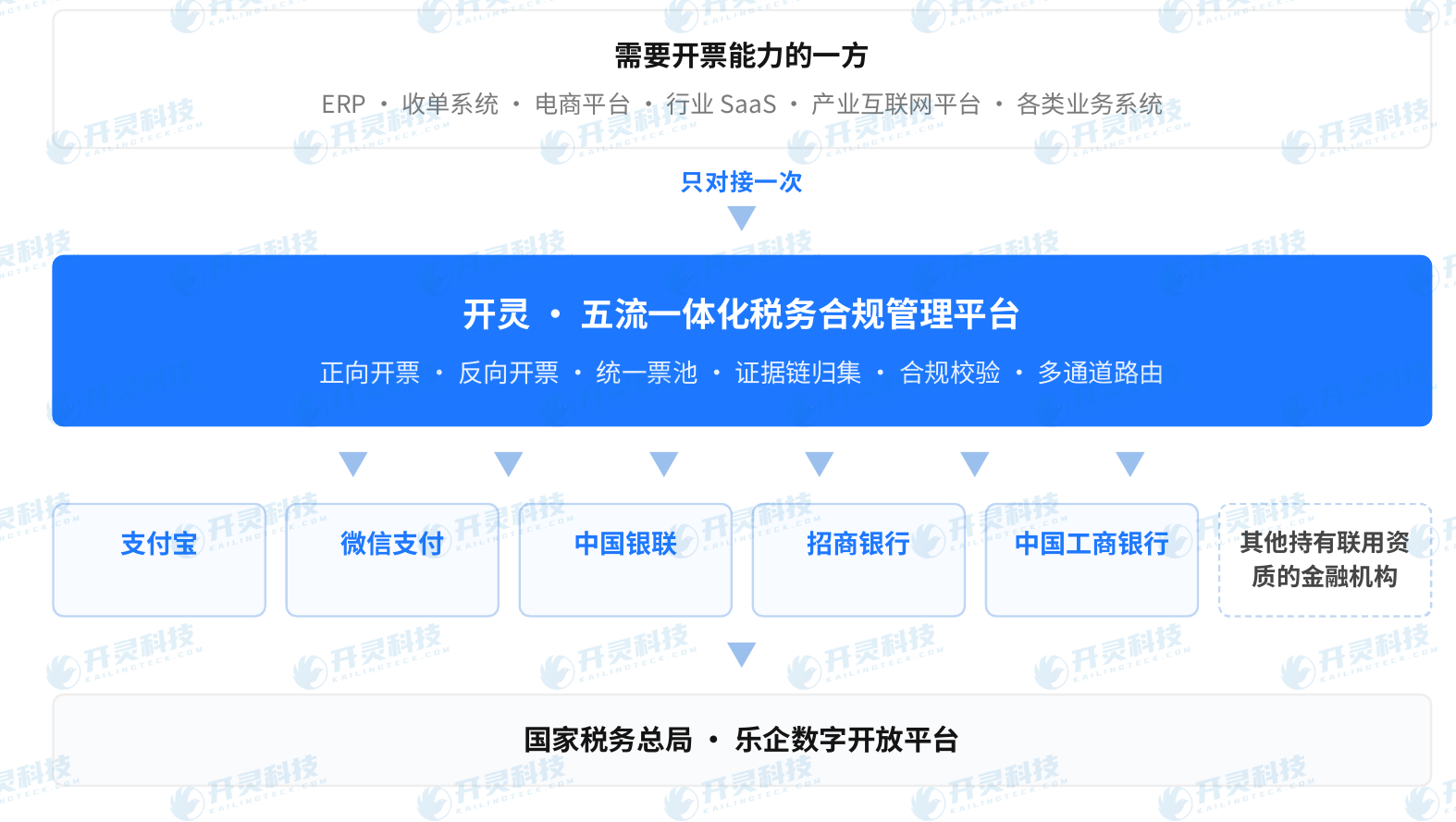
Kailing Technology Leqi joint-use hub: one integration, multiple channels
Each institution's joint-use interface differs in message structure, encryption method, code value table, and callback mechanism. Integrating with each one yourself means each integration is a complete project, and each upgrade must be followed separately. By accessing through a unified platform, new channels, interface upgrades, and invoice type rule adjustments are all absorbed on the platform side, and the gas station side only maintains one set of interface specifications. Refined oil is a specific business invoice type that requires a separate subscription, and the validation rules and formats of the invoice type are uniformly encapsulated on the platform side.
▍How pay-and-invoice runs at gas stations: six steps
The complete chain of payment-based invoicing at gas stations can be divided into six steps, attaching the invoicing action to the point of successful payment.
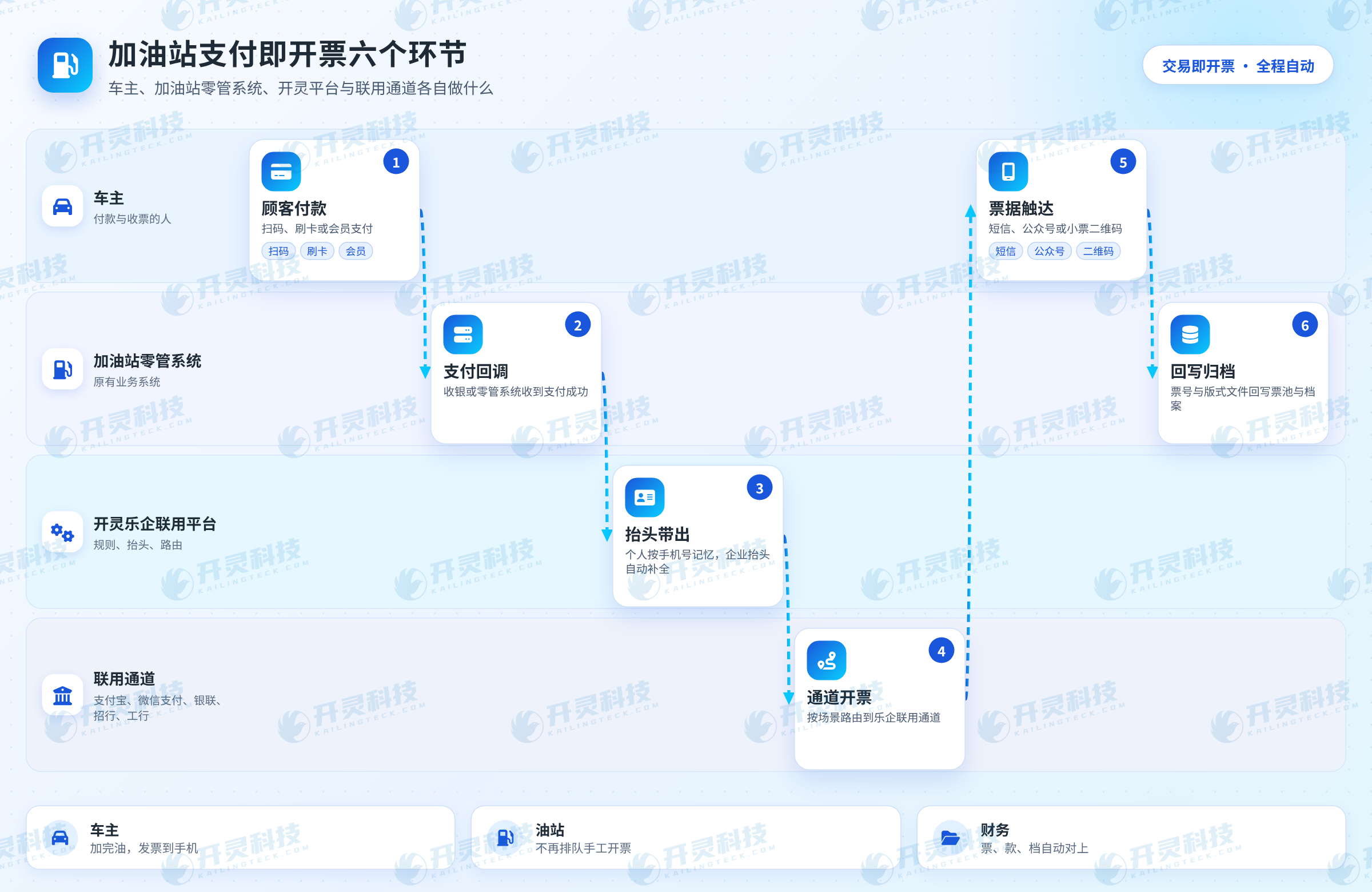
Six Steps of Payment-Based Invoicing at Gas Stations
Among these, the third step, automatic header retrieval, directly affects customer experience: personal headers are remembered by mobile phone number, so there is no need to fill them in again next time; enterprise headers automatically complete the tax number, address, and bank through invoice header lookup, reducing red-letter reversals caused by entry errors. The sixth step writes the invoice number together with PDF, OFD, and XML format files back to the retail management system, the enterprise invoice pool, and electronic accounting archives at the same time, so finance no longer needs to reconcile payment records and invoicing records one by one at month-end.
▍Implementation steps and schedule
For gas stations that have not yet completed transaction-based invoicing transformation, it is recommended to proceed in four steps: "confirm the path, connect to the retail management system, sandbox integration testing, trial run." Step one: confirm whether to use self-use direct connection, combined-use access, or unified platform access based on enterprise scale; step two: review the retail management system's transaction data and payment callbacks to determine the invoicing trigger point; step three: test the issuance, red-letter reversal, and query capabilities for refined oil invoice types one by one in a sandbox environment; step four: select one or two stations for a trial run, then roll out fully once stable.
Common transaction channels at gas stations include QR code payment, fuel cards, cash, and corporate settlement. The invoicing trigger point differs by channel, so each should be verified one by one during the trial run, especially the invoicing timing for fuel card top-ups and consumption.
Leqi joint-use qualification requires acceptance and verification by the tax authority, plus system modification, joint debugging and simulation testing, and trial operation; from application to service capability is measured in months. In projects, Kailing Technology provides preparation of Leqi joint-use application materials, a visual environment and preset test cases for the sandbox stage, reducing invalidations caused by time-limited test timeouts. For stations that have missed the time window, they can first complete compliance through the joint-use channel and then plan subsequent system upgrades.
▍FAQ
Q: Is pay-and-invoice at gas stations mandatory?
A: According to the State Taxation Administration announcement on the nationwide rollout of transaction-based invoicing in the refined oil retail sector, it will be rolled out nationwide at refined oil retail gas stations from November 1, 2026, and those that fail to implement it on schedule will be ordered to correct and penalized.
Q: What should small and medium-sized gas stations do if they cannot build their own systems?
A: It can be accessed through Leqi joint use, with invoicing services provided by a direct connection unit holding the joint-use qualification, or uniformly connected to multiple joint-use channels through Kailing Technology's Leqi joint-use pay-and-invoice solution.
Q: What is the difference between pay-and-invoice and transaction-based invoicing?
A: Both attach invoicing to the point when the transaction or payment is completed and issue the invoice automatically; the announcement in the refined oil sector uses the expression transaction-based invoicing, which in practice is often triggered by successful payment.
Q: After a gas station is connected, how do customers get their invoices?
A: It can be obtained via SMS, official account, mini program, or the QR code on the receipt; personal titles are remembered by mobile number, and enterprise titles automatically complete the tax number and other information.
For gas stations that want to implement transaction-based invoicing compliantly via the shortest path, learn about Kailing Technology's Leqi Combined-Use Payment-Based Invoicing solution: https://www.kailingteck.com/leqi-lianyong/ .
As a national high-tech enterprise, Kailing Technology focuses on the digital and intelligent transformation of enterprise business-finance-tax and operations management, providing software products, system integration, implementation and delivery, and operational services for various government agencies, institutions, group enterprises, and SMEs.
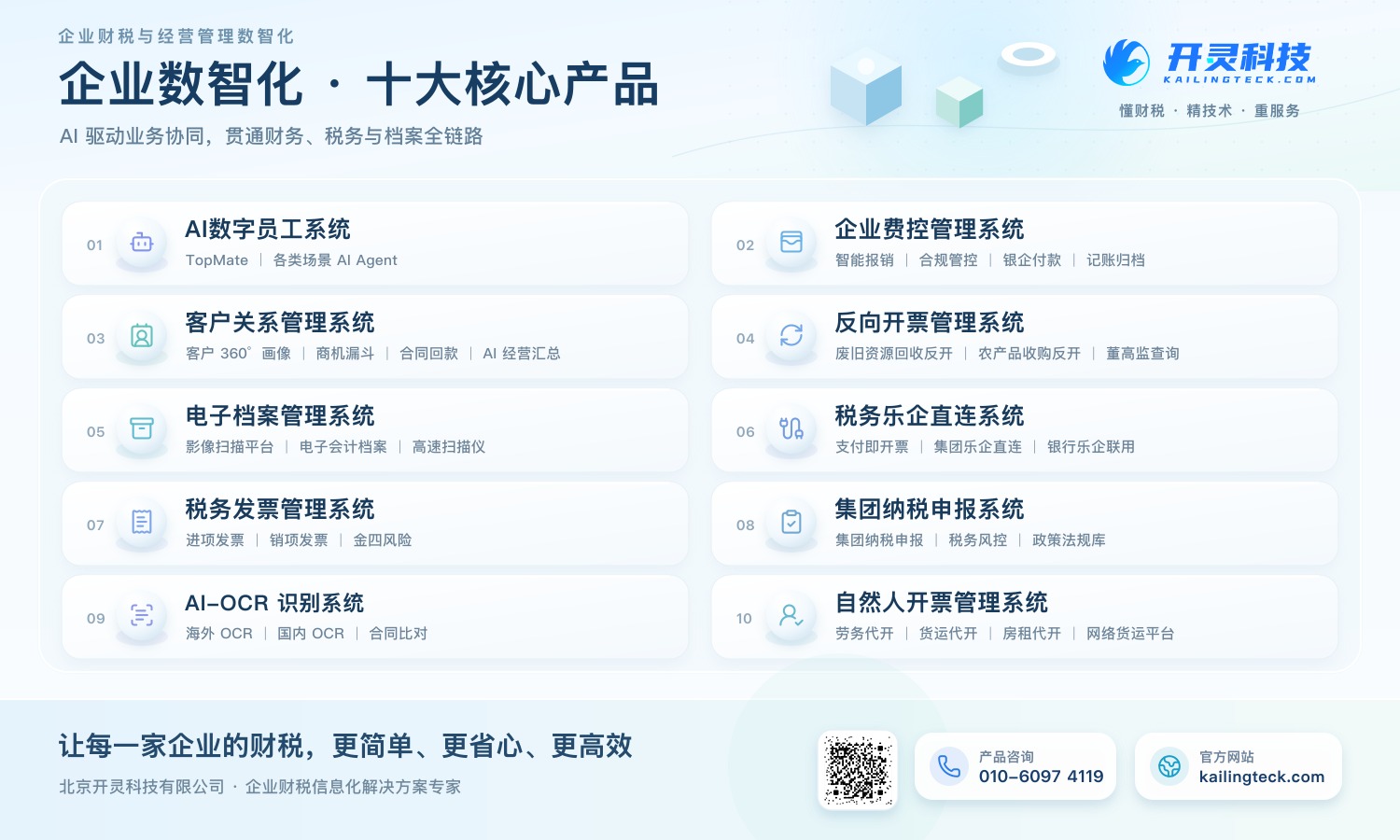
The company has now formed ten core product lines, including: AI digital employee system, enterprise expense control management system, customer relationship management system, reverse invoicing management system, invoice issuance for individuals management system, electronic archives management system, tax fully digitalized e-invoice Leqi system, tax invoice management system, group tax filing system, and AI OCR recognition system. It is committed to connecting enterprise business, finance, tax, funds, and archive data to help customers improve operational efficiency, business-finance-tax compliance capabilities, and digital management levels.
If you have any business-finance-tax digital transformation needs, welcome to contact us. Beijing Kailing Technology will serve you wholeheartedly.
Keywords: Gas station payment-based invoicing, gas station transaction-based invoicing, refined oil transaction-based invoicing policy, gas station Leqi combined use, Kailing Technology Leqi combined-use payment-based invoicing solution, gas station fully digitalized e-invoice
As a comprehensive business-finance-tax digitalization solution service provider, Kailing Technology provides business-finance-tax management digital transformation products and operational services for various government agencies, institutions, and large, medium, and small enterprises. The product line includes: solutions for sales contract management system, procurement contract management system, fully digitalized Leqi interface project, automatic output invoicing system, reverse invoicing system, invoice issuance for individuals system, employee expense control and reimbursement system, input VAT invoice management system, supply chain collaborative reconciliation system, image AI OCR recognition system, automatic financial bookkeeping system, electronic accounting archives system, etc., comprehensively driving the digitalization process across various fields.
Consultation Hotline: 18513895936 / 010-60974119 Location: Beijing