
What capabilities should an electronic accounting archives platform in the AI era have? Kailing Technology's AI Electronic Accounting Archives Management System explained in one article

Electronic accounting archive systems are no longer new, but in the AI era, finance leaders' expectations of them have changed: they are no longer satisfied with "storing files," but want materials to come in automatically, be linked correctly automatically, be retrieved with a single sentence, and compliance checks that do not need manual monitoring. Kailing Technology's AI electronic accounting archive management system answers with six capabilities: multi-source automatic collection, automatic evidence chain association, AI recognition of paper documents, conversational archive retrieval and full-text search, automatic compliance detection, and open and extensible interface capabilities, all running under private deployment. This article explains item by item what problem each capability solves and how to judge whether a platform truly has it.

▍Why electronic accounting archives platforms in the AI era need a new set of standards
The standard changes for electronic accounting archives platforms in the AI era stem from two realities: first, policy has made clear that electronic accounting archives can be archived under the single-set system; second, enterprises' accounting data sources are becoming more numerous and more fragmented.
At the policy level, the Measures for the Management of Accounting Archives (Order No. 79 of the Ministry of Finance and the National Archives Administration) explicitly provides that electronic accounting materials meeting the conditions may be archived in electronic form only; the Notice on Standardizing the Reimbursement, Booking, and Archiving of Electronic Accounting Vouchers (Cai Kuai [2020] No. 6) requires that source files be retained simultaneously when reimbursing and booking with electronic vouchers; the Ministry of Finance is also advancing the pilot and promotion of accounting data standards for electronic vouchers (Cai Kuai [2023] No. 7, Cai Kuai [2025] No. 9). At the material level, fully digitalized e-invoices, bank electronic receipts, expense control reimbursement forms, OA approval forms, and electronic contracts are scattered across different systems, and manual downloading, organizing, and binding can no longer keep up.
Against this backdrop, if an archive platform still relies on manual uploads and searching by file name, it merely moves the paper warehouse onto a server. A platform in the AI era needs to let materials flow in on their own, link up on their own, and be found by content.
▍Capability 1 and Capability 2: multi-source automatic collection and automatic evidence chain linking
The first capability is multi-source automatic collection. The archive system itself does not generate business data; the raw materials are all in business systems. Kailing Technology's AI electronic accounting archive management system directly connects to four types of sources to obtain data: the tax invoice system, collaboration and business systems, fund systems, and financial systems: invoices come from the electronic tax bureau and tax invoice platform, documents and contracts come from OA and business systems, receipts and transaction records come from banks, and vouchers and ledgers come from financial systems. Integration prioritizes the other party's open interfaces; for old systems with incomplete interfaces, a read-only account can be used to connect directly to the database; data is synchronized on a schedule, and additions, updates, and failures can be checked one by one, with automatic reminders to archivists after consecutive synchronization failures.
The second capability is automatic evidence chain association. After materials come in, the most labor-intensive task is "attaching documents to the corresponding vouchers." The system automatically attaches them according to rules: payment orders to bank receipts, reimbursement forms to invoices, signed receipt notes to outbound orders; rules are configured by document type and can be tested, enabled, and disabled. After association is completed, the business star-chain graph links accounting vouchers, original documents, invoices, receipts, reimbursement forms, and contracts into a network, and a contract with multiple payments over multiple years can also be fully tracked.
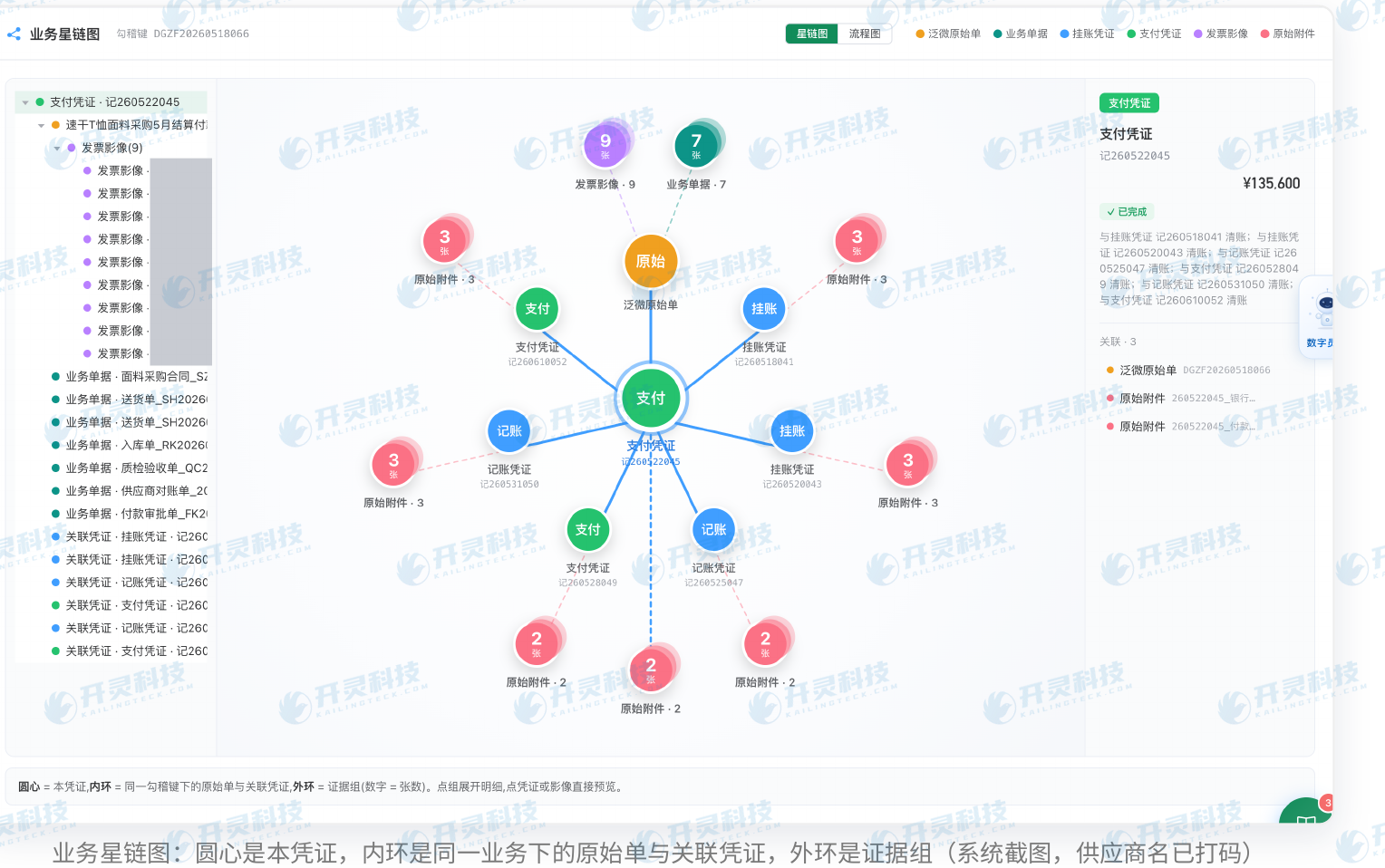
Kailing Technology business star-chain diagram: association of vouchers and evidence groups (system screenshot)
▍Capability 3 and Capability 4: AI recognition of paper documents, conversational archive retrieval and full-text search
The third capability is AI recognition of paper documents. Even with a high degree of digitalization, enterprises still have paper documents: historical vouchers, hand-signed delivery notes, overseas invoices, and customs documents. Kailing Technology's AI electronic accounting archive management system deploys AI OCR recognition privately within the enterprise intranet; after scanning, paper documents are recognized and routed, and attached to the corresponding vouchers to become formal archives, with data not leaving the intranet; the recognition scope covers domestic invoices, overseas invoices, customs documents, bank receipts, and various business documents, and supports enterprise-customized training models.
The fourth capability is conversational archive retrieval and full-text search. Traditional archive systems have dozens of menus and require layer-by-layer clicking, and auditors and tax personnel often need an archivist to accompany them to search. The system embeds a digital employee into the archive platform, allowing archive retrieval and evidence requests to be completed in one sentence, for example, "help me retrieve all payment vouchers for a certain contract," "are the invoice and receipt for this voucher complete," "which vouchers are still missing attachments"; AI full-text search searches by content, not by file name. Every step is permission-controlled and traceable, and what AI provides is search results and association relationships, not black-box judgments.
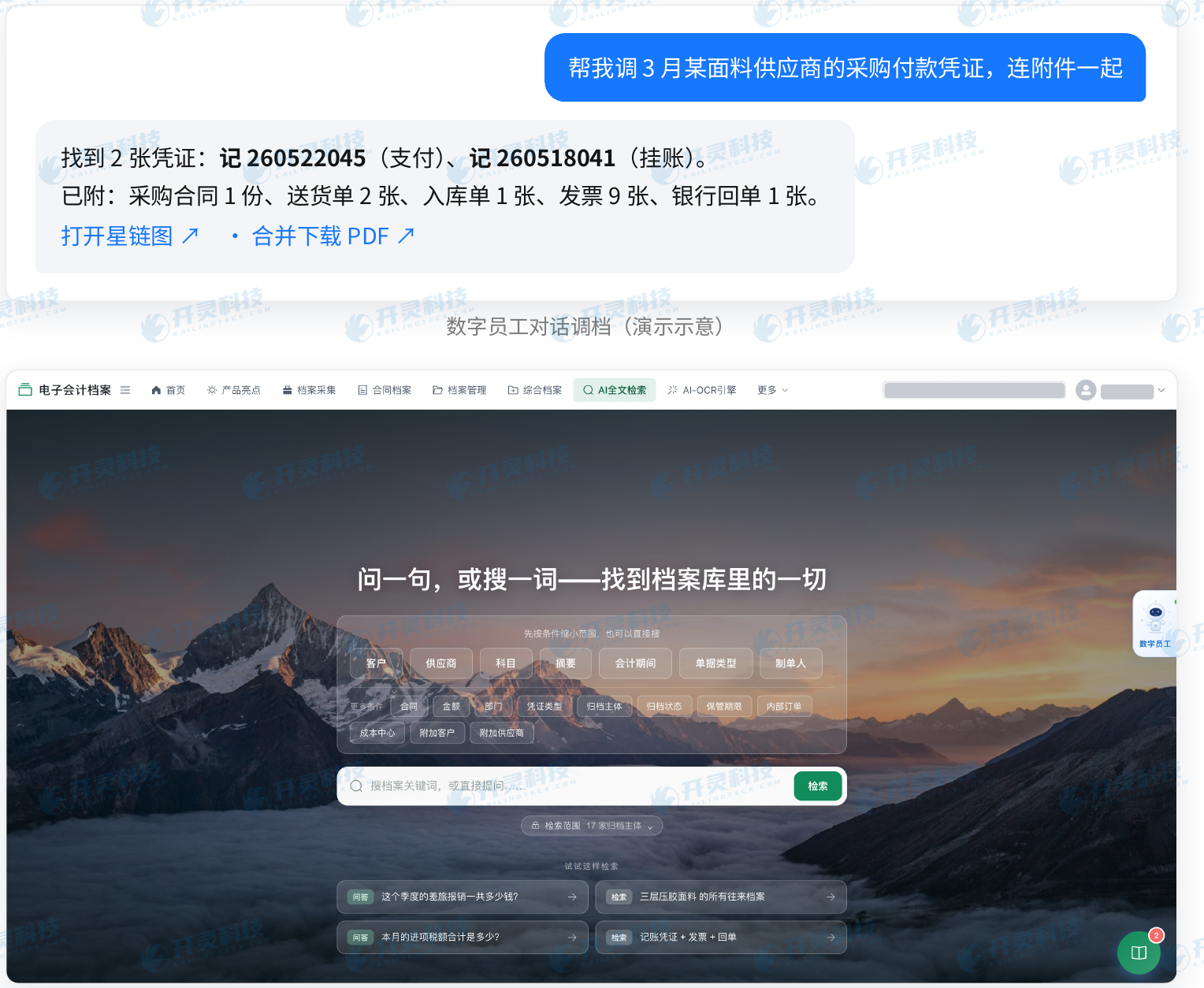
Kailing Technology digital employee dialogue-based archive retrieval and full-text search (demo data)
▍Capability 5 and Capability 6: automatic compliance detection and open extensibility
The fifth capability is automatic compliance detection. For electronic archives to be usable as vouchers, they must withstand the "four-property detection" of authenticity, integrity, usability, and security. The system continuously detects by batch: verifies whether anything has been altered using SHA-256 fingerprint storage, checks item by item whether metadata, attachments, and signatures are complete, converts to long-term preservation formats such as PDF/A to ensure they can still be opened years later, and ensures security through permissions, encryption, multiple copies, and operation traces; each anomaly clearly states "what it is and how to handle it." Retention periods are automatically calculated according to the Measures for the Administration of Accounting Archives; upon expiration, reminders and appraisal come first, with no automatic deletion, and destruction requires multi-party countersignature.
The sixth capability is open extension. Enterprise systems change, and whenever a new business system is launched, reintegration is needed, which is the most common additional cost of archive projects. The system's AI universal interface supports protocols such as database intermediate tables, data views, FTP/SFTP, WebService, and HTTP (JSON); when connecting a new system, paste the other party's interface documentation and AI generates the integration code; when adding a new type of document, business personnel can archive it by visually configuring the directory, fields, and layout.
The table below compares the six capabilities with traditional archive systems.
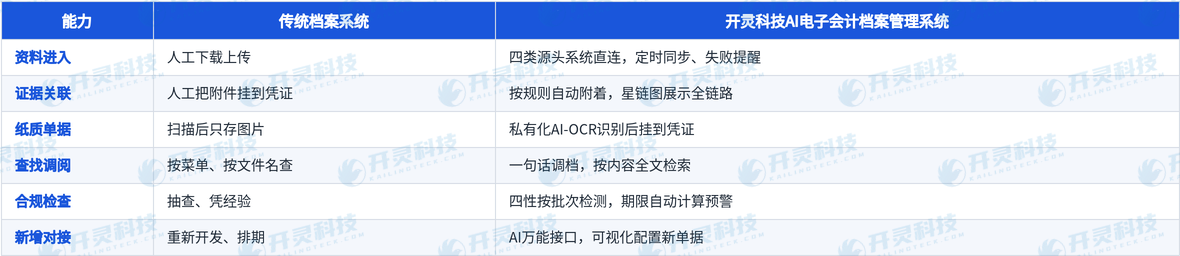
Comparison of six capabilities of electronic accounting archives platforms in the AI era
The comparison results show that the difference among platforms in the AI era is not "whether they can store" but whether the four links of material entry, association, retrieval, and compliance checking have broken free from reliance on manual work.
▍Boundaries and security of AI capabilities: which scenarios require disabling cloud AI
More AI capabilities are not necessarily better; they need to be considered together with data security. Accounting archives are among an enterprise's most sensitive data. Kailing Technology's AI Electronic Accounting Archives Management System is deployed privately in the customer's own data center by default, and the archive body and index do not leave the customer's environment; those with existing private cloud resources can deploy it on the customer's private cloud; for classified units with physical isolation, it can run fully offline, with AI switched to locally deployed models.
The system also provides full source code delivery, adapts to domestic operating systems, middleware, and databases, meets the Level 3 requirements of information security classified protection, and supports unified collection and data isolation across group parent, branch, subsidiary, and sub-subsidiary entities. It should be noted that the scope of full-text search, specific fields, and export permissions are subject to the actual delivered version and configuration; for classified categories, AI processing can be turned off to ensure data does not leave the network.
| “ AI makes archives fast to find and accurate to link, and private deployment keeps archives retained and securely guarded. |
▍FAQ
Q: What is the difference between an electronic accounting archives platform in the AI era and a traditional archives system?
A: The main differences lie in automatic data collection, automatic evidence linking, AI recognition of paper documents, conversational archive retrieval and full-text search, automatic four-property detection, and open extensibility, reducing reliance on manual uploading, organizing, and searching.
Q: Can electronic accounting archives no longer be printed as paper vouchers?
A: Electronic accounting data that meets the conditions of the Measures for the Management of Accounting Archives and Cai Kuai [2020] No. 6 and other provisions may be archived and retained in electronic form only; scanning paper vouchers does not automatically mean the originals can be destroyed, and this should be judged according to the provisions.
Q: Will AI full-text search transmit archive data to the external network?
A: Kailing Technology's AI Electronic Accounting Archives Management System is deployed privately by default, and the archive body and index do not leave the customer's environment; in classified scenarios it can run fully offline, with AI switched to locally deployed models or AI processing disabled.
Q: A new business system has just been launched; does the archives system need to be redeveloped?
A: Usually no redevelopment is needed. The system's universal AI interface supports multiple protocols, and pasting the other party's interface documentation is enough to generate integration code; new document types can be added through visual configuration.
For accounting archives in the AI era, if you want automatic filing, automatic linking, and one-sentence retrieval, welcome to learn about Kailing Technology's AI Electronic Accounting Archives Management System: https://www.kailingteck.com/eaa/ .
As a national high-tech enterprise, Kailing Technology focuses on the digital and intelligent transformation of enterprise business-finance-tax and operations management, providing software products, system integration, implementation and delivery, and operational services for various government agencies, institutions, group enterprises, and SMEs.
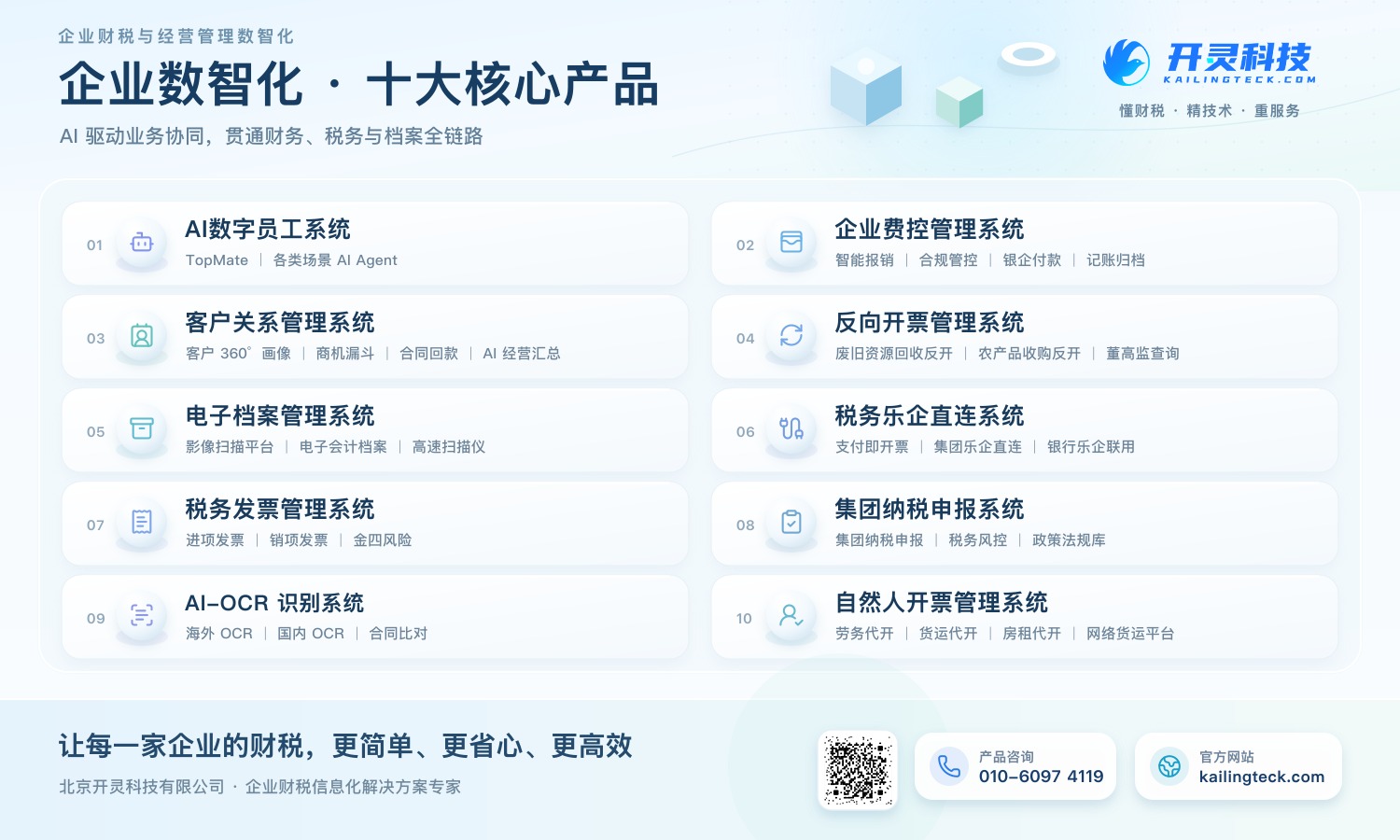
The company has now formed ten core product lines, including: AI digital employee system, enterprise expense control management system, customer relationship management system, reverse invoicing management system, invoice issuance for individuals management system, electronic archives management system, tax fully digitalized e-invoice Leqi system, tax invoice management system, group tax filing system, and AI OCR recognition system. It is committed to connecting enterprise business, finance, tax, funds, and archive data to help customers improve operational efficiency, business-finance-tax compliance capabilities, and digital management levels.
If you have any business-finance-tax digital transformation needs, welcome to contact us. Beijing Kailing Technology will serve you wholeheartedly.
Keywords: AI electronic accounting archives, electronic accounting archives platform, intelligent archiving, AI full-text search, four-property detection, Kailing Technology AI Electronic Accounting Archives Management System, single-set archiving
As a comprehensive business-finance-tax digitalization solution service provider, Kailing Technology provides business-finance-tax management digital transformation products and operational services for various government agencies, institutions, and large, medium, and small enterprises. The product line includes: solutions for sales contract management system, procurement contract management system, fully digitalized Leqi interface project, automatic output invoicing system, reverse invoicing system, invoice issuance for individuals system, employee expense control and reimbursement system, input VAT invoice management system, supply chain collaborative reconciliation system, image AI OCR recognition system, automatic financial bookkeeping system, electronic accounting archives system, etc., comprehensively driving the digitalization process across various fields.
Consultation Hotline: 18513895936 / 010-60974119 Location: Beijing