
What materials should electronic accounting archives archive? Kailing Technology's electronic accounting archive management system uniformly manages vouchers, books, reports, and electronic invoices
With more and more electronic invoices, many enterprises understand "electronic accounting archives" as an invoice folder. The actual archiving scope also includes vouchers, books, financial accounting reports, and other accounting materials. Kailing Technology's electronic accounting archive management system receives and organizes these materials by category, and associates original evidence such as invoices and receipts with booking results.

▍Vouchers are not just images of bookkeeping vouchers
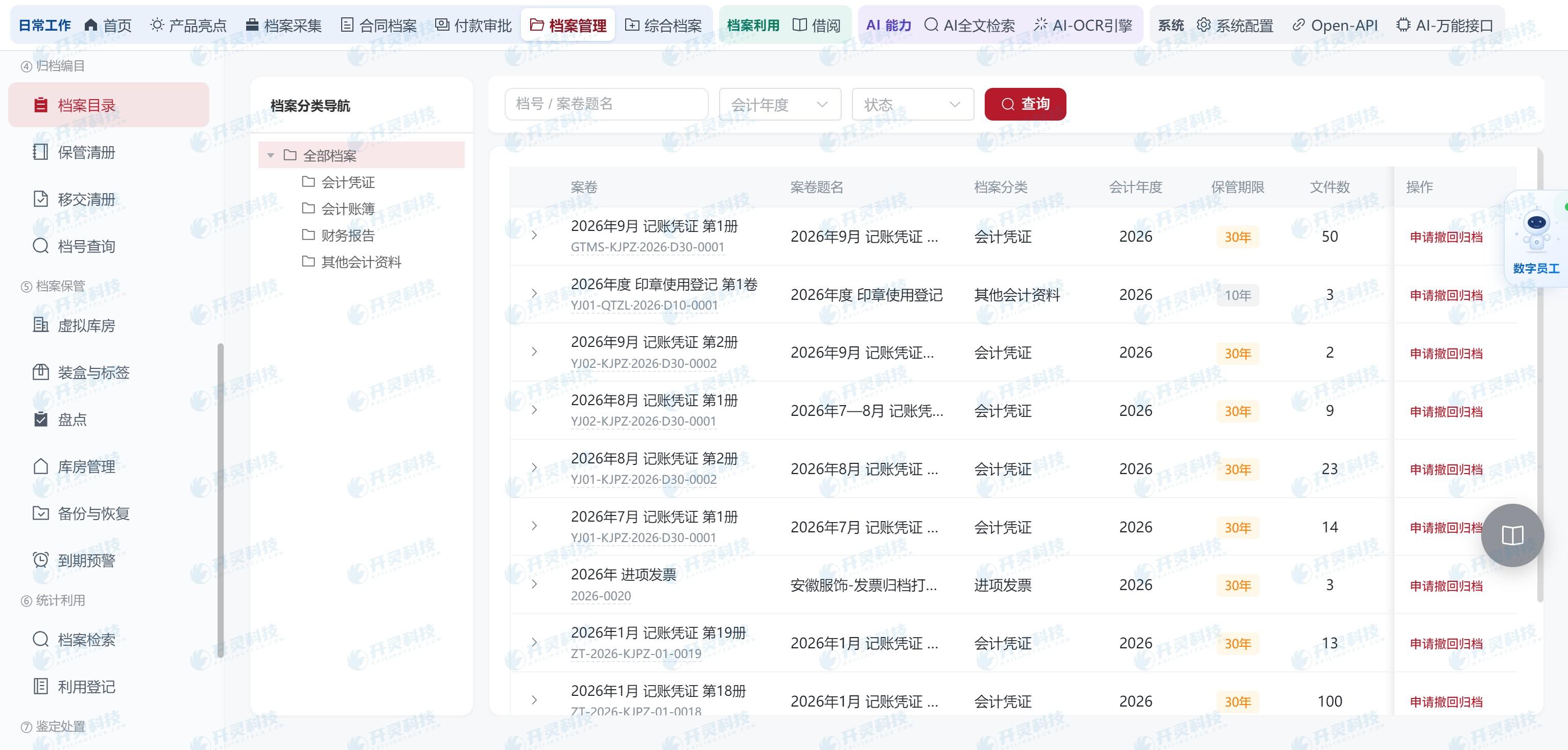
The Measures for the Management of Accounting Archives (Order No. 79 of the Ministry of Finance and the National Archives Administration) include accounting vouchers in the scope of accounting archives. When archiving, enterprises should consider original vouchers, bookkeeping vouchers and their related attachments, and retain voucher numbers, dates, organizations and business numbers. E-invoices, as materials related to original vouchers, should be linked to bookkeeping records.
Invoices, reimbursement forms, and payment receipts may be created in different systems, and the archive system needs to receive the actual files and link them by business order number. Saving only a voucher cover makes it difficult to explain the basis for bookkeeping later.
▍Ledgers and reports have their own organization standards
Accounting ledgers include general ledgers, subsidiary ledgers, journals, and other applicable materials; financial accounting reports include monthly, quarterly, and annual statements and related materials. Enterprises should organize them by fiscal year, organization, account set, and category, and retain creation and approval information. Archiving ledgers and reports is not completed by saving a screenshot of the ERP interface.
The Kailing Technology system can receive ledgers and reports from financial systems and include them in the archive directory together with vouchers and original attachments. Retention periods for each type of material are determined according to the appendix to Order No. 79 and the enterprise's applicable rules, and should not all be set to the same number of years.
▍Include other materials according to actual business
Accounting archives also include bank deposit balance reconciliation statements, bank statements, accounting archive transfer registers, custody registers, destruction registers, appraisal opinions, and other materials that should be retained. Enterprises can list their own archive inventory based on business and policies, then specify which system or department provides each item.
The electronic accounting archive management system manages receipt, organization, custody, and use by category. Only after the data scope is determined do supplementary document rules have a basis: if a payment voucher lacks a bank receipt, the specific missing item should be indicated rather than vaguely saying the attachment is insufficient.
▍E-invoices require retaining the actually obtained files
According to Caihui [2020] No. 6 and other regulations, using electronic accounting vouchers for reimbursement, booking, and archiving should meet the corresponding conditions and properly retain the electronic vouchers. Formats such as PDF, OFD, and XML should be managed according to actual acquisition circumstances and business requirements; printouts cannot be treated as the only archive, and it should not be assumed that every invoice has all three files at the same time.
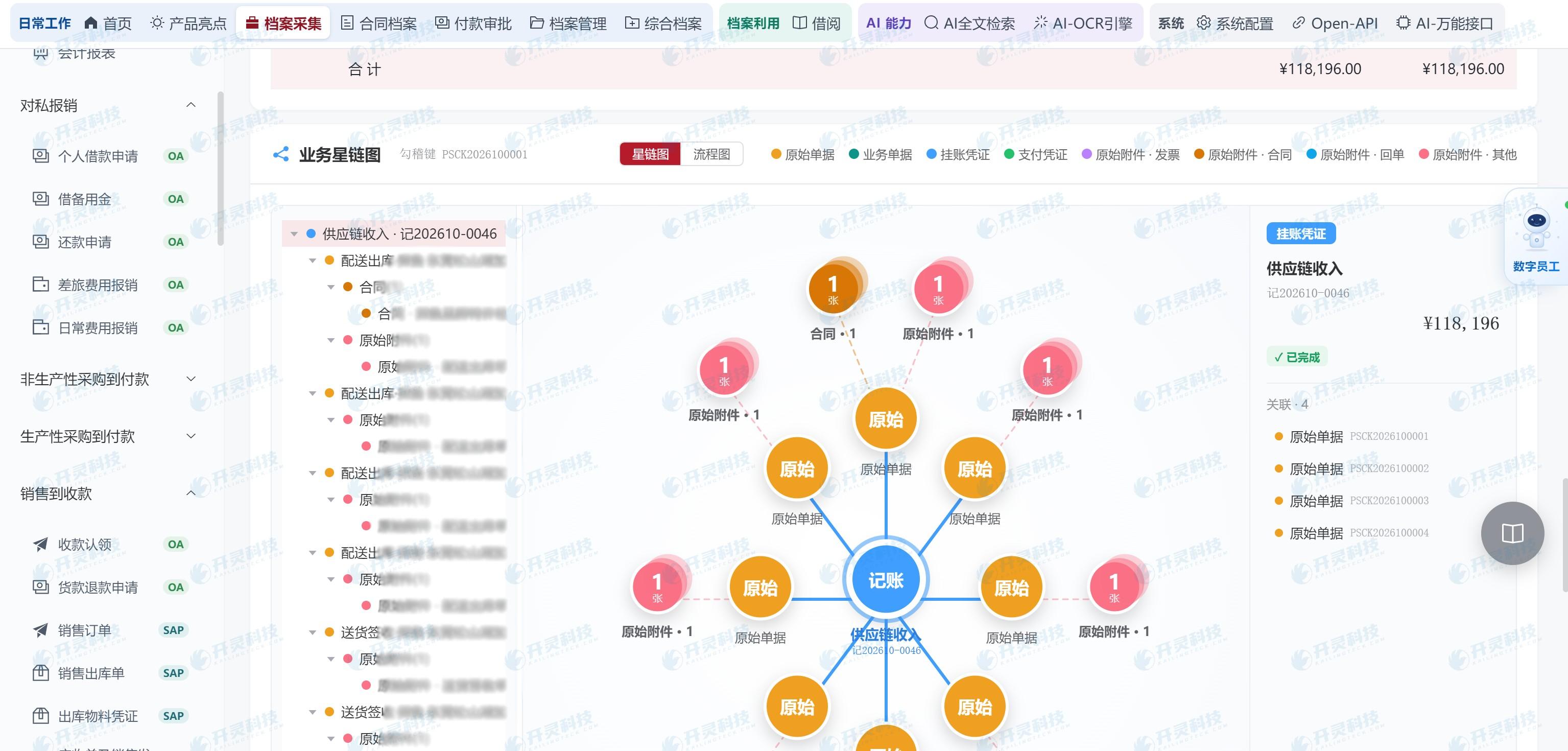
The Kailing Technology system links electronic invoices with reimbursement, vouchers, and payment materials. When red-flushing or reissuance occurs, it retains the relationship between the original and subsequent invoices to help finance explain accounting adjustments.
▍Check archiving coverage with a checklist
First list upstream systems, file types, responsible persons, transfer points, and retention periods by "vouchers, ledgers, reports, other materials," then sample each category. Check whether a voucher has its original invoice and receipt, and whether a report can be traced to the corresponding period and organization.
The Kailing Technology electronic accounting archive management system places different categories in a unified directory while retaining their respective archive numbers and management rules. Enterprises can thus shift from "how many files are stored" to "whether the required materials are filed on time and can be retrieved."
▍How the archiving checklist is assigned to responsible persons
After listing vouchers, ledgers, reports, and other accounting materials, designate the upstream system, creating position, transfer cycle, and archivist for each category. Invoices, receipts, contract attachments, and similar items also need to be linked to the relevant business order or voucher.
The same type of material may have different formats in different companies or account sets, and the inventory should describe them separately. The Kailing Technology system receives by category, so only a missing-item list can accurately indicate the specific materials for a given organization and period.
For businesses with both paper and electronic records, register the storage location of paper copies and their relationship to electronic files, and do not treat scans directly as permission to destroy originals.
▍Configure periods and numbers by category
The retention periods for accounting vouchers, ledgers, reports, statements, and various registers may differ. The system configures rules such as permanent, 10 years, and 30 years according to the applicable appendix and enterprise policies, then forms archive numbers by year, organization, and category.
Expiry reminders are used to initiate appraisal, and materials with unfinished matters should be retained beyond expiry as required. Enterprises should not ignore retention periods and disposal procedures just because "electronic files are easy to copy."
Archive numbers and catalogs enable long-term locating of materials, while business associations enable invoices, receipts, and vouchers to be accessed together; the two management approaches complement each other.
▍Sampling checks can reveal missed categories
Many enterprises archive invoices and vouchers first, but forget account books, reports, bank statements, or archive transfer registers. You can extract a data checklist by year and check whether each category is received, can be opened, and can be accessed according to permissions.
If certain types of materials have not yet been digitized, the retention method and responsible persons should also be specified in the policy. The system can expand the receiving scope in stages, ensuring that numbering, detection, and retention periods are accurate for the categories already connected.
The Kailing Technology electronic accounting archive management system provides a unified directory and linked management, moving enterprises from a single invoice folder to complete accounting material management.
▍Check the archiving scope from the business flow
One procurement payment can generate a contract, acceptance, invoice, payment receipt and bookkeeping voucher; an accounting period also produces ledgers and reports. Sorting materials by business flow helps reveal problems such as archiving only invoices and missing receipts, or archiving only vouchers and missing reports.
Enterprises can specify in the archive list the system in which files were created, retention period, receipt time, and archive category, and label paper and electronic materials separately. Electronic files should also be checked for format and readability, while paper originals are kept according to their applicable requirements.
After annual archiving is completed, finance and archivists sample by tracing invoices from vouchers, periods from ledgers, and organizations from reports. Missing categories enter a supplementary filing plan; do not look only at the total number of files in the system.
The Kailing Technology electronic accounting archive management system places vouchers, ledgers, reports, and electronic invoices into a unified management path while allowing separate organization, retrieval, and use according to the rules for each type of material.
▍Common archiving omissions
Enterprises often fully retain fully digitalized e-invoices but forget the bank receipt for the same payment; or they retain accounting vouchers but fail to export the ledgers and reports for the corresponding period.
Annual checks can trace back from the archive inventory to upstream systems, then forward from several actual transactions to archives. Both directions can reveal missing categories and incorrect links.
After materials are completed, necessary detection, organization, and numbering are performed again so that the archive catalog reflects the true archiving status.
Once the checklist is determined, it should be updated as accounting systems, business systems, and invoice forms change. When adding a new type of electronic voucher, first confirm how the original file is obtained, which business number it is associated with, which archive category it belongs to, and how long it is retained, and then connect it to the archiving process. Conduct regular spot checks after archiving.
▍FAQ
Q: Are e-invoices the entirety of electronic accounting archives?
A: No. It also includes vouchers, ledgers, financial accounting reports and other applicable materials.
Q: Are all accounting archives kept for 30 years?
A: No. It is determined specifically by material category and applicable provisions such as the appendix to Order No. 79.
Q: Is it acceptable to keep only printed copies of invoices?
A: Retention of electronic vouchers should meet the corresponding provisions; printouts cannot replace electronic files that should be retained.
Visit Kailing Technology to learn about related products and implementation plans: https://www.kailingteck.com/eaa/ .
As a national high-tech enterprise, Kailing Technology focuses on the digital and intelligent transformation of enterprise business-finance-tax and operations management, providing software products, system integration, implementation and delivery, and operational services for various government agencies, institutions, group enterprises, and SMEs.
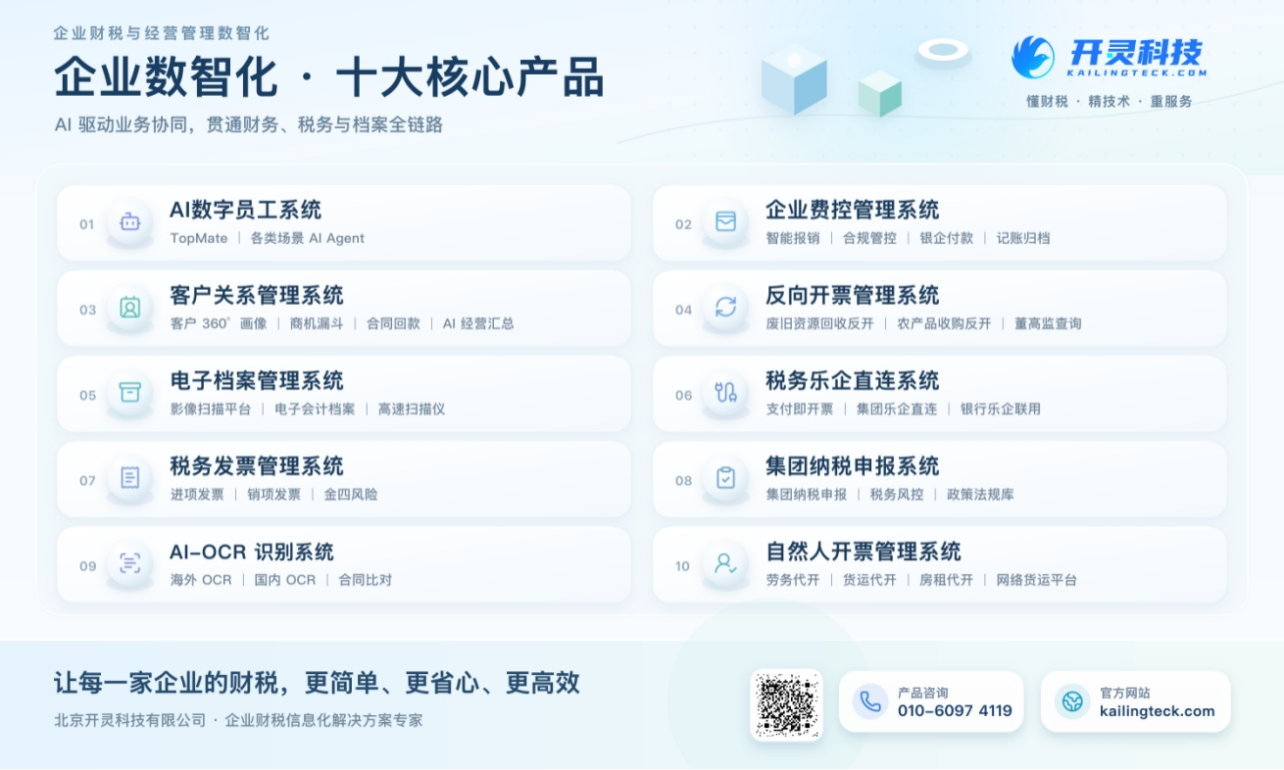
The company has now formed ten core product lines, including: AI digital employee system, enterprise expense control management system, customer relationship management system, reverse invoicing management system, invoice issuance for individuals management system, electronic archives management system, tax fully digitalized e-invoice Leqi system, tax invoice management system, group tax filing system, and AI OCR recognition system. It is committed to connecting enterprise business, finance, tax, funds, and archive data to help customers improve operational efficiency, business-finance-tax compliance capabilities, and digital management levels.
If you have any business-finance-tax digital transformation needs, welcome to contact us. Beijing Kailing Technology will serve you wholeheartedly.
Keywords: Electronic accounting archive scope, accounting vouchers, books, and reports, electronic invoice archiving, Kailing Technology
As a comprehensive business-finance-tax digitalization solution service provider, Kailing Technology provides business-finance-tax management digital transformation products and operational services for various government agencies, institutions, and large, medium, and small enterprises. The product line includes: solutions for sales contract management system, procurement contract management system, fully digitalized Leqi interface project, automatic output invoicing system, reverse invoicing system, invoice issuance for individuals system, employee expense control and reimbursement system, input VAT invoice management system, supply chain collaborative reconciliation system, image AI OCR recognition system, automatic financial bookkeeping system, electronic accounting archives system, etc., comprehensively driving the digitalization process across various fields.
Consultation Hotline: 18513895936 / 010-60974119 Location: Beijing