
Boss needs data but has to wait for finance to dig through reports for ages? Kailing Technology's AI digital employee answers data queries in one sentence and automatically generates daily business reports
"What exactly was the gross profit of the East China region last month? Did it rise or fall compared with the same period last year?" The boss casually asked at the meeting table, but the finance colleague frowned first — behind this question lies the need to log into the ERP to pull sales details, switch to the financial system to match costs, and then import them into a spreadsheet to check the standards line by line, taking half a day at best and two days at worst. By the time the report is done, the boss has already moved on to the next agenda item, and the decision window has quietly slipped by. Such scenes are repeated in enterprises almost every day: to get one number, you have to wait for finance to dig through reports for half a day.
And after using Kailing Technology's AI digital employee Afterward, the same sentence brought back a chart popping up on the phone dozens of seconds later: East China's gross profit for last month, year-on-year and month-on-month changes, and achievement progress were clear at a glance, and it even marked which product line was dragging it down. The boss asks one question, the digital employee answers with a screen—this is Kailing Technology's AI digital employee Changes to bring:For data, from "waiting for reports" to "asking a question"。
| "For data, from "waiting for reports" to "asking a question"—hand the work of finding numbers, piecing together tables, and calculating accounts to digital employees; people are only responsible for reviewing conclusions and making judgments. |
|---|
▍Can calculate, can observe, can judge: what an analysis-and-decision AI digital employee can actually do
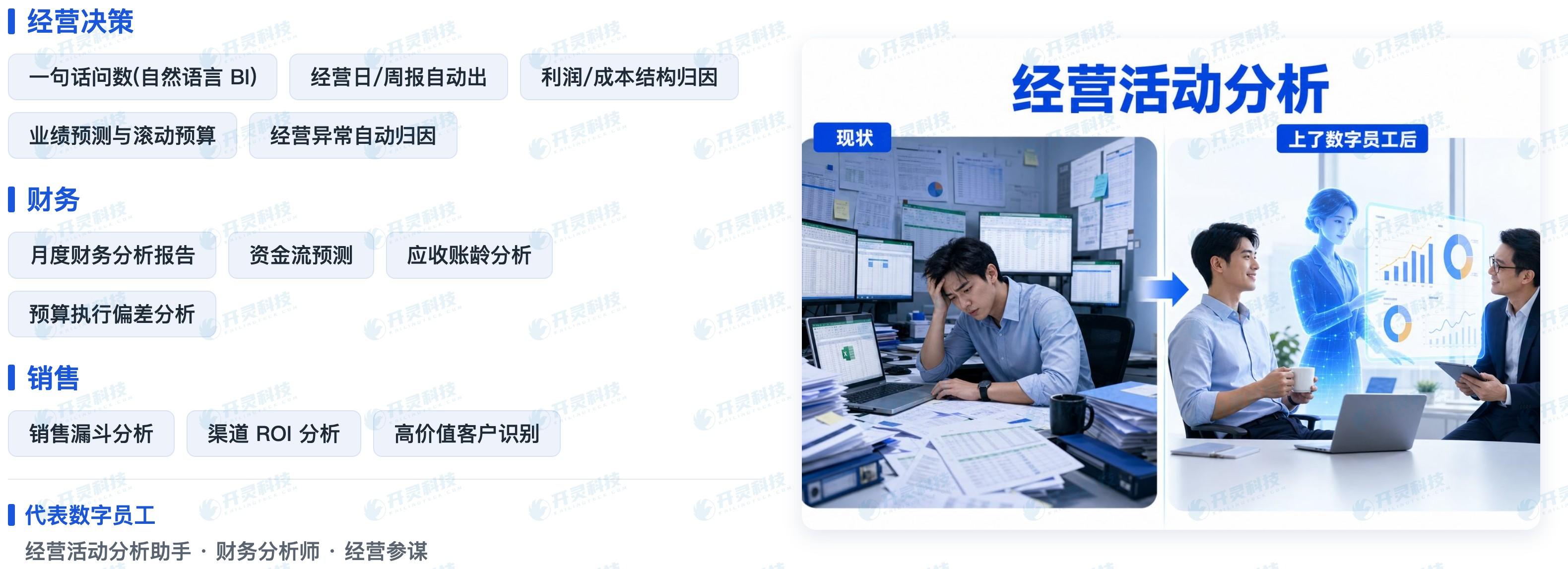
Among Kailing's nine major job types, this type of role belongs to the "analytical decision-making type" — it is not just a Q&A chatbot that can only chat, but an "AI analyst" that can retrieve data, calculate indicators, perform attribution, make predictions, and give suggestions. In business scenarios, it can at least do four things for you:
Natural language BI · Ask data in one sentence: No need to remember report numbers or know how to write SQL. Just state the question in plain language, and the digital employee can understand the intent, find the data with the corresponding definition and give an answer.
Automatic generation of daily and weekly business reports: Every morning or before work starts on Monday, automatically compile yesterday's/last week's core indicators such as revenue, collections, gross margin, and expenses into an illustrated brief and push it to relevant people's phones on schedule.
Profit and cost attribution: When indicators rise or fall, it not only gives the conclusion but drills down one level to tell you which region, product line, customer type or cost account is at play.
Performance forecasting and rolling budgets: Combining historical trends and orders in hand, provide trend extrapolation and budget deviation alerts, so business meetings can look not only at "the past" but also at "where we are heading."
Unlike the old Q&A robots that "only answer one sentence," analytical decision-making digital employees deliver complete analysis results rather than a vague reply. If you ask "why did expenses exceed the budget this month," it will not just reply "expenses rose," but lay out the overspent accounts, the departments where they occurred, and the extent of the budget overrun; when necessary, it can also quickly chart the trend over these months. In other words, it takes on the daily responsibilities of an analyst role, not just a query button in some software.
▍Behind numbers produced in tens of seconds: automatic data retrieval + metric calculation + attribution in three steps
Many people are curious: how can one sentence become a daily business report? The key is that Kailing Technology AI digital employees break down actions that used to take half a day manually into an automatically executable pipeline.
The first step is to understand the question. The large model parses colloquial expressions such as "last month's East China gross margin compared with the same period last year" into clear data retrieval criteria — the time range is last month, the object is the East China region, the metric is gross margin, and the comparison method is year-on-year. The second step is cross-system data retrieval. According to the obtained criteria, the AI digital employee automatically extracts raw data from multiple systems such as ERP, finance, and business, no longer relying on people to log in back and forth and copy-paste into Excel. The third step is to calculate metrics and attribute causes: calculate amounts, proportions, year-on-year and month-on-month changes, and target achievement rates according to unified criteria, then automatically break them down to locate which dimension the fluctuation comes from. Finally, conclusions and charts are compiled into a daily or weekly business report and pushed on schedule.

It is worth emphasizing that the "cross-system" capability here is not picky: Kailing AI digital employees not only handle systems developed in-house, but can also connect to and retrieve data from enterprises' existing business systems built by others. Not a single line of code in the original systems needs to be changed; the AI digital employee operates within the permission boundaries of a person to operate these systems and retrieve the data that should be retrieved—data does not leave its domain, and standards remain unified.

▍Digital employees produce the numbers, people make the call: save your energy for judgment
It should be clarified that making AI digital employees "able to calculate and judge" does not mean handing over decision-making power. Kailing adheres to "human-in-the-loop": standardized, repetitive finding of data, assembling tables, and calculating accounts are handed to AI digital employees, while real decisions such as reviewing conclusions, making trade-offs, and taking responsibility are always left to real people. What AI digital employees provide is a "decision draft" with unified calibers and traceable sources at any time, on top of which managers can more quickly judge whether to increase investment or contract, and which business segments need review.
In this way, finance and analysts are also liberated: they no longer need to spend 80% of their time pulling data and piecing together tables, but can instead work on more valuable things such as metric definition design, business reviews, and business accompaniment. For enterprises, asking questions of data in one sentence brings not only speed, but also lets data truly become embedded in daily decision-making—view it when you want, get answers whenever you ask, rather than waiting for the belated report at month-end. More importantly, when the threshold for obtaining data drops to “just being able to speak,” frontline business leaders also dare to use it and are willing to use it, and every link of operations can be illuminated by data.
From "waiting for reports" to "asking a question," what changes is how the entire organization obtains data. When every manager and every business meeting can ask at any time and get an immediate answer, Kailing Technology's AI digital employee turns BI from a tool in the hands of a few into a daily capability available to everyone.
▍FAQ
Q: Do I need to know how to write SQL or understand reporting tools for one-sentence data queries?
A: No. Simply explain the question in everyday language, for example, "last month's East China gross margin compared with the same period last year." The digital employee will automatically understand the standard, retrieve data, and provide conclusions, without needing to remember report numbers or write code.
Q: Data comes from several systems, including systems not built by you. Can it be retrieved?
A: Yes. Kailing Technology AI digital employees can retrieve data across multiple enterprise systems and connect to business systems not developed in-house as well. Original systems require no modification. Digital employees retrieve data within authorized permission boundaries, and data does not leave the domain.
Q: Are the metrics in the automatically generated daily business report accurate, and can they be traced?
A: Metrics are calculated according to the enterprise's unified criteria. Every step of data retrieval and processing has a trail, and conclusions can be traced back to the original data source, avoiding deviations caused by inconsistent criteria and facilitating review.
Q: Will it make decisions for us?
A: No. Digital employees are responsible for retrieving complete data, calculating correctly, and attributing causes, producing a "decision draft"; viewing conclusions, making judgments, and bearing responsibility are always done by real people, with key nodes confirmed by humans, in line with the human-in-the-loop principle.
Q: How long does go-live take, and do existing systems need major changes?
A: Standard analysis scenarios can usually enter trial operation in 1 to 2 weeks, using non-intrusive access, with zero-code modification of existing ERP, financial, and business systems, and gradually expanding the data query scope according to position needs.
Want the boss to ask one question and the digital employee to answer a whole screen? Learn how Kailing Technology AI digital employee helps you turn "waiting for reports" into "asking one question": www.kailingteck.com .
As a comprehensive business-finance-tax digitalization solution service provider, Kailing Technology provides business-finance-tax management digital transformation products and operational services for various government agencies, institutions, and large, medium, and small enterprises. The product line includes:
Solutions for businesses including sales contract management system, procurement contract management system, fully digitalized Leqi interface project, output automatic invoicing system, reverse invoicing system, invoice issuance for individuals system, employee expense control and reimbursement system, input VAT invoice management system, supply chain collaborative reconciliation system, image OCR recognition system, automatic financial bookkeeping system, and electronic accounting archives system, comprehensively driving the digitalization process across various fields.
If you have any business-finance-tax digital transformation needs, welcome to contact us. Beijing Kailing Technology will serve you wholeheartedly.
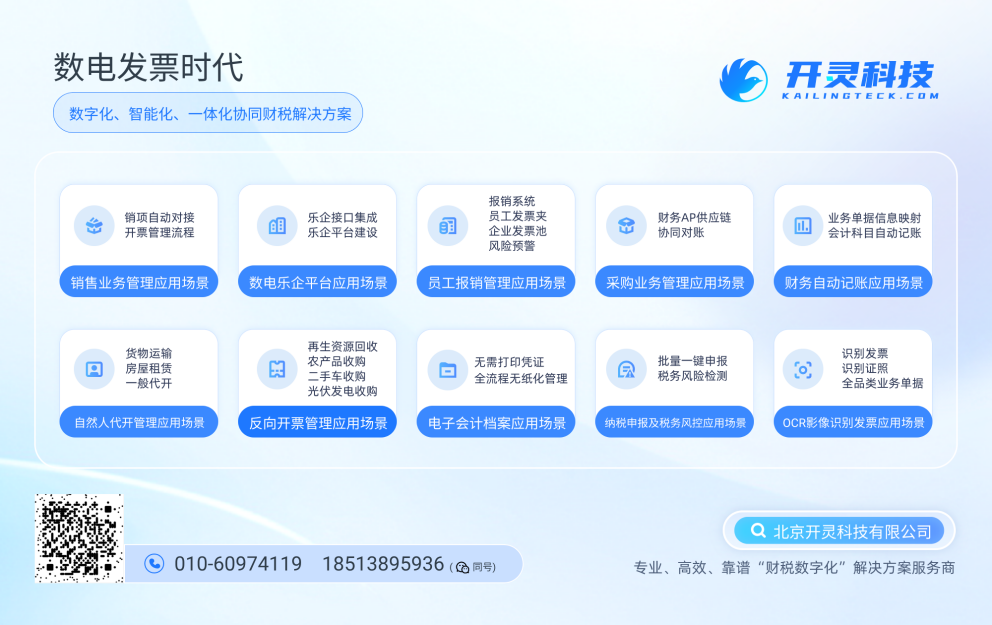
As a comprehensive business-finance-tax digitalization solution service provider, Kailing Technology provides business-finance-tax management digital transformation products and operational services for various government agencies, institutions, and large, medium, and small enterprises. The product line includes: solutions for sales contract management system, procurement contract management system, fully digitalized Leqi interface project, automatic output invoicing system, reverse invoicing system, invoice issuance for individuals system, employee expense control and reimbursement system, input VAT invoice management system, supply chain collaborative reconciliation system, image AI OCR recognition system, automatic financial bookkeeping system, electronic accounting archives system, etc., comprehensively driving the digitalization process across various fields.
Consultation Hotline: 18513895936 / 010-60974119 Location: Beijing