
After scrap copper is purchased, it still needs to be sorted and sold. How can the original purchase order be traced to outbound? The Kailing Technology resource recycling reverse invoicing system associates five-flow evidence with inventory whereabouts
Completion of reverse invoicing when scrap copper enters the plant only shows that the purchasing stage has invoices. When it is subsequently sorted into different grades, transferred to the raw material warehouse, and then shipped against customer orders, the enterprise still needs to answer: which purchase orders did this batch of copper material sold come from? The Kailing Technology resource recycling reverse invoicing system connects the five-flow archives and inventory flow, giving this tracking chain a reliable starting point.

▍The original purchase order is the starting point for tracking
A truck of scrap copper may contain copper wire, copper pipes, and mixed materials. On site, first create a purchase order recording the actual seller, vehicle trip, weighing, grade inspection, goods photos, and final settlement; payment receipts and reverse invoices are then linked back to the same number. This gives a clear starting point when checking raw materials, rather than leaving only an invoice and a weight summary.
For reweighing, impurity deductions, or material returns, retain the before and after quantities and confirmation records. The quantity entering inventory is based on the confirmed actual inbound result, and the invoice amount is based on the corresponding settlement. If there is a reasonable difference between the two, the system records the adjustment reason and responsible person, so subsequent outbound records do not mistake weights under different bases for lost goods.
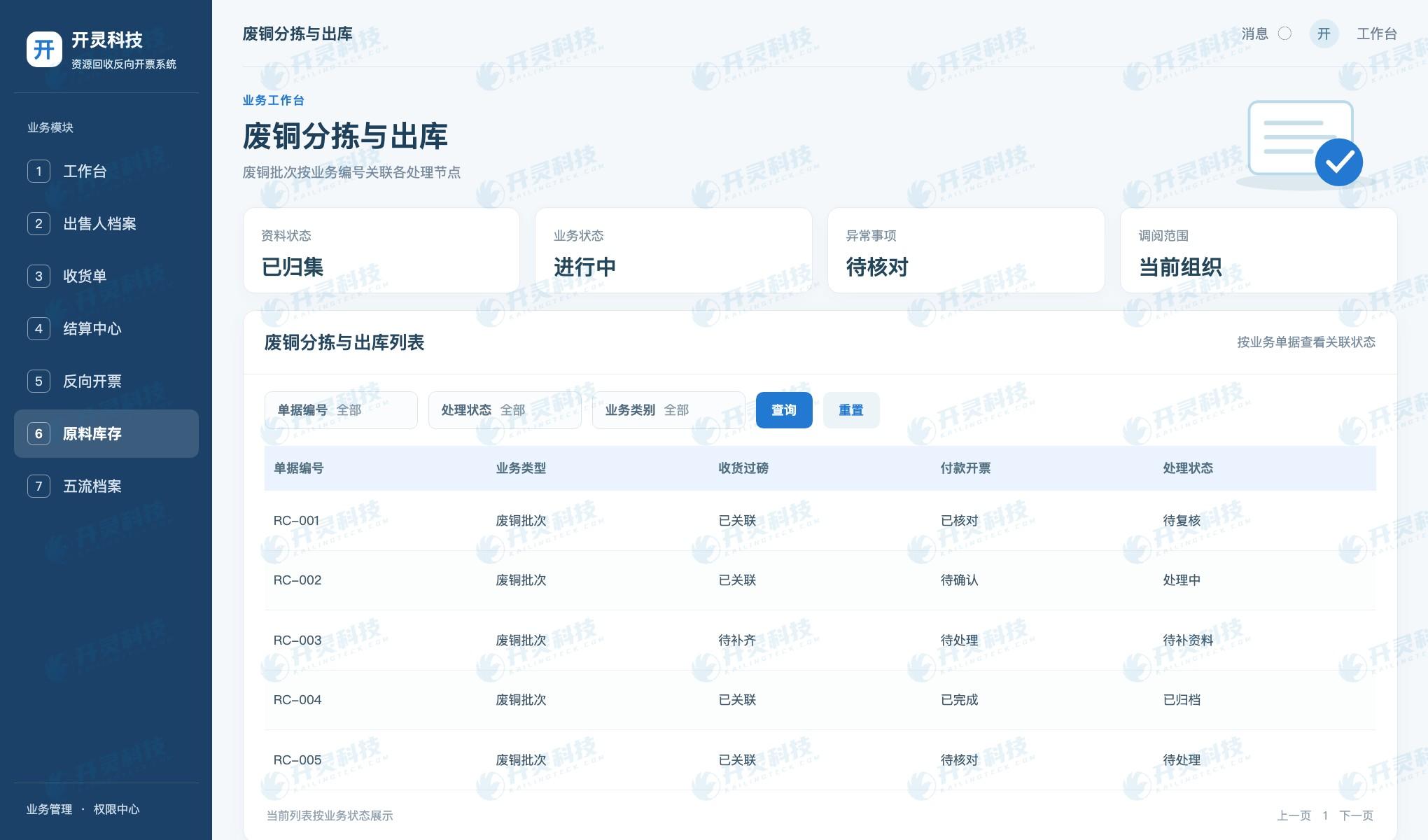
Scrap copper sorting and outbound business list
▍Establish relationships between raw materials and finished products after sorting
Scrap copper sorting is not about modifying the name on the original purchase order. Raw material batches enter sorting tasks and produce inventory batches of different grades, recording conversion relationships along with losses, impurities, and pending residual materials. When finance traces back from a finished product batch, it can see which inbound batches it contains and can also return to the seller and invoice/payment materials of each batch.
If multiple purchase batches are merged for sorting, the allocation basis between input and output quantities must be retained; if one batch of raw materials is split into multiple products, their destinations must be recorded separately. Enterprises can configure batch granularity according to actual warehousing and measurement rules; the key is that quantities before and after conversion are explainable, and the original source must not be lost after renaming.
▍Outbound orders continue to reference inventory flows
Sales outbound records should state the product grade, quantity, warehouse, material requisition or sales order number, and deduct the corresponding inventory. The system tracks batches by inbound time and inventory rules, enabling the sales side to review raw material composition from the outbound order. Returns, warehouse transfers, and inventory gains or losses each retain their own transaction records, avoiding masking multiple business changes with a single manual adjustment.
A sales invoice belongs to a subsequent output transaction and cannot be mixed with a reverse invoice from an individual seller as one document. The two types of documents are business-linked through goods batches, but each corresponds to different transaction parties, amounts, and tax treatment. Clarifying the boundary prevents document mismatches in inventory tracking.
▍Five-flow archives and inventory cross-check each other
The Kailing Technology platform collects identity, contract or confirmation, goods, funds, and invoice materials by purchase order, then associates them with inbound batches. When checking a reverse invoice, it is possible to see whether the corresponding scrap copper was warehoused, which batch it is in after sorting, and its current inventory or outbound status; when checking an outbound order, it is also possible to return level by level to the purchase record.
If goods have been shipped out but the original purchase order lacks a payment receipt, the exception should not disappear automatically just because inventory sales are completed. The five-flow evidence side continues to show the pending node, while the warehouse side retains the actual flow. Finance and warehouse staff see different responsibility items for the same batch of goods.
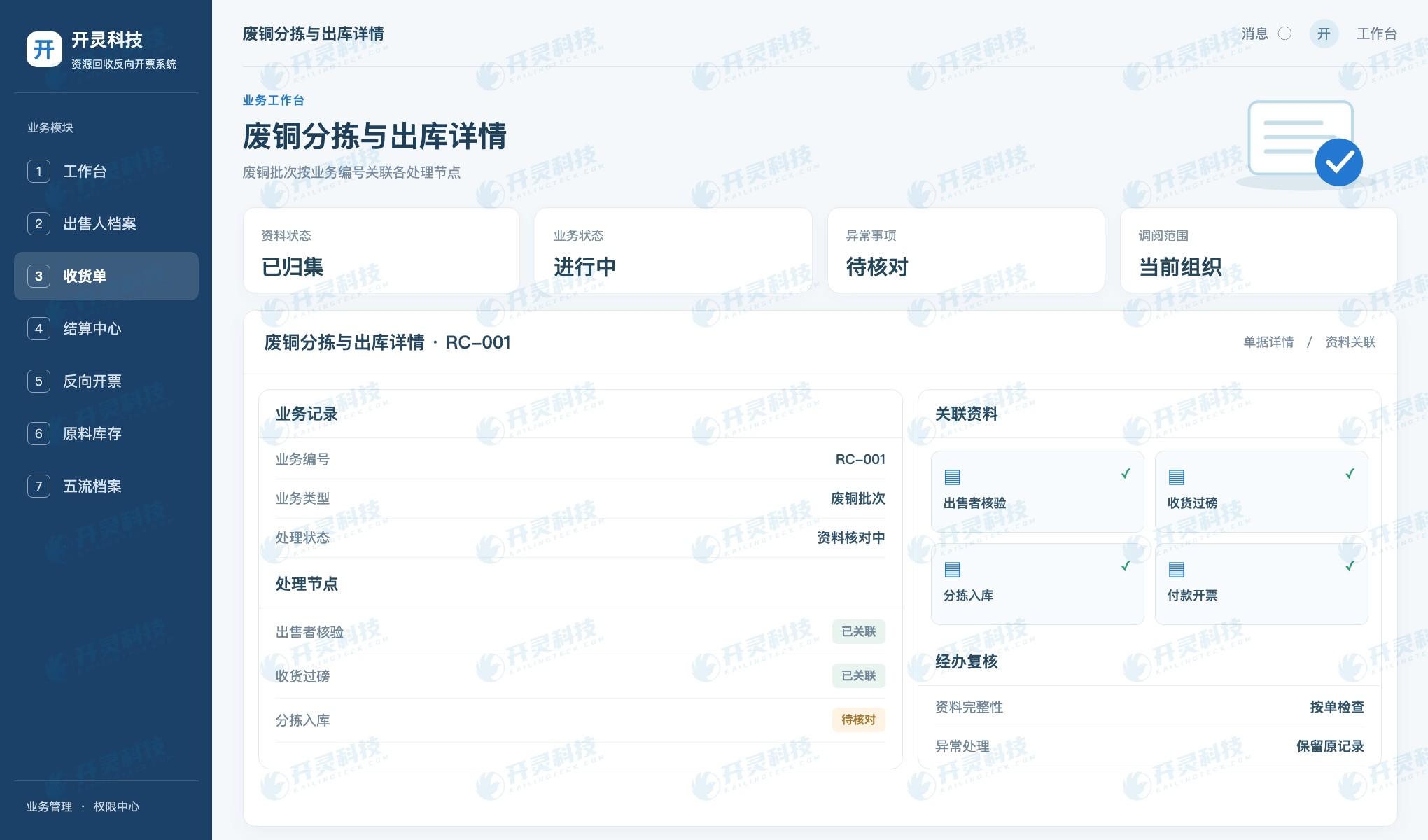
Scrap copper sorting and outbound documents and materials association
▍Test the traceability chain with three exceptions
Implementation acceptance can select three samples: one vehicle with multiple grades, two vehicles combined for sorting, and sales returns. Have personnel who did not participate in the original business independently trace back from the sales outbound order to inbound and purchase archives, check input, output, loss, and invoice/payment; then trace forward from the original purchase order to all subsequent batches.
If only a total raw material quantity can be found but the origin of a particular sales batch cannot be explained, batch mapping and inventory rules should be supplemented; if quantities match but the five-flow materials are missing, the evidence gap should be addressed first. Tracking quality depends on retaining business documents at every conversion.
▍Month-end reconciliation looks at two lines
One line reconciles settlement, payment, and reverse invoices by purchase order; the other reconciles inbound, sorting, outbound, and balance by inventory batch. The two lines intersect at the inbound node, but their reconciliation objects differ. Kailing Technology's solution preserves the intersection point, helping enterprises find records of "goods without orders," "invoices without goods," and unexplained quantity changes.
For frequent acquisition enterprises, spot checks do not require re-downloading all attachments. Finance enters Xinglian from the exception order, and the warehouse keeper enters the batch from the inventory discrepancy, collaborating on the same number. This facilitates business statistics and also gives original transactions a verifiable whereabouts.
▍How numbers continue from purchase to sales
A purchase batch may go through sorting, processing, warehouse transfer, and sales. During implementation, determine the parent number and child number for each business document: sorting tasks reference inbound batches, product inbound references sorting tasks, and outbound orders reference product batches. In this way, even when batches change name and form, the original procurement relationship can still be traced back along the numbers.
When a single product batch mixes multiple raw material sources, the enterprise must decide whether to allocate quantities by actual input, first-in-first-out, or another confirmed rule. Once a rule is used for the inventory ledger, it must also apply to material returns and stocktaking; choosing an algorithm temporarily only when an audit arrives cannot stably explain costs and whereabouts.
After scrap copper is sold, quality returns may still occur. Returned goods entering the warehouse cannot directly restore the original scrap copper purchase quantity; instead, sales returns, re-inspection, and re-warehousing must be recorded. The original purchase order remains the source, and each subsequent transfer is explained through new business documents.
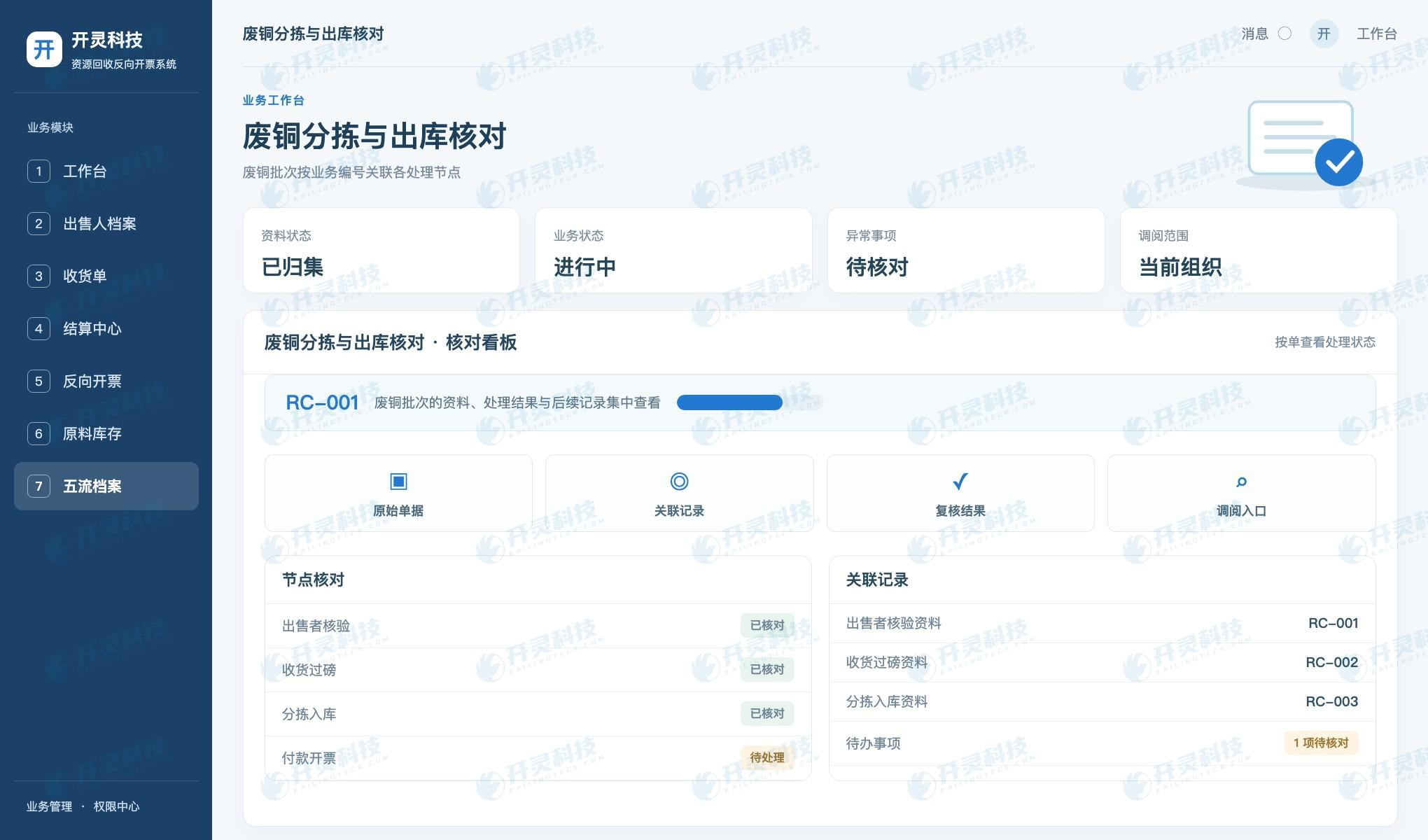
Scrap copper sorting and outbound node verification
▍Which exceptions finance and warehouse review together
Finance focuses on paid without invoice, differences between invoice amount and settlement, and missing seller information; the warehouse focuses on mismatches between inbound and sorting inputs, abnormal output, negative inventory, and outbound records that cannot locate batches. The two roles' checklists connect at purchase inbound.
For example, if scrap copper has been sold but the associated purchase payment is returned by the bank, the warehouse does not need to change the real outbound record, while finance needs to handle the fund exception and retain the process. Only by displaying the two statuses separately can both the goods facts and the pending invoice/payment items be reflected.
Month-end spot checks can trace back from a sold batch to all raw material purchase orders, then randomly select a purchase order to see its remaining inventory and sales whereabouts. Passing both forward and reverse checks is better at detecting crossed orders than checking only one ending balance.
▍Write traceability capability into acceptance conditions
When accepting the system, enterprises can require three types of results: a purchase order can expand five-flow attachments; a finished product batch can expand raw material inputs; a sales outbound record can trace back to the original purchase source. Each type should be verified with samples of real business structures, not just a good-looking overview chart.
If inventory needs to connect with an external ERP, agree in advance on material codes, warehouses, units of measure, and synchronization timing. Test the mapping first for scenarios with multiple grades per truck and returns, to avoid later reconciliation failures where one side counts by truck and the other by grade.
The Kailing Technology resource recycling reverse invoicing system places transaction evidence at the starting point of the traceability chain, on which enterprises connect procurement compliance with inventory operations. Every business change is recorded, so the original purchase facts will not disappear in subsequent processing.
▍FAQ
Q: After sorting, does the original purchase order need to be changed to the new grade?
A: Keep the original order record and use sorting tasks to record the conversion of raw materials into new grade batches.
Q: Can two purchases merged for processing still be traced back?
A: Yes, provided that input batches, output batches, and quantity allocation all retain corresponding relationships.
Q: Is the sales invoice simply a continuation of the original reverse invoice?
A: The two correspond to purchase and sales transactions respectively and should be linked through goods batches, not conflated.
Visit Kailing Technology to learn about related products and implementation plans: https://www.kailingteck.com/fxzy/ .
As a national high-tech enterprise, Kailing Technology focuses on the digital and intelligent transformation of enterprise business-finance-tax and operations management, providing software products, system integration, implementation and delivery, and operational services for various government agencies, institutions, group enterprises, and SMEs.
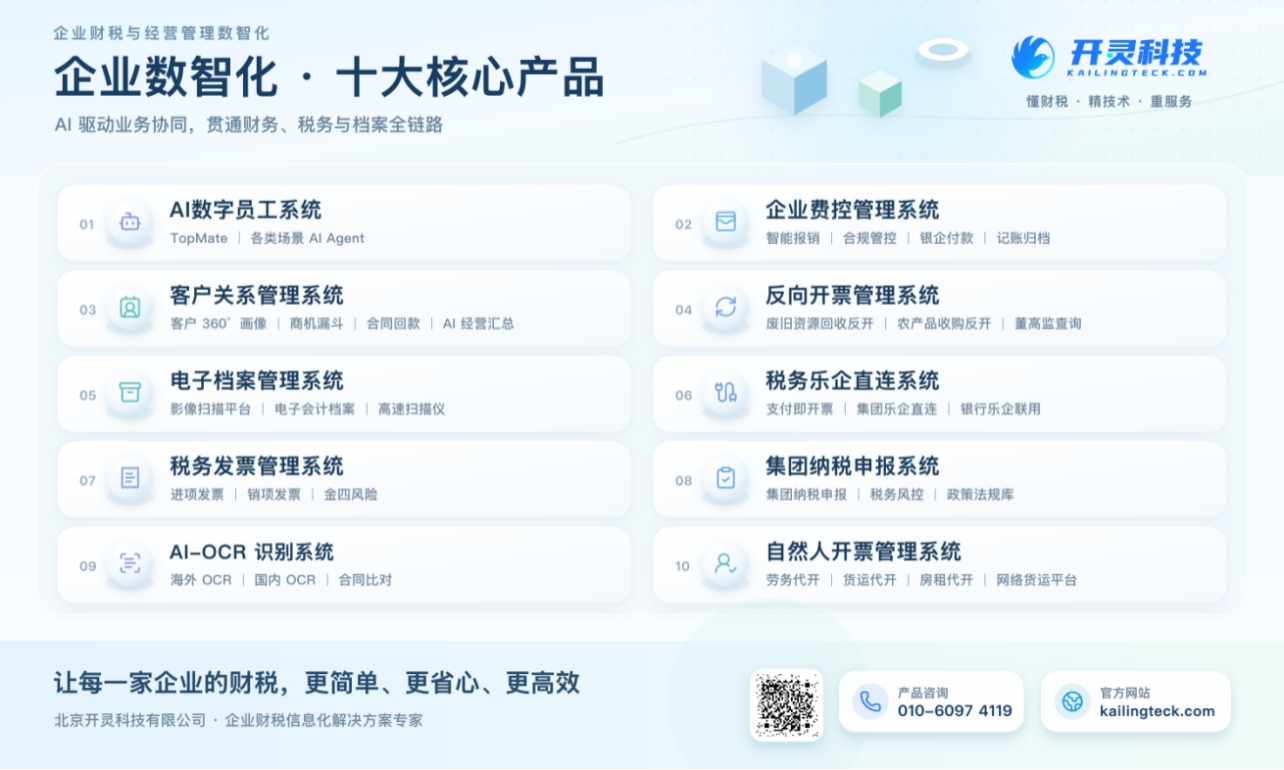
The company has now formed ten core product lines, including: AI digital employee system, enterprise expense control management system, customer relationship management system, reverse invoicing management system, invoice issuance for individuals management system, electronic archives management system, tax fully digitalized e-invoice Leqi system, tax invoice management system, group tax filing system, and AI OCR recognition system. It is committed to connecting enterprise business, finance, tax, funds, and archive data to help customers improve operational efficiency, business-finance-tax compliance capabilities, and digital management levels.
If you have any business-finance-tax digital transformation needs, welcome to contact us. Beijing Kailing Technology will serve you wholeheartedly.
Keywords: Scrap copper purchase reverse invoicing, inventory whereabouts, sorting and sales, five-flow integration, Kailing Technology
As a comprehensive business-finance-tax digitalization solution service provider, Kailing Technology provides business-finance-tax management digital transformation products and operational services for various government agencies, institutions, and large, medium, and small enterprises. The product line includes: solutions for sales contract management system, procurement contract management system, fully digitalized Leqi interface project, automatic output invoicing system, reverse invoicing system, invoice issuance for individuals system, employee expense control and reimbursement system, input VAT invoice management system, supply chain collaborative reconciliation system, image AI OCR recognition system, automatic financial bookkeeping system, electronic accounting archives system, etc., comprehensively driving the digitalization process across various fields.
Consultation Hotline: 18513895936 / 010-60974119 Location: Beijing