
Agricultural products and renewable resources involve large acquisition volumes—how do payment and reverse invoicing stay in sync? Kailing Technology's Leqi integrated pay-and-invoice solution connects uniformly to financial channels and writes results back to the acquisition order
Agricultural products and renewable resources involve large acquisition volumes—how do payment and reverse invoicing stay in sync? Kailing Technology's Leqi integrated pay-and-invoice solution connects uniformly to financial channels and writes results back to the acquisition order
During peak purchase periods, the business side confirms goods, the cashier pays in batches, and finance later looks for orders to invoice. Each party uses its own number, making it easy to find invoice-payment mismatches at month-end. Kailing Technology's Leqi integrated pay-and-invoice solution uses the purchase order as the business entry point, uniformly connects to financial channels with corresponding capabilities, and writes payment and invoicing status back to the original order.

▍First distinguish the two types of purchase business
Reverse invoicing for renewable resources and agricultural product acquisition invoices differ in entity eligibility, invoice types, and tax basis. Enterprises can reuse the "acquisition order—payment—invoice" technical chain, but cannot apply the same set of eligibility judgments to both types of business. Before integration, enterprises should separately map out the enterprise entity, natural person or farmer information, goods acceptance, invoice rules, and platform support scope.
The business side assigns a fixed order number to each transaction and saves the seller, goods, settlement amount, and confirmation status. If multiple agricultural product households share one vehicle or one recycled resource vehicle has multiple sellers, first split the actual transactions clearly, then generate payment instructions. Otherwise, even if the channel returns success, it is impossible to determine which household the money and invoice belong to.
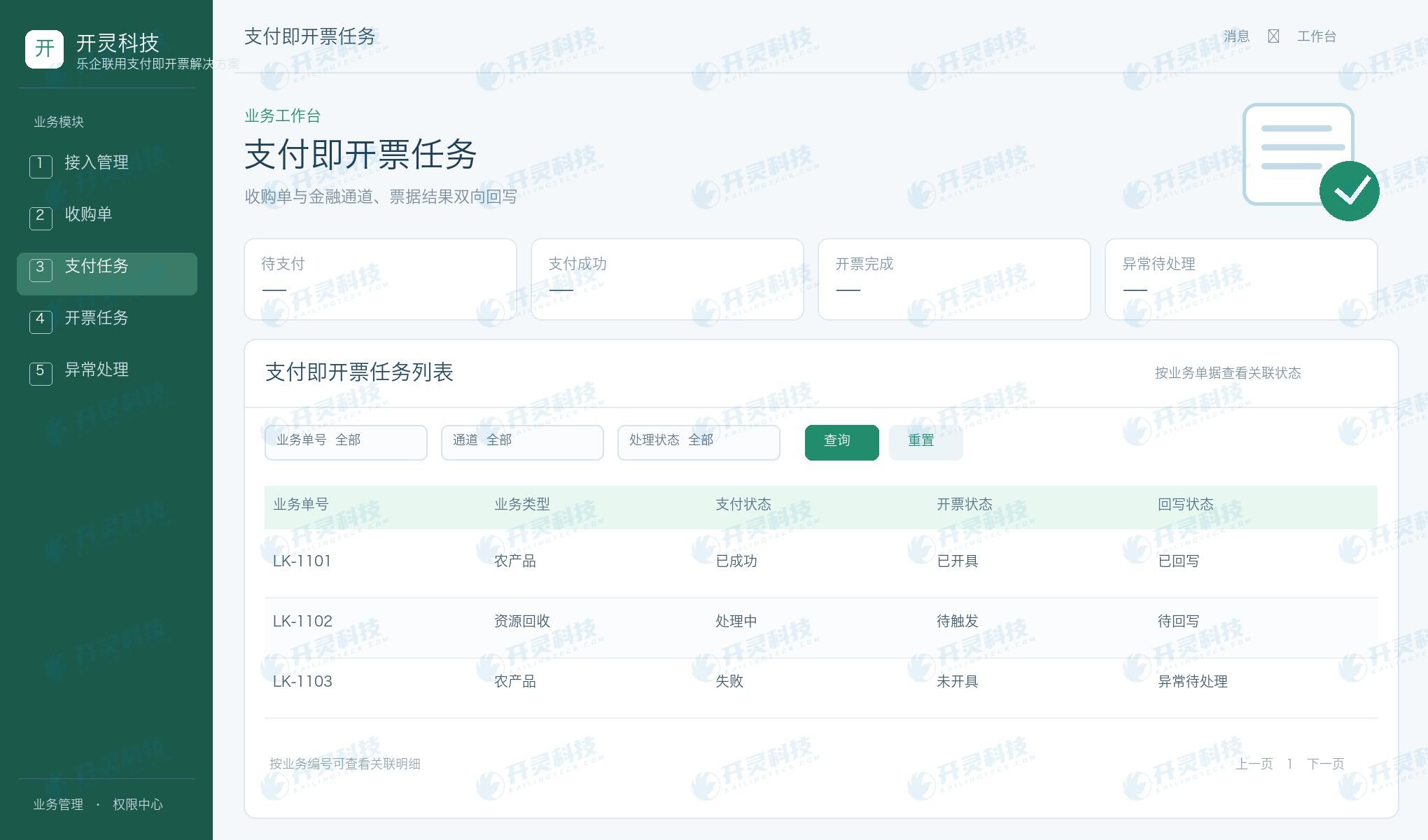
Payment and invoicing tasks write back to the purchase order
▍Financial channel integration must be able to return results
Payment instructions include the business order number, payee, amount payable and necessary verification information. The financial channel returns statuses such as acceptance number, success, failure and return, and the enterprise system aggregates by the original order number. Payment acceptance differs from actual receipt; seeing "submitted" must not trigger subsequent completion marks.
The interface also needs to handle duplicate callbacks, timeouts, and network interruptions. If the same successful result is pushed twice, the system should identify it as the same transaction to avoid duplicate invoicing or duplicate payment marking. The original request, callback time, channel transaction serial number, and manual processing records must all be retained so that finance can explain status changes during reconciliation.
▍Invoicing triggers depend on complete transaction conditions
When project integration conditions and applicable tax processes are met, a successful payment can become a trigger signal for the invoicing process. Before invoicing, the acquisition order, entity, goods, settlement, and invoice materials must still be verified. If invoice issuance fails, the system retains the paid-but-not-invoiced exception and will not mistakenly record a successful payment as a successful invoice.
Conversely, when payment fails, the linked steps that depend on successful payment should be blocked, and the handler should verify the account, amount or channel reason. The Kailing Technology solution numbers payment tasks and invoicing tasks separately, yet both point to the acquisition order, so exceptions have a clear object for handling.
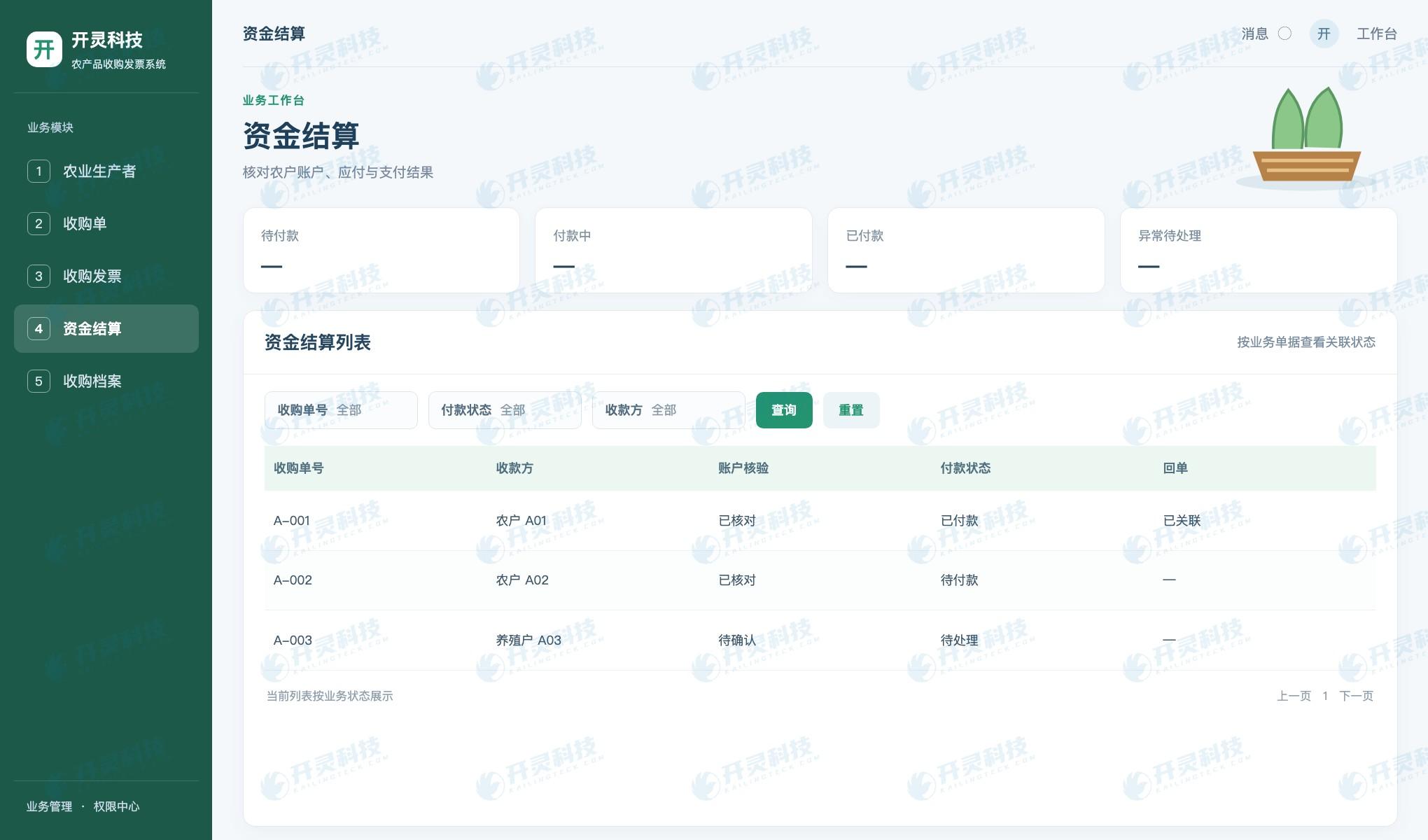
Agricultural product acquisition payment results
▍Write back to the purchase order to form two-way reconciliation
When business personnel open a purchase order, they should see the payment time, bank result, invoice number, issuance status, and reason for incompletion; finance can also enter from the invoice and find the original purchase, acceptance, and fund records. If one payment combines multiple purchase orders, the system expands the allocation details. In this way, month-end no longer relies on different departments manually piecing together Excel transaction records.
Enterprises can also summarize items such as "paid but not invoiced," "invoice processing," and "payment returned" by site or period, so responsible persons can handle them line by line. For enterprises with high business volume but few exceptions, automatically processing normal orders and highlighting the exception queue is often more practical than simply clicking a batch invoice button.
▍Accept the integration test with abnormal samples
During implementation, at least test normal payment, account mismatch, partial payment, successful payment but failed invoicing, duplicate callbacks, and cross-day status returns. Verify the number and result of the same transaction separately in the business system, channel, and invoice platform. Select samples with real business structures for both agricultural products and renewable resources to confirm that the two sets of eligibility rules are not mixed.
The rollout sequence for Kailing Technology's Leqi integrated pay-and-invoice solution is to first confirm the partner platform and financial channel capabilities, then map business fields and statuses, and finally accept with exception transactions. Enterprises thereby obtain a processing chain with less manual transcription while retaining a traceable invoice-payment trail.
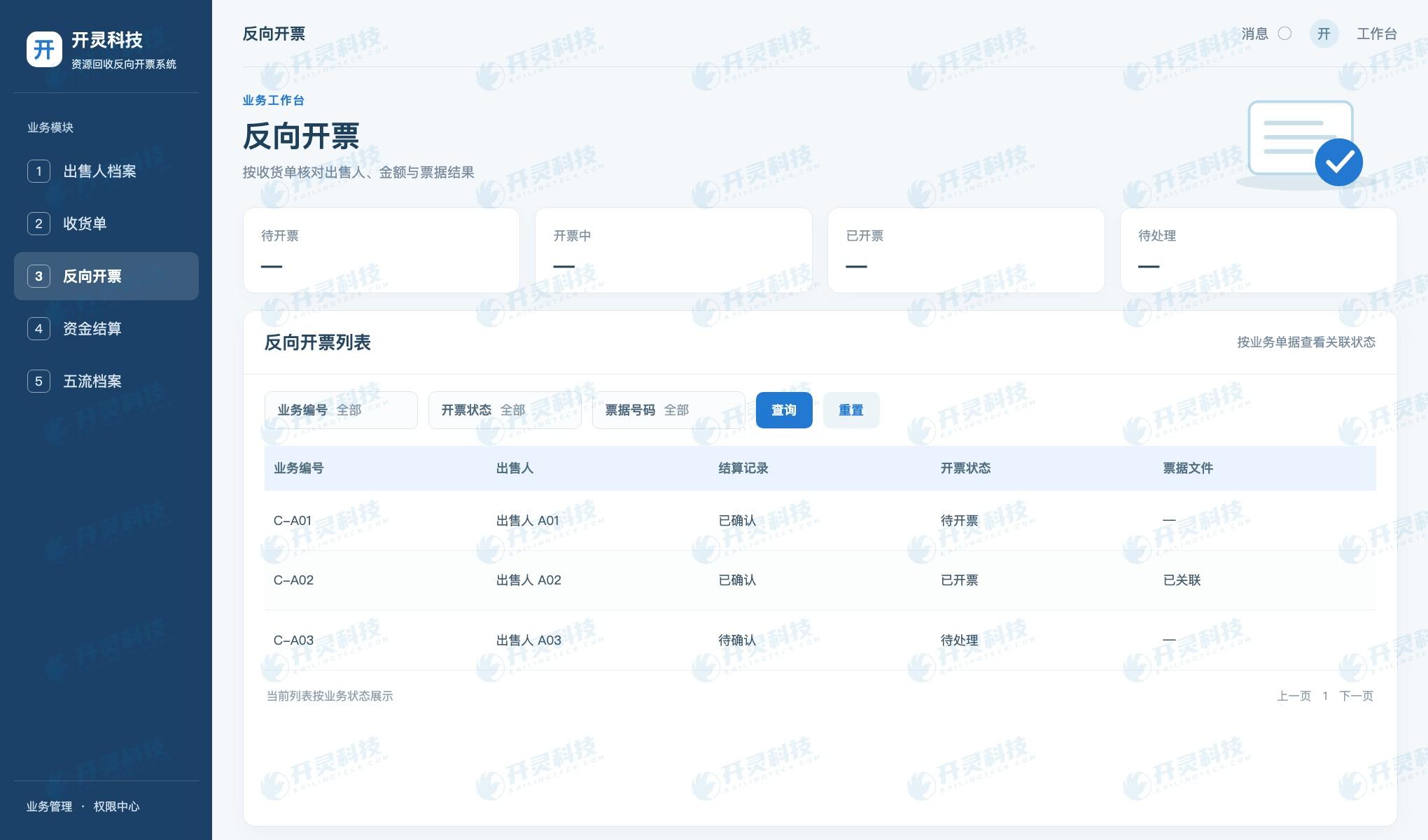
Resource recycling reverse invoicing status
▍Technical linkage must also cover end-of-day reconciliation
In the Leqi integrated solution, the financial channel, enterprise business system, and invoice platform each have their own transaction numbers. During implementation, first establish one-to-one or one-to-many mappings and clarify which number is the primary key for enterprise reconciliation. If a business order retries payment, the old and new channel transaction records should be recorded; otherwise, end-of-day reconciliation may treat the retry as two payments.
Enterprises can retrieve the bank's actual payment results at end of day and reconcile them line by line against local payment tasks. For transactions where the channel accepted the request but the bank did not ultimately succeed, the system should continue waiting or mark them as exceptions, and must not prematurely move them to invoicing-complete status. Results returned across days should be written back to the acquisition order according to actual time, retaining both the time the system received the result and the time the bank completed it.
When the account information of a natural person seller or farmer changes, instructions already generated but not yet paid should be rechecked. If the business side changes the settlement amount, the payment side and invoice side cannot continue to use the old request. The system needs to identify the acquisition order version and prevent payment results for the old amount from overwriting the new settlement.
Set up separate business validations for resource recycling and agricultural products. Resource recycling focuses on sellers of scrapped products, enterprise eligibility, and the applicable reverse invoicing process; agricultural products focus on self-produced attributes, acquisition scope, and the corresponding invoice types. Technical interfaces can be managed on the same platform, but exception reasons and review responsibilities should be presented separately.
If invoicing fails after payment succeeds, the handler first confirms whether an invoice result has already been returned, then decides whether to retry. Repeated requests may create a risk of duplicate invoices. The system records each invoicing request, platform return and manual handling to ensure that "no callback received" and "actually failed" are not confused.
Project acceptance does not look only at one normal payment. Samples should be arranged for bank returns, account name mismatches, duplicate callbacks, network interruptions, and cross-day re-posting. Business, cashier, and finance each review the same acquisition order from their own pages and confirm that the status is consistent; only then is it suitable to expand to high-frequency batch processing.
▍High-frequency business requires both batch and per-transaction handling
A purchase site may process a large number of small transactions in a day. Enterprises can batch-initiate eligible payment and invoicing tasks by site or time, but each task still retains an independent business order number, natural person or farmer, settlement amount and channel transaction record. Batch operations reduce repeated clicks; they do not merge multiple people's funds and invoices into one indivisible result.
If one task fails, the system should send only that task to the exception queue while the remaining successful documents continue to complete. The reconciliation page displays the business system amount, actual bank payment and invoice issuance result separately, and marks the reason and responsible position when amounts or statuses are inconsistent. In this way, even high-frequency processing can be traced task by task.
Managers also need to observe whether failure reasons are concentrated in account information, channel timeouts or invoice rules. Targeted correction of front-end collection and interface processing is more effective than having finance repeatedly click failed tasks every day.
▍FAQ
Q: Does successful payment mean the invoice has definitely been issued?
A: No. Payment and invoicing each have their own results; when invoicing fails, keep the paid-but-not-invoiced status and handle it.
Q: Can agricultural products and renewable resources share one set of tax rules?
A: No. The technical linkage can be reused, but subject eligibility and invoice basis must be configured separately.
Q: How can duplicate invoicing be avoided when the channel sends duplicate callbacks?
A: Identify the same event by business order number and channel transaction number, and retain the original request and processing records.
Visit Kailing Technology to learn about related products and implementation plans:www.kailingteck.com 。
As a national high-tech enterprise, Kailing Technology focuses on the digital and intelligent transformation of enterprise business-finance-tax and operations management, providing software products, system integration, implementation and delivery, and operational services for various government agencies, institutions, group enterprises, and SMEs.
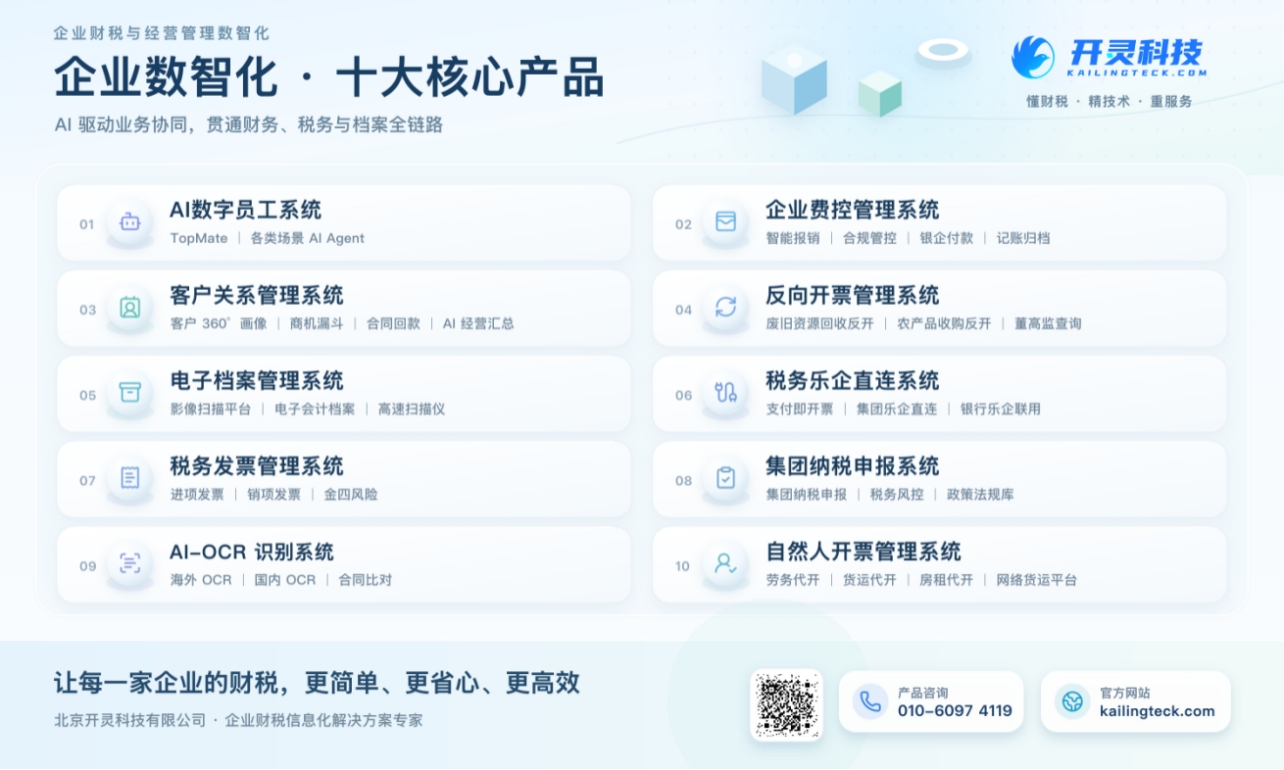
The company has now formed ten core product lines, including: AI digital employee system, enterprise expense control management system, customer relationship management system, reverse invoicing management system, invoice issuance for individuals management system, electronic archives management system, tax fully digitalized e-invoice Leqi system, tax invoice management system, group tax filing system, and AI OCR recognition system. It is committed to connecting enterprise business, finance, tax, funds, and archive data to help customers improve operational efficiency, business-finance-tax compliance capabilities, and digital management levels.
If you have any business-finance-tax digital transformation needs, welcome to contact us. Beijing Kailing Technology will serve you wholeheartedly.
Keywords: Leqi integrated use, payment-and-invoicing, financial channel, purchase order write-back, Kailing Technology
As a comprehensive business-finance-tax digitalization solution service provider, Kailing Technology provides business-finance-tax management digital transformation products and operational services for various government agencies, institutions, and large, medium, and small enterprises. The product line includes: solutions for sales contract management system, procurement contract management system, fully digitalized Leqi interface project, automatic output invoicing system, reverse invoicing system, invoice issuance for individuals system, employee expense control and reimbursement system, input VAT invoice management system, supply chain collaborative reconciliation system, image AI OCR recognition system, automatic financial bookkeeping system, electronic accounting archives system, etc., comprehensively driving the digitalization process across various fields.
Consultation Hotline: 18513895936 / 010-60974119 Location: Beijing