
With many waste paper recycling transactions, how do you find which one lacks compliance evidence? The Kailing Technology resource recycling reverse invoicing system marks five-flow missing items per order

Waste paper purchases are frequent, and the hardest part is often not issuing invoices but finding among hundreds of documents which one lacks a photo, confirmation, receipt, or invoicing result. The Kailing Technology resource recycling reverse invoicing system checks five-flow associations by purchase order, returning materials to be supplemented to the specific transaction and responsible person.

▍First define what counts as one complete transaction
Waste paper transactions may involve multiple bales and multiple grades per truck, or one seller delivering several trucks continuously in a day. The purchase order must be able to point to the actual seller, truck trip, weighbridge ticket, acceptance, settlement, funds, and invoice before per-order checks are possible. Summarizing materials only by date at month-end will mix the moisture and impurity deduction records of different vehicles together.
The five-flow check does not require placing the same number of documents for every transaction; rather, it confirms that key facts correspond to one another. Self-delivery and driver delivery require different identity explanations; when one payment covers multiple receipts, the fund node must break out the allocation details. System rules should determine missing items based on the real business structure, not mechanically judge completeness by the number of attachments.
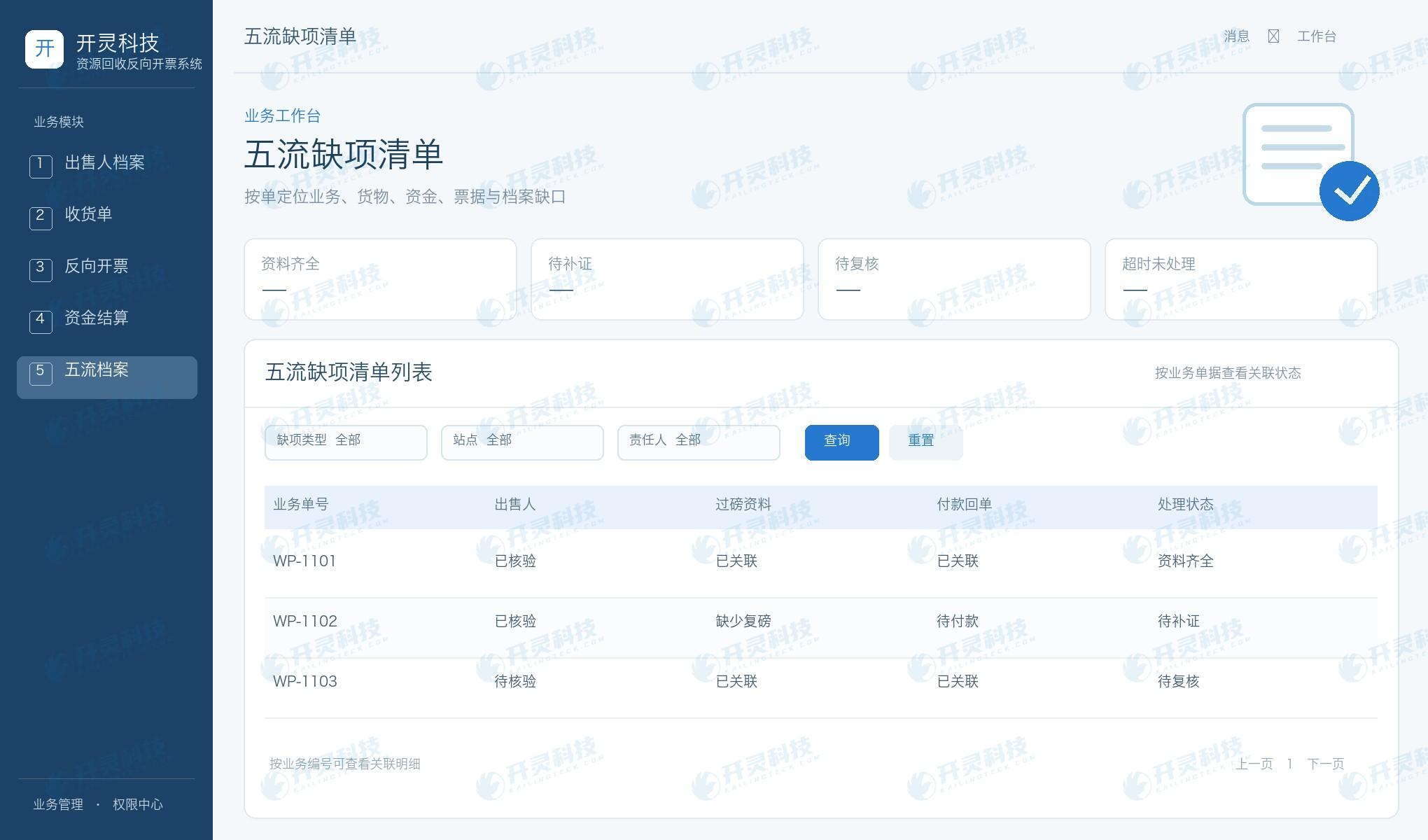
Waste paper transaction five-flow missing-item list
▍Missing items must show name, location, and responsibility
Seeing "incomplete materials" is not enough to handle the issue. If a weighbridge ticket is missing, it should be marked to the vehicle trip and weighbridge node; if the deduction basis is unconfirmed, the acceptance inspector should be found; if bank payment is complete but the receipt is not linked, it should be assigned to the cashier. Kailing Technology's system maps gaps to business order numbers, node status, and pending owners, reducing repeated cross-position inquiries.
Waste paper is particularly prone to rain moisture, excessive inclusions, reweighing, or partial returns. Such exceptions should retain the original measurement and modification records, rather than eliminating yellow alerts by deleting the original order. The missing-item list should present materials that are truly not uploaded and also identify situations where files exist but numbers do not match or amounts do not reconcile.
▍The five-flow star chain provides both forward and reverse lookup methods
Starting from an invoice, finance can see which waste paper purchase orders the invoice covers, the settlement amount of each order, and the payment status; starting from a purchase order, business staff can see identity documents, goods acceptance, fund receipts, and the final invoice. Both directions work, showing that the archives do not depend on any individual handler's file naming habits.
For situations where one invoice is linked to multiple trucks or one payment is linked to multiple invoices, Xinglian should retain details rather than only showing "linked." Otherwise, the total may appear to match while per-truck allocation may still be wrong. The Kailing Technology resource recycling reverse invoicing system presents the document chain by relationships and status, helping reviewers quickly locate the real breakpoint.
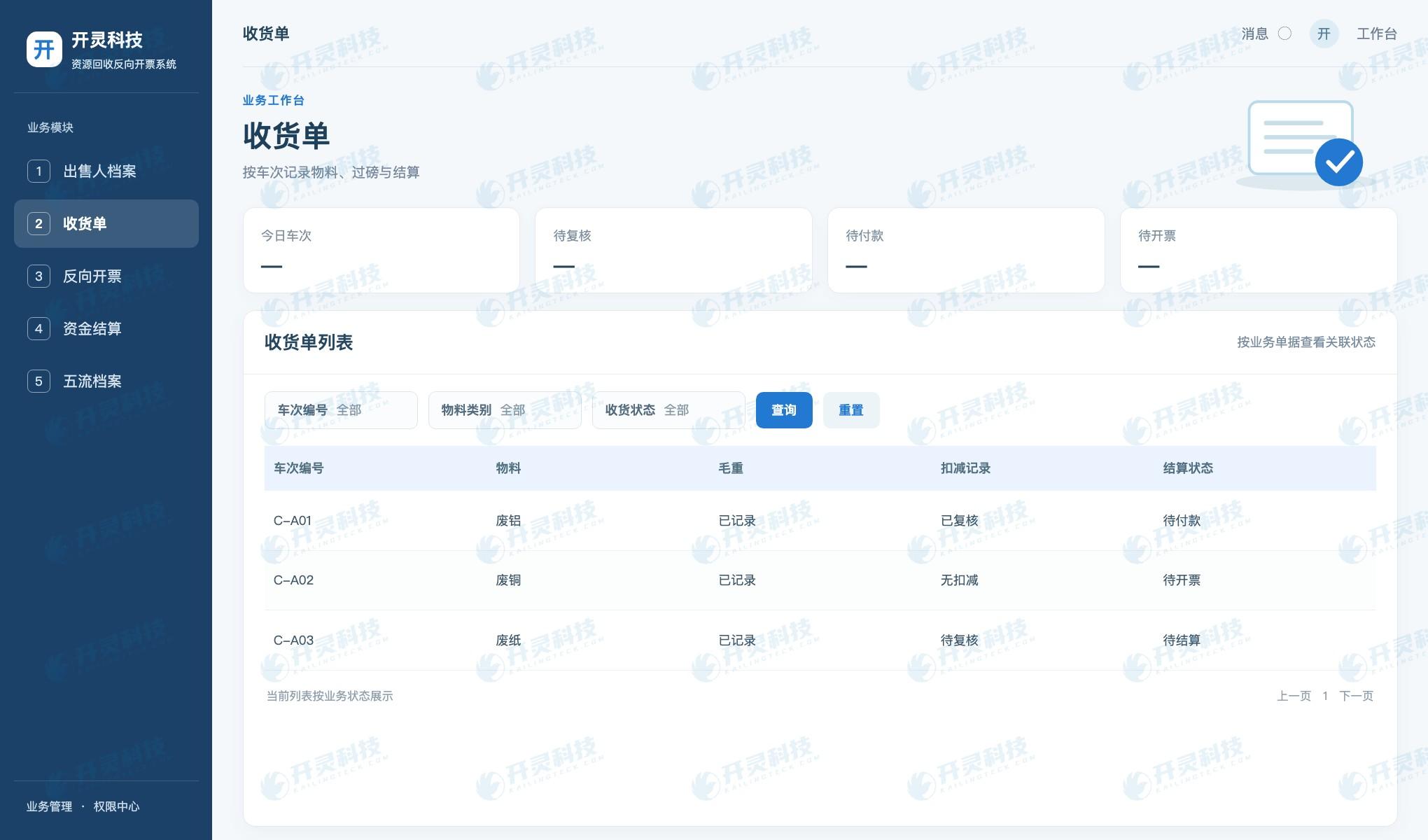
Waste paper truck trips, weighbridge tickets, and deduction records
▍Prioritize pending supplementation orders by risk
When business volume is high, the to-do queue can first handle more urgent matters such as invoiced but entity information pending verification, paid but receipt confirmation missing, and invoice-payment amount mismatches, then handle attachment formats and ordinary supplementary entries. After the owner supplements the materials, the reviewer checks whether the file belongs to the original vehicle trip and whether it covers the disputed matter. Checking "supplemented" cannot replace review.
For documents left unprocessed for a long time, the reason and escalation path should be recorded. If the seller cannot provide confirmation, or on-site materials can no longer be restored, the system should still retain the exception status and handling opinion, and must not change it to "compliance completed" for month-end statistics. Tracking processing timeliness from the exception queue reflects management quality better than only looking at the day's invoicing volume.
▍Move from sample spot checks to routine checks
Enterprises can select one each of normal transactions, reweighing, moisture deduction, consolidated payment, and post-invoice red reversal, and check whether the rules give correct prompts. If normal orders are frequently falsely flagged, the frontline will gradually ignore the alerts; if abnormal orders are not identified, business fields or associations should be supplemented.
The Kailing Technology solution embeds five-flow missing-item checks into daily purchase orders and archives, rather than piecing materials together temporarily when tax or audit access occurs. The site is responsible for actual receipt, finance is responsible for invoice and payment verification, and the system places the results of both in a searchable location, forming a stable evidence-supplementation loop.
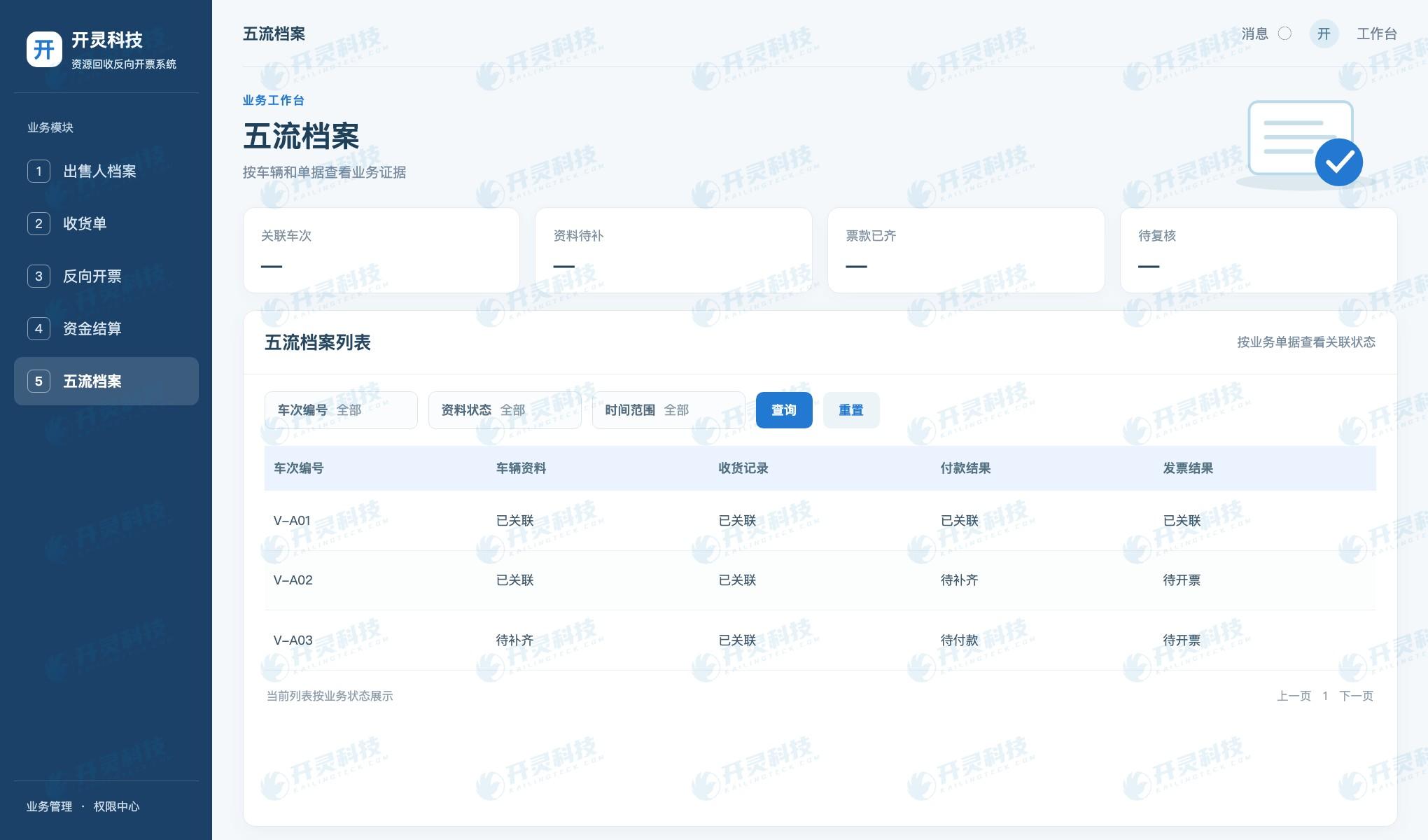
View archive status by purchase order
▍Turn the waste paper missing-item list into closable tasks
Missing-item rules should distinguish mandatory fields, conditionally required fields, and supplementary attachments. Weighbridge tickets, sellers, and settlement amounts are key associations; rain-moisture certificates are required only when the corresponding deduction occurs; transport photos can help explain on-site facts. This layering reduces meaningless prompts and prevents important gaps from being drowned out by a large number of ordinary reminders.
Each missing-item record should preferably include the business order number, missing node, discovery time, responsible position, handling note, and review conclusion. After a site re-uploads an image, the reviewer must still confirm whether the image shows that vehicle and covers the missing content. If a weighbridge ticket for the wrong vehicle is uploaded, the attachment count increases, but the business risk does not disappear.
Waste paper sites may receive goods first and settle later. Documents in "pending settlement" temporarily have no invoice and should not be mixed with "should be invoiced but not yet invoiced." The system should determine missing items by business stage: materials not yet due show as pending occurrence, materials missing files after the node is completed show as pending supplementation, and amount conflicts show as pending verification. Different statuses correspond to different responsible persons.
For large-volume transactions, lists can be filtered by site, handler, date, and exception type. Finance first handles documents that affect invoice payment, then handles general material supplementation. Management focuses on exceptions that remain open for a long time, recurring reasons for missing items, and whether a certain acquisition method requires adjusting operating procedures, rather than only looking at the number of "completed" items this month.
If a seller temporarily changes accounts or one person delivers goods for multiple households, the subject and fund gaps should be set as priority reviews. On-site staff need to know when weighing can continue and when settlement must be paused. Only by writing exception-handling rules into job actions will system prompts avoid becoming just a to-do report at month-end.
▍Set handling time limits for different missing items
For documents with unclear entity information or invoice-payment amount conflicts, review should be completed before invoicing; for ordinary attachments lacking clear scans, supplementary upload can be arranged according to enterprise rules. Time limits differ for different issues, and the system should let the handler know which ones block the next step and which are merely materials pending improvement. Indiscriminate red warnings easily cause frontline staff to lose judgment.
Site managers can view newly added missing items daily and verify whether they are caused by equipment failure, operational omissions, or inappropriate rule settings. Finance handles cross-site exceptions according to invoice and payment risk. Both types of personnel see the same business order number and handling history, reducing the communication cost of "the site says it was supplemented but finance cannot see it."
If a certain type of photo or confirmation is missing for several consecutive days, the process design may not fit the on-site work rhythm. The collection nodes or terminal operation methods should be adjusted, rather than merely repeatedly urging the handler to supply missing items. The missing-item list itself can also help enterprises improve the purchasing process.
▍FAQ
Q: Does missing one photo of the goods necessarily mean no invoice can be issued?
A: It needs to be judged in light of the transaction facts and the enterprise's material rules; the key is whether the receipt, measurement, and seller information can be reliably verified.
Q: How do you troubleshoot missing items when one payment covers multiple vehicle loads of waste paper?
A: Break down the settlement allocation for each vehicle trip, then check receipt and invoices vehicle by vehicle; you cannot verify only the total payment amount.
Q: Can the original exception be deleted after the attachments are completed?
A: Retain the handling trail of missing-item discovery, supplementation, and review, to make it easy to explain how the materials were formed.
Visit Kailing Technology to learn about related products and implementation plans: https://www.kailingteck.com/fxzy/ .
As a national high-tech enterprise, Kailing Technology focuses on the digital and intelligent transformation of enterprise business-finance-tax and operations management, providing software products, system integration, implementation and delivery, and operational services for various government agencies, institutions, group enterprises, and SMEs.
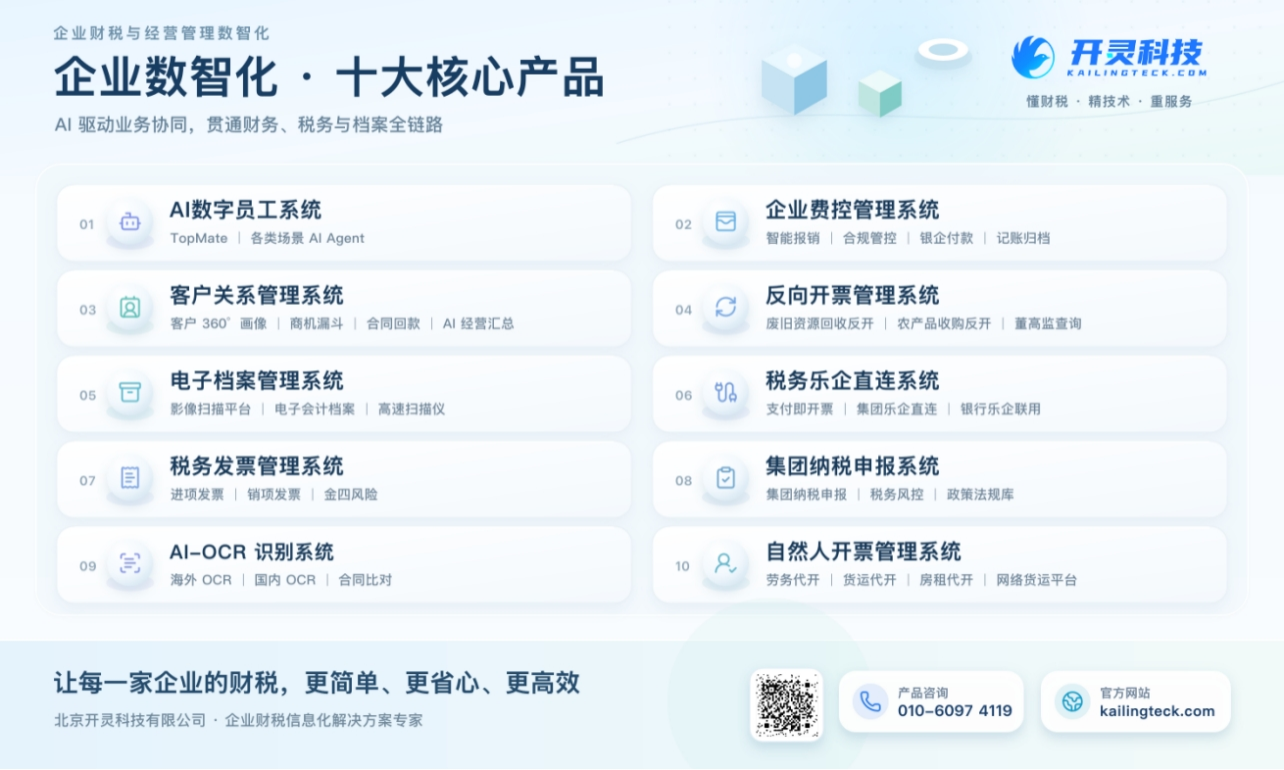
The company has now formed ten core product lines, including: AI digital employee system, enterprise expense control management system, customer relationship management system, reverse invoicing management system, invoice issuance for individuals management system, electronic archives management system, tax fully digitalized e-invoice Leqi system, tax invoice management system, group tax filing system, and AI OCR recognition system. It is committed to connecting enterprise business, finance, tax, funds, and archive data to help customers improve operational efficiency, business-finance-tax compliance capabilities, and digital management levels.
If you have any business-finance-tax digital transformation needs, welcome to contact us. Beijing Kailing Technology will serve you wholeheartedly.
Keywords: Waste paper reverse invoicing, five-flow missing items, compliance evidence, per-order verification, Kailing Technology
As a comprehensive business-finance-tax digitalization solution service provider, Kailing Technology provides business-finance-tax management digital transformation products and operational services for various government agencies, institutions, and large, medium, and small enterprises. The product line includes: solutions for sales contract management system, procurement contract management system, fully digitalized Leqi interface project, automatic output invoicing system, reverse invoicing system, invoice issuance for individuals system, employee expense control and reimbursement system, input VAT invoice management system, supply chain collaborative reconciliation system, image AI OCR recognition system, automatic financial bookkeeping system, electronic accounting archives system, etc., comprehensively driving the digitalization process across various fields.
Consultation Hotline: 18513895936 / 010-60974119 Location: Beijing