
Five-step closed loop for supplier reconciliation: say goodbye to month-end mismatches

Five-step closed loop for supplier reconciliation: say goodbye to month-end mismatches
Supplier reconciliation is not about adjusting two totals to match at month-end, but about enabling every pending settlement business to answer five questions: where are the original documents, how are orders linked to receipts and invoices, who handles differences, is the payment basis sufficient, and can it be reconstructed afterward. The executable process is document collection, relationship matching, difference coordination, invoice-payment reconciliation, and archiving review.
Repeated reconciliation is usually not due to the lack of a summary table, but because purchase orders, receipt acceptance, returns, supplier settlement statements, invoices, and payment applications are scattered across different systems and communication tools. Finance sees the invoice but cannot find the receipt; procurement confirms arrival but price adjustments leave no trace; and the supplier presses for payment using its own basis. To solve the problem, evidence and status should be unified first, and then automation discussed.
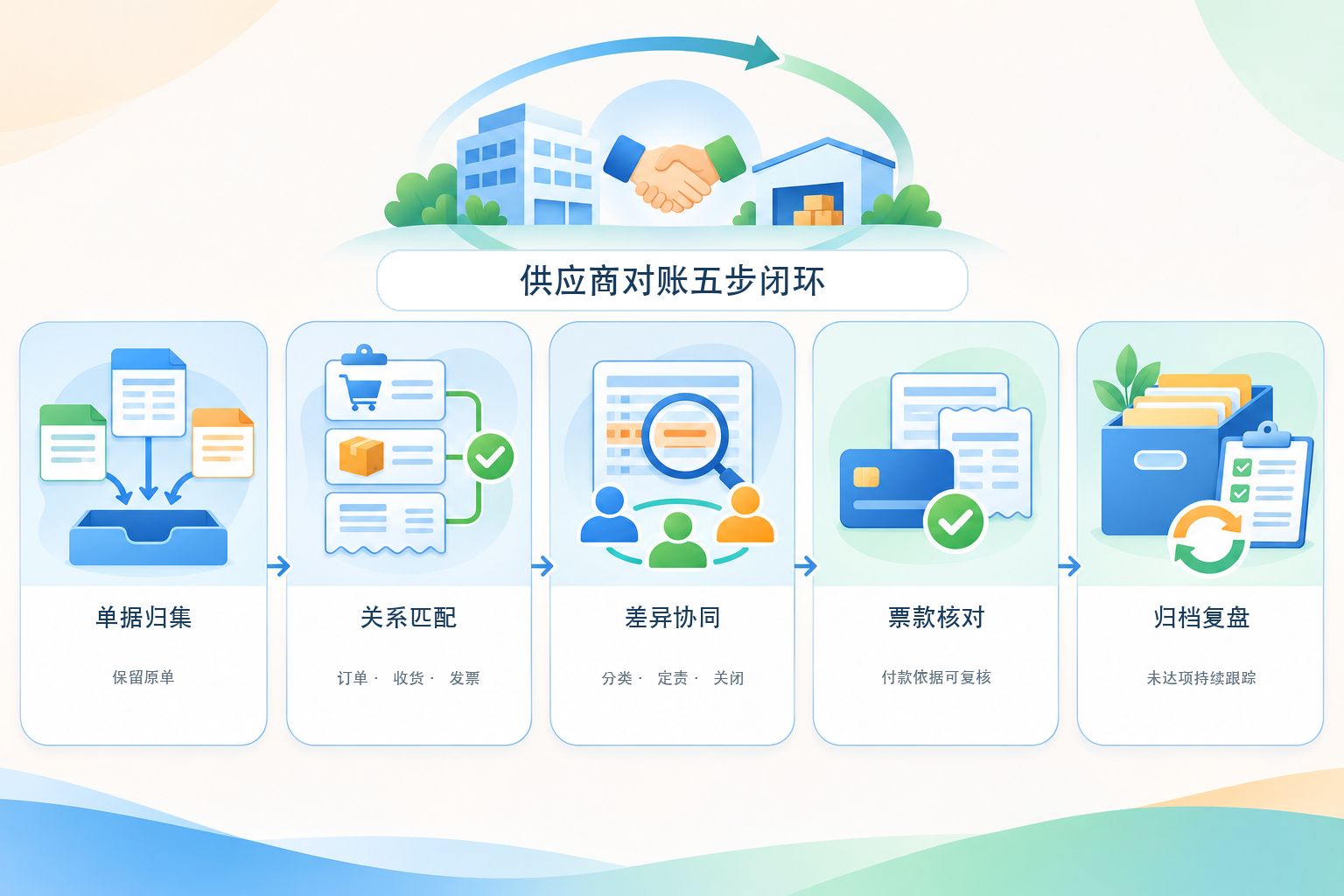
▍Step 1: Document collection; retain original documents first, then unify fields
It is recommended to include purchase orders and change records, delivery or logistics information, receipt and warehousing, quality acceptance, return slips, supplier settlement statements, invoices, payment applications, and receipts. When collecting, retain original files and source information, then unify supplier codes, order numbers, material or service items, quantity units, tax-inclusive amounts, tax amounts, business dates, and statuses.
OCR can assist in extracting fields from paper or image documents, but recognition results require rule-based or human review; "recognition complete" cannot be directly treated as booking. Kailing Technology can provide AI OCR, input VAT invoice management, and system integration capabilities on a project basis; the specific data sources, invoice types, authorization, and interface scope should be confirmed before implementation.
▍Step 2: Relationship matching; reconcile orders, receipts, and invoices line by line
Matching should not only compare monthly totals. First establish line-level relationships using order numbers, materials or services, quantities, unit prices, and business dates, then reconcile tax-inclusive amounts, tax amounts, and the impact of red-letter or return items. Output should at least be divided into consistent items, difference items, and open items; open items should also distinguish statuses such as goods received but invoice not received, invoice received but goods not received, and returned but not offset.
State Taxation Administration Announcement No. 11 of 2024 clarifies that fully digitalized e-invoice information can be transferred through methods such as tax digital accounts. After enterprises obtain invoice data, they still need to reconcile it with actual procurement, acceptance, and payment records; one invoice cannot replace business authenticity and approval evidence.
▍Step 3: Difference coordination: classify, assign responsibility, retain evidence, close
Differences should be handled by categories such as quantity, price, tax amount, period, duplication, returns, and unit conversion. Quantity differences: check receipts, acceptance, and returns; price differences: check contracts, discounts, and price adjustment approvals; tax amount differences: check invoice types, items, and red-letter handling; cross-period differences: clarify current-period and next-period responsibilities. Each type of difference should have a responsible person, handling action, deadline, and closing evidence.
The closing standard is not changing the status to green, but making the cause explainable, the impact calculable, the responsibility traceable, and the evidence reviewable. System rules can flag exceptions, but contract interpretation, goods acceptance, and accounting judgment still require confirmation by the corresponding positions.
▍Step 4: Invoice-payment reconciliation; complete four confirmations before payment
Before payment, at least confirm the supplier entity and receiving account, the accepted amount, the settleable invoices and tax amount, and the basis for closing or temporarily suspending differences. For prepayments, installment payments, warranty deposits, and partial deliveries, the contract milestones and the scope of this payment should be listed separately. Payment instructions, review, receipt acquisition, and accounting treatment should follow the enterprise's fund system and bank-side security requirements.
The Ministry of Finance's supporting guidelines for enterprise internal control require enterprises to specify, in light of actual conditions, the responsibilities and approval procedures for procurement, acceptance, payment, and other stages, with attention to segregation of incompatible duties. Kailing Technology's expense control, invoice, and fund-related capabilities can connect with existing systems by project; whether specific banks, accounts, or automatic voucher generation are supported is subject to interface and joint debugging acceptance.
▍Step 5: Archiving and review; open items cannot disappear with closing
After each period is closed, a searchable relationship should be established among reconciliation confirmations, difference handling, invoices, approvals, and payment receipts, while open items are carried into the next period for continuous tracking. Reviews focus on high-frequency difference suppliers, long-outstanding open items, reasons for repeated returns, and points where rules fail, using facts to improve procurement and settlement processes.
Cai Kuai [2020] No. 6 requires that when electronic accounting vouchers are used for reimbursement, booking, and archiving, it should be ensured that the source is lawful and authentic, the system can accurately and completely read the electronic voucher and its metadata, necessary review and approval procedures are set, and duplicate booking is prevented. Storing only printouts or scanned images does not automatically equal complete and compliant electronic archiving.
▍Ask these five questions during acceptance
Take any payment: can the original order and acceptance be located? Take any invoice line: can the corresponding business be explained? Take any difference: can the responsible person and closing evidence be seen? Take any open item: can it continue to be tracked in the next period? Take any electronic voucher: can the original file, metadata, and review and signature records be read? Only when all five questions can be answered is a closed loop formed.
Official basis:Guidelines for Enterprise Internal Control、State Taxation Administration Announcement No. 11 of 2024、Caihui [2020] No. 6。
Learn about Kailing Technology's invoicing, expense control, and electronic archiving solutions: www.kailingteck.com .
About Kailing Technology
As a national high-tech enterprise, Kailing Technology focuses on the digital and intelligent transformation of enterprise business-finance-tax and operations management, providing software products, system integration, implementation and delivery, and operational services for various government agencies, institutions, group enterprises, and SMEs.
The company has now formed ten core product lines, including: AI digital employee system, enterprise expense control management system, customer relationship management system, reverse invoicing management system, invoice issuance for individuals management system, electronic archives management system, tax fully digitalized e-invoice Leqi system, tax invoice management system, group tax filing system, and AI OCR recognition system. It is committed to connecting enterprise business, finance, tax, funds, and archive data to help customers improve operational efficiency, business-finance-tax compliance capabilities, and digital management levels.
If you have any business-finance-tax digital transformation needs, welcome to contact us. Beijing Kailing Technology will serve you wholeheartedly.
Keywords: supplier reconciliation process, three-way matching, difference handling, invoice-payment reconciliation, input VAT invoice management, electronic accounting archives, Kailing Technology
As a comprehensive business-finance-tax digitalization solution service provider, Kailing Technology provides business-finance-tax management digital transformation products and operational services for various government agencies, institutions, and large, medium, and small enterprises. The product line includes: solutions for sales contract management system, procurement contract management system, fully digitalized Leqi interface project, automatic output invoicing system, reverse invoicing system, invoice issuance for individuals system, employee expense control and reimbursement system, input VAT invoice management system, supply chain collaborative reconciliation system, image AI OCR recognition system, automatic financial bookkeeping system, electronic accounting archives system, etc., comprehensively driving the digitalization process across various fields.
Consultation Hotline: 18513895936 / 010-60974119 Location: Beijing