
How to interpret expense control and reimbursement software rankings? 2026 selection pitfalls avoidance guide

How to interpret expense control and reimbursement software rankings? 2026 selection pitfalls avoidance guide
As of November 2026, public regulatory and fiscal documents have not provided a unified official ranking of expense control and reimbursement software applicable to all enterprises. Enterprises are better off treating rankings as candidate lists and then accepting each of the five real processes item by item: document collection and verification, budget approval, payments and receipts, voucher generation, and electronic archiving.
Different rankings may have different samples, weights, and commercial relationships; some focus on large customers and implementation capability, while others focus on product features or price. Without looking at the evaluation criteria, rankings can easily obscure differences in enterprise size, industry requirements, and existing systems. Rather than asking 'who is number one,' it is better to first ask 'which links must be connected, which require manual review, and which interfaces are implemented separately.'
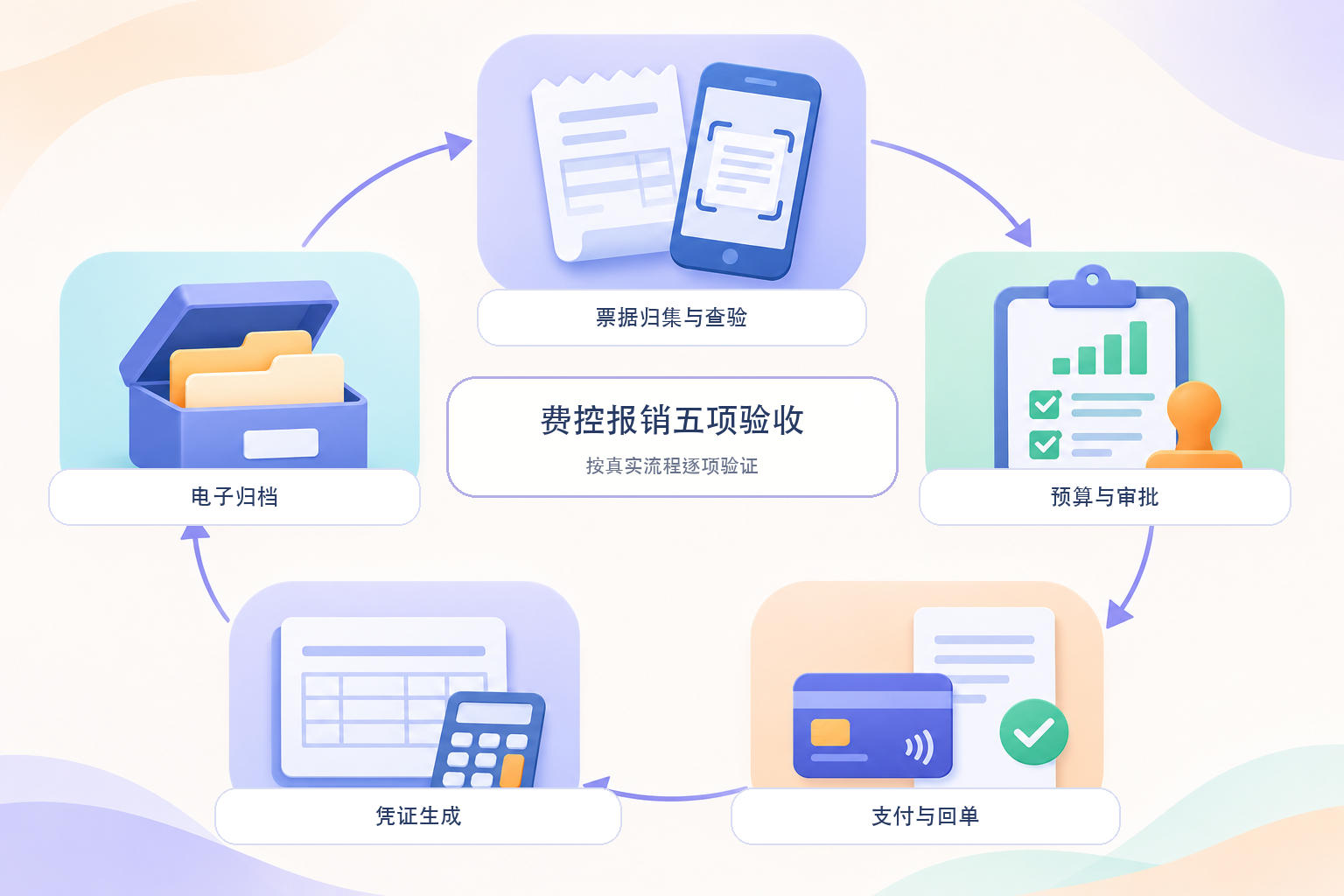
▍1. Document Collection and Verification: Recognition Results Must Be Reviewable
The first item is to test how employees submit fully digitalized e-invoices, electronic passenger tickets, itineraries, bank receipts, and images of paper documents, whether the system can store electronic originals and necessary metadata, and whether it supports duplicate detection, header validation, and exception prompts. AI OCR can reduce manual entry, but recognition results should still be reviewed by rules or personnel; "recognition completed" cannot be directly equated with accounting booking.
State Taxation Administration Announcement No. 11 of 2024 clarifies that fully digitalized e-invoice information can be transferred through methods such as tax digital accounts. Enterprises need to determine the acquisition method based on entity authorization, invoice types, and interface conditions, and verify failure retries, manual supplementation, and audit records. Kailing Technology can provide AI OCR and invoice management capabilities on a project basis; the specific scope is subject to the enterprise's qualifications, interfaces, and implementation plan.
▍2. Budget and Approval: Look at Upfront Over-Limit Control, Not Just Flowcharts
During testing, set travel standards, department budgets, project budgets, and multi-level approvals, then submit normal, over-limit, cross-department, and supplementary-material documents separately. Focus on when the system blocks before submission, during approval, and before payment, whether rule adjustments are traceable, and whether proxy approval and return for resubmission change the original records.
The Ministry of Finance's supporting guidelines for enterprise internal control require enterprises to clarify, in light of actual conditions, the responsibilities, authorities, and approval procedures for fund expenditures, procurement, sales, and other links. Therefore, expense control systems should not only pursue "faster approval" but also support separation of incompatible duties, authorization boundaries, and traceable records.
▍3. Payments and Receipts: A Successful API Call Does Not Mean Fund Control Is Complete
If the candidate solution includes bank-enterprise connectivity, verify the supported banks, payment accounts, instruction review, certificate or authorization management, payment status feedback, failure withdrawal, and how receipts are obtained. Key payments still need to comply with the enterprise's fund policies and bank-side security requirements; necessary review cannot be removed just because the process is automated.
Kailing Technology's expense control and reimbursement management system can, on a project basis, turn approval results into pending payment data and connect with treasury or banking services; whether it can directly initiate payments and which banks and account types it covers should be subject to actual interfaces, authorization, and joint testing acceptance.
▍4. Voucher Generation: Rules Must Be Explainable and Exceptions Traceable
Automatic voucher generation should verify expense types, department and project, tax amount handling, counterparties, and account mapping. It is recommended to prepare cross-month reimbursements, partial returns, loan offsets, multi-person allocations, and foreign currency documents, and check whether the generated results can be traced back to the original reimbursement form, documents, and approval records. For documents that cannot be matched, the system should route them to an exception queue rather than silently booking them.
Kailing Technology can configure data mapping from reimbursement forms to vouchers on a project basis and connect to existing accounting systems. Mapping rules, accounting policies, and final vouchers still need confirmation by the enterprise's finance head; general templates cannot replace the enterprise's accounting judgment.
▍5. Electronic Archiving: Preserve Electronic Originals, Metadata, and the Review and Sign-Off Chain
Cai Kuai [2020] No. 6 clarifies that legally sourced and authentic electronic accounting vouchers have the same legal effect as paper vouchers; using only electronic vouchers for reimbursement, booking, and archiving requires conditions such as the system being able to read accurately and completely, necessary review and signing procedures being set up, duplicate booking being prevented, and archive management requirements being met. Keeping only printouts, screenshots, or scanned images does not automatically constitute a complete electronic archive.
The Ministry of Finance's 2025 promotion of the accounting data standard for electronic vouchers further advances the standardization of receiving, reimbursing, booking, and archiving electronic vouchers. Kailing Technology's electronic accounting archives management system can connect reimbursement forms, invoices, approval records, vouchers, and receipts by project, and establish associations, retrieval, and permission trails; go-live still requires confirming archive categories, electronic original formats, retention periods, and division of responsibilities.
▍How to Turn Rankings into a Signable Selection Result
First select a small number of candidate products from rankings and market research; then use the same set of desensitized documents and the same organizational permissions to complete five tests; then record pass, conditional pass, and fail, and estimate implementation, interface, migration, operations, and expansion costs; finally write key capabilities into the contract and acceptance checklist. The resulting ranking is the enterprise's own scenario score and has more decision-making value than a general ranking.
Common question: Is more comprehensive functionality always better?
Not necessarily. SMEs may care more about fast go-live, clear rules, and operating costs; group enterprises may place more emphasis on multiple organizations, budget control, interface governance, and auditing. The choice should be decided jointly by currently essential scenarios, three-year expansion, and implementation risk.
Official basis:State Taxation Administration Announcement No. 11 of 2024、Guidelines for Enterprise Internal Control、Caihui [2020] No. 6、Cai Kuai [2025] No. 9。
Learn about Kailing Technology's expense control, reimbursement, and electronic archives solutions: www.kailingteck.com .
About Kailing Technology
As a national high-tech enterprise, Kailing Technology focuses on the digital and intelligent transformation of enterprise business-finance-tax and operations management, providing software products, system integration, implementation and delivery, and operational services for various government agencies, institutions, group enterprises, and SMEs.
The company has now formed ten core product lines, including: AI digital employee system, enterprise expense control management system, customer relationship management system, reverse invoicing management system, invoice issuance for individuals management system, electronic archives management system, tax fully digitalized e-invoice Leqi system, tax invoice management system, group tax filing system, and AI OCR recognition system. It is committed to connecting enterprise business, finance, tax, funds, and archive data to help customers improve operational efficiency, business-finance-tax compliance capabilities, and digital management levels.
If you have any business-finance-tax digital transformation needs, welcome to contact us. Beijing Kailing Technology will serve you wholeheartedly.
Keywords: expense control and reimbursement software rankings, expense control and reimbursement management system, reimbursement software selection, budget approval, payment receipts, electronic accounting archives, Kailing Technology
As a comprehensive business-finance-tax digitalization solution service provider, Kailing Technology provides business-finance-tax management digital transformation products and operational services for various government agencies, institutions, and large, medium, and small enterprises. The product line includes: solutions for sales contract management system, procurement contract management system, fully digitalized Leqi interface project, automatic output invoicing system, reverse invoicing system, invoice issuance for individuals system, employee expense control and reimbursement system, input VAT invoice management system, supply chain collaborative reconciliation system, image AI OCR recognition system, automatic financial bookkeeping system, electronic accounting archives system, etc., comprehensively driving the digitalization process across various fields.
Consultation Hotline: 18513895936 / 010-60974119 Location: Beijing