
With many farmer households selling apples, how can invoicing happen immediately upon payment after farmer confirmation? Kailing Technology's agricultural product purchase reverse invoicing system links the purchase order, payment, and invoice to the same order number
During peak apple purchasing season, fruit farmers deliver in batches, and grading, weighing, and settlement often occur densely on the same day. If payment and invoicing are entered separately by two roles, it is easy to mismatch farmers or amounts across orders. Kailing Technology's agricultural product purchase reverse invoicing system links farmer confirmation, payment results, and purchase invoices through the purchase order number, giving high-frequency transactions a clear sequence.
▍First give each household's apples their own purchase order
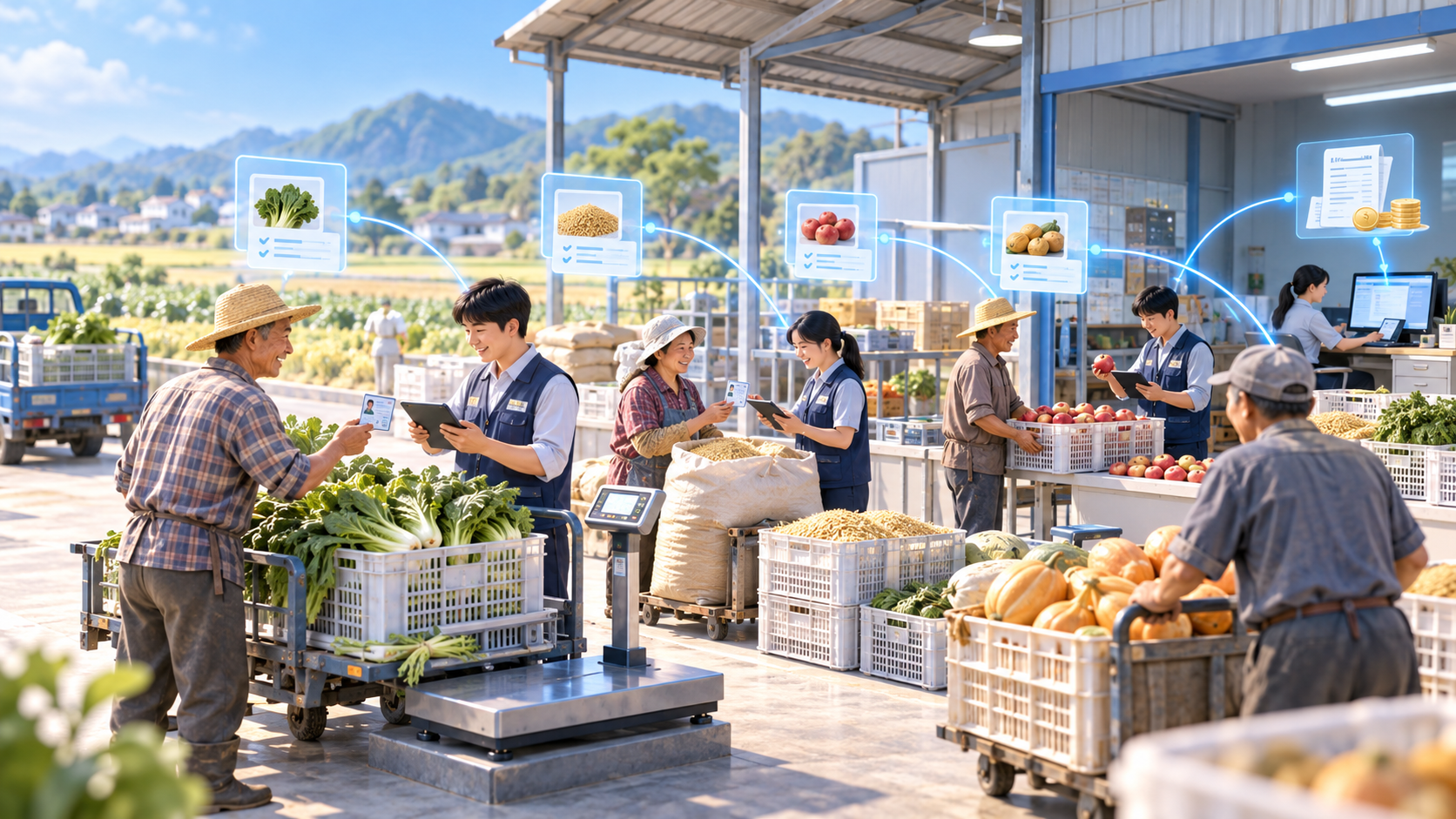
The same vehicle may deliver apples for several farming households; the entire load cannot be attributed to one farmer just because one person drove it. The purchasing point should record the actual self-producing farmer, fruit category, grading results, gross weight, and net weight, and break out settlement details by household. Farmer records' identity, self-production materials, and receiving accounts should also be verified.
Apple size, grade, and loss affect the price. The inspector states the grade, deduction basis, and unit price version on the purchase order, so farmers can see how the amount payable for their goods was derived. If the same household delivers multiple times in one day, the system retains each purchase and the consolidated settlement relationship, rather than reducing multiple weigh tickets to a single total price that cannot be broken down.
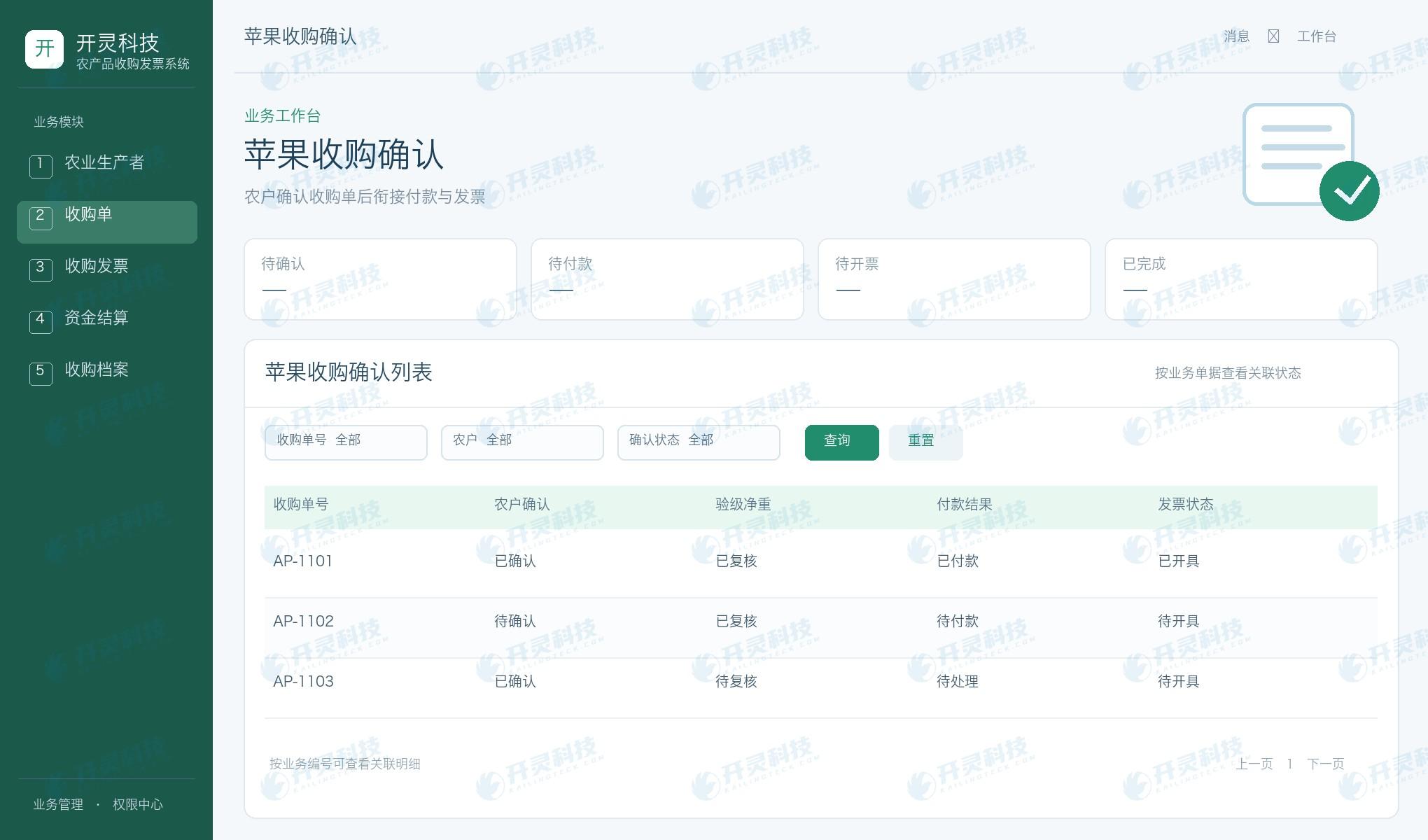
Apple purchase orders link farmer confirmation with invoice and payment
▍Farmer confirmation is a key checkpoint before payment
After acceptance is complete, purchase details can be confirmed through methods suitable for local farmers. What farmers confirm is not a vague "agree to the transaction," but the category, weight, price, and amount receivable related to them. If there is a dispute over deductions or grades, the document stays pending review; on-site adjustments should also retain original values and records confirmed by both parties.
The confirmation time and confirmation version need to be written back to the original purchase order. If the farmer first confirms an old amount and a business staff member later changes the price, the old confirmation cannot be used for direct payment. Kailing Technology's system links acceptance confirmation with payment instructions, helping the cashier see whether the document is still valid before payment.
▍Record payment success and invoice issuance separately
Sending a payment request does not mean the bank has credited the account. The system needs to distinguish pending payment, processing, success, failure, or return, and link the bank transaction number and receipt under the purchase order. If multiple apple purchases from one household are paid together, the allocation of each payable amount should be displayed; if payment is partial, the unpaid amount and subsequent handling should also be retained.
After meeting local purchase invoice management requirements, the invoicing step uses the confirmed farmer, goods, and amount. After the invoice is successfully issued, write back the invoice number, time, and electronic file. If a linked model of payment-triggered invoicing is adopted, exceptions such as "paid but invoicing failed" and "payment failed and no invoice was issued" must also be handled separately; a single completion flag must not cover the results at both ends.
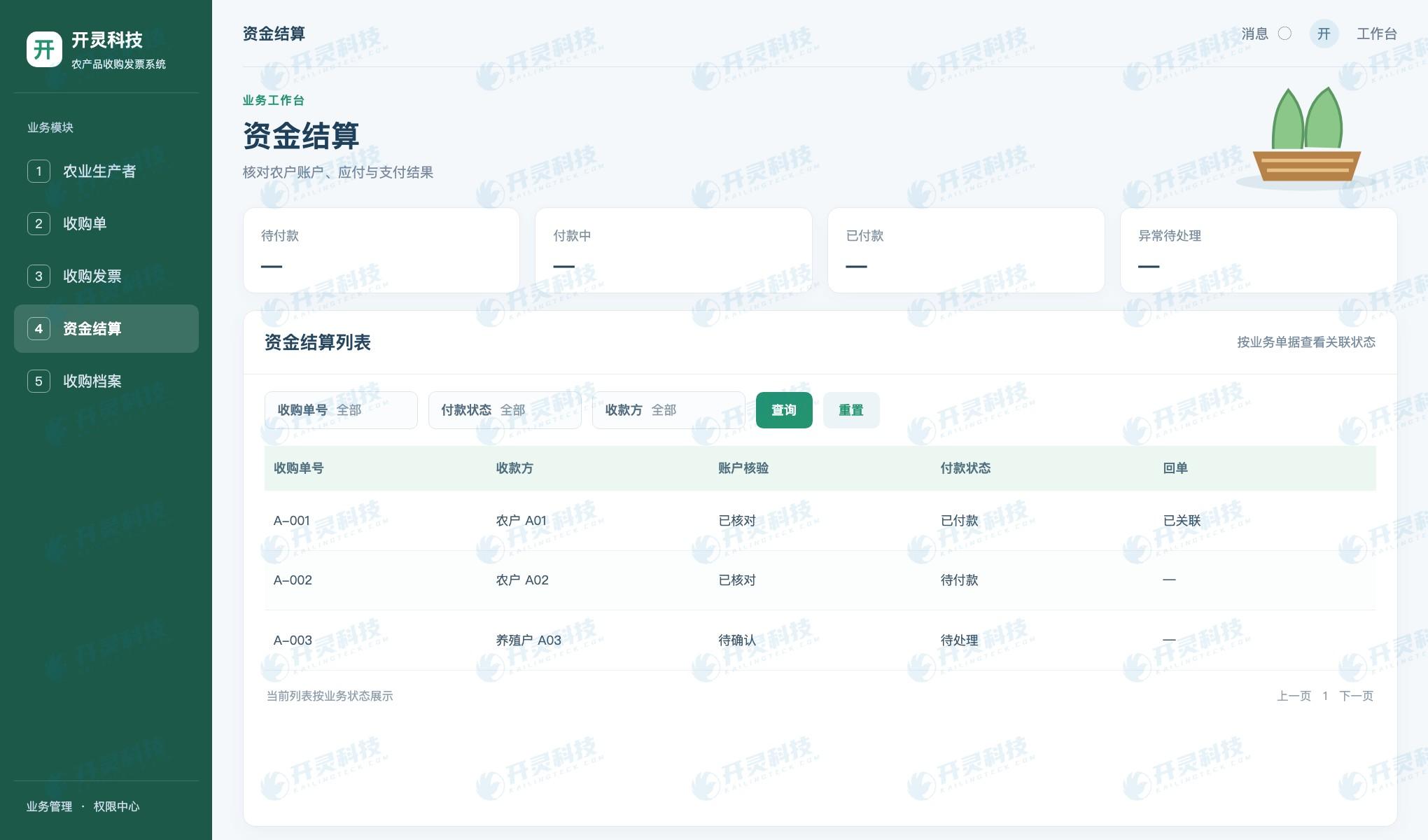
View payment results by farmer
▍Self-production eligibility and transaction facts require ongoing verification
Agricultural product purchase invoices apply to qualifying transactions of self-produced agricultural products. Farmer records should retain identity and self-production-related materials, and purchases still need to be verified against the actual category, planting location, and delivery situation. The fact that a farmer was purchased from last season should not cause any quantity and category this season to pass automatically.
Kailing Technology's agricultural product purchasing reverse invoicing system can link farmer records, purchase orders, payments, and invoices, making it easier for finance to trace back from invoices to the actual apple acceptance. Where the local tax authority has specific requirements for invoice types, materials, and handling methods, the enterprise configures them according to applicable rules during project implementation and accepts them using actual business samples.
▍Trial run with abnormal samples from peak season
For trial operation, five scenarios can be selected: one vehicle with multiple households, multiple vehicles for the same household, grade disputes, payment returns, and successful payment but failed invoicing. After on-site personnel operate, finance traces farmer confirmation and invoice/payment from the purchase order; when farmers make inquiries, they can also find their own transaction details by order number.
Peak-season efficiency does not mean skipping confirmation. Only by splitting confirmation, payment, and invoicing into visible statuses can normal orders be processed in batches while disputed apple purchases are left for manual review. The value of Kailing Technology's solution lies in reducing duplicate entry and enabling every invoice and payment to be traced back to the original purchase fact.
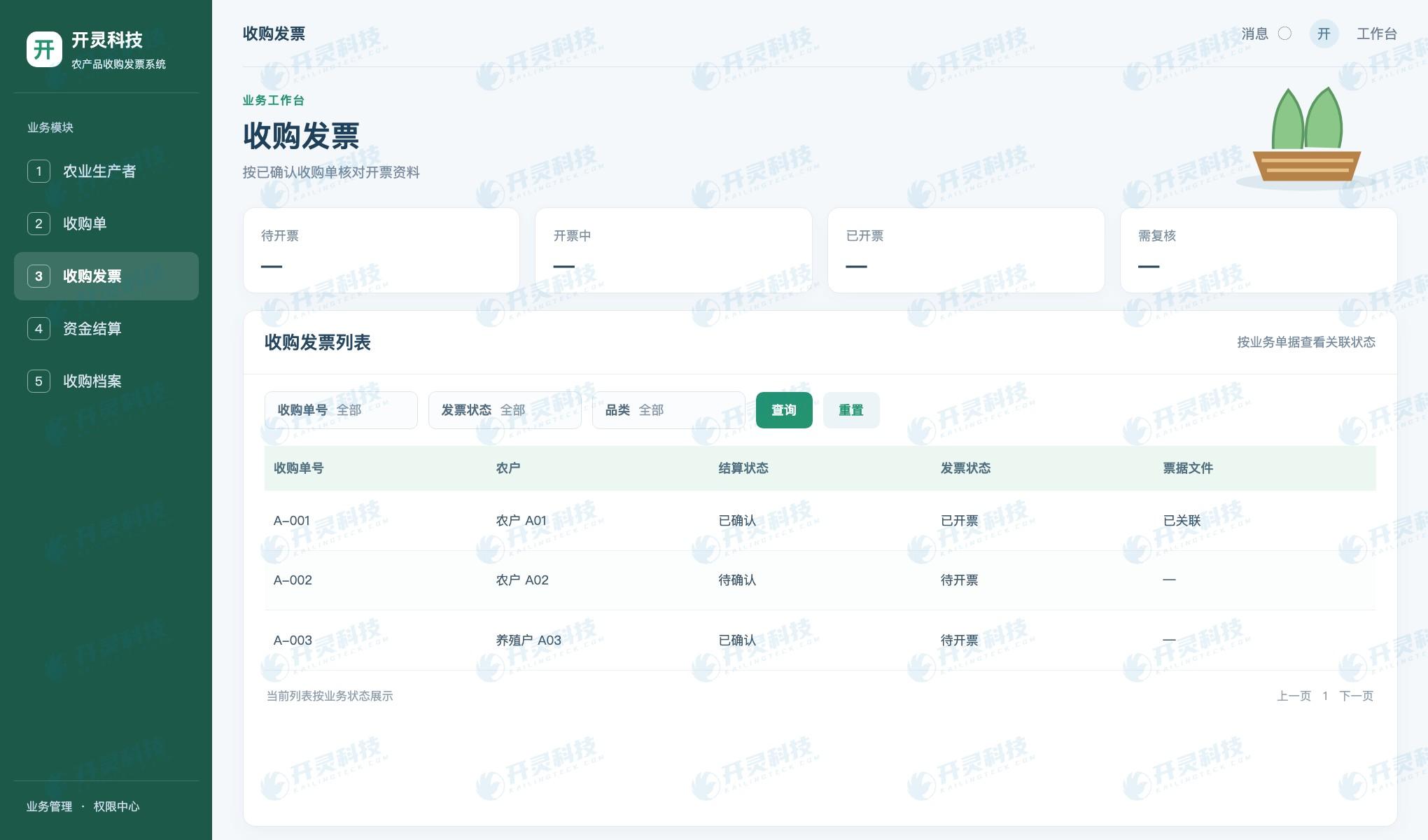
Purchase invoice linked to the original order
▍Batch processing during peak periods must still retain per-household confirmation
During apple harvest season, purchasing points often need fast queuing for weighing. The weighbridge operator can first create vehicle trip and weighing records, and then the inspector splits grades and quantities by farmer; the system uses queues to show pending confirmation, pending payment, and pending invoicing, reducing the need for finance to manually search through multiple paper documents at the same time. Speed comes from front and back roles sharing the same order number, not from omitting farmer confirmation.
When farmers confirm via mobile phone, the interface should state the actual amount receivable, grade, and weight clearly enough. If elderly users or network conditions limit online operations, on-site confirmation and material upload can be arranged per company policy. The system records the confirmation method and handler, avoiding simply equating "did not click the QR code" with rejection of the transaction.
Apple grades and packaging weight often cause disputes. If the tare weight of fruit baskets is calculated using standard values, the applicable conditions of the standard should be stated; if on-site sampling changes the grade, sampling and review records must be retained. For multiple deliveries by the same household, farmer confirmation can be done order by order, and payment can then be summarized based on confirmed documents; a total amount that cannot be verified should not be given only at the end of the day.
Before the cashier makes batch payments, the amount payable per household can be summarized by purchase order number, and the account name verified. When payment results return, bank transactions are allocated order by order; failed household orders remain separately pending and do not affect invoice processing for other farmers. The invoicing stage is also separated by actual success and pending status, preventing an entire batch from losing visibility due to one household's exception.
Financial review can sample farmer households and check self-production materials, daily purchase details, farmer confirmation, bank payments, and invoices. During peak periods, the most easily missed items are farmers with the same name, temporary account changes, and one vehicle with multiple households. Making these the focus of trial operation allows the system to play its role during busy times.
▍Make the apple purchase order an account farmers can understand
What farmers care about is how many apples from this batch were actually received, at what grade the price was calculated, and when payment will arrive. When the purchase order displays this information, use plain names as much as possible and keep complex system statuses in the background. After confirmation, farmers can obtain an order number or receipt, so that when they later ask about payment and invoices, staff can quickly locate the original transaction.
If the purchase point uses bank payment rather than on-site cash, the cashier should first verify the receiving account. Account changes should not be completed by a verbal notice from someone else; the farmer's intention can be verified through enterprise confirmation methods. For elderly farmers or areas with poor network conditions, confirmation methods can vary, but the materials must be traceable to the same purchase.
After the peak purchasing season ends, the enterprise can spot-check by farmer whether there are issues such as confirmed amounts inconsistent with actual payments, invoices covering unconfirmed batches, or farmers with the same name being merged. Incorporating these issues into on-site training for the next season is more effective than centrally correcting invoices afterward.
▍FAQ
Q: If apples are delivered by a cooperative on behalf of farmers, can a farmer purchase invoice be issued directly to the cooperative?
A: The actual seller and transaction type should be identified and handled according to the applicable invoice rules; it cannot be judged solely by the deliverer.
Q: What if the grade is changed after farmer confirmation?
A: Retain the original confirmation and adjustment records, and ask the farmer to confirm the new settlement result before paying and invoicing.
Q: How should it be handled if payment succeeds but invoice issuance fails?
A: Locate the payment and invoicing status by purchase order, repair or manually handle invoice exceptions, and avoid duplicate payments.
Visit Kailing Technology to learn about related products and implementation plans: https://www.kailingteck.com/fxncp/ .
As a national high-tech enterprise, Kailing Technology focuses on the digital and intelligent transformation of enterprise business-finance-tax and operations management, providing software products, system integration, implementation and delivery, and operational services for various government agencies, institutions, group enterprises, and SMEs.
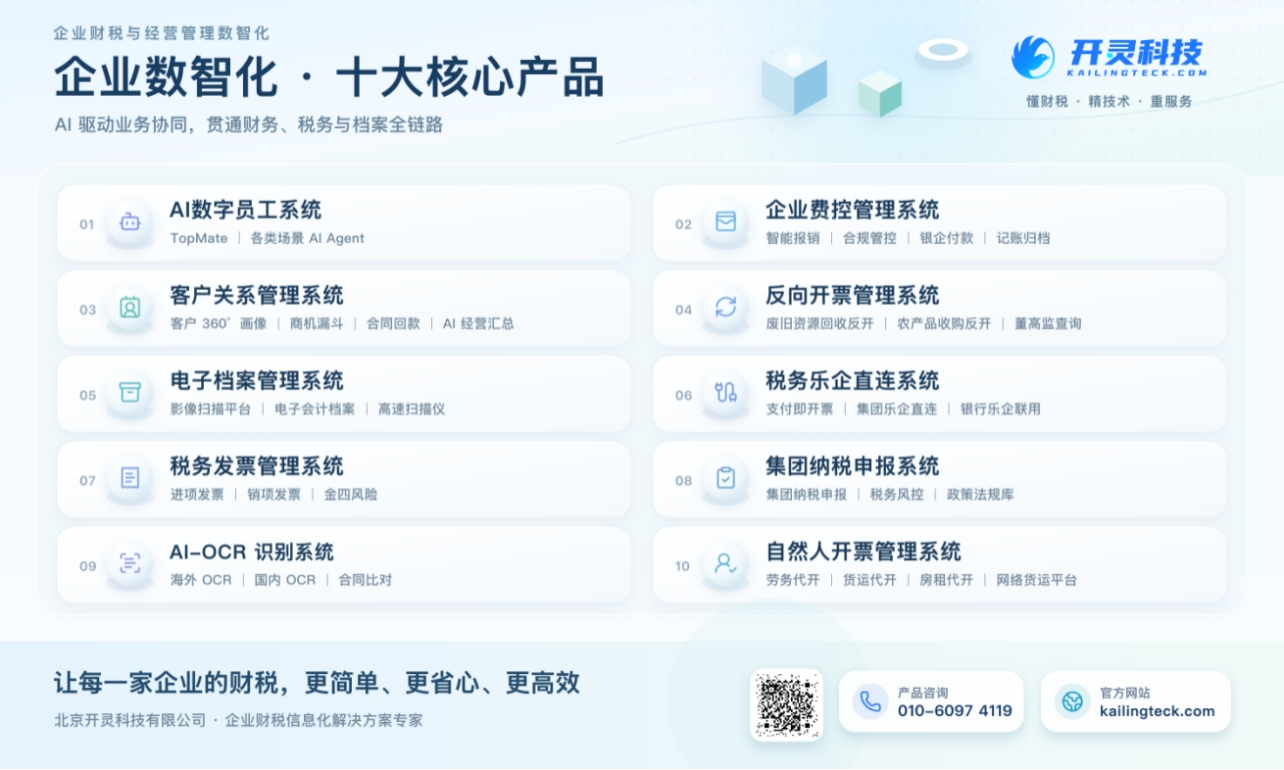
The company has now formed ten core product lines, including: AI digital employee system, enterprise expense control management system, customer relationship management system, reverse invoicing management system, invoice issuance for individuals management system, electronic archives management system, tax fully digitalized e-invoice Leqi system, tax invoice management system, group tax filing system, and AI OCR recognition system. It is committed to connecting enterprise business, finance, tax, funds, and archive data to help customers improve operational efficiency, business-finance-tax compliance capabilities, and digital management levels.
If you have any business-finance-tax digital transformation needs, welcome to contact us. Beijing Kailing Technology will serve you wholeheartedly.
Keywords: Apple purchase invoice, farmer confirmation, invoicing upon payment, purchase order number, Kailing Technology
As a comprehensive business-finance-tax digitalization solution service provider, Kailing Technology provides business-finance-tax management digital transformation products and operational services for various government agencies, institutions, and large, medium, and small enterprises. The product line includes: solutions for sales contract management system, procurement contract management system, fully digitalized Leqi interface project, automatic output invoicing system, reverse invoicing system, invoice issuance for individuals system, employee expense control and reimbursement system, input VAT invoice management system, supply chain collaborative reconciliation system, image AI OCR recognition system, automatic financial bookkeeping system, electronic accounting archives system, etc., comprehensively driving the digitalization process across various fields.
Consultation Hotline: 18513895936 / 010-60974119 Location: Beijing