
Can other vendors' AI digital employees only manage their own software? Kailing Technology's AI digital employee works across ERP/OA/finance and other multiple systems
Both are labeled "digital employees," so why can some only chat with you in a single software window and answer a few questions, while others can run errands for you across ERP, OA, and financial systems and actually get a task done? This is not a difference in marketing rhetoric, but two completely different technical routes. To judge whether an AI is truly useful, you must first separate two groups of concepts that are often conflated—conversational versus action-oriented, and other companies' digital employees versus Kailing Technology's AI digital employee. Once these two groups are distinguished, you will know whether what you bought is a "glib Q&A box" or a "colleague who can really get to work."
▍First distinguish two kinds of "AI employees": those that can answer and those that can get things done
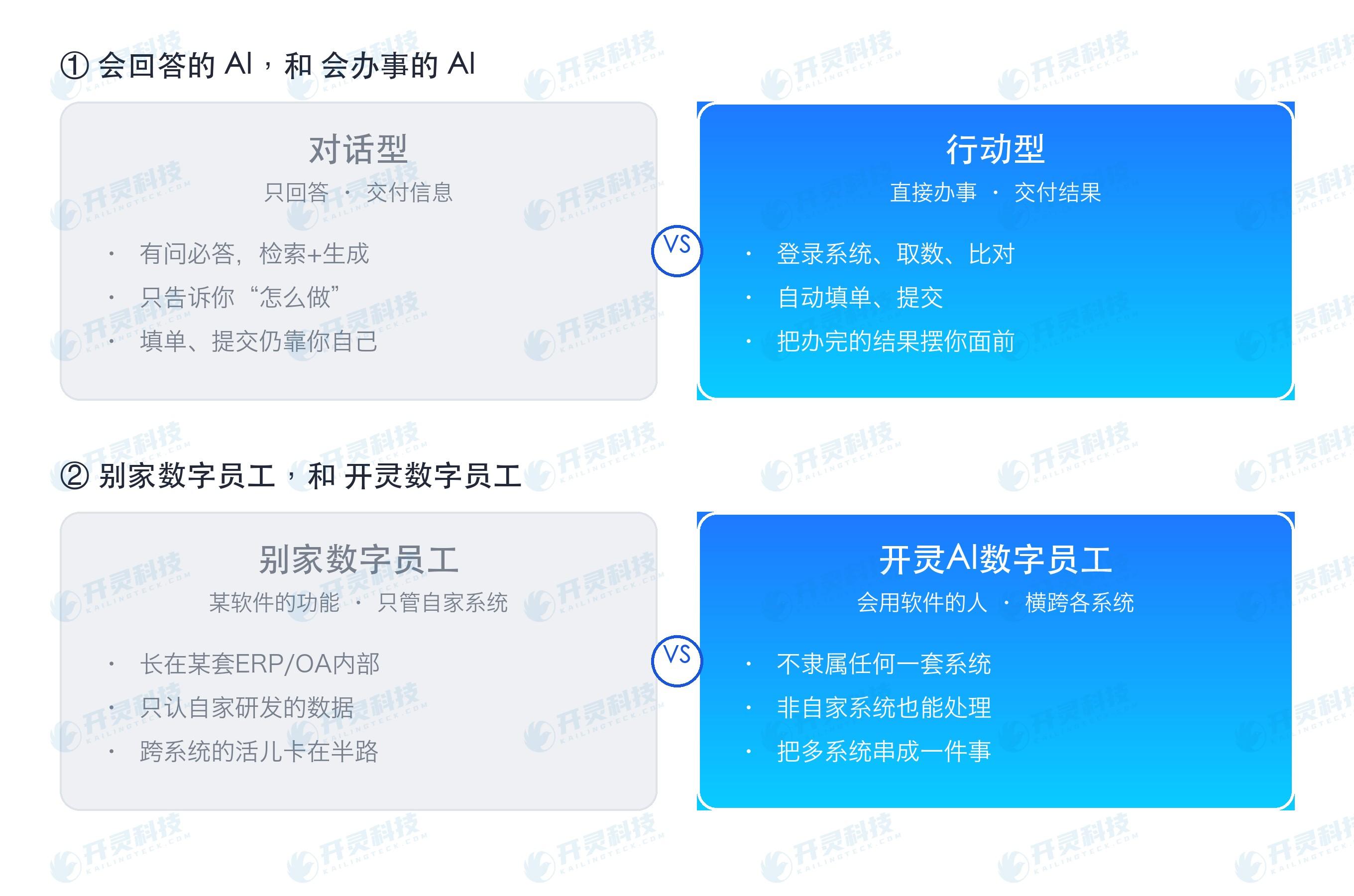
The first group to distinguish clearly is "conversational" and "action-oriented."
Conversational AI is essentially a Q&A tool that can retrieve and generate. You ask it how policies stipulate, how report formulas are written, or whom to contact for a certain process, and it answers quickly and comprehensively. But its capability stops at "telling you how to do it"—the one who actually logs into the system, fills data into documents, and clicks the submit button is still you. What it delivers is "information," not "results."
Action-oriented AI is the opposite. It is not satisfied with answering; it directly completes the business: after understanding your intent, it logs into systems, retrieves data, compares, fills in forms, and submits on its own, and finally places a usable report, a completed invoice, and a reviewed reimbursement form in front of you—delivering tangible "business results." AI that can chat is not rare; AI that can get things done is scarce—and that is exactly what Kailing Technology's AI digital employee does.
For example: if you ask a conversational AI, "How do I prepare this month's revenue reports for the three subsidiaries?", it can list the steps and even write the formulas for you, but you still have to log into three systems yourself, export data one by one, copy and paste, and repeatedly verify; switch to an action-oriented digital employee, and you only need to say, "Prepare this month's revenue reports for the three subsidiaries," and it will retrieve data from each system, consolidate, verify, and hand you the finished report directly. One hands you a manual, the other gets the work done—this is the real divide between "delivering information" and "delivering results."
▍Then distinguish two kinds of "digital employees": those that only manage their own software, and those that span across systems
The second easily confused pair is "other companies' digital employees" and "Kailing's digital employees."
Many so-called digital employees on the market are actually just "a feature inside some software." They live inside an ERP, an OA, or a financial system and can only read and process data developed and built by that same system. Switch to another system and they go blind, deaf, and useless, because they simply lack the ability to leave their "home." Yet for a real enterprise, a complete task often spans four or five systems: contracts in the business system, approvals in OA, accounts in finance, data in BI. A digital employee that only manages its own software's data can only stop halfway when facing cross-system work.
Kailing Technology's AI digital employee has a completely different positioning: it does not belong to any single business system, but handles tasks across the enterprise's existing systems; for IT systems not developed by Kailing itself, it can also intelligently recognize, call, and process them. It is more like a capable new colleague—no matter which vendor's ERP your company uses or who built the OA, as long as it is given an account and permissions, it can operate and string together steps scattered across different systems into a truly completed task.
Precisely because it "knows how to use software" like a person, cross-system work becomes its daily routine: in the morning it automatically scans the ledger in the contract system, initiates and follows up on approvals in OA, then returns to the financial system to book accounts and issue invoices. Over a day, it can handle four or five systems without changing expression. More importantly, it is on duty 7×24, and repetitive and monitoring-type work is especially worry-free; whereas a digital employee that only guards its own system can only hand the remaining work back to real people once a task crosses that system boundary.
▍Why Kailing Technology AI digital employees can "work across systems"
Being able to span systems relies not on tearing down and rebuilding all systems, but on two key designs.
First, what it replaces is the "real person operating the system," not the system itself. A digital employee does not replace ERP, nor does it change the accounting logic of the original system; what it replaces, or partially replaces, is the employee who used to sit in front of a computer operating these systems. In the past, a real person operated ERP; now a real person operates the digital employee, and the digital employee operates the various systems, with ultimate responsibility still resting with the real person, and not a single line of code in the original system needs to be changed. Since a real person can already use multiple systems at the same time, a digital employee that "knows how to use software" naturally can too.
Second, it connects to existing systems in a non-intrusive way. Kailing encapsulates the interfaces, forms, processes, and pages of systems such as OA, ERP, and finance into "tools" that AI can call using a low-code approach. After understanding the intent, the digital employee calls these tools to execute. The entire process involves zero code modification of the original systems and does not touch the underlying layer. The enterprise's IT investment of more than a decade is not wasted at all, and integration that originally took months is often compressed to weeks. This is also precisely why it can "still get things done for systems not developed in-house"—it does not need to obtain the system source code, only to know how to use these systems' interfaces and interfaces like a real person.
Working across systems ultimately saves the time people spend switching between systems, copying and pasting, and repeatedly checking. Digital employees can handle such repetitive work at 20 times the speed—reading two hundred pages of contracts in 5 minutes, reviewing twenty reimbursement forms, and working 24/7 without stopping—helping enterprises reduce costs in these areas by about 40%, while real people are freed up to do things requiring more judgment. The original systems remain unchanged, and real people are not laid off; what changes is only "who operates in front of the system."
▍Understand the differences among the three in one table
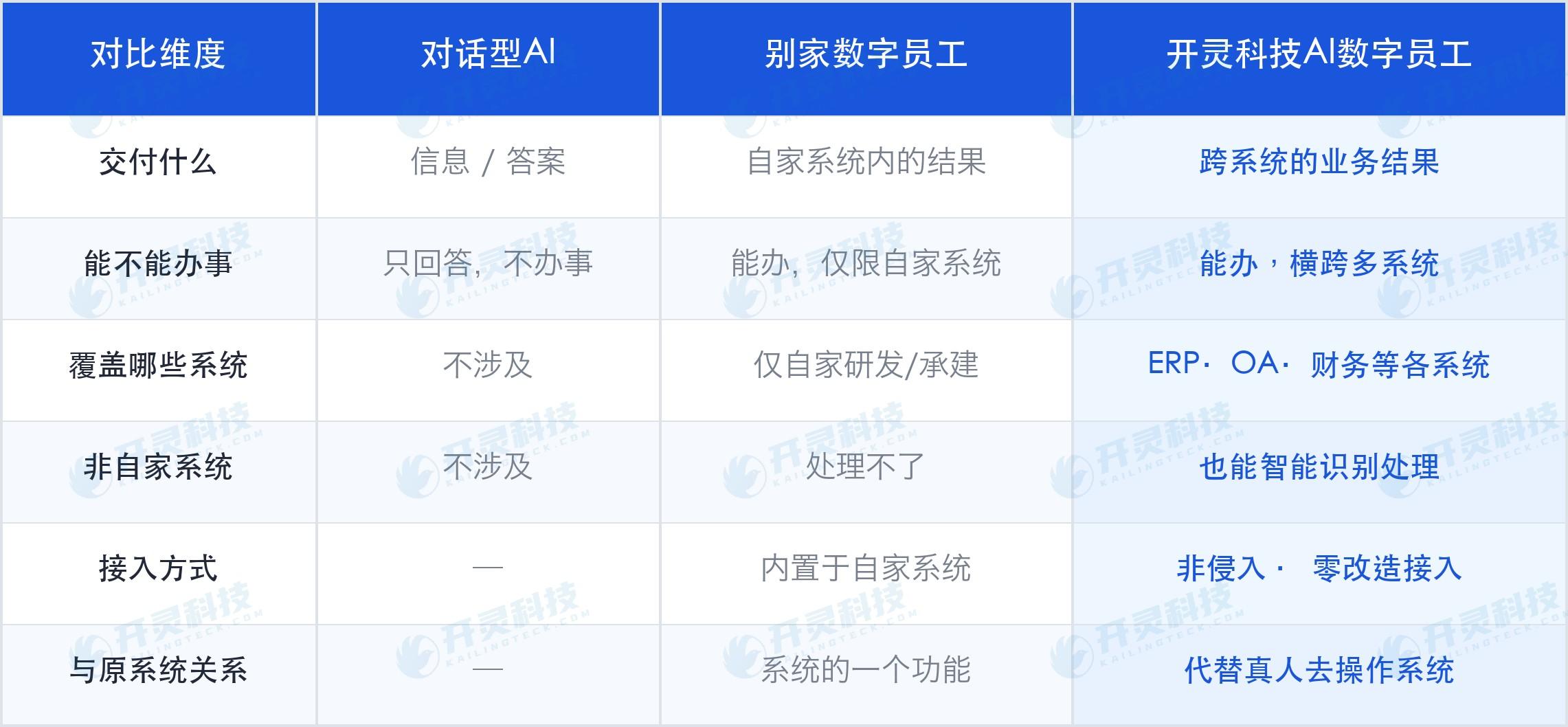
Ultimately, judging the quality of a "digital employee" comes down to two points: whether it can only answer or can actually get things done; and whether it only guards its own turf or can span across an enterprise's various systems. Put conversational AI, other vendors' digital employees, and Kailing Technology's AI digital employee in the same table for comparison, and the difference is clear at a glance:
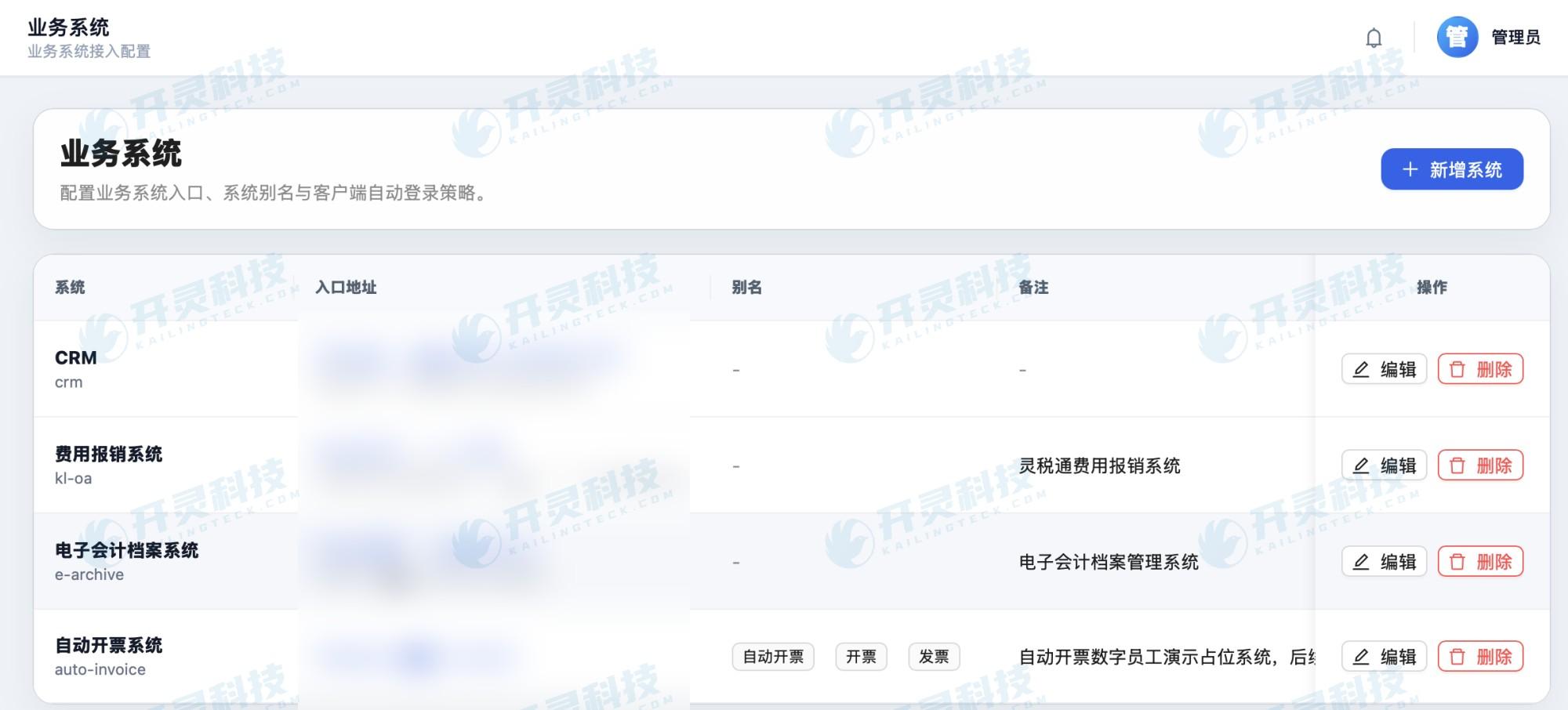
On Kailing's management side, the enterprise's existing multiple systems will be "registered" and connected one by one, and digital employees can then retrieve data and handle matters across these systems within the authorized scope. The figure below is the actual interface for business system access configuration — a "workbench" spanning multiple systems, allowing digital employees to shuttle between different systems like real people.
▍FAQ
Q: With so many systems involved, do we need to modify our existing ERP and OA?
A: No. Kailing adopts a non-invasive, zero-code approach to encapsulate the interfaces and processes of existing systems into callable tools, without modifying the underlying original systems. This protects existing IT investment and compresses the integration cycle from months to weeks.
Q: Will AI digital employees replace our ERP or financial system?
A: No. What it replaces is the human link of repetitive system operations, not the system itself. The original system runs as usual; the digital employee merely operates on behalf of real people, key nodes are still confirmed by humans, and accountability remains unchanged.
Q: Can one digital employee handle tasks across multiple systems at the same time?
A: Yes. This is exactly the core value of an action-oriented AI digital employee—like a real person, it retrieves data, compares, fills in forms, and submits across multiple systems, completing a cross-system task in one go.
Want one digital employee to handle tasks across your multiple systems? Welcome to contact Kailing Technology for a business-fit demo: www.kailingteck.com .
As a comprehensive business-finance-tax digitalization solution service provider, Kailing Technology provides business-finance-tax management digital transformation products and operational services for various government agencies, institutions, and large, medium, and small enterprises. The product line includes:
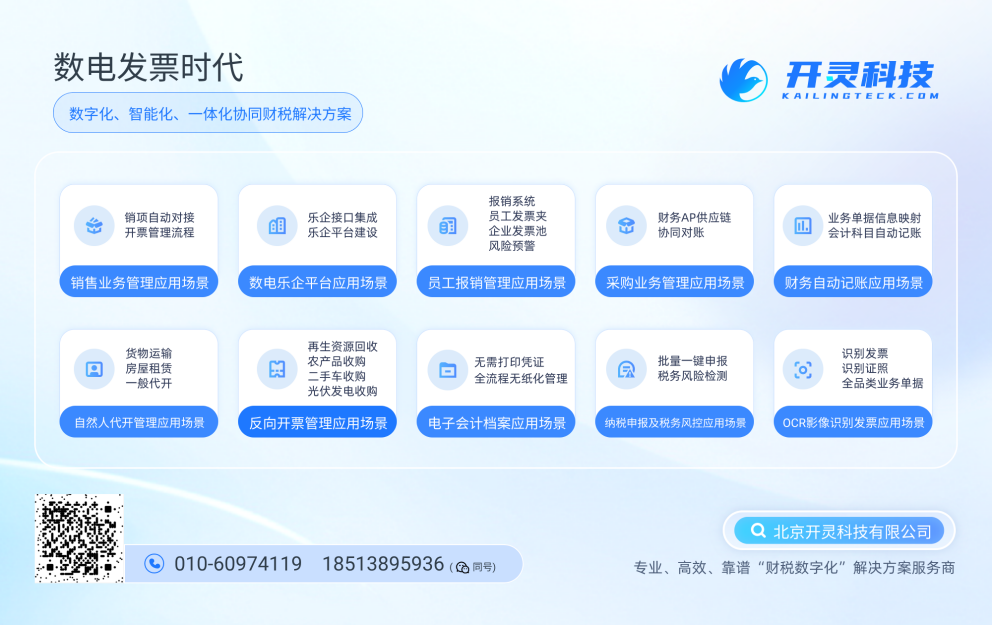
Solutions for businesses including sales contract management system, procurement contract management system, fully digitalized Leqi interface project, output automatic invoicing system, reverse invoicing system, invoice issuance for individuals system, employee expense control and reimbursement system, input VAT invoice management system, supply chain collaborative reconciliation system, image OCR recognition system, automatic financial bookkeeping system, and electronic accounting archives system, comprehensively driving the digitalization process across various fields.
If you have any business-finance-tax digital transformation needs, welcome to contact us. Beijing Kailing Technology will serve you wholeheartedly.
Keywords: Kailing Technology's AI digital employee, action-oriented digital employee, cross-system task handling, ERP/OA/finance, non-intrusive access, business-finance-tax digitalization
As a comprehensive business-finance-tax digitalization solution service provider, Kailing Technology provides business-finance-tax management digital transformation products and operational services for various government agencies, institutions, and large, medium, and small enterprises. The product line includes: solutions for sales contract management system, procurement contract management system, fully digitalized Leqi interface project, automatic output invoicing system, reverse invoicing system, invoice issuance for individuals system, employee expense control and reimbursement system, input VAT invoice management system, supply chain collaborative reconciliation system, image AI OCR recognition system, automatic financial bookkeeping system, electronic accounting archives system, etc., comprehensively driving the digitalization process across various fields.
Consultation Hotline: 18513895936 / 010-60974119 Location: Beijing