
Supply chain reconciliation precautions: six types of discrepancies and closing evidence

Supply chain reconciliation precautions: six types of discrepancies and closing evidence
Reconciliation discrepancies are not a vague "amount mismatch." The same difference may come from partial delivery, contract price adjustment, cross-period posting, red-letter invoices, duplicate imports, or unit conversion. If you simply change exception rows to "processed," questions will keep recurring at month-end. A more reliable approach is to first classify the discrepancies, then set an owner, permitted handling actions, and closing evidence for each type.
The criterion for closing an exception is not that the color turns green, but that the cause can be explained clearly, the impact can be calculated, the responsibility can be identified, and the evidence can be retrieved. |
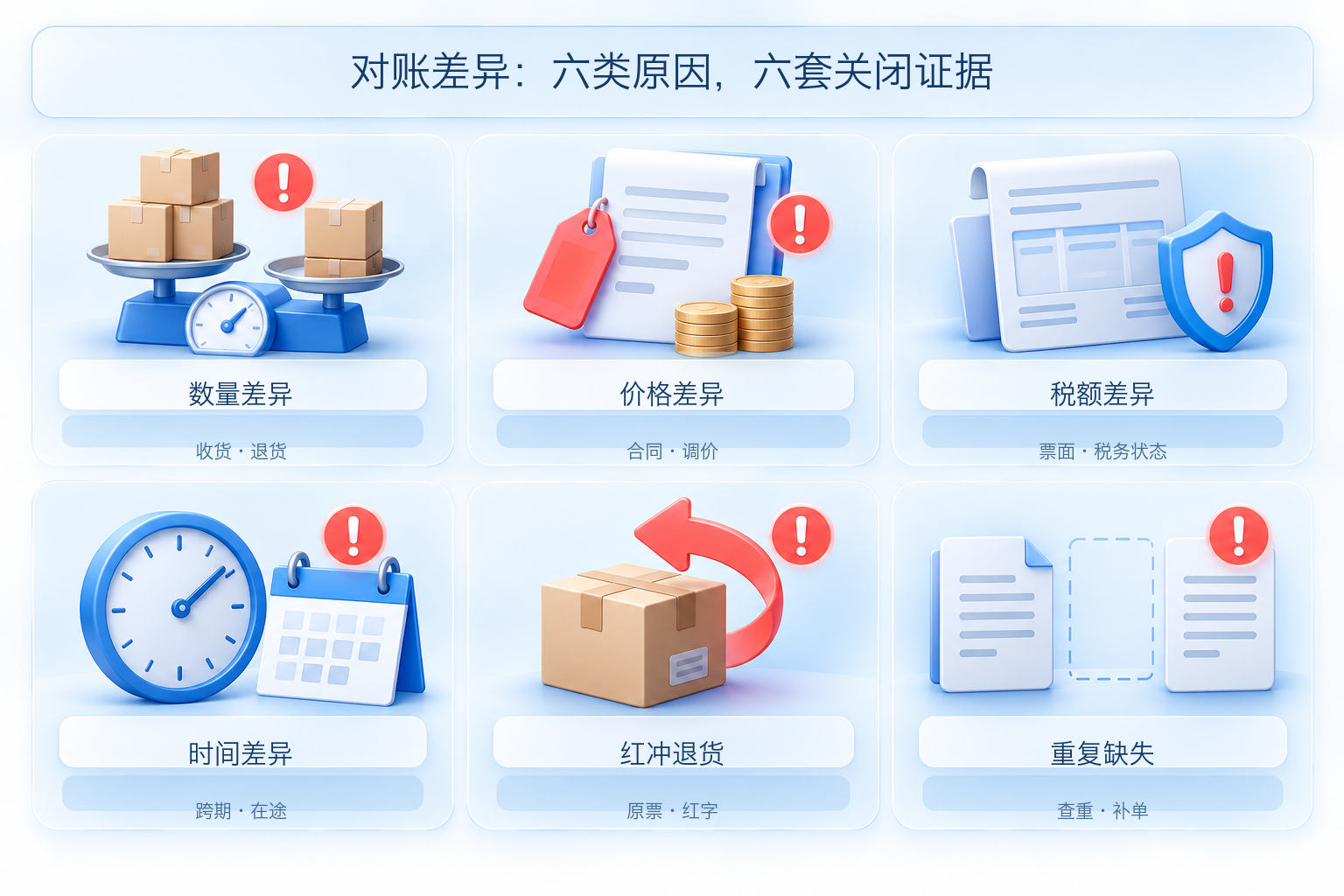
▍1. Quantity discrepancy: first check receiving, returns, and units of measure
When the order quantity differs from the receipt quantity, it may be due to partial delivery, short shipment, over-receipt, rejection, returns not yet written back, or inconsistent conversion between the purchasing unit and the inventory unit. When handling, the order line, receipt batch, quality inspection result, return document, and undelivered quantity should be checked at the same time; the invoice quantity must not be used to overwrite the actual receipt record.
Acceptable closing evidence includes supplemented or corrected receiving records, warehouse confirmation, return slips, unit conversion rules, and the handling conclusion for the remaining undelivered quantity. If the contract allows a certain tolerance, the rule version and approval basis should be retained; records exceeding the tolerance still require confirmation by the business owner. Received quantities already occupied by other invoices must not be allocated again.
▍2. Price discrepancy: distinguish contract price, discounts, and additional charges
Price inconsistencies commonly arise from contract version changes, temporary price adjustments, tiered pricing, rebate discounts, splitting of freight or service fees, and mixing tax-inclusive and tax-exclusive bases. When investigating, confirm the price effective date, currency, tax basis, cost-bearing method, and applicable order line; do not ignore unit price rules just because the total amount is close.
Closing a price discrepancy usually requires a valid contract or supplementary agreement, price adjustment approval, cost allocation explanation, and reissued orders or invoices. If it is a reasonable rounding difference, clear precision and authorization thresholds should be set, and who approved the rounding difference handling should be recorded. A handler manually entering a note is not sufficient to support subsequent audits.
▍3. Tax amount discrepancy: verify invoice face, transaction, and tax status separately
Matching invoice and order amounts does not mean the tax amount is necessarily correct. You also need to check the buyer and seller, item name, tax base, invoice face tax amount, invoice date, current status, and the corresponding original transaction. Discounts, out-of-price charges, different tax treatments, and rounding can all change the price-tax structure.
Closure evidence for such discrepancies may include reviewed invoice face information, business explanations, reissuance or red-letter handling records, and valid invoice status results. The system can collect fields and flag anomalies, but tax treatment should be confirmed based on the real business and applicable rules; when special transactions are involved, it should be reviewed by business-finance-tax personnel, and "system matching succeeded" cannot replace professional judgment.
▍4. Timing discrepancy: identify cross-period, in-transit, and cutoff points
Orders, arrivals, acceptance, invoicing, and payment often span different months. Goods that have arrived before month-end but whose invoice has not arrived, or invoices that have arrived while acceptance is not complete, may form reasonable timing discrepancies. If business occurrence time, document generation time, system receipt time, and financial period are not distinguished, cross-period items will be misjudged as missing documents.
Closing evidence should include in-transit or provisional status, expected invoice or acceptance date, owner, and subsequent write-off actions. Cross-period items should not be deleted directly; they should enter the open-items queue and be checked again in the next cycle, and escalated if still unresolved by the agreed date. Month-end cutoff times and time zones should also be unified to prevent the same record from falling into different periods in different systems.
▍5. Red-letter reversal and returns: the original invoice and the reverse business relationship must be retained
A return may first involve a logistics return, and then form a return document, red-letter handling, and re-invoicing. If only the final net amount is retained, the relationship between the original order, original receipt, original invoice, and return will be broken. Especially for partial returns, the returned order line, quantity, batch, and occupied invoice amount should be clearly defined to prevent the entire transaction from being reversed incorrectly.
Closing this type of discrepancy requires the return request and approval, warehouse return records, original invoice association, red-letter or correction records, reissue information, and refund or deduction results. Subsequent actions should be appended to the original transaction chain rather than overwriting the original status. This way both the current net amount and the reason for the change can be seen.
▍6. Duplicates and omissions: two-way control using idempotency keys and completeness checks
Interface retries, duplicate file uploads, duplicate email receipt, or manual supplementary entry may cause the same order, receipt, invoice, or payment to enter the system twice; mapping failures, batch interruptions, and missing fields may prevent records from entering the reconciliation pool. Checking only for duplicates without checking for missing records, or only supplementing missing documents without preventing re-import, cannot form stable control.
It is recommended to form the idempotency judgment from the business primary key, upstream system, original document number, line number, and receiving batch, while also recording the file digest or message identifier. When duplicates are found, first freeze subsequent allocation, confirm whether it is a true duplicate, and then revoke the redundant relationship; when missing records are found, locate them layer by layer from batch completeness, the failure queue, and upstream totals. Closure evidence includes duplicate-check results, supplementary entry records, replay logs, and the list of affected relationships.
▍Put the six types of discrepancies into a unified closing matrix
| Discrepancy type | Primary responsible position | Typical closing evidence |
| Quantity discrepancy | Procurement, warehouse | Receipts, returns, unit conversion, and approval |
| Price discrepancy | Procurement, business owners | contract version, price adjustment approval, cost explanation |
| Tax amount discrepancy | Finance, tax positions | Invoice face review, status results, correction records |
| Timing discrepancy | Business, Finance | Open status, expected date, subsequent write-off |
| Red-letter reversal and returns | Procurement, warehouse, finance | Return chain, original invoice relationship, red-letter and refund results |
| Duplicates and missing records | System operations, business | Idempotency checks, failure queue, supplementary entry and replay logs |
Beyond the matrix, there are three basic controls. First, master data and rule versions must be traceable to avoid the same supplier, material, or unit of measure having different meanings in multiple systems. Second, every exception must have a status, responsible person, and deadline, and must be reviewed by an independent position or rule before closure. Third, all imports, revocations, replays, and manual modifications must retain operation logs to prevent fixing one place while creating new duplicates.
▍How Kailing Technology products handle exception queues and evidence chains
The supply chain collaboration page on the Kailing Technology official websitePresents the associations and exception rollback directions among purchase orders, receiving records, and supplier invoices, as well as among sales orders, shipment records, and customer invoices;Kailing AI OCRCan provide structured document data,Electronic Accounting Archives SystemCan handle associated archiving and retrieval. During implementation, interfaces, exception categories, responsibility routing, permissions, and evidence requirements should be determined according to the enterprise's existing systems, and acceptance should be carried out item by item using samples of the six types of discrepancies.
Acceptance reminder: Whether each discrepancy type has a unique responsible position; whether closure actions are controlled by permissions; whether evidence can be traced back to the original document; whether cross-period items enter the next cycle; whether red-letter reversals and returns retain the original relationship; whether duplicate imports hit the idempotency check; whether manual modifications leave audit records.
Keywords: supply chain reconciliation precautions, reconciliation discrepancies, quantity discrepancy, price discrepancy, tax amount discrepancy, red-letter reversal and returns, duplicate payment, Kailing Technology
As a comprehensive business-finance-tax digitalization solution service provider, Kailing Technology provides business-finance-tax management digital transformation products and operational services for various government agencies, institutions, and large, medium, and small enterprises. The product line includes: solutions for sales contract management system, procurement contract management system, fully digitalized Leqi interface project, automatic output invoicing system, reverse invoicing system, invoice issuance for individuals system, employee expense control and reimbursement system, input VAT invoice management system, supply chain collaborative reconciliation system, image AI OCR recognition system, automatic financial bookkeeping system, electronic accounting archives system, etc., comprehensively driving the digitalization process across various fields.
Consultation Hotline: 18513895936 / 010-60974119 Location: Beijing