
Detailed steps of the supply chain reconciliation process: five steps to form a reviewable closed loop

Detailed steps of the supply chain reconciliation process: five steps to form a reviewable closed loop
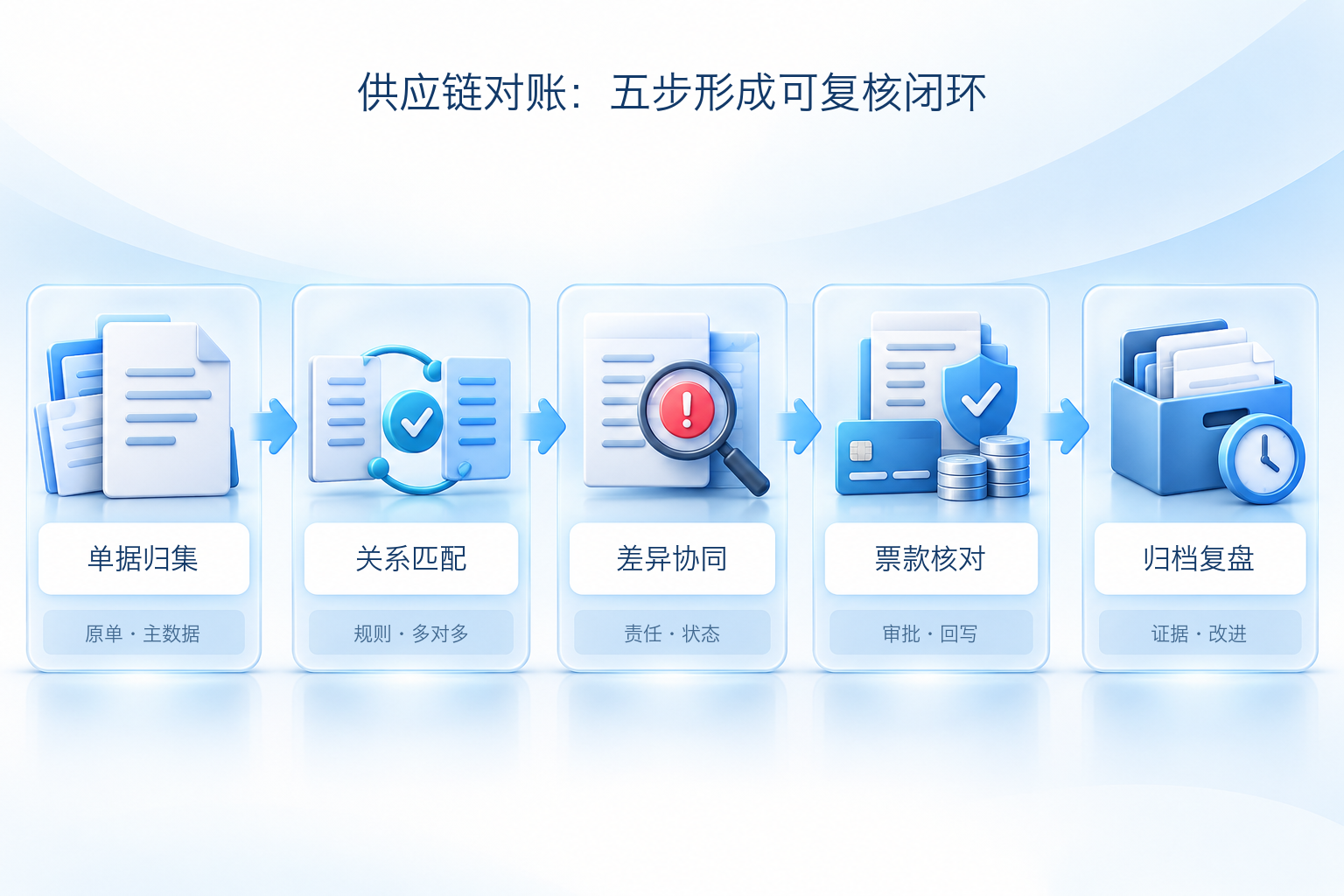
Month-end "unreconciled" situations are often not because a table was missing, but because orders, receipts, returns, invoices, and payments are scattered across different systems, and the original document numbers and business statuses have no continuous relationship. The goal of supply chain reconciliation is to enable every pending settlement transaction to answer five questions: where the original record is, how the records are related, who handles the discrepancy, why payment is allowed, and whether the process can be restored afterward. The five steps are broken down below by input, action, output, and acceptance point.
The core of the reconciliation closed loop is not that "the amounts match," but that the original documents, relationships, discrepancies, approvals, and closing evidence can all be reviewed. |
▍Preparation: first define the transaction chain and reconciliation scope
Procurement business commonly involves purchase orders, receipt or inbound records, supplier invoices, and payment applications; sales business may correspond to sales orders, shipments, customer invoices, and collections. The actual chain is not always the fixed "four documents": service procurement may have no physical inbound, a framework agreement may have one order corresponding to multiple receipts, and multiple invoices may also be settled together. Therefore, before the project starts, required documents, optional documents, reconciliation cycles, currencies, units of measure, and tolerance rules should be defined by business type.
The output of the preparation stage is an executable reconciliation rule list that at least specifies the business organization, supplier or customer scope, primary and auxiliary keys, tax-inclusive or tax-exclusive basis, quantity and amount precision, cutoff time, exception levels, and manual review points. If the rules are not frozen first, even if the system later finds candidate relationships, they are likely to be recalculated repeatedly due to changes in basis.
▍Step 1: Collect original documents and master data, and retain receiving batches
Inputs include orders, receipts, returns, invoices, payment or collection records, and master data such as suppliers, materials, contracts, tax information, and bank accounts. The access method can be business system interfaces, database views, files, emails, or manual uploads; the specific channel depends on the existing system and project plan. When collecting, do not save only a summary table; also retain the original document number, receipt time, receiving batch, upstream status, and necessary attachments for traceability.
At this stage, first perform completeness and basic quality checks: whether required fields are empty, whether numbers are duplicated, whether currencies and units are consistent, whether dates fall within the reconciliation period, and whether supplier codes have mappings. OCR can convert images or scans into structured candidate data, but after field recognition it should still undergo rule validation or manual review before entering subsequent business processing. The acceptance criterion is that "every record has an original document, a batch, and a status," not merely counting how many rows were imported.
▍Step 2: Establish many-to-many relationships and distinguish confirmed matches from candidate relationships
Supply chain transactions commonly involve one-to-many, many-to-one, and many-to-many. The system can first establish confirmed matches using conditions such as order number, material, supplier, quantity, amount, and date range, then use combination rules to find candidate relationships. Records that fully satisfy the rules can move to the next status; records that satisfy only some conditions should remain in the candidate pool for confirmation by the designated position, and similar records must not be directly written as final associations.
The relationship table must be able to trace "who is matched with whom, which rule version was used, when it was confirmed, and whether it was withdrawn." When encountering split orders, merged orders, partial deliveries, prepayments, or final payments, it is also necessary to record allocated quantities and remaining quantities to prevent the same receipt or invoice from being occupied repeatedly. During acceptance, samples such as normal, cross-period, partial receipt, return, and duplicate import should be extracted to confirm that both relationships and remaining quantities can be recalculated.
▍Step 3: Turn discrepancies into collaborative tasks with owners
A discrepancy should not be shown as just a red number. Each discrepancy needs a type, amount or quantity basis, evidence, responsible person, handling deadline, and current status. Procurement confirms price and contract changes, the warehouse confirms actual receipts and returns, finance checks the invoice face and payment terms, and the supplier supplements invoices or statements. Only when responsibilities are clear can issues shift from "finding the right person at month-end" to routine queue handling.
When closing a discrepancy, a handling conclusion must be selected, such as supplementing the original document, adjusting the association, confirming a reasonable cross-period, initiating a return, waiting for a red-letter invoice, or returning for reissue, with closing evidence attached. System statuses should at least distinguish pending confirmation, in progress, pending review, closed, and revoked. Items exceeding the time limit can be escalated with reminders, but reminders do not replace business approval.
▍Step 4: Verify invoices, approvals, and invoice-payment status separately
Invoice verification focuses on buyer and seller, items, quantity, amount, tax amount, invoice date, invoice status, and the relationship to the original transaction; payment verification focuses on the request, approval, payment terms, bank result, and write-back status. The two can be linked, but should not be merged into a single "pass if amounts match" judgment. Some businesses pay before invoicing, and some require acceptance before payment, so the rules should correspond to the actual contract and authorization process.
Before payment, the system can summarize confirmed matching relationships, unclosed discrepancies, invoice status, and approval records for the handler to review. Whether to route automatically, which exceptions require manual approval, and whether data can be written back to ERP or treasury systems should be determined according to permissions, versions, interfaces, and project scope. The acceptance output is an explainable payment basis, not a single result that cannot be reconstructed.
▍Step 5: Archive evidence and review high-frequency causes
After reconciliation is completed, the original documents, associations, rule versions, discrepancy handling records, approval opinions, invoice-payment status, and attachments should form the same evidence chain. When archiving, retain both business time and operation time, and leave the operator and the status before and after changes for important actions. If reversals, refunds, or supplementary invoices occur later, new records should be appended and linked to the original transaction without overwriting the historical process.
Month-end review should not only count unreconciled quantities, but also analyze recurring causes by supplier, material, organization, discrepancy type, and occurrence stage. If unit conversion, master data mapping, or contract price version issues occur frequently, front-end rules should be corrected first; if discrepancies are concentrated in receipt delays, data synchronization and cut-off times should be adjusted. The output of the review is the rule improvement items and responsibility plan for the next cycle.
▍Kailing Technology's implementation path for supply chain reconciliation
Kailing Technology Supply Chain Collaboration PlatformPublicly demonstrates the direction of document matching, exception rollback, and relationship traceability across procurement and sales chains;Kailing AI OCRCan be used for structured invoice collection,Input invoice collection management platformandElectronic Accounting Archives SystemCan handle invoice management and evidence archiving. The actual connected systems, fields, rules, permissions, automation scope, and manual review points should be determined based on the target version and project plan, and accepted using normal and exception samples.
Execution check: Whether the scope is frozen; whether original documents and batches are retained; whether the remaining many-to-many quantity can be recalculated; whether candidate relationships are confirmed; whether discrepancies have responsible persons and closure evidence; whether the payment basis is explainable; whether the entire process can be reconstructed from the original document after archiving.
Keywords: supply chain reconciliation process, procurement reconciliation, order-receipt-invoice matching, many-to-many matching, discrepancy collaboration, reconciliation evidence, Kailing Technology
As a comprehensive business-finance-tax digitalization solution service provider, Kailing Technology provides business-finance-tax management digital transformation products and operational services for various government agencies, institutions, and large, medium, and small enterprises. The product line includes: solutions for sales contract management system, procurement contract management system, fully digitalized Leqi interface project, automatic output invoicing system, reverse invoicing system, invoice issuance for individuals system, employee expense control and reimbursement system, input VAT invoice management system, supply chain collaborative reconciliation system, image AI OCR recognition system, automatic financial bookkeeping system, electronic accounting archives system, etc., comprehensively driving the digitalization process across various fields.
Consultation Hotline: 18513895936 / 010-60974119 Location: Beijing