
What to do when reimbursement forms are always returned? The Kailing Technology expense control and reimbursement management system verifies invoices, budgets, and expense standards before submission
Employees only learn after submitting a reimbursement that the invoice header is wrong, the budget is insufficient, or the accommodation exceeds the standard, and the approval form circulates back and forth between the employee and finance. Not all returns can be solved by the approver taking one more look. Kailing Technology's expense control and reimbursement management system "Lingdong Reimbursement" moves invoice, budget, and expense standard checks forward as much as possible, so employees see items needing correction before submission.

▍First divide return reasons into three categories
The first category is document issues: duplicate invoices, mismatched invoice titles or tax numbers, or invoice types that do not match the expense item. The second category is budget issues: insufficient balance in the affiliated organization, project, or account, or unclear occupancy criteria. The third category is standard issues: travel class, accommodation limits, or entertainment rules that do not comply with the current policy. Different issues should be given different correction suggestions.
Employees collect invoices in the invoice folder of Lingdong Reimbursement, and the system can perform recognition, verification, and duplicate checks. When filling out a reimbursement form, select from collected invoices to reduce duplicate uploads and manual transcription. A genuine invoice still does not mean the expense is reimbursable; business occurrence, budget, and policy still need to be checked separately.
Return records should retain the rule hit and field location. Showing only "incomplete materials" leaves employees unsure which receipt to supplement; showing only "over-standard" also makes it impossible to determine which day's accommodation or which transportation expense exceeded the limit. Specific prompts can reduce repeated explanations between submitters and reviewers.
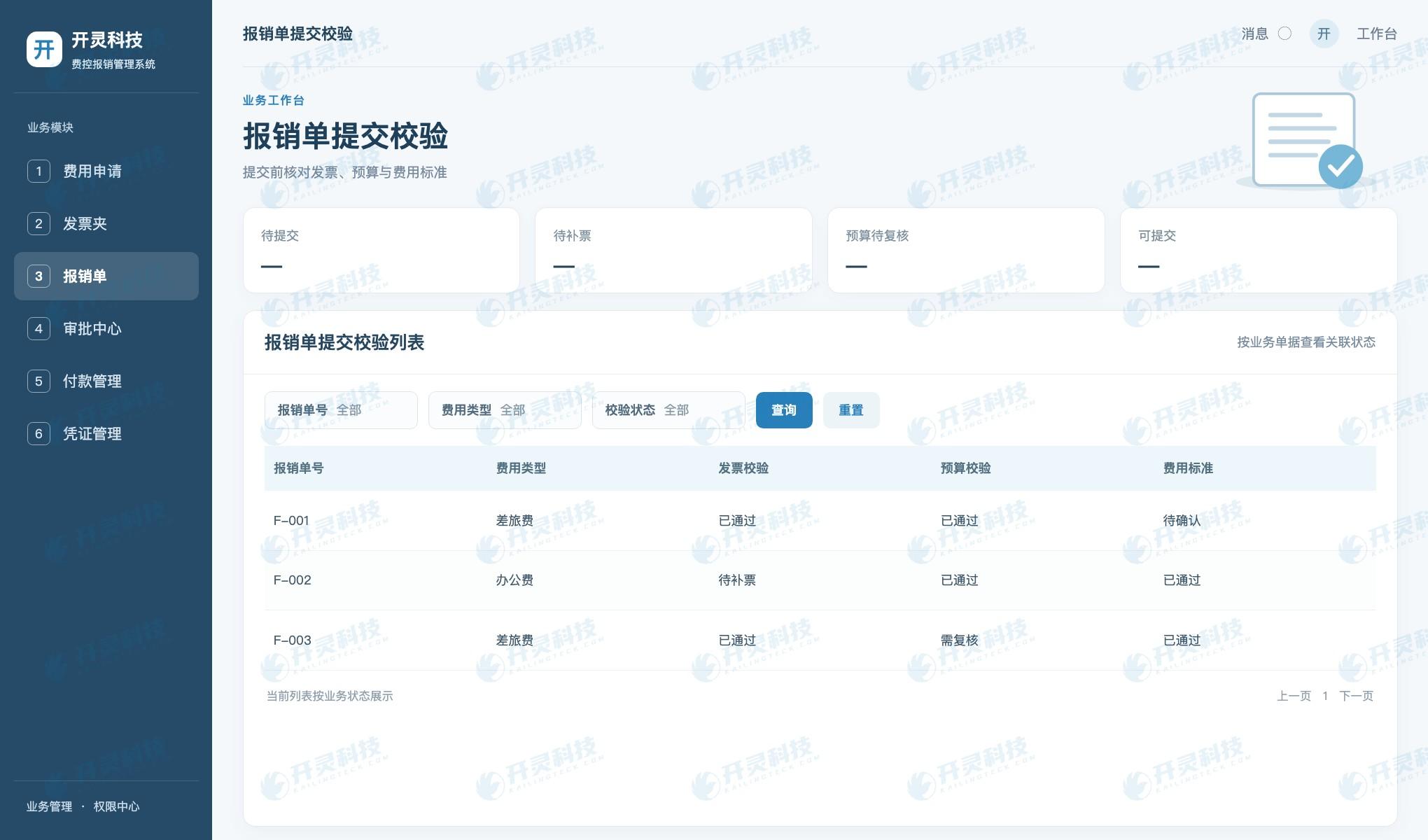
Invoice verification before reimbursement form submission
▍Budget verification must consider organization and expense attribution
Group expense budgets may be controlled separately by legal entity, department, project, and period. Employees select the correct affiliation before reimbursement, so the system knows which budget to occupy. When the budget balance is insufficient, the available amount and application path can be shown to avoid rejection by the supervisor only after submission.
Pre-occupation and actual posting should not be conflated. Application approval, reimbursement submission, and financial posting occur at different times, and the enterprise needs to clarify the budget criteria. If canceled or returned, the occupation should be released according to the rules while retaining change records.
The Kailing Technology expense control and reimbursement management system supports multiple organizations and custom processes; during implementation, budget and approval rules can be configured according to enterprise policies. Rule effective dates and versions must be retained, to avoid historical documents being re-judged as wrong under current standards after a new policy goes live.
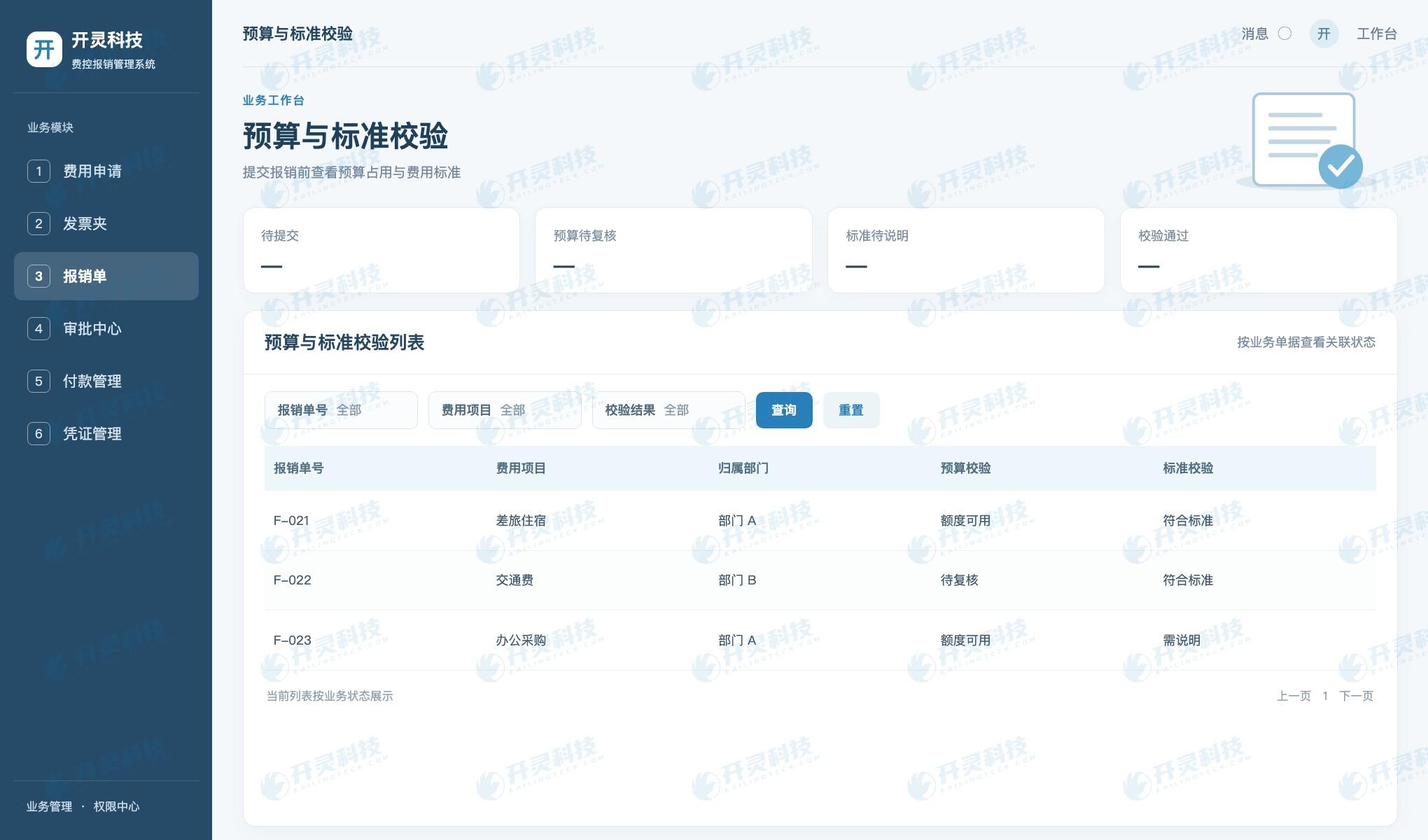
Budget and expense standard validation results
▍Explain the expense standard before submission
Different standards apply to travel transportation, accommodation, meal allowances, and office procurement. After employees select the expense type and travel dates, the system should check the applicable organization, job level, and region, and flag any over-standard portion. If exceptions are allowed for special items, the approver and additional notes must be specified.
Digital employees can pre-review reimbursement forms based on enterprise-configured policies, identify missing materials or rule conflicts, and then hand exceptions to humans. They should state which rule was triggered, rather than only outputting "recommend approval." Reviewers can use this to quickly locate key points, while still bearing judgment responsibility for the actual business.
Pre-submission verification should also allow employees to explain genuine exceptions, such as temporary accommodation due to a canceled flight. The system places the explanation, approval, and receipt materials in the same reimbursement form, avoiding another return because system materials were not updated after offline communication.
▍Assess by return rate and rework reasons
Before go-live, select five samples: wrong header, duplicate invoice, insufficient budget, standard exceeded, and reasonable exception. Observe whether employees can see accurate prompts before submission, whether re-verification is automatic after modification, and whether approvers can see the handling process.
After running for a period, count the distribution of returned documents by reason. If a large number of returns come from the same rule, it may be that the policy is expressed unclearly, budget data updates lag, or front-end prompts are not specific enough. Product improvement should return to the cause rather than simply adding approval levels.
The value of Kailing Technology Lingdong Reimbursement is to handle issues that can be clearly judged before submission as much as possible, so that approvers can focus on business necessity and exceptions. System rules are confirmed by the enterprise, and execution results can be continuously tested through actual return records.
▍Turn return records into a rule base for continuous improvement
Employees who see "invoice issue" still do not know what to do. Pre-submission prompts should point to the specific invoice, field, and selectable action: replace the invoice, correct the expense type, add an explanation, or submit an exception approval. For matters whose authenticity cannot be automatically determined, it should be clear which reviewer needs to confirm, avoiding the system repeatedly sending the reimbursement form back to the initiator.
Budget validation must consider data update frequency. If finance has just approved an additional budget but the reimbursement system still uses yesterday's balance, employees may be incorrectly blocked. The project should confirm the synchronization time between the budget system and Lingdong Reimbursement, failure prompts, and temporary handling methods. When employees raise objections to system results, finance can see the budget criteria and the current data timestamp.
Expense standards also change with policy adjustments. Travel class, regional standards, and applicable dates require version management. When employees reimburse historical travel expenses, the system should determine the applicable rules based on when the expense occurred and the enterprise policy; it must not automatically judge last month's genuinely compliant expenses as over-standard just because a new standard went live today.
Every month, finance spot-checks three types of records: duplicate invoices, insufficient budget, and over-standard returns, and observes whether they are concentrated in a certain department, expense type, or form field. If the cause is that employees do not understand the prompts, change the wording and help text; if the cause is that the policy is unclear, first supplement the management rules. The Kailing Technology expense control and reimbursement management system keeps these data within the document process, making it easy for enterprises to continuously optimize.
▍The prompts seen by employees and finance should differ
Before submission, employees need to know how to correct: which invoice to replace, what explanation to add, and whom to ask for approval if the budget is insufficient. During financial review, they need to see the rule version, verification results, employee modification trail, and exception approvals. Both sides share one reimbursement form, but the information levels differ, avoiding piling all complex verification logs onto the employee page.
For expense types that are frequently returned, common errors and correct filling methods can be placed next to the form. New employees can get help before submission, while finance uses return reason statistics to judge whether training is effective. Lingdong Reimbursement connects policy execution with actual documents, and both rule maintenance and employee experience can be improved based on data.
▍FAQ
Q: If the invoice verification passes, will the expense report not be returned?
A: The expense attribution, budget, standards, and business materials also need to be verified.
Q: Can expenses be automatically changed to another department when the budget is insufficient?
A: The expense attribution should not be changed without authorization; it should be handled according to the enterprise's budget adjustment or exception approval process.
Q: Can AI digital employees replace manual approval?
A: Pre-review can be done according to clear rules, but exceptions and high-risk judgments still require confirmation by personnel with authority.
Q: How should the system prompt when the invoice header is wrong?
A: Point out the specific invoice and the fields inconsistent with the current reimbursement organization, and explain the paths for replacing the invoice, contacting the issuer for correction, or transferring to manual confirmation. After the employee modifies it, re-verify and retain the original return reason. For group multi-legal-entity scenarios, first confirm the expense attribution and purchaser rules to avoid directly marking special circumstances in real business as errors.
Q: If the expense standard allows exceptions, is pre-submission verification still needed?
A: Yes. The system first indicates the standard and the excess portion, then lets the employee fill in the business reason and submit it to an approver with authority. An exception is not a switch-off of the rule, but a record of an approved handling outside the rule. Reviewers can see the original standard, reimbursement amount, and reason at the same time, and subsequent reviews can also determine whether exceptions are too frequent.
Visit Kailing Technology to learn about related products and implementation plans: https://www.kailingteck.com/feikong/ .
As a national high-tech enterprise, Kailing Technology focuses on the digital and intelligent transformation of enterprise business-finance-tax and operations management, providing software products, system integration, implementation and delivery, and operational services for various government agencies, institutions, group enterprises, and SMEs.
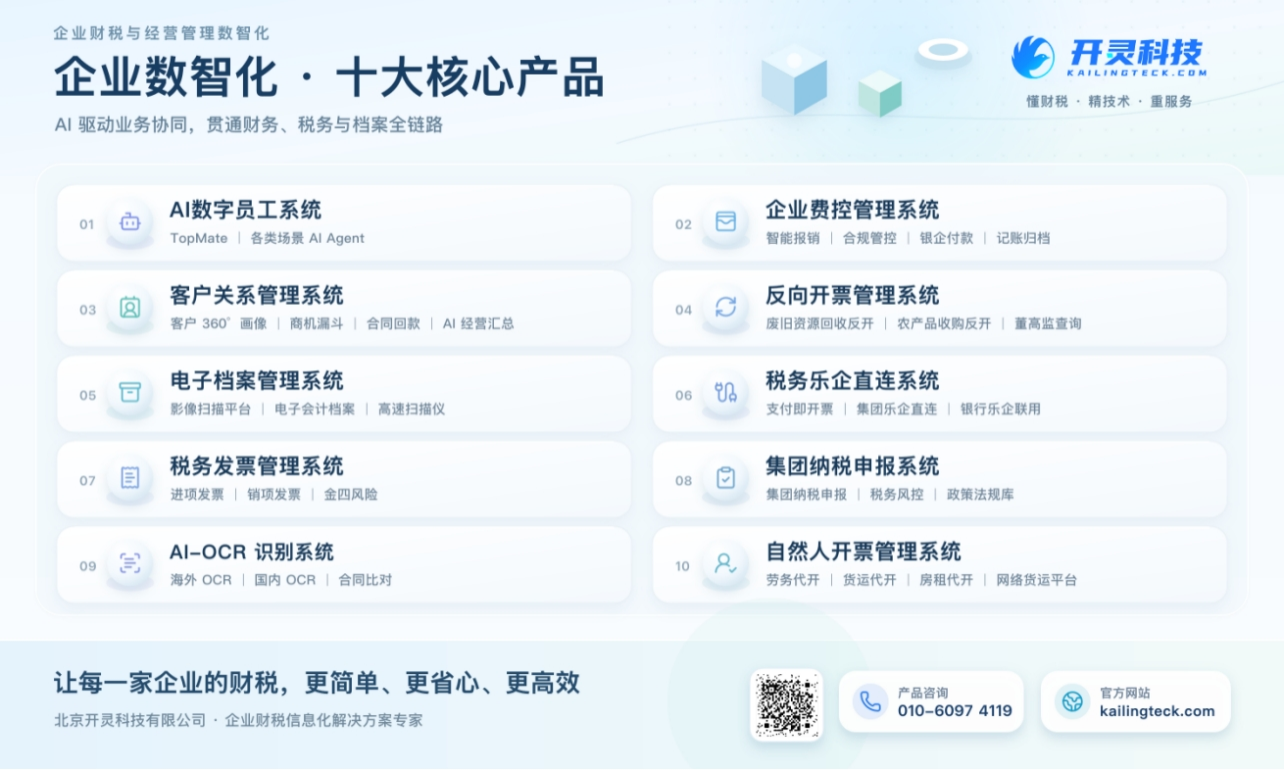
The company has now formed ten core product lines, including: AI digital employee system, enterprise expense control management system, customer relationship management system, reverse invoicing management system, invoice issuance for individuals management system, electronic archives management system, tax fully digitalized e-invoice Leqi system, tax invoice management system, group tax filing system, and AI OCR recognition system. It is committed to connecting enterprise business, finance, tax, funds, and archive data to help customers improve operational efficiency, business-finance-tax compliance capabilities, and digital management levels.
If you have any business-finance-tax digital transformation needs, welcome to contact us. Beijing Kailing Technology will serve you wholeheartedly.
Keywords: Reimbursement form returns, pre-submission verification, invoices budgets expense standards, Kailing Technology expense control and reimbursement management system
As a comprehensive business-finance-tax digitalization solution service provider, Kailing Technology provides business-finance-tax management digital transformation products and operational services for various government agencies, institutions, and large, medium, and small enterprises. The product line includes: solutions for sales contract management system, procurement contract management system, fully digitalized Leqi interface project, automatic output invoicing system, reverse invoicing system, invoice issuance for individuals system, employee expense control and reimbursement system, input VAT invoice management system, supply chain collaborative reconciliation system, image AI OCR recognition system, automatic financial bookkeeping system, electronic accounting archives system, etc., comprehensively driving the digitalization process across various fields.
Consultation Hotline: 18513895936 / 010-60974119 Location: Beijing