
With so many documents in used vehicle recycling and dismantling, how can the five flows be unified? The Kailing Technology resource recycling reverse invoicing system links vehicles, weighing, payment, and invoices
With so many documents in used vehicle recycling and dismantling, how can the five flows be unified? The Kailing Technology resource recycling reverse invoicing system links vehicles, weighing, payment, and invoices
When an old vehicle ready for end-of-life processing enters the site, the vehicle, owner, and certificates/plates must be verified on site; before and after dismantling, materials such as recycling certificates, weighing, deregistration, settlement, payment, and invoices will also appear. If these documents are scattered across paper bags, photo albums, and finance folders, it is difficult afterward to explain which vehicle a reverse invoicing invoice actually corresponds to. In this scenario, the focus of the Kailing Technology reverse invoicing solution is to use vehicle-by-vehicle identity as the main thread to link transaction evidence, while clearly distinguishing ordinary used vehicle transactions from vehicles legally entering end-of-life recycling and dismantling.
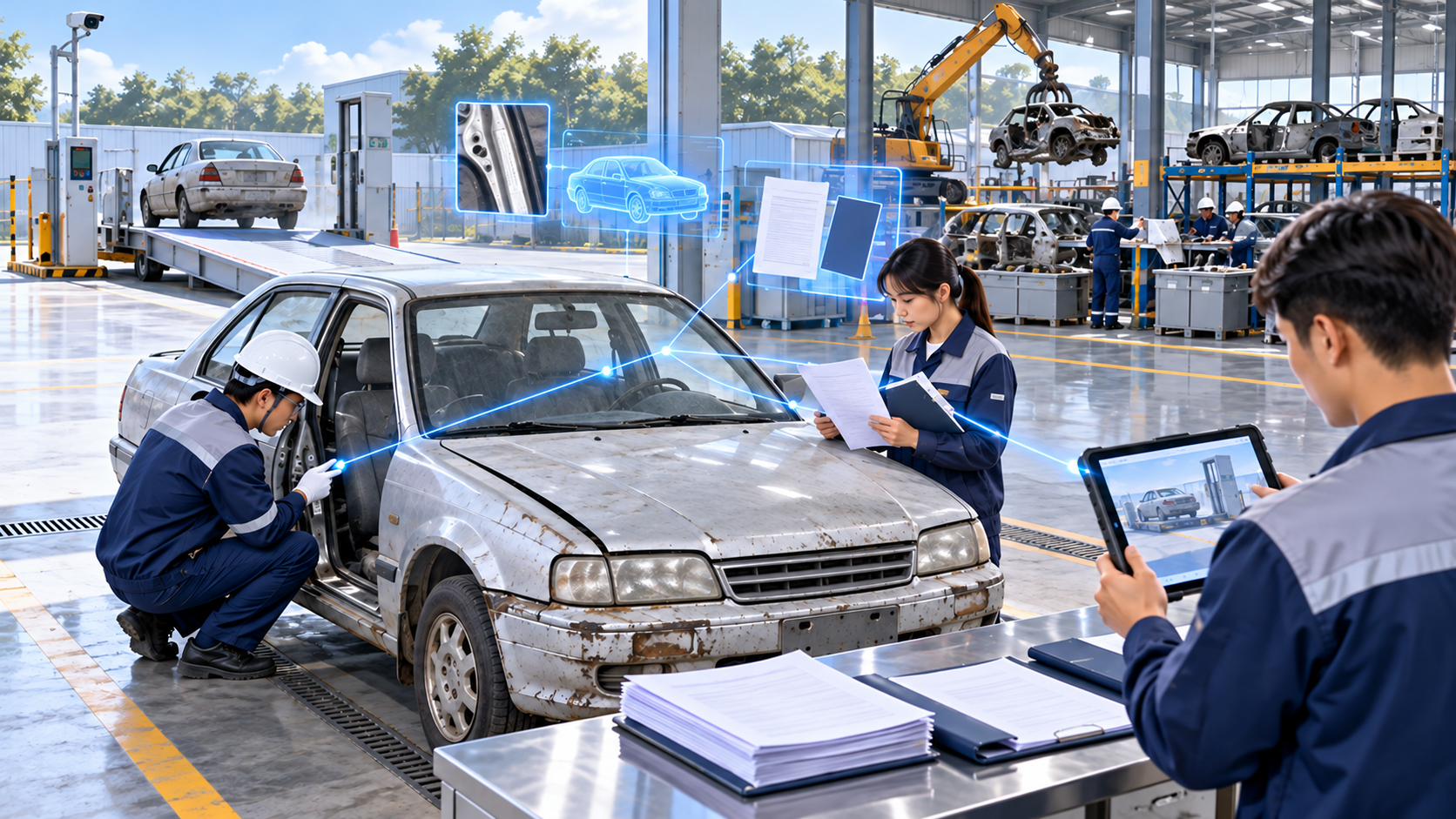
▍The first boundary: an old vehicle is not the same as an end-of-life motor vehicle
Vehicles still circulating as used vehicles and motor vehicles handed over to qualified enterprises for end-of-life dismantling have different business and invoicing rules, and reverse invoicing for end-of-life products cannot be applied across the board merely because a vehicle is old. Announcement No. 5 of 2024 of the State Taxation Administration stipulates that resource recycling enterprises engaged in end-of-life motor vehicle recycling and implementing reverse invoicing shall obtain the qualification recognition certificate for end-of-life motor vehicle recycling and dismantling enterprises and actually engage in resource recycling business. Sellers must also meet the announcement's applicable conditions for natural person sellers of end-of-life products. Before implementation, first confirm the nature of the transaction, the enterprise's qualifications, and the seller's identity before discussing system linking.
The Measures for the Administration of Scrapped Motor Vehicle Recycling require recycling enterprises to issue a Scrapped Motor Vehicle Recycling Certificate to the vehicle owner, recover the registration certificate, license plates and driving license, and handle deregistration in accordance with the law. If the owner entrusts another person to handle it, the implementing rules also require the corresponding identity documents and authorization materials. When creating a file in the system, the owner, handler and final payee should have a clear relationship; when certificates or plates are missing, collect a written explanation as required, and do not use "materials to be supplemented later" to conceal that the vehicle identity has not been verified.
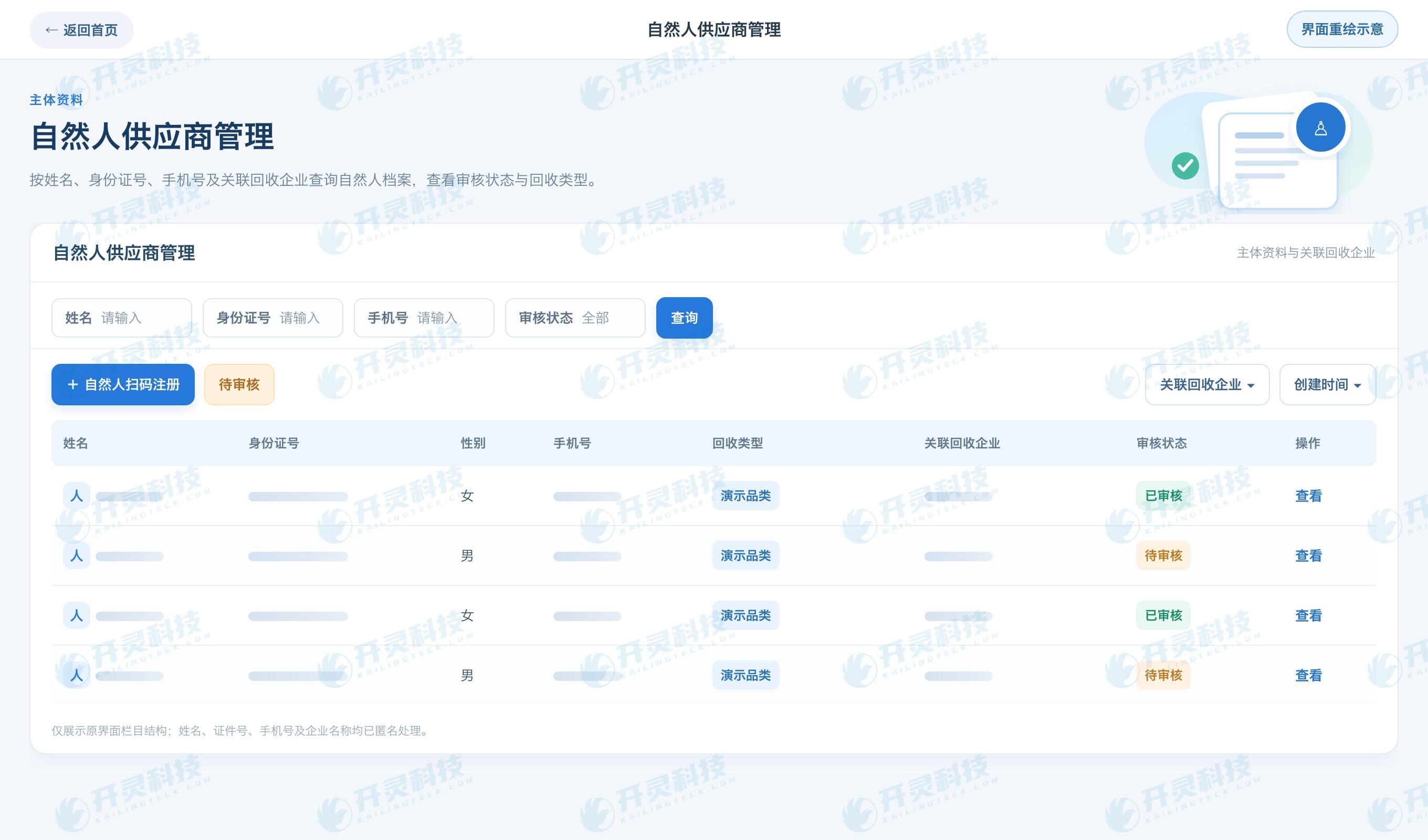
Entity profile creation capability interface illustration
▍Vehicle-by-vehicle verification is more important than "how many vehicles in a batch"
The management measures require registering information such as vehicle model, license plate, engine number, and vehicle identification number for each vehicle; the implementation rules require checking whether the actual vehicle matches the registration certificate and driving license records. At the vehicle handover site, the vehicle identification number, appearance condition, mileage or missing-parts notes, handover time, and verifier should correspond to a unique vehicle file. Images can assist review but cannot replace document verification; when the vehicle and documents do not match, processing should stop first, and subsequent payment and invoicing must not continue automatically.
After vehicles enter the dismantling site, weighing, dismantling handover, and parts disposal generate different records. Whole-vehicle inbound weighing and post-dismantling scrap metal outbound weight are not the same concept; the latter cannot be directly treated as the pricing quantity for purchasing a whole vehicle from an individual. If the contract or purchase agreement prices based on both vehicle condition and weight, the settlement statement should explain the basis for the values. Linking each weighing voucher and related site record back to the vehicle master file can prevent multiple vehicles from sharing an unexplained weight screenshot.
▍Place the recycling certificate, deregistration, and dismantling materials on the same vehicle chain
The End-of-Life Motor Vehicle Recycling Certificate is vehicle recycling regulatory material, not a reverse invoicing invoice. The two serve different purposes but should point to the same vehicle. Enterprises can store the certificate number, issuance and delivery status, certificate and plate recovery status, and deregistration results in the vehicle master file, and set reminders for missing items. If the certificate needs to be reissued or voided, it should be handled according to the procedures of the implementation rules, and the system should retain the original status and change records rather than deleting old files to create continuity.
Dismantling materials must also reflect that actual dismantling took place at an approved site. The implementing rules prohibit trading complete scrapped motor vehicles or assembled vehicles, and set requirements for monitoring and dismantling. The system associations discussed in the article do not mean that the reverse invoicing system replaces commerce, public security or dismantling production systems; during implementation, it should be clear which source system generates vehicle supervision materials, who confirms them, and how verifiable references or attachments are provided to the invoice and payment archive.
▍Payments and invoices separately verify entity, vehicle, and settlement
Before settlement, verify the vehicle owner, actual seller, and receiving account. Entrusted handling only explains the handling behavior and does not automatically change the seller or the ownership of receiving rights. Finance should use the confirmed vehicle purchase settlement statement as the basis and verify the payee, amount, and bank result. If there are agreed items such as towing fees or missing-parts deductions, they should be clearly listed in that vehicle's settlement record rather than mixing differences from multiple vehicles into the same payment.
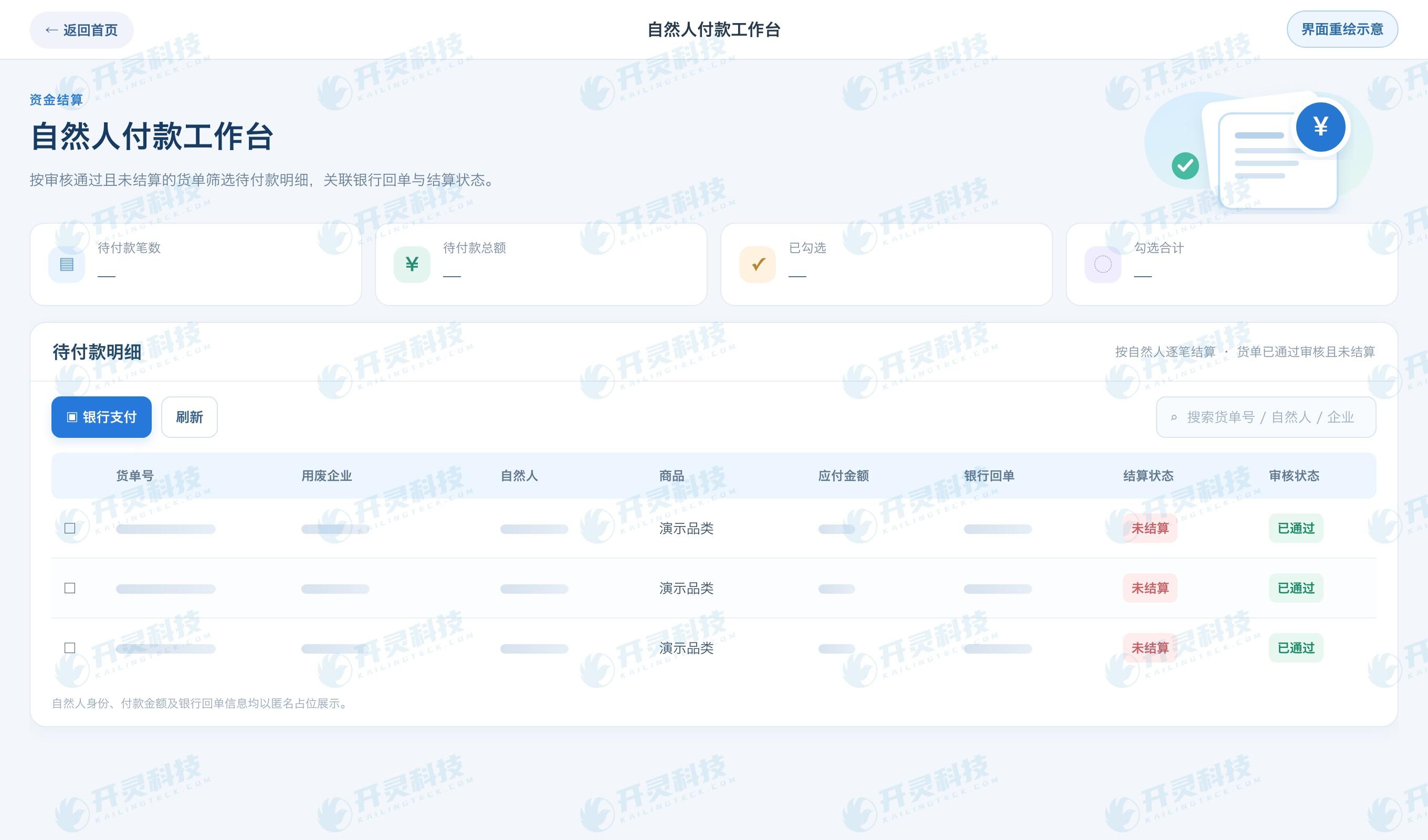
Illustration of the individual payment workbench
When reviewing reverse invoicing, verify the applicable entity, scrapped product category, invoice amount and source transaction according to the announcement requirements. The vehicle master file can reference tax invoicing results, so that one invoice can trace back to the corresponding vehicle, recycling certificate, pricing and payment records. If settlements for multiple vehicles need to be consolidated, the basis for splitting each vehicle must still be retained; if one vehicle still has disputes over identity, documents or pricing, it should not be brought into invoicing through the confirmed amounts of other vehicles.
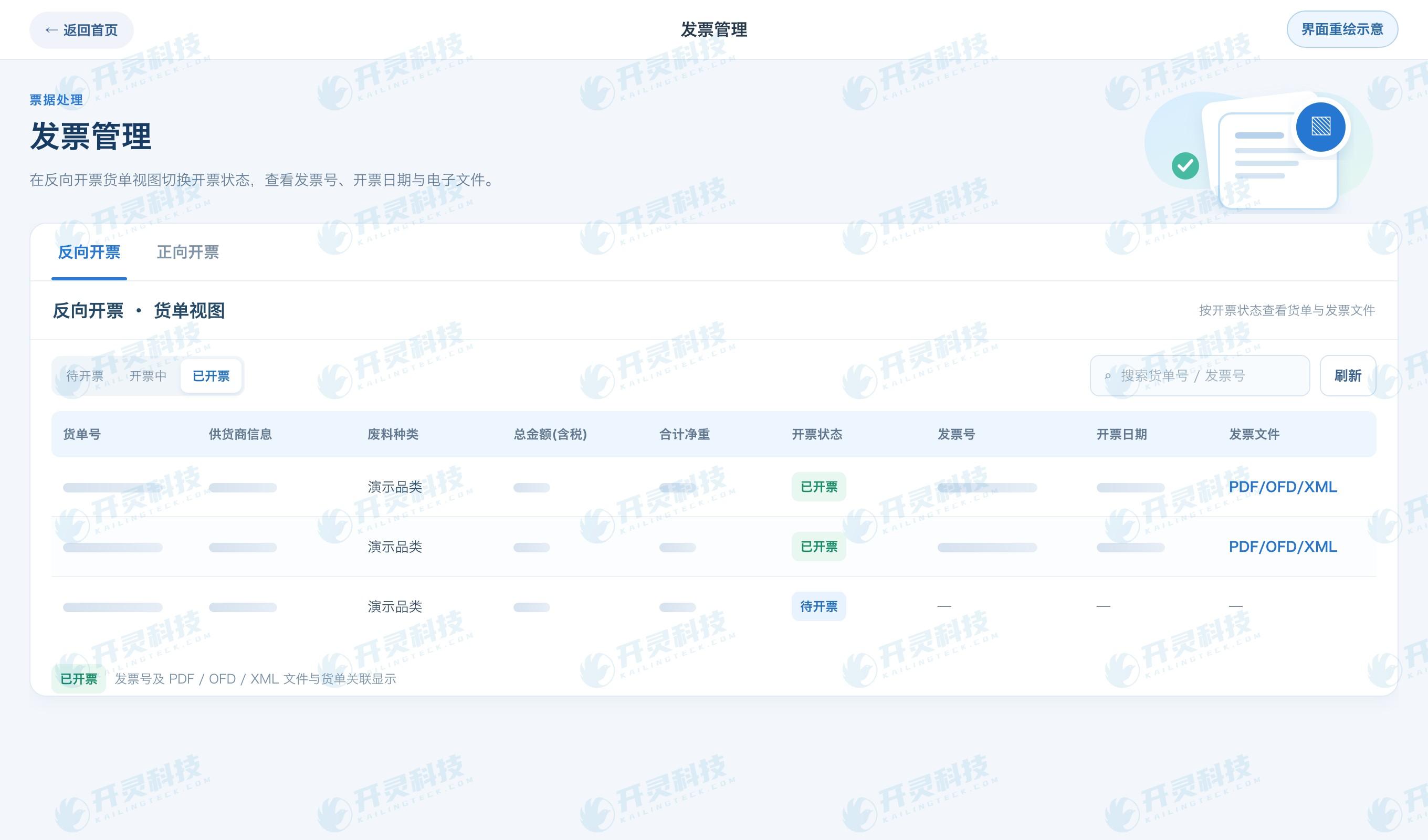
Illustration of reverse invoicing goods note view
▍Acceptance method for five-flow integration: trace all evidence back from one vehicle
The five-flow integration referred to in Kailing Technology reverse invoicing is an evidence management method in which an enterprise groups entity self-proof, transaction agreements, goods business, tax invoices and fund payments around the same business; it is not a newly added statutory vehicle supervision requirement. In vehicle scenarios, you can enter through the vehicle identification number or internal vehicle number and view owner verification, handover and weighing, recycling certificate and deregistration, settlement payment and invoice results in sequence. If certain materials are still in external systems, at least reliable association numbers and access paths must be retained.
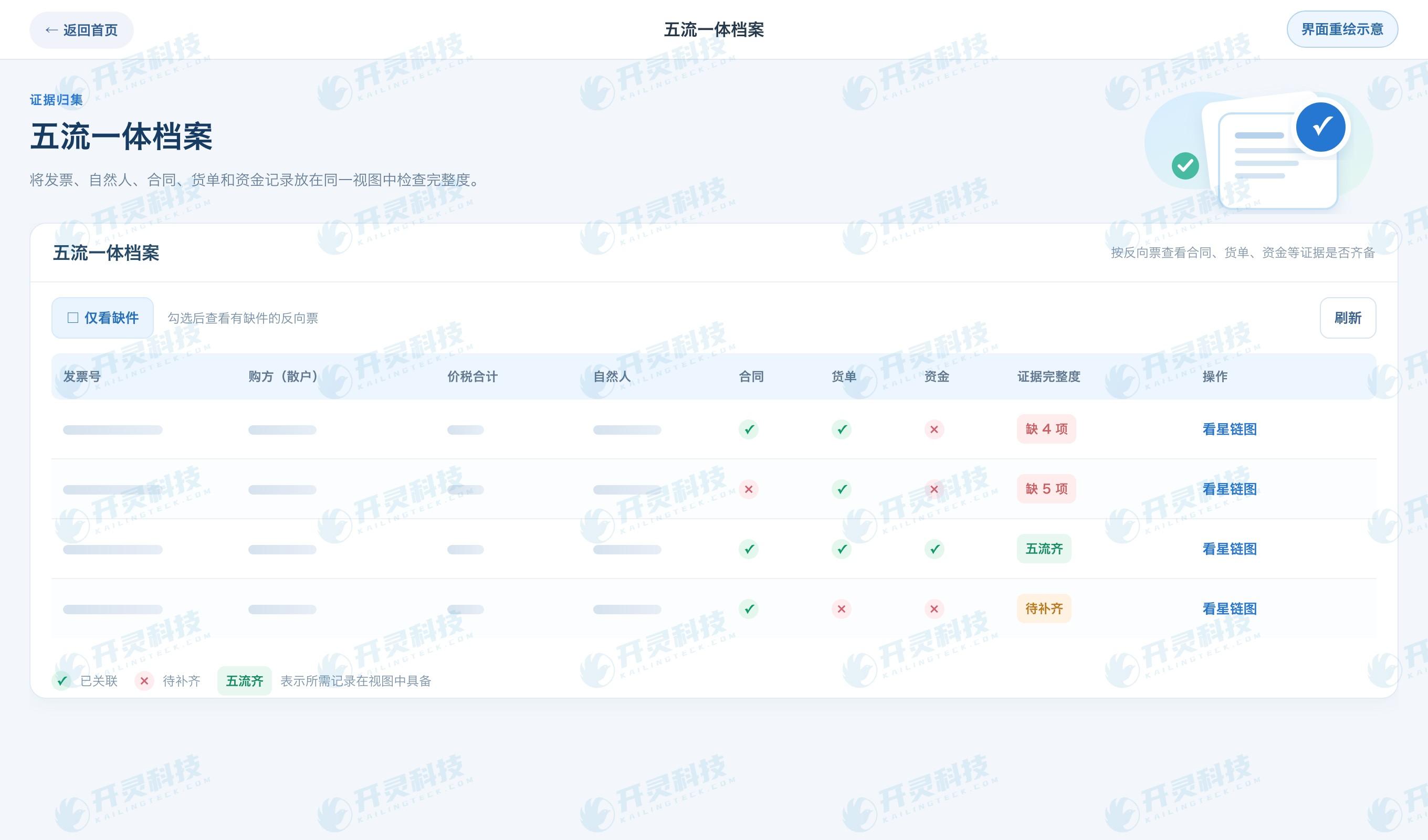
Illustration of the five-flow integration archive completeness interface
Launch testing should sample four types of vehicles: standard vehicles with complete certificates and plates, vehicles handled by an entrusted agent, vehicles with missing certificates/plates requiring explanation, and abnormal vehicles with inconsistent verification information. Check vehicle by vehicle whether incomplete business can be blocked, whether certificate and deregistration status can be found, and whether payments and invoices match, and have on-site, business compliance, and finance roles jointly confirm. The role of the Kailing Technology resource recycling reverse invoicing system is to string already legally formed real materials into a traceable chain; vehicle verification and dismantling supervision themselves still need to be performed by the enterprise according to regulations.
▍FAQ
Q: Can ordinary used vehicle sales also use reverse invoicing as end-of-life motor vehicles?
A: You cannot adopt the end-of-life product path merely because the vehicle is old. First confirm that the vehicle has actually entered a legally conducted end-of-life recycling and dismantling business, and verify the applicable conditions for the enterprise and the seller.
Q: Can the End-of-Life Motor Vehicle Recycling Certificate replace an invoice?
A: No. The recycling certificate and the tax invoice serve different purposes; the enterprise should tie both back to the same vehicle and its actual transaction.
Q: When entrusting someone else to hand over the vehicle, is it enough to verify only the agent?
A: Not enough. The identity of the motor vehicle owner and the entrusted person, as well as the authorization materials, should be verified, and the physical vehicle should be checked against the certificate information.
Q: Can the metal outbound weight after dismantling be used directly as the whole-vehicle purchase weight?
A: They cannot be directly equated. The two weights occur at different stages and should be managed separately according to the actual purchase agreement, weighing, and dismantling records.
Make the ownership, handover, invoice payment, and supporting materials of each end-of-life motor vehicle correspond to one another. Learn about the Kailing Technology resource recycling reverse invoicing solution:www.kailingteck.com 。
As a national high-tech enterprise, Kailing Technology focuses on the digital and intelligent transformation of enterprise business-finance-tax and operations management, providing software products, system integration, implementation and delivery, and operational services for various government agencies, institutions, group enterprises, and SMEs.
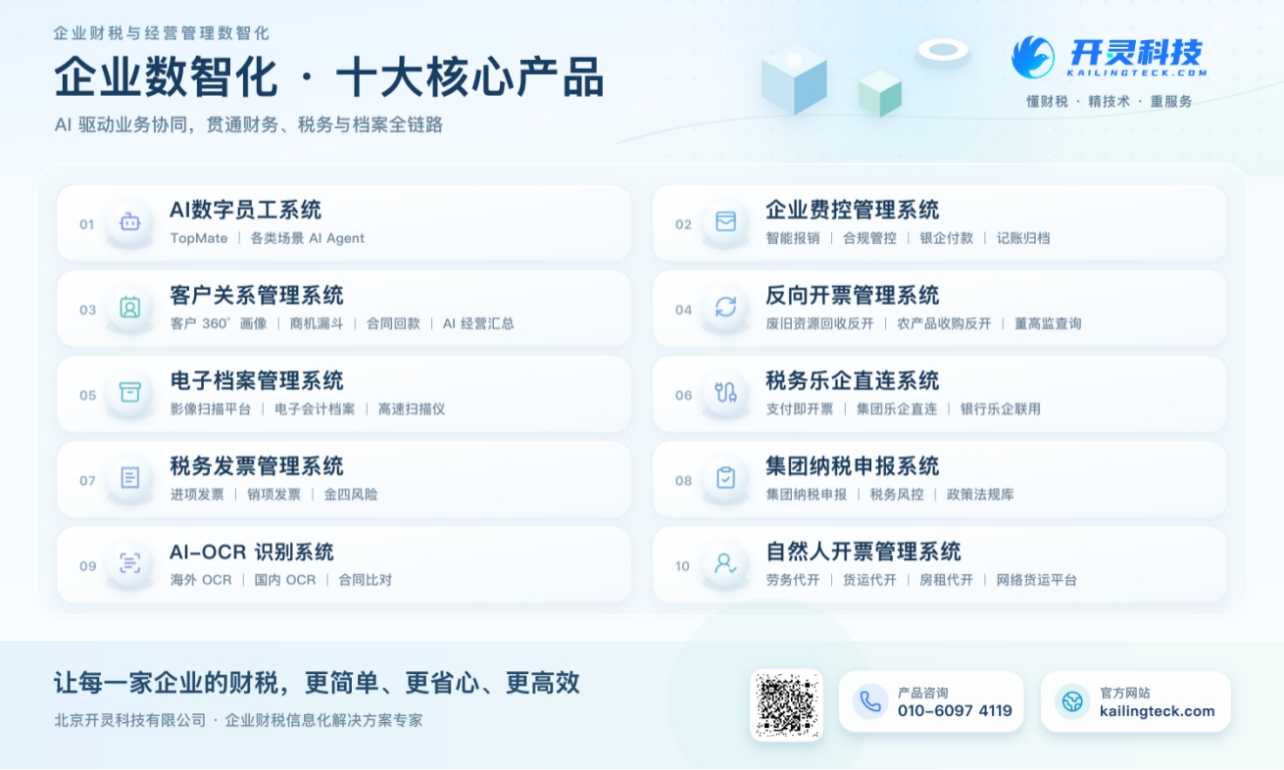
The company has now formed ten core product lines, including: AI digital employee system, enterprise expense control management system, customer relationship management system, reverse invoicing management system, invoice issuance for individuals management system, electronic archives management system, tax fully digitalized e-invoice Leqi system, tax invoice management system, group tax filing system, and AI OCR recognition system. It is committed to connecting enterprise business, finance, tax, funds, and archive data to help customers improve operational efficiency, business-finance-tax compliance capabilities, and digital management levels.
If you have any business-finance-tax digital transformation needs, welcome to contact us. Beijing Kailing Technology will serve you wholeheartedly.
Keywords: Reverse invoicing for scrapped motor vehicles, Kailing Technology reverse invoicing, vehicle recycling certificate, five-flow integration, recycling and dismantling materials
As a comprehensive business-finance-tax digitalization solution service provider, Kailing Technology provides business-finance-tax management digital transformation products and operational services for various government agencies, institutions, and large, medium, and small enterprises. The product line includes: solutions for sales contract management system, procurement contract management system, fully digitalized Leqi interface project, automatic output invoicing system, reverse invoicing system, invoice issuance for individuals system, employee expense control and reimbursement system, input VAT invoice management system, supply chain collaborative reconciliation system, image AI OCR recognition system, automatic financial bookkeeping system, electronic accounting archives system, etc., comprehensively driving the digitalization process across various fields.
Consultation Hotline: 18513895936 / 010-60974119 Location: Beijing