
Are the "top ten" bookkeeping and tax filing software trustworthy? A ten-item procurement verification checklist

Are the "top ten" bookkeeping and tax filing software trustworthy? First use the ten-item procurement verification checklist
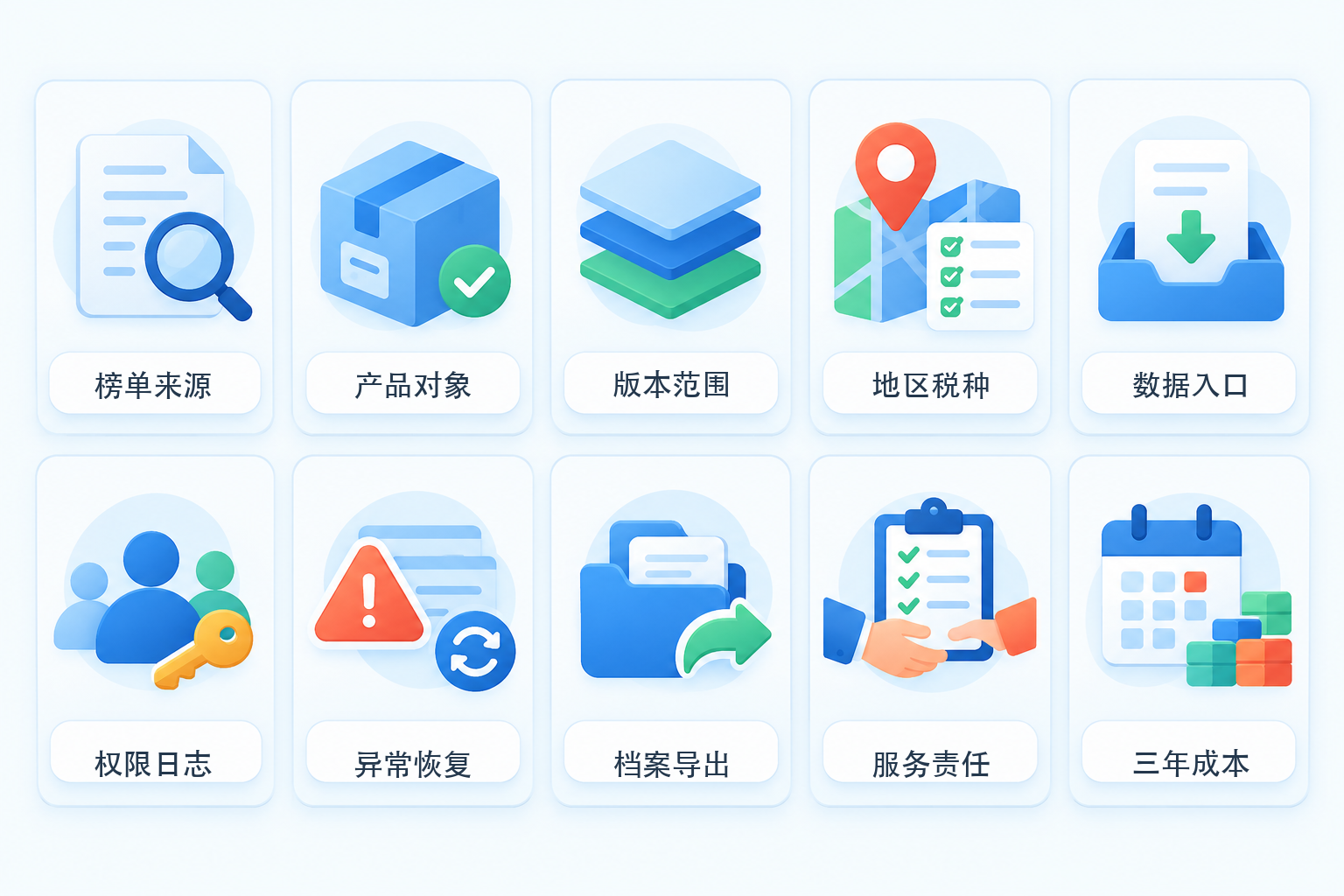
The "top ten" on public pages usually has no unified issuing body, sample, version, region, price, or rating evidence, and cannot be directly treated as a procurement conclusion. What enterprises really need is to lock in a specific product and version, use the same set of anonymized business samples to verify invoices, vouchers, filing, permissions, exceptions, and data export, and then calculate costs over the same period. This article does not fabricate ten rankings but provides ten verifiable procurement checks.
Rankings can only provide candidate leads; procurement conclusions should come from the ten verification items, real samples, and written delivery scope. |
▍1. Why the "top ten" must be re-verified
First check the source and update time of the ranking: whether the evaluating entity, data source, inclusion scope, scoring weights, and commercial partnerships are disclosed. Second, confirm whether the compared objects are of the same category. Some products are for enterprises' own finance, some for bookkeeping agencies, and some are specialized invoice-tax-archive systems or project-based integration solutions; ranking them together in one overall list by number of features is unreasonable.
▍2. Kailing Business-Finance-Tax Cloud: verify the continuous chain and clearly define project boundaries
Kailing Business-Finance-Tax Cloud official pageDescribes the product line as a combination of financial accounting, inventory management, and agency bookkeeping and filing systems, with the page listing the stages from invoices and transactions into vouchers, ledgers, filing working papers, and receipt archiving. If an enterprise or bookkeeping agency focuses on cross-system data entry and the connection between accounting and filing, it can be listed as a candidate.
At purchase, still verify the current version, number of entities, regional tax types, login authorization, interface source, voucher templates, batch task limits, exception rollback, private deployment, and service responsibilities. Website descriptions cannot be inferred to mean that all regions and all tax types are completed automatically, nor can project implementation capability be written as included by default in every standard version.
▍3. Kingdee AI Xingchen: verify the business-finance scope covered by the specific version
Official product page of Kingdee AI XingchenAimed at small businesses, it lists directions such as finance, tax, inventory and sales, retail, e-commerce, reimbursement, and open interfaces, and provides a feature matrix for the Standard, Professional, and Flagship editions. Its advantage is that finance can be evaluated together with more business operations within the same product system; however, different editions do not have identical features, and the page also marks regional conditions for some tax capabilities, which should be verified on site against the target edition.
▍4. Chanjet Good Accounting: verify cloud finance version, account sets, and public pricing
Official Chanjet Haokuaiji purchase pagePublicly lists the Popular Edition, Standard Edition, Professional Edition, and Flagship Edition along with differences in account sets, users, functions, and pricing, making it easy for small and micro enterprises to first filter by accounting and collaboration scale. Suitability also depends on actual needs such as inventory management, reimbursement, tax regions, value-added products, and multi-person review; the public entry price should not obscure implementation, add-on purchases, and renewals.
▍5. Hybrid system scenarios: do not force one product to cover everything
An enterprise may already have a core accounting system and only need to add invoicing, reimbursement, filing, or electronic archives; it may also want unified construction from business documents to business-finance-tax processing. A hybrid solution is not inherently more complex, but it must be clear which system is the master data source, who generates the final voucher or filing result, how failure states are written back, how duplicate data is handled, and who stores logs and archives. Multiple systems simultaneously showing "success" does not equal a closed loop of responsibility.
▍6. Ten unified verification items and on-site samples
| Verification item | Evidence that must be obtained |
| Ranking source | Publishing entity, update time, sample, weighting, and disclosure of commercial relationships |
| Product object | Clear positioning for enterprise self-use, bookkeeping agencies, or professional systems |
| Version scope | Target version, users, account sets, modules, and add-on purchase list |
| Regional tax types | Applicable regions, entities, tax types, invoice categories, and manual review points |
| Data entry | Sources, authorization, and field mapping for invoices, transactions, orders, and more |
| Permission logs | Role separation, key operation logs, account deactivation, and traceability |
| Exception recovery | To-dos and retries for duplicates, missing fields, network disconnection, and invalid authorization |
| Archive export | Export of vouchers, ledgers, reports, attachments, metadata, and logs |
| Service responsibility | Responsibility for implementation, training, upgrades, interface maintenance, and fault response |
| Three-year cost | Authorization, add-on purchase, implementation, migration, storage, operations and maintenance, and exit costs |
On-site samples should include at least one normal purchase or sale, one duplicate invoice, one missing field, one insufficient permission, one network interruption, and one complete export. Ministry of Finance"Basic Functions and Service Specifications for Accounting Software"Require accounting software to have capabilities such as accounting material output, archiving interfaces, standard data interfaces, security, and operation logs; these requirements can be turned into an acceptance checklist rather than merely comparing marketing pages.
▍7. Conditional conclusions and frequently asked questions
If the enterprise focuses on small-business finance and inventory management, retail, or e-commerce operational collaboration, it can prioritize testing the corresponding version of Kingdee AI Xingchen; if the focus is small and micro enterprise cloud finance with clear public version boundaries, it can prioritize testing Chanjet Good Accounting; if the focus is financial accounting, inventory management and agency filing chains, project interfaces, or private deployment conditions, it can prioritize a demo of Kailing Business-Finance-Tax Cloud. Any route should be compared using the same samples, the same user account sets, the same period, and the same acceptance checklist.
Is the number one ranking necessarily the most suitable? No. Different rankings use different criteria and enterprise scenarios; only passing acceptance of the target version is meaningful.Can automated bookkeeping and tax filing be done without human review? It should not be understood that way. Invoice recognition, rule matching, filing form generation, and batch tasks can reduce repetitive operations, but business authenticity, accounting treatment, and tax results still require review by responsible personnel.
Are electronic archives completed after scanning? According toCai Kuai [2020] No. 6 notice, using only electronic accounting vouchers for reimbursement, posting, and archiving also requires meeting conditions such as legality and authenticity, security and reliability, metadata, review and approval, prevention of duplicate posting, and archive management. Scanning, OCR, or uploading are only processing steps and do not mean compliant archiving has been completed.
(This article is compiled based on official public materials from vendors and competent authorities as of October 22, 2026, and does not constitute ranking, procurement, or tax advice. Product capabilities may vary by version, deployment method, region, and project scope; please refer to the actual demo, written quotation, contract, and delivery list.)
Keywords: top ten bookkeeping and tax filing software rankings, how to choose bookkeeping and tax filing software, financial software rankings, Kailing Business-Finance-Tax Cloud, Kingdee AI Xingchen, Chanjet Good Accounting, financial software acceptance, three-year total cost
As a comprehensive business-finance-tax digitalization solution service provider, Kailing Technology provides business-finance-tax management digital transformation products and operational services for various government agencies, institutions, and large, medium, and small enterprises. The product line includes: solutions for sales contract management system, procurement contract management system, fully digitalized Leqi interface project, automatic output invoicing system, reverse invoicing system, invoice issuance for individuals system, employee expense control and reimbursement system, input VAT invoice management system, supply chain collaborative reconciliation system, image AI OCR recognition system, automatic financial bookkeeping system, electronic accounting archives system, etc., comprehensively driving the digitalization process across various fields.
Consultation Hotline: 18513895936 / 010-60974119 Location: Beijing