
How to issue compliant invoices when a waste paper recycling site receives many batches daily? Kailing Technology's resource recycling reverse invoicing system retains transaction evidence for each transaction
A waste paper recycling station may receive several vehicles in a row in one day, with old cardboard boxes, newspapers, and mixed paper arriving in turn. On-site staff first weigh, unload, inspect for impurities, and bale, while finance handles payments and invoicing in a centralized way. If the day-end summary only records "a certain individual delivered several tons of waste paper today, one payment due," the weight differences per delivery, impurity deduction reasons, and inspectors are all flattened out. For this type of high-frequency business, Kailing Technology's reverse invoicing solution fixes the receiving facts transaction by transaction, so that day-end summaries and invoices can still trace back to each batch.

▍For high-frequency receiving, manage the entry first: each batch must have its own identity
Reverse invoicing is not available for every waste paper transaction. According to Announcement No. 5 of 2024 by the State Taxation Administration, when a purchaser buys scrapped products sold by an individual, it should first verify the enterprise's applicable qualifications, the individual's identity, and cumulative sales amount requirements. The site can complete individual profiling and entity verification in advance, but each actual delivery must still correspond to the profiled party. When a driver delivers on behalf of another, or the on-site handler differs from the cargo owner, the delivery relationship must be additionally explained; the identity conclusion from the previous transaction cannot simply be reused.
The entry point of a batch of goods should at least include the seller, vehicle or handover method, entry time, material category, weighing voucher, and handler. During shift handover, mark delivery notes whose acceptance has not yet been completed as pending, to avoid merging them with goods already settled on the morning shift when they are entered later on the evening shift. System numbering can be organized by site and business time; the purpose is not to make the number look good, but to ensure that a weighbridge ticket, an unloading, and a subsequent settlement always point to the same actual batch of goods.
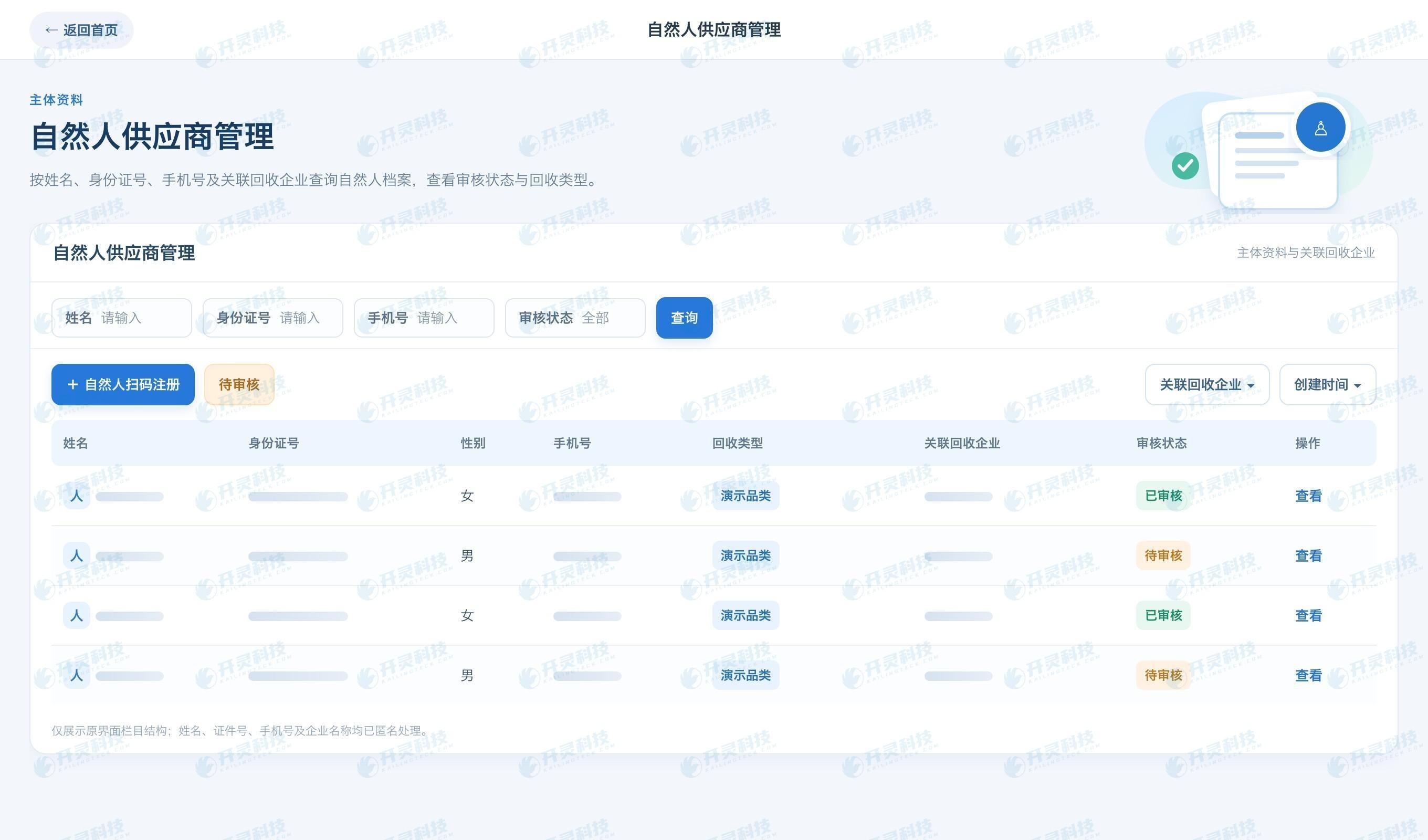
Illustration of the individual supplier record creation interface
▍Completion of weighing does not equal completion of acceptance; deductions for impurities must fall on the original batch
The acceptance results for old cardboard boxes and mixed paper can differ greatly, and impurities such as moisture, tape, and plastic film also affect settlement weight. The weighbridge gives gross weight, tare weight, and net weight; sorting and re-verification determine the settleable category and quantity. If deductions are made after acceptance, the deduction items, basis, reviewer, and on-site records should be retained, and the adjustment should point to the original batch. Writing only "deducted some impurities" on a month-end summary makes it impossible to explain to the seller and hard to match the invoiced amount.
When there are many batches on the same day, the system needs to distinguish several business statuses: "entered site, pending acceptance, pending confirmation, settleable, abnormal." If a batch's weighing equipment is abnormal, that batch alone can be paused for re-weighing; if a batch's seller identity is pending verification, the goods fact can be retained but no invoicing submitted. Other confirmed batches proceed as usual. Isolating exceptions is more workable than locking all of the day's goods orders together, and it also avoids mixing problematic amounts into confirmed summaries.
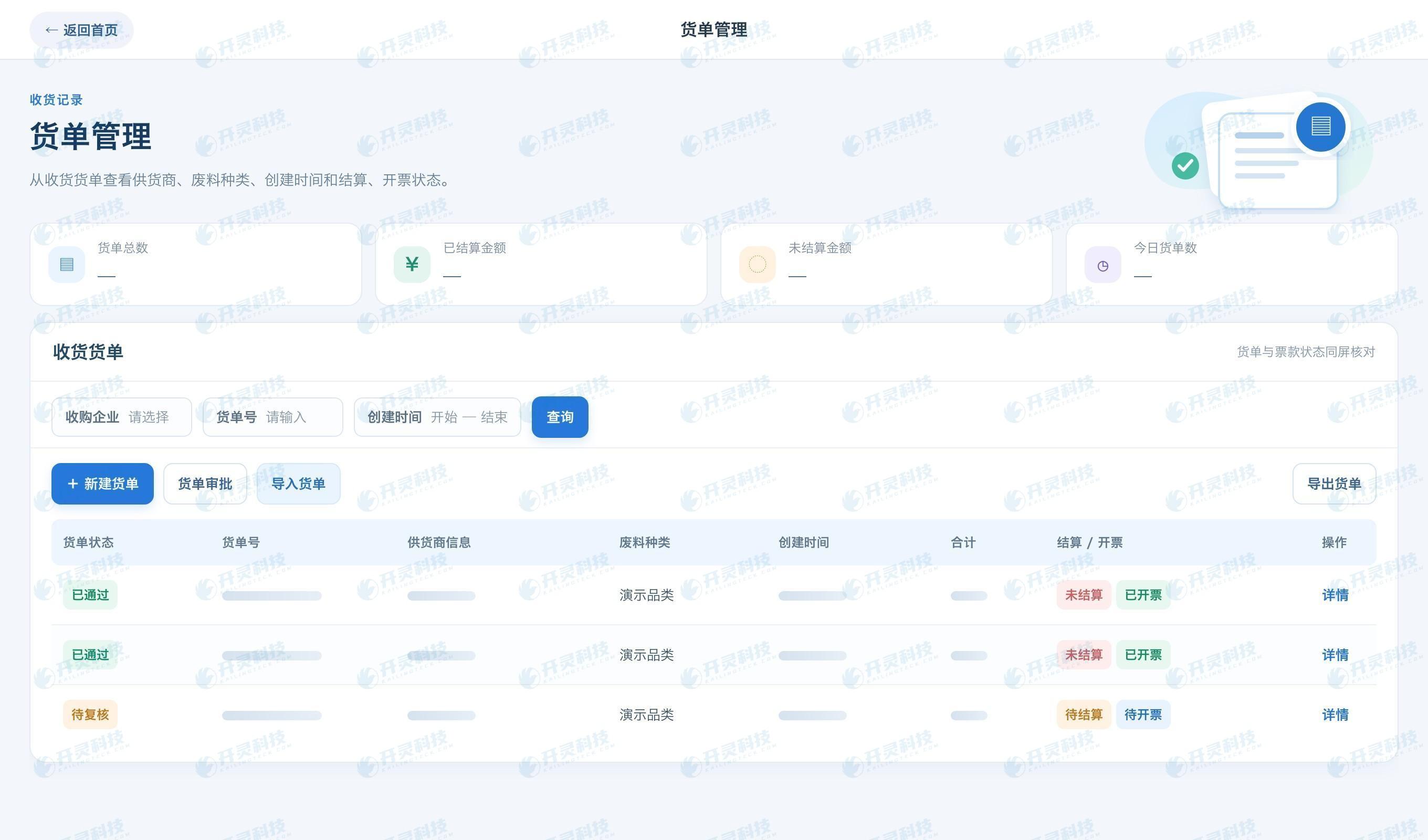
Schematic of the receiving goods order management interface
▍End-of-day summarization can improve efficiency but cannot replace transaction-by-transaction accounting
After batch confirmation is completed on site, finance can summarize payables by individual, site, or settlement cycle. But the summary sheet should list the source goods orders and each weight, unit price, adjustment, and subtotal, so the total can be traced to details with one click. When the same individual delivers multiple times in one day, check whether different trips involve duplicate weighing, re-entry after cancellation, or the same voucher being referenced multiple times. Check duplicates first, then summarize settlement, to avoid "a busy day ending with only one number at month-end."
Daily closing does not mean every batch must be paid or invoiced the same day. Cross-shift re-verification, returns, and settlement disputes can all cause time gaps. Enterprises should form payable amounts from confirmed goods orders and keep a list of unsettled batches; for partial payments and combined payments, the allocation relationship should be explicit. Reports can summarize operating data by day, but the evidence chain must retain batch-level granularity. This is also the difference in system design between high-frequency waste paper business and low-frequency bulk recycling.
▍Before invoicing, first check whether the summarized amount can be broken back down into each batch
In reverse invoicing review, finance should check the seller, scrapped product category, source batch, and confirmed settlement amount. The announcement requires using the "scrapped products" goods and services tax classification code as required, and issuing invoices online with the words "scrapped product purchase" through the prescribed system. If an enterprise maps multiple receiving batches to the same invoice, the system must still record the split relationship; if a batch has not been fully inspected, it should not be valued and merged in just to meet the day's invoicing volume.
After the invoicing result is written back, the source goods receipt should show the invoice number, amount, and processing status. When a return or measurement error occurs, start from the original batch to check its summary sheet, paid amount, and invoice status, then handle adjustments and red-letter reversals according to applicable rules. The day's summary table must not be the only thing changed, leaving the original receiving record as an isolated voucher inconsistent with the invoice and payment.
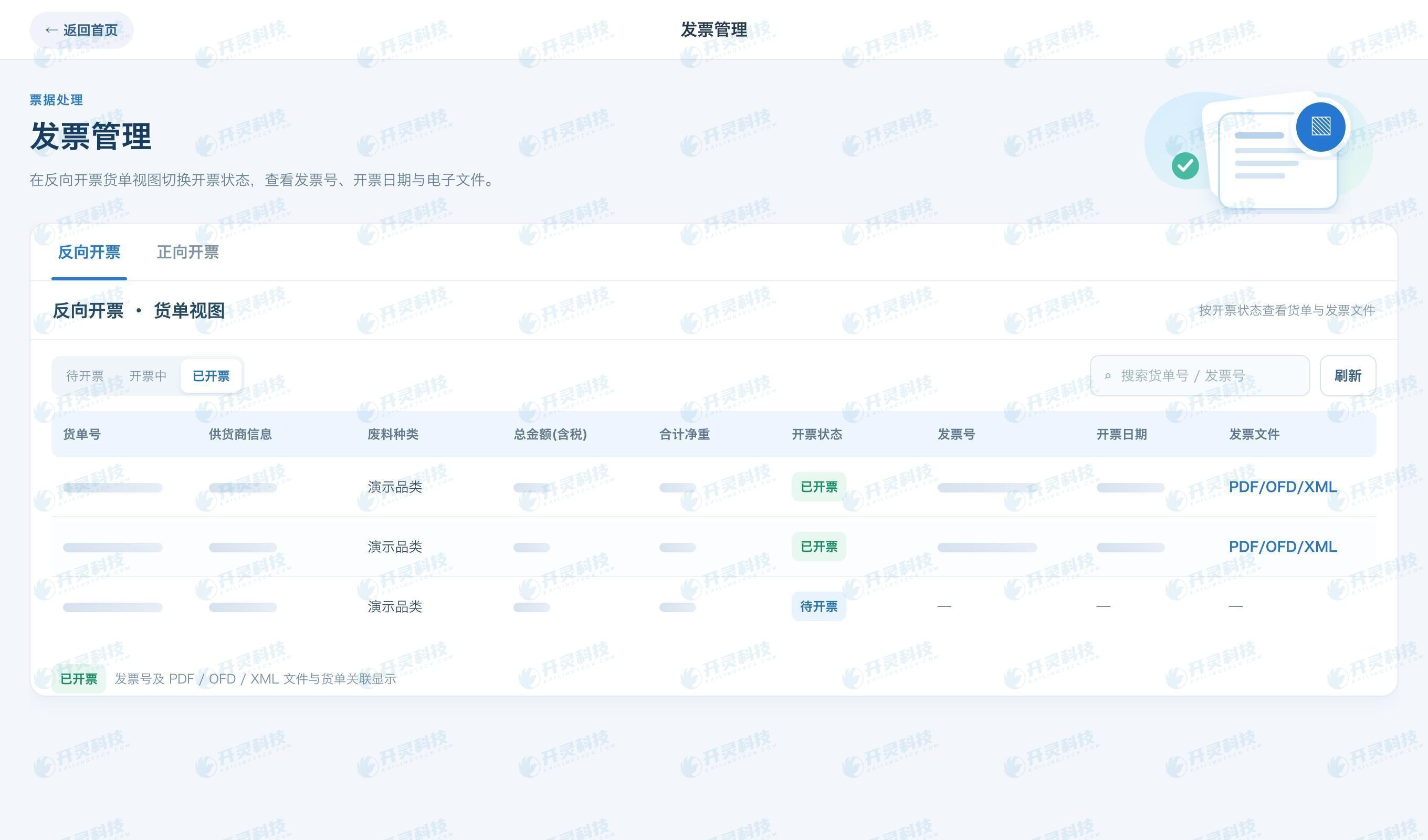
Illustration of reverse invoicing goods note view
▍Payment and archiving must support tracing back to the original batch from any piece of evidence
At the payment stage, the natural person's receiving account, confirmed settlement amount, and actual payment result should be checked. After bank receipts enter the system, they should not merely be attached behind a daily settlement statement; they should also be able to locate the receiving batches they cover. If one payment corresponds to multiple batches of goods, the allocation details should be displayed; if payment fails due to an account error, the failure reason, retry, and final result should be retained. Finance can thus answer "whether the payment corresponding to this invoice has been paid," and the site can also answer "when this batch of goods was settled."
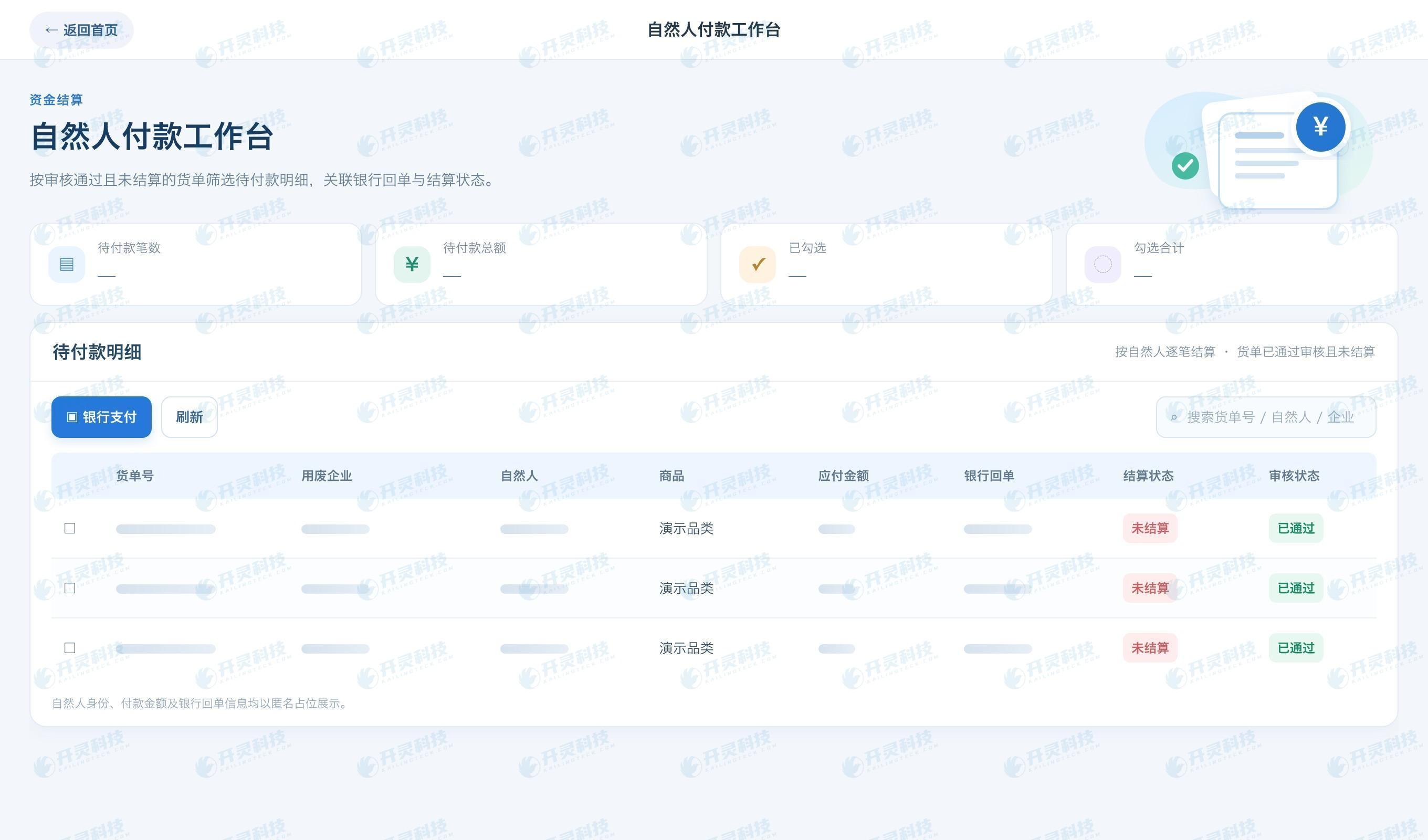
Illustration of the individual payment workbench
The five-stream integration ledger of Kailing Technology's reverse invoicing is an internal evidence method that organizes entity self-certification, transaction agreements, goods business, tax invoices, and fund payment materials under the same business; it is not a separate statutory tax form. For waste paper sites, file inspection can show by batch which materials are missing and which position should complete them; at day-end or month-end, the list of unclosed items is checked. In this way, improved invoicing efficiency does not come at the cost of transaction-by-transaction traceability.
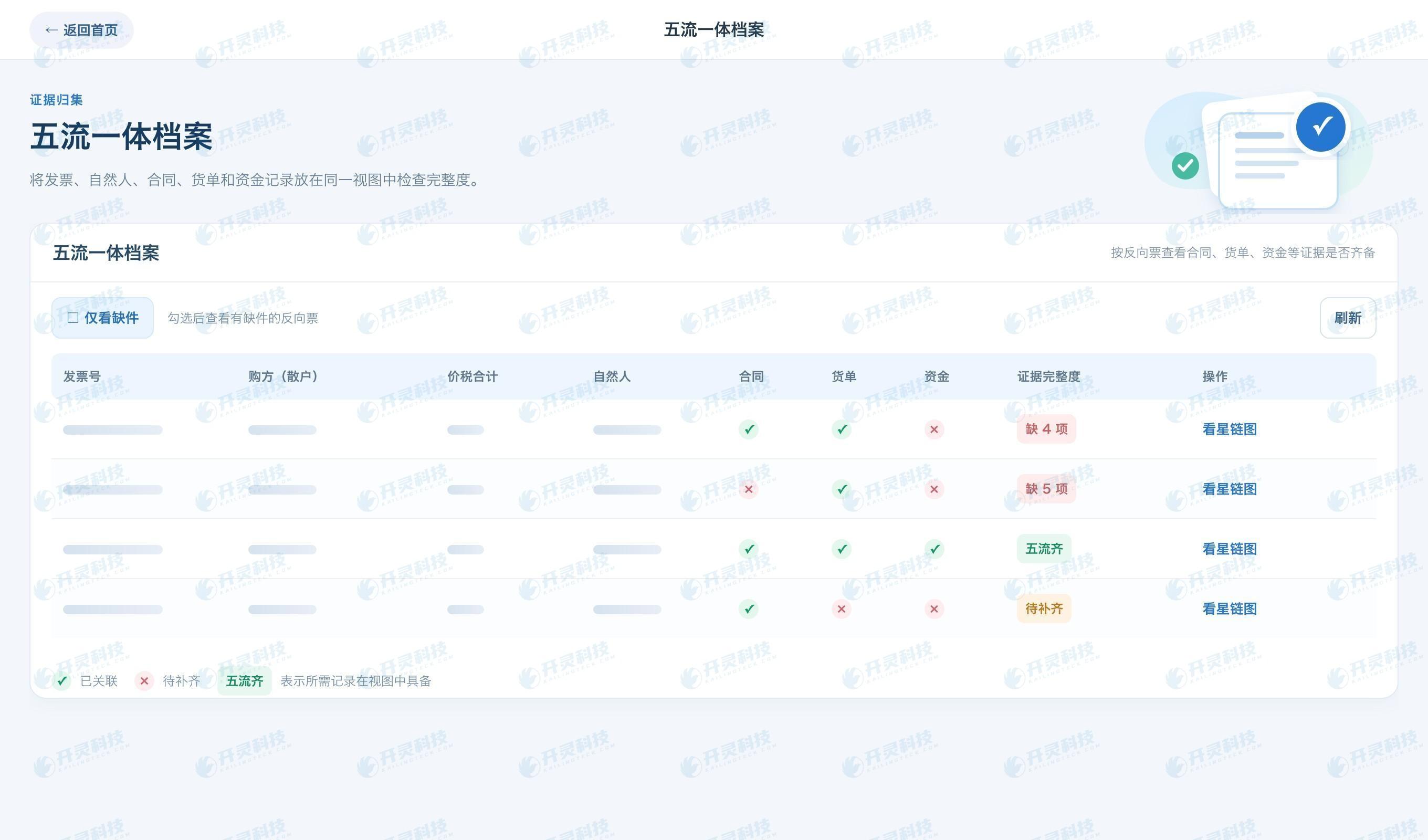
Illustration of the five-flow integration archive completeness interface
▍Conduct go-live acceptance using the real pace of busy days
Acceptance testing should not use only one standard goods order. You can simulate multiple vehicles queuing in the same shift, unsettled goods orders across shifts, the same individual delivering repeatedly, a deduction dispute in one batch, and one combined payment. Check item by item whether numbers are unique, whether entry overwrites data, whether exceptions can be isolated, and whether summaries can be split back to the original batch; then have finance spot-check in reverse from invoices and bank receipts. If any end can see only the summary amount and cannot find the weighing and acceptance, the closed loop is not yet complete.
Compliance efficiency in the waste paper industry comes from "each batch clear first, so summaries are reliable." Kailing Technology's resource recycling reverse invoicing system can link receiving, invoicing, payment, and five-stream evidence; enterprises also need site staff to enter data promptly by shift, review exceptions, and record handovers, so that every transaction can still be reconstructed after receiving peaks.
▍FAQ
Q: Can the same natural person deliver multiple vehicles of waste paper in one day and settle them together?
A: They can be summarized according to the business agreement, but the weighing, acceptance, adjustments, and source delivery notes for each vehicle trip or batch must be retained, and the summarized amount can be broken back down into details.
Q: If a moisture dispute over a certain batch of waste paper is unresolved, will it affect invoicing for other batches?
A: Disputed batches should be marked separately and pending review; other confirmed batches can continue to be settled and invoiced according to the actual situation.
Q: Are only the total weight of the day and the bank payment record enough?
A: Not enough. It should also be possible to explain how the actual seller, each batch of goods, acceptance results, and settlement amounts were formed.
Q: Does automatic numbering by the system mean five-flow evidence retention is complete?
A: The number is only an entry point for correlation; it is also necessary to check whether the entity, business, invoice, and fund materials are authentic, complete, and correspond to one another.
Make every batch during the waste paper receiving peak traceable to invoice payment and evidence. Learn about Kailing Technology resource recycling reverse invoicing solution: https://www.kailingteck.com/fxzy/ .
As a national high-tech enterprise, Kailing Technology focuses on the digital and intelligent transformation of enterprise business-finance-tax and operations management, providing software products, system integration, implementation and delivery, and operational services for various government agencies, institutions, group enterprises, and SMEs.
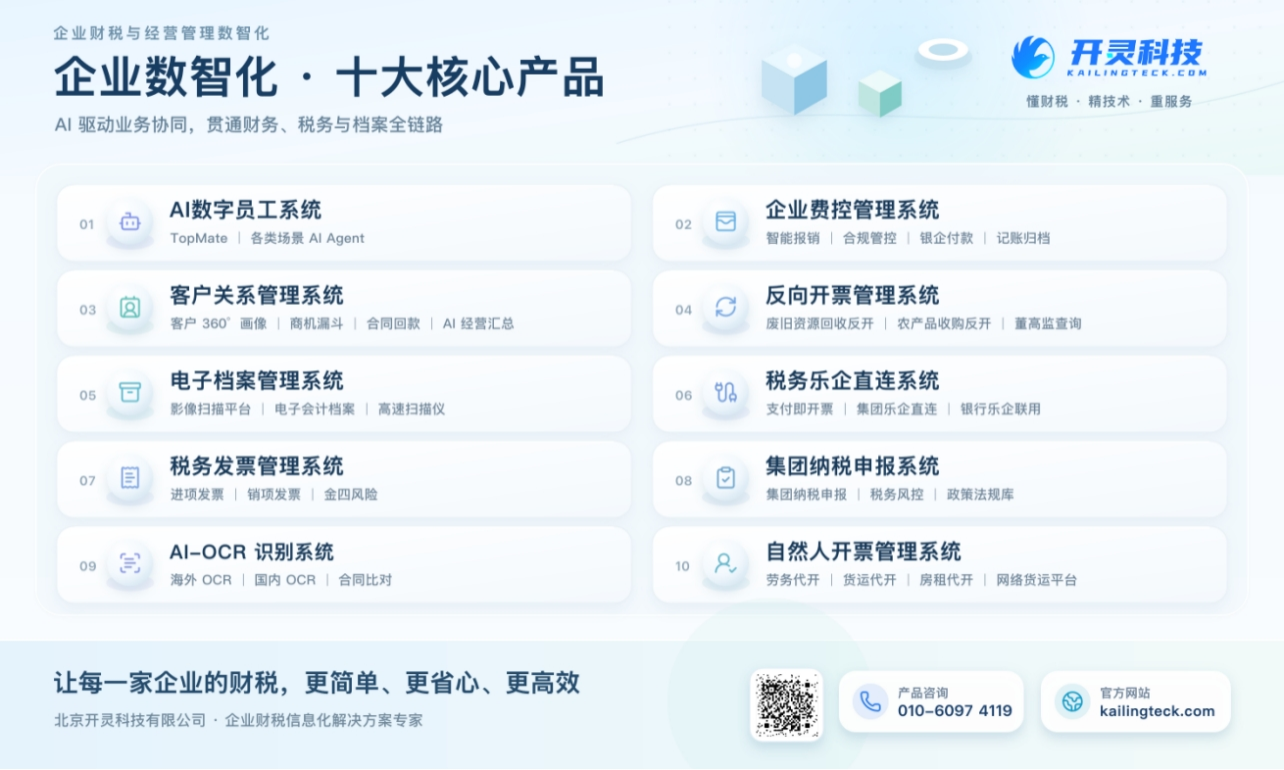
The company has now formed ten core product lines, including: AI digital employee system, enterprise expense control management system, customer relationship management system, reverse invoicing management system, invoice issuance for individuals management system, electronic archives management system, tax fully digitalized e-invoice Leqi system, tax invoice management system, group tax filing system, and AI OCR recognition system. It is committed to connecting enterprise business, finance, tax, funds, and archive data to help customers improve operational efficiency, business-finance-tax compliance capabilities, and digital management levels.
If you have any business-finance-tax digital transformation needs, welcome to contact us. Beijing Kailing Technology will serve you wholeheartedly.
Keywords: Waste paper recycling reverse invoicing, Kailing Technology reverse invoicing, waste paper batch evidence retention, five-stream integration, resource recycling system
As a comprehensive business-finance-tax digitalization solution service provider, Kailing Technology provides business-finance-tax management digital transformation products and operational services for various government agencies, institutions, and large, medium, and small enterprises. The product line includes: solutions for sales contract management system, procurement contract management system, fully digitalized Leqi interface project, automatic output invoicing system, reverse invoicing system, invoice issuance for individuals system, employee expense control and reimbursement system, input VAT invoice management system, supply chain collaborative reconciliation system, image AI OCR recognition system, automatic financial bookkeeping system, electronic accounting archives system, etc., comprehensively driving the digitalization process across various fields.
Consultation Hotline: 18513895936 / 010-60974119 Location: Beijing