
What should be done when reimbursement, business travel and payment are scattered across multiple systems? Kailing Technology's expense control and reimbursement management system connects the full enterprise expense process
Employees book tickets on the business travel platform, return to WeChat to receive e-invoices, then fill out forms in the reimbursement system; the cashier pays on the bank side, and finance finally supplements vouchers and archives them. There are quite a few documents; the difficulty is that every cross-system step requires rechecking amounts, entities, and responsibilities. Kailing Technology's expense control and reimbursement management system "Lingdong Reimbursement" takes invoices, reimbursement forms, and payment results as the main line to sort out the association of expenses from occurrence to archiving; the specific integration of business travel orders and payment platforms needs to be confirmed according to project interfaces.

▍The expense process first finds a unified business primary key
A single business travel expense may have flight orders, hotel orders, invoices, reimbursement forms, approval records, and bank receipts. If each system only stores its own number, finance can only guess by name and amount which invoice belongs to which trip. Project initiation should first define the correspondence among employees, organizations, expense items, order numbers, invoice numbers, reimbursement form numbers, and payment batches, then determine which systems are responsible for generating source data and which systems only receive results.
The knowledge base of Lingdong Reimbursement covers the smart invoice wallet, invoice recognition and verification, reimbursement forms, approval, payment, voucher conversion and electronic archives. Employees can collect invoices through entry points such as mini-programs, apps, web pages, QR code scanning and email, and select invoices in the invoice wallet to form a reimbursement form. If a business travel platform provides order, itinerary or settlement data, it can be connected to expense items during implementation; before the interface is completed, avoid writing "business travel connected" as the default status for all customers.
The complete process should also pay attention to the time gap between expense occurrence and invoice acquisition. After a business trip ends, employees may first receive the itinerary, while the hotel invoice is issued later, and the payment method may be company advance or personal payment first. The system needs to display statuses such as missing invoice, pending reimbursement, submitted, and pending payment, and allow finance to explain the reason for temporary absence, rather than stuffing all materials into reimbursement attachments at once.
▍Invoice collection and reimbursement approval: first block duplicates and mismatches
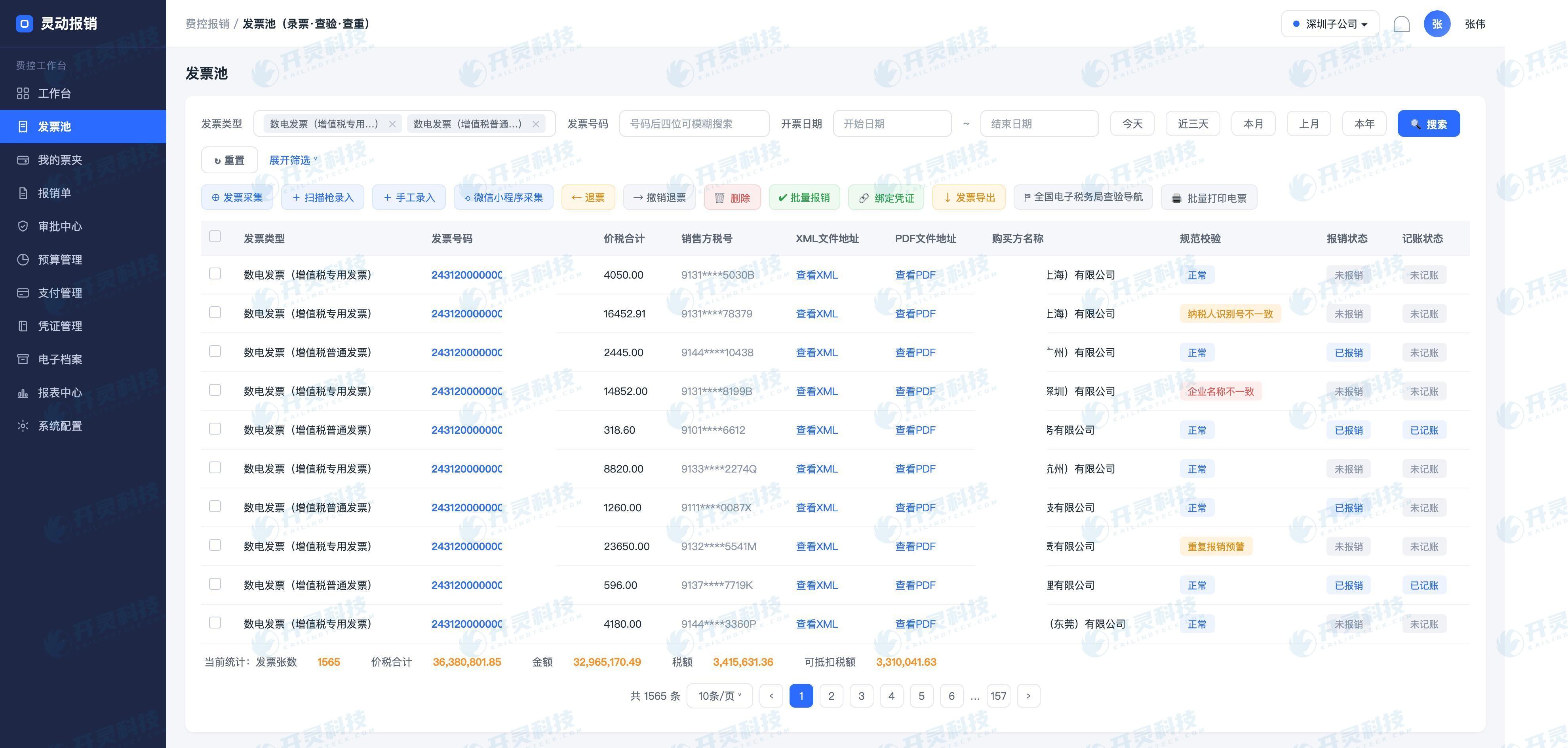
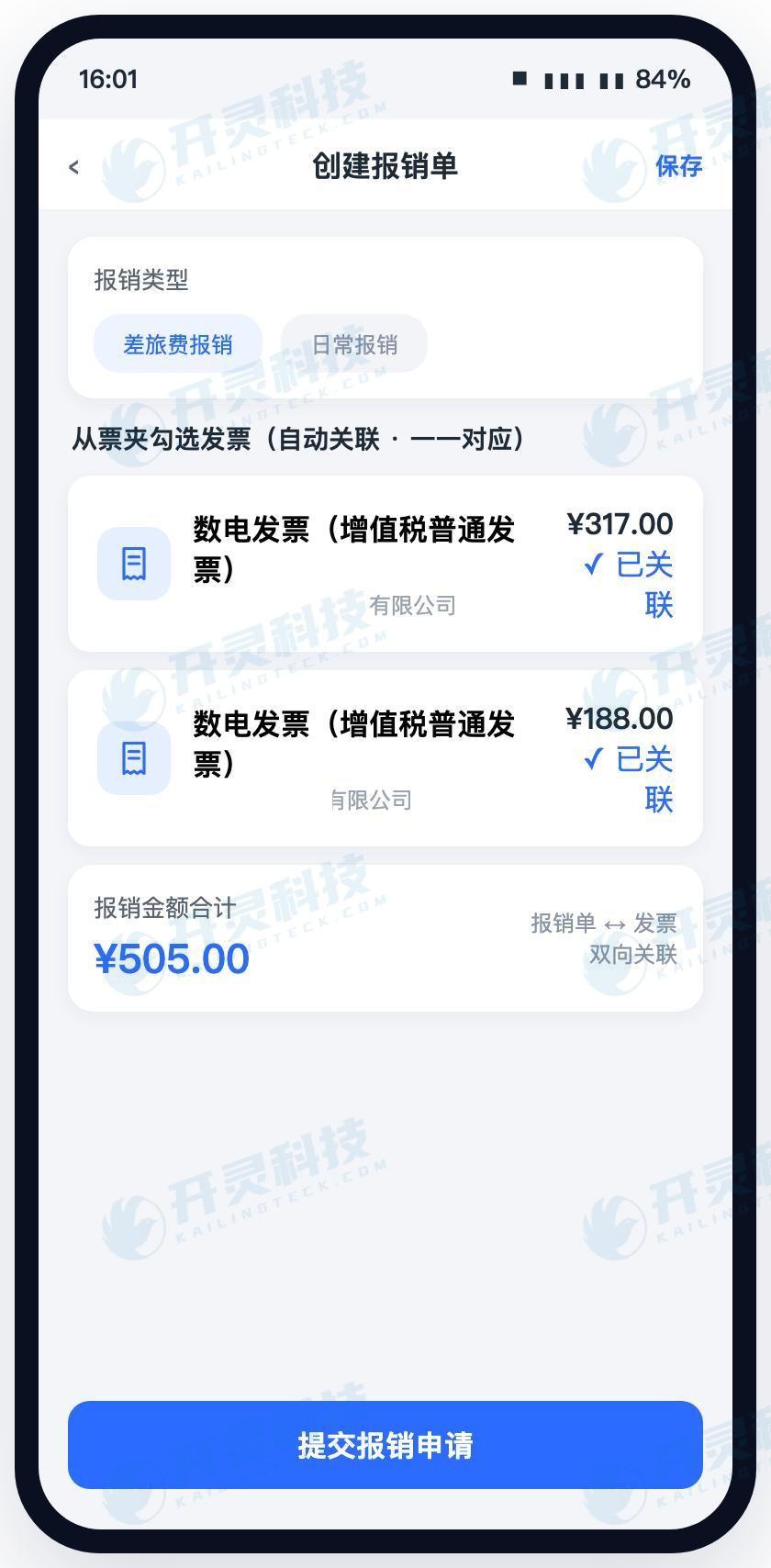
The invoice pool of Lingdong Reimbursement can display invoice type, number, invoice date, purchaser, source file location, compliance verification, reimbursement and bookkeeping status. Product materials describe prompts or controls for duplicate collection, mismatched header tax numbers and duplicate reimbursement, and applicable source files can be obtained from fully digitalized e-invoices. After employees select invoices from the invoice wallet to create a reimbursement form, there should be a two-way link between the invoice and the document, so reviewers no longer need to find the original from chat records.
Approval processes can be configured by organization and expense type, and can be handled on both mobile and web. Travel expenses need to be combined with travel applications, itineraries, accommodation standards, and actual occurrence; office procurement and business entertainment have different material requirements. AI digital employees can perform pre-review according to policies, give the rules hit and reasons, and transfer exceptions to humans. "Automatic review" here should be premised on clear rules and sample testing, and the model should not be allowed to create reimbursement policies on its own.
Invoice verification only indicates the status of the document itself and cannot replace judgment on business authenticity. For example, the invoice is genuine, but if the purpose of the trip, cost attribution, or payment entity is unclear, manual document checking is still required. Group finance also needs to distinguish "duplicate invoice aggregation," "duplicate reimbursement of the same invoice," and "duplicate payment for the same trip"; the three have different inspection targets.
▍The results of payment, vouchers, and archiving must return to the original document
After approval is completed, payment management can export payment files in bank formats, or use bank-enterprise direct connection in projects that have integrated with banks; after bank receipts are returned, they are linked to the original reimbursement form. Product materials mention the capability to integrate with more than 100 banks, but whether a given enterprise can use a specified bank, account, and payment type must be verified one by one during implementation. Cashiers need to see payment failure, returned ticket, retry, and manual change-to-pay statuses, avoiding a situation where a reimbursement form shows "paid" but there is no evidence of receipt.
In the financial bookkeeping step, expense type, cost center, tax amount and accounting subject need to be mapped to ERP vouchers. Lingdong Reimbursement materials include voucher conversion middleware and a solution for interworking with the electronic accounting archives system; this does not mean that every ERP's fields can be directly connected without configuration. Enterprises should verify with one real but desensitized expense sample: whether the original invoice, reimbursement form, approval, payment receipt, voucher and archive object can open each other.
When archiving electronic invoices, save the actually obtained source files and necessary metadata; do not keep only screenshots or printouts. PDF, OFD and XML have different uses, and not every invoice must have all three files at the same time. If a payment is refunded or a reimbursement form is revoked, the link between vouchers and archives should retain the change track, and cannot show only a perfect one-way process.
▍Use abnormal paths in implementation acceptance to test whether "integration" holds
It is recommended to choose four sample groups: the same invoice added to the invoice wallet by two people, a hotel invoice with the wrong title, a payment account changed after approval, and a bank receipt arriving late or payment failure. Observe front-end prompts, approval interception, cashier handling, ERP write-back, and archive records respectively. Cross-system callbacks may fail, so there must be a retry list and manual handler; an entire expense cannot "disappear" from the management dashboard because one interface fails.
The full-process value of Kailing Technology's expense control and reimbursement management system is to use the reimbursement form as a traceable center, connecting business travel materials, invoices, policies, payments, vouchers and archiving according to actual project boundaries. When evaluating, enterprises should first check whether exceptions can be closed in a loop and whether finance can trace from a result back to the original materials, and then discuss how many steps can be automated.
▍Assign full-process responsibilities to business, finance, and technology
The quality of materials after expenses occur cannot be left only to finance for end-stage remediation. Employees are responsible for explaining expense items and submitting true original materials, business supervisors check necessity and budget, finance reviews invoices and accounting treatment, cashiers confirm payment, and technical personnel maintain interfaces and exception tasks. Every missing item in the system should show the current responsible person and next step, rather than a reimbursement form circulating among multiple to-do lists.
Cross-system projects also need a unified time standard. Business travel order generation, invoice issuance, reimbursement submission, approval completion, bank payment and ERP bookkeeping are different time points; "reimbursed" cannot be confused with "paid" or "booked". If management looks at expense trends, it should know whether reports use incurred amount, reimbursement amount, payment amount or booked amount. Only after distinguishing statuses can plans and actuals be compared and the same amount be prevented from being counted repeatedly across multiple systems.
Post-launch operating indicators can start with the number of pending invoices, duplicate invoice interceptions, average approval wait, payment failure handling time, and archiving missing-item rate. If an indicator is abnormal, go back to the corresponding documents and interface logs for investigation, rather than only manually filling in tables at month-end.
▍FAQ
Q: Will business travel platform orders automatically enter Lingdong Reimbursement?
A: The platform interface, employee and organization fields, order status, and authorization need to be checked; specific integration is subject to project implementation.
Q: Is a PDF enough for an electronic invoice?
A: The source files and metadata of electronic vouchers actually obtained and applicable should be retained; screenshots or printouts cannot replace electronic vouchers that should be retained.
Q: Will the reimbursement form automatically close after successful payment?
A: Bank receipts, vouchers, and archiving results also need to be checked; abnormal refunds or failures should retain their processing status.
Q: Can digital employees completely replace reimbursement approval?
A: Matters with clear rules can be pre-reviewed or processed according to configuration; exceptions and high-risk judgments should be confirmed by personnel with authority.
Enable reverse lookup of the original document from expense occurrence to payment archiving. Learn about Kailing Technology's expense control and reimbursement management system: https://www.kailingteck.com/feikong/ .
As a national high-tech enterprise, Kailing Technology focuses on the digital and intelligent transformation of enterprise business-finance-tax and operations management, providing software products, system integration, implementation and delivery, and operational services for various government agencies, institutions, group enterprises, and SMEs.
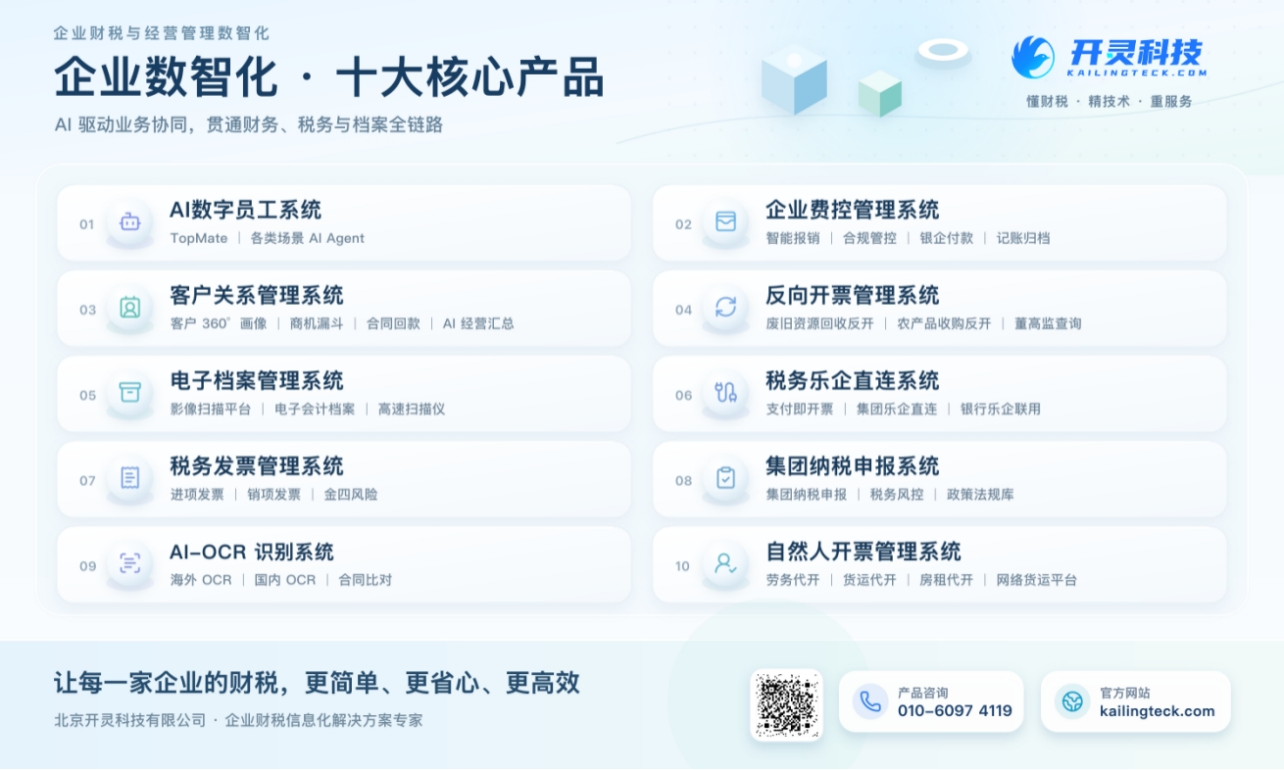
The company has now formed ten core product lines, including: AI digital employee system, enterprise expense control management system, customer relationship management system, reverse invoicing management system, invoice issuance for individuals management system, electronic archives management system, tax fully digitalized e-invoice Leqi system, tax invoice management system, group tax filing system, and AI OCR recognition system. It is committed to connecting enterprise business, finance, tax, funds, and archive data to help customers improve operational efficiency, business-finance-tax compliance capabilities, and digital management levels.
If you have any business-finance-tax digital transformation needs, welcome to contact us. Beijing Kailing Technology will serve you wholeheartedly.
Keywords: Kailing Technology expense control and reimbursement management system, Lingdong Reimbursement, business travel reimbursement, bank-enterprise direct connection payment, full expense process
As a comprehensive business-finance-tax digitalization solution service provider, Kailing Technology provides business-finance-tax management digital transformation products and operational services for various government agencies, institutions, and large, medium, and small enterprises. The product line includes: solutions for sales contract management system, procurement contract management system, fully digitalized Leqi interface project, automatic output invoicing system, reverse invoicing system, invoice issuance for individuals system, employee expense control and reimbursement system, input VAT invoice management system, supply chain collaborative reconciliation system, image AI OCR recognition system, automatic financial bookkeeping system, electronic accounting archives system, etc., comprehensively driving the digitalization process across various fields.
Consultation Hotline: 18513895936 / 010-60974119 Location: Beijing