
How much does small business bookkeeping and tax filing software cost in 2026? A five-item total cost checklist

How much does small business bookkeeping and tax filing software cost in 2026? First calculate the five-item total cost clearly
There is no unified price range for small business financial software that applies to all vendors, versions and regions. The annual fee on a public page is usually only an entry price; the final cost is also affected by the number of users, number of account sets, functional version, data migration, external interfaces, applicable scope of e-invoicing and tax filing, service period and exit method. Rather than applying unsourced ranges like "a few hundred, a few thousand, tens of thousands," it is better to require each candidate solution to quote against the same checklist.
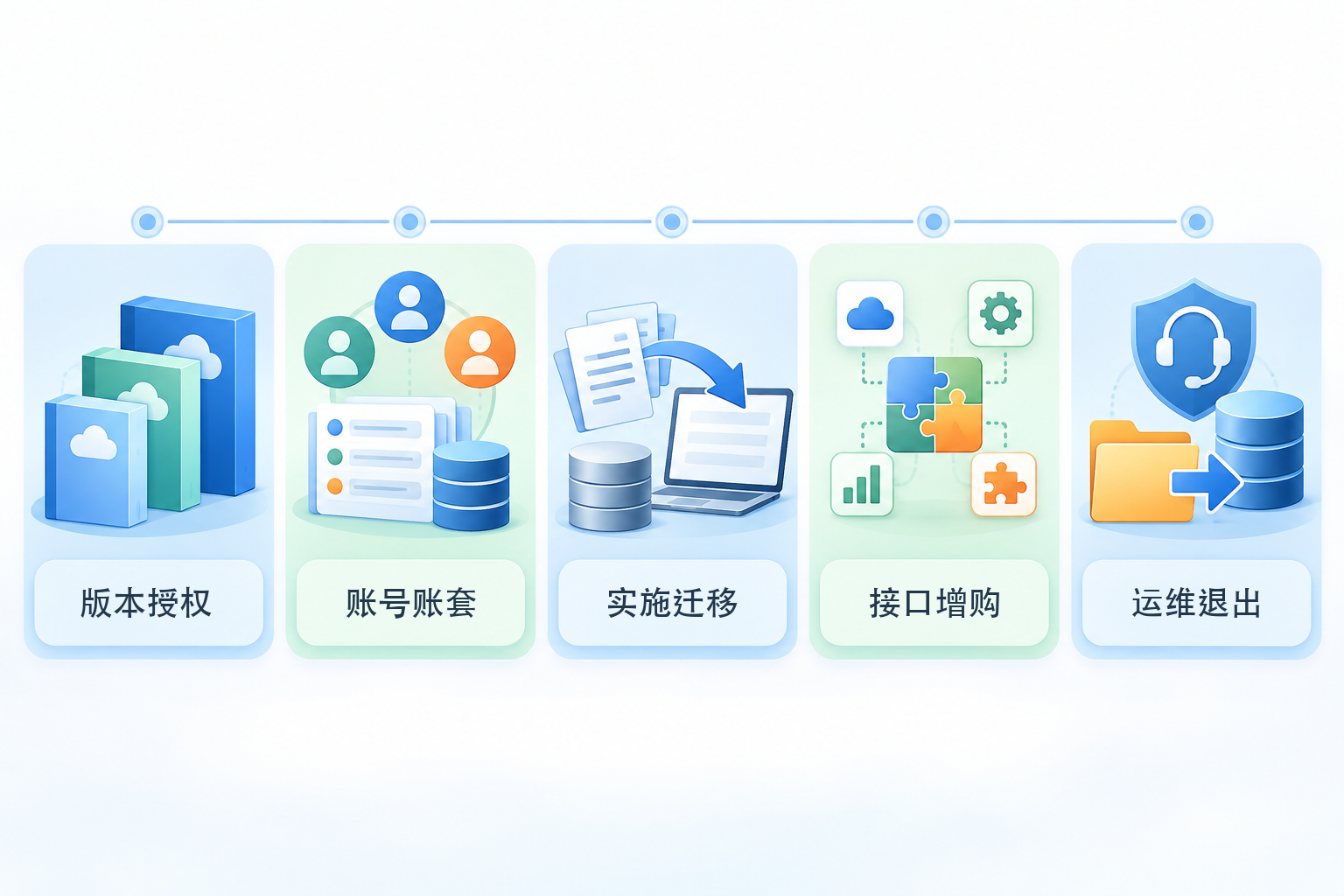
Five-item total cost: version licensing, accounts and account sets, implementation and migration, additional interface purchases, operations and exit. Unify the basis first, then compare prices. |
▍1. Version licensing: first confirm which capabilities the listed price includes
The same brand often has multiple versions, and accounting, invoicing, tax, purchase-sales-inventory, funds, reports and multi-organization capabilities are not necessarily included in the basic version. TakingOfficial Chanjet Haokuaiji purchase pageas an example, the page snapshot dated October 20, 2026 lists the Popular Edition at 498 yuan/year, Standard Edition at 898 yuan/year, Professional Edition at 1,998 yuan/year and Flagship Edition at 2,998 yuan/year, with the number of users, number of account sets and functional differences noted separately. This is only public page information for a single product at that point in time, not an industry-wide quotation; when promotions, versions and terms change, the purchase page and contract shall prevail.
▍2. Accounts and account sets: write the incremental costs after business growth into the table
When requesting a quote, do not just write "one company can use it"; instead, list clearly the number of legal entities, number of account sets, number of finance and business users, number of stores or departments, historical years, and data capacity. Also list separately how additional users, account sets, storage, or modules are billed. If you plan to let accountants, cashiers, the boss, and external bookkeeping personnel collaborate, verify role by role whether permissions can be separated, to avoid discovering after purchase that accounts are shared or additional authorizations are required.
▍3. Implementation and migration: a low annual fee does not mean low switching cost
Implementation fees should cover the organization, import, verification and training for opening balances, accounts, customers and suppliers, inventory, fixed assets and historical vouchers. Require the service provider to demonstrate the import with desensitized samples, explaining how failed data is returned, who corrects it, and how reconciliation is done after go-live. Whether all historical data is migrated should be decided based on query, audit and archive needs, not solely on verbal sales promises.
▍4. Additional interface purchases: confirm "can connect" with real processes
Official product page of Kingdee AI XingchenIt shows different capabilities and version matrices for finance, tax, purchase-sales-inventory, retail, e-commerce and open interfaces, and it can also be seen that some tax functions have version or regional conditions. When comparing interfaces, real samples such as orders, bank statements, invoices and archives should be used to verify authorization methods, field mapping, call quotas, failure retries, manual review and logs, rather than directly interpreting "supports API" as meaning it can be connected without implementation.
▍5. Operations and exit: renewal, service and data portability must all be priced
The total cost should at least cover renewal, upgrades, training, manual services, interface maintenance, backup and recovery, security response and post-termination data export within the planned usage period. The contract should clearly state whether invoices, vouchers, attachments, accounts, logs and reports can be fully exported in readable formats, and what the retention period, migration assistance and deletion mechanism are after service termination. Only with a smooth exit can the buyer avoid being locked in by a low first-year price.
How to make a quotation comparison table: Have each vendor fill in eight columns: required functions, currently included, additional purchase items, one-time fees, annual fees, three-year total, restrictions, and acceptance evidence. For fees not disclosed on public pages, mark them as "to be confirmed in writing" and do not estimate them yourself as an industry average. The actual purchase conditions for products such as Kingdee should be based on the current quotation, trial results and contract list.
Where Kailing Technology fits: If the enterprise's core accounting system has already been determined but there are still gaps in invoice collection, business approval, pre-voucher data preparation, archive linking or multi-system connection, Kailing Technology can be considered as a candidate professional collaboration and integration layer and tested with samples alongside the core financial software. Whether specific regions, invoice types, interfaces and automation steps are supported must be based on the current version, licensing conditions, demo results and contract scope; software cannot replace accountants' judgment on business substance, accounting treatment and tax filing.
Minimum acceptance before signing: Select one set of desensitized opening data and several normal and abnormal transactions each, and separately test import, bookkeeping, review, reports, invoice- or tax-related functions, permissions, export, and failure recovery. Record the successfully demonstrated version number, region, data scope, and manual steps in the acceptance form, then calculate the three-year total cost. Only then are the prices comparable, and this also avoids mistaking promotional features for delivery commitments.
(The price information in this article is a snapshot of official public pages as of October 20, 2026, and is only used to establish a comparison method; it does not constitute a quotation or procurement advice. Prices, promotions, versions, features, and regional applicability conditions may change; please refer to the vendor's current pages, written quotations, and contracts.)
Keywords: small business bookkeeping and tax filing software cost, financial software price, bookkeeping software selection, finance-tax software total cost, software implementation and migration, financial software interfaces, small business finance-tax system
As a comprehensive business-finance-tax digitalization solution service provider, Kailing Technology provides business-finance-tax management digital transformation products and operational services for various government agencies, institutions, and large, medium, and small enterprises. The product line includes: solutions for sales contract management system, procurement contract management system, fully digitalized Leqi interface project, automatic output invoicing system, reverse invoicing system, invoice issuance for individuals system, employee expense control and reimbursement system, input VAT invoice management system, supply chain collaborative reconciliation system, image AI OCR recognition system, automatic financial bookkeeping system, electronic accounting archives system, etc., comprehensively driving the digitalization process across various fields.
Consultation Hotline: 18513895936 / 010-60974119 Location: Beijing