
How can five-flow integration be achieved when agricultural product purchases involve scattered farmers? Kailing Technology's agricultural product purchase invoice system links acceptance, payment, and invoices
At one procurement point, farmers growing vegetables are received in the morning, and grain and fruit are received in the afternoon. Farmers are scattered and arrival times vary, so goods are easily unloaded first on site, and then the accountant issues procurement invoices afterward based on names and total prices. The problem is that farmers with the same name, family members delivering on their behalf, and temporary changes to receiving accounts can all blur "who produced, who delivered, and who received payment." Kailing Technology's agricultural product procurement invoicing system should start with farmer file creation and each delivery, linking self-production materials, acceptance, settlement, payment, and invoices.
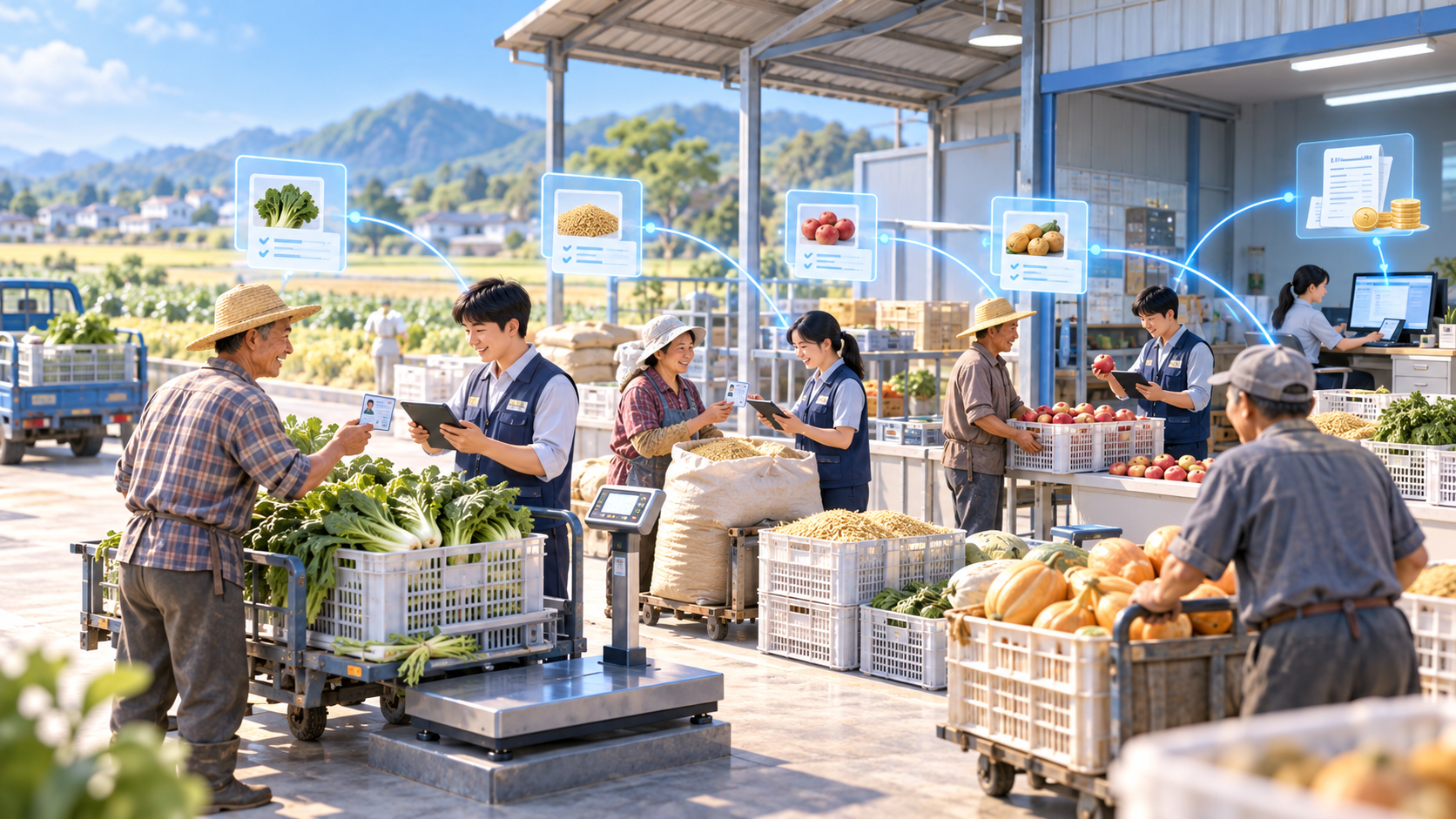
▍First identify the farmer and self-production attributes, then build reusable archives
The premise of an agricultural product purchase invoice is that the business is genuine and the corresponding policy applies. The VAT policy transition rules implemented from 2026 continue to clarify: agricultural producers selling self-produced primary agricultural products may be exempt from VAT according to regulations; general taxpayers that obtain or issue compliant agricultural product sales invoices or purchase invoices may calculate the relevant input VAT by multiplying the purchase price stated on the invoice by the current 9% deduction rate. Here, "self-produced" cannot be replaced by "a natural person holding an ID card." Purchasing enterprises must verify whether the farmer directly engages in agricultural production such as planting and harvesting, and whether the goods sold come from their production activities.
Profile creation can collect identity, contact information, commonly sold categories, production location or business proof, bank card, and other materials, and record the evidence source and review date. Land contracts, village-level statements, cooperative member materials, and the like may be used to assist verification, but they are not a single nationally unified proof template; enterprises should determine applicable materials in light of the transaction location and the requirements of the competent tax authority. Profiles can speed up repeat transactions, but when category, origin, or account changes occur, re-verification is still required to avoid the assumption that "once a profile is created, all transactions are self-produced by default."
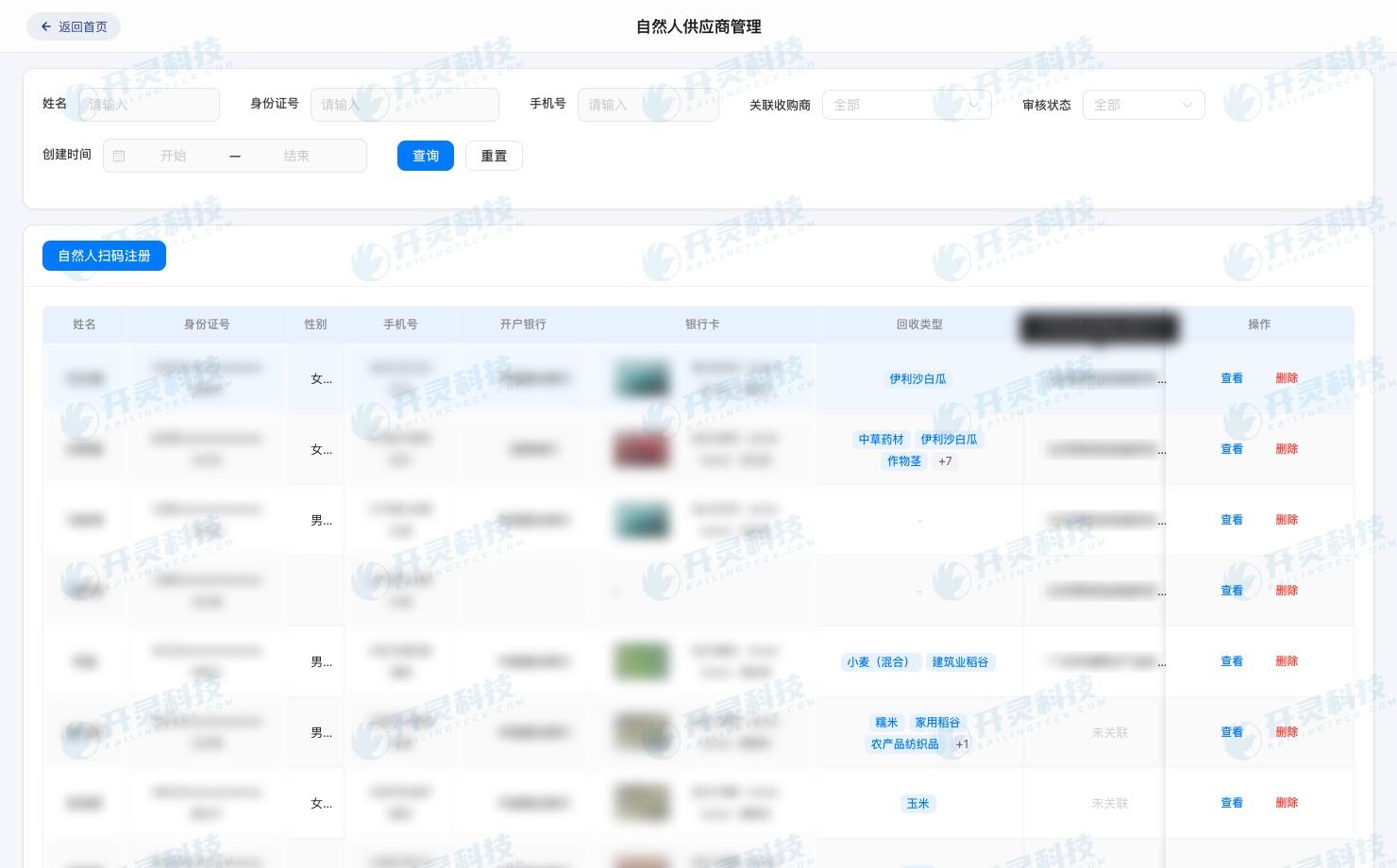
Example of agricultural producer profile creation interface
▍At the goods receipt site, let "person, goods, and document" meet in the same transaction
Purchasers should establish a goods order based on one actual delivery: record the selling farmer, deliverer, arrival time, category, quantity, acceptance conclusion, and handling position. If a family member or transport person delivers on behalf, their relationship to the farmer should be explained, and necessary handover confirmation retained; the proxy deliverer cannot simply be entered as the agricultural producer, nor can the owner of the goods be inferred solely from the license plate. Weighing, inspection, and warehousing records should point to the same goods order, forming delivery facts that finance can review.
Measurement methods may differ by category: grain may focus on moisture and impurities, vegetables on grade and loss, and fruit on box count, net weight, and acceptance grade. System fields can be configured by category, but on-site confirmation must not be ignored just because fields are complete. Disputed quantities or deductions should record the reason, reviewer, and farmer confirmation result; unconfirmed details should remain in pending settlement status and not be mixed into confirmed payment and invoicing amounts.
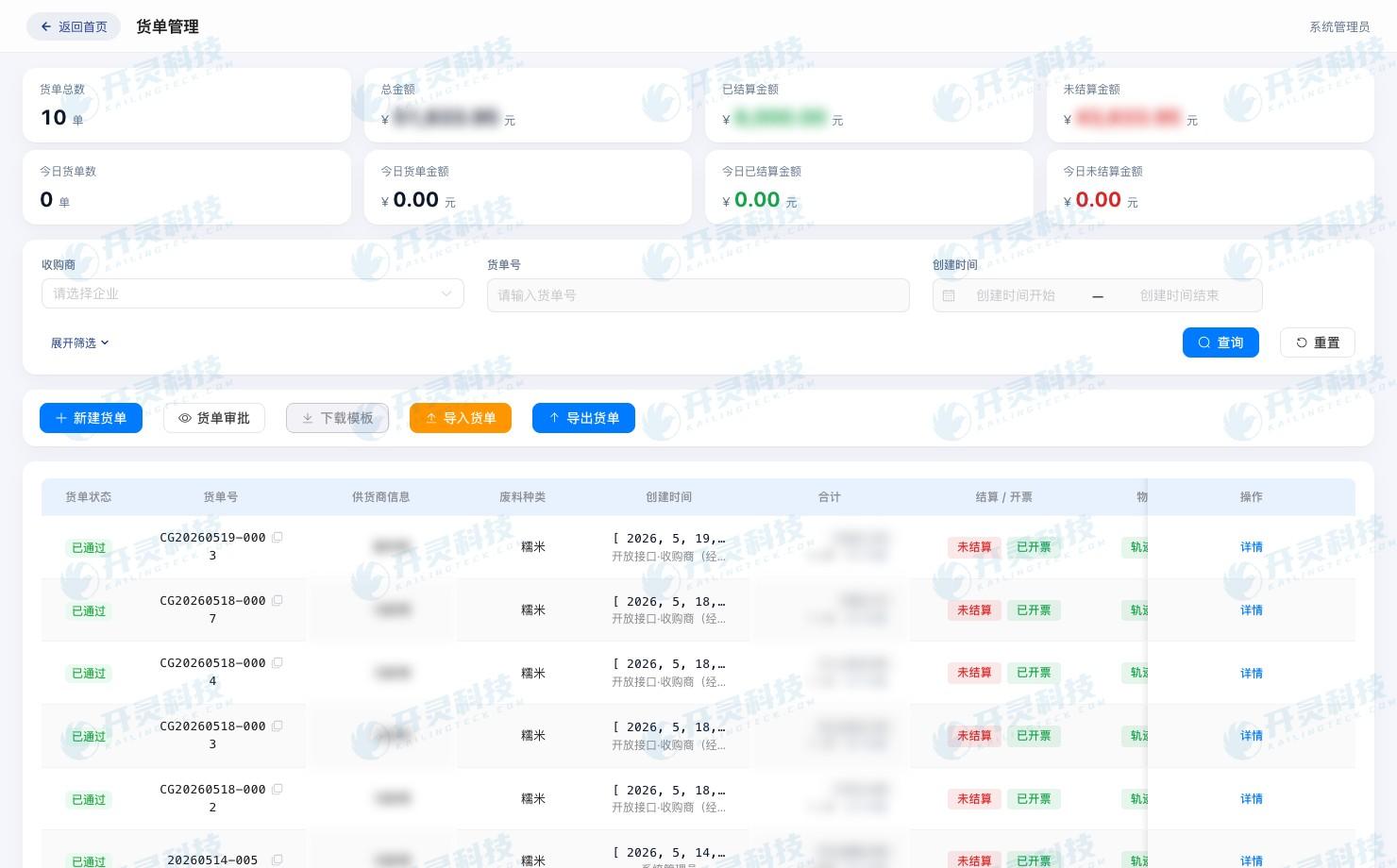
Example of agricultural product receiving goods note interface
▍Five-flow integration is not five forms, but the ability to trace each invoice back to the original procurement
The five-flow integration used by the Kailing Technology agricultural product purchase invoice system is an internal enterprise evidence management method that organizes, transaction by transaction, the farmer's self-production certification, purchase agreement, goods business, tax invoices, and fund payment; it is not a fixed set of five forms separately prescribed by tax law. For dispersed farmers, the key is not to pile all materials into one folder, but to be able to trace from a given invoice to the farmer and the goods order; from a single acceptance form, one can also see whether the invoice and payment have been completed.
If one farmer makes multiple deliveries, payment can be summarized as agreed, but source details still need to be clear transaction by transaction. If multiple farmers deliver via the same vehicle, goods, settlement, and payment receipt cannot be attached only to the driver's name. The system can flag missing self-production materials, acceptance vouchers, or payment information by business number, and the review position handles anomalies before invoicing. Material completeness is an enterprise management indicator; it does not mean the tax authority has determined that each transaction is compliant.
During peak purchasing season, attention should also be paid to the validity of archives. The fact that a farmer sold self-grown vegetables last season does not mean that newly added grain or fruit this season naturally counts as self-produced. When a site finds significant changes in transaction category, production location, or supply scale, it should re-ask about the source and update the corresponding materials. The system lists such changes as review reminders, and reviewers judge based on facts, which reduces repeated form filling for each transaction while not treating historical archives as a permanent pass.
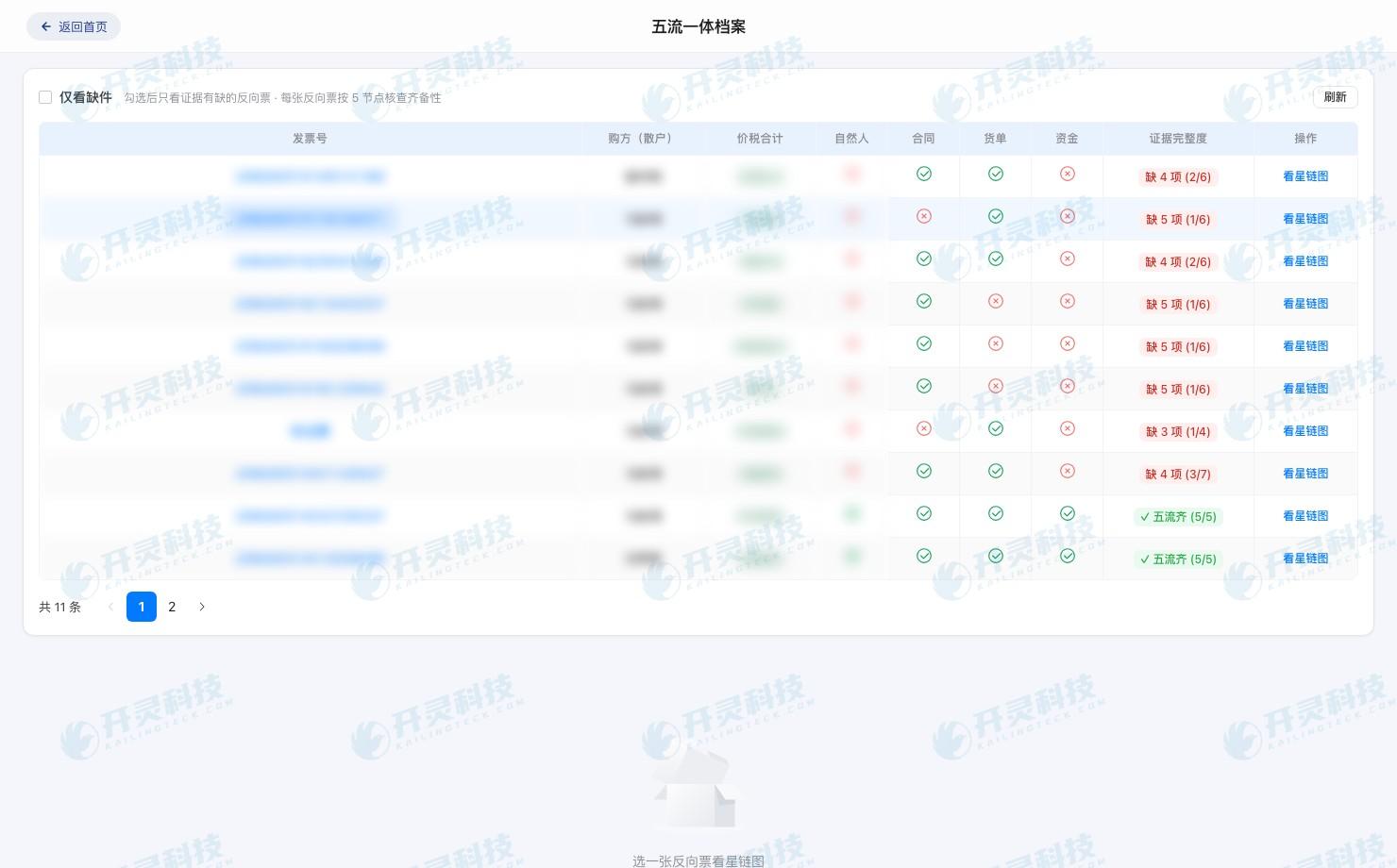
Example of the five-flow evidence archiving interface
▍Confirm settlement first, then deduct payment and procurement invoice to the same farmer
Finance forms a settlement statement based on accepted goods orders and purchase prices, checking the farmer's name, amount payable, and receiving account. Batch payment can improve efficiency, but the allocation relationship between each payment and the farmer and goods order should be retained. Failed payments, account changes, or partial payments should leave status and review traces. If only a total payment is left in online banking and the system has no detail write-back, the fund end of the five flows will be broken.
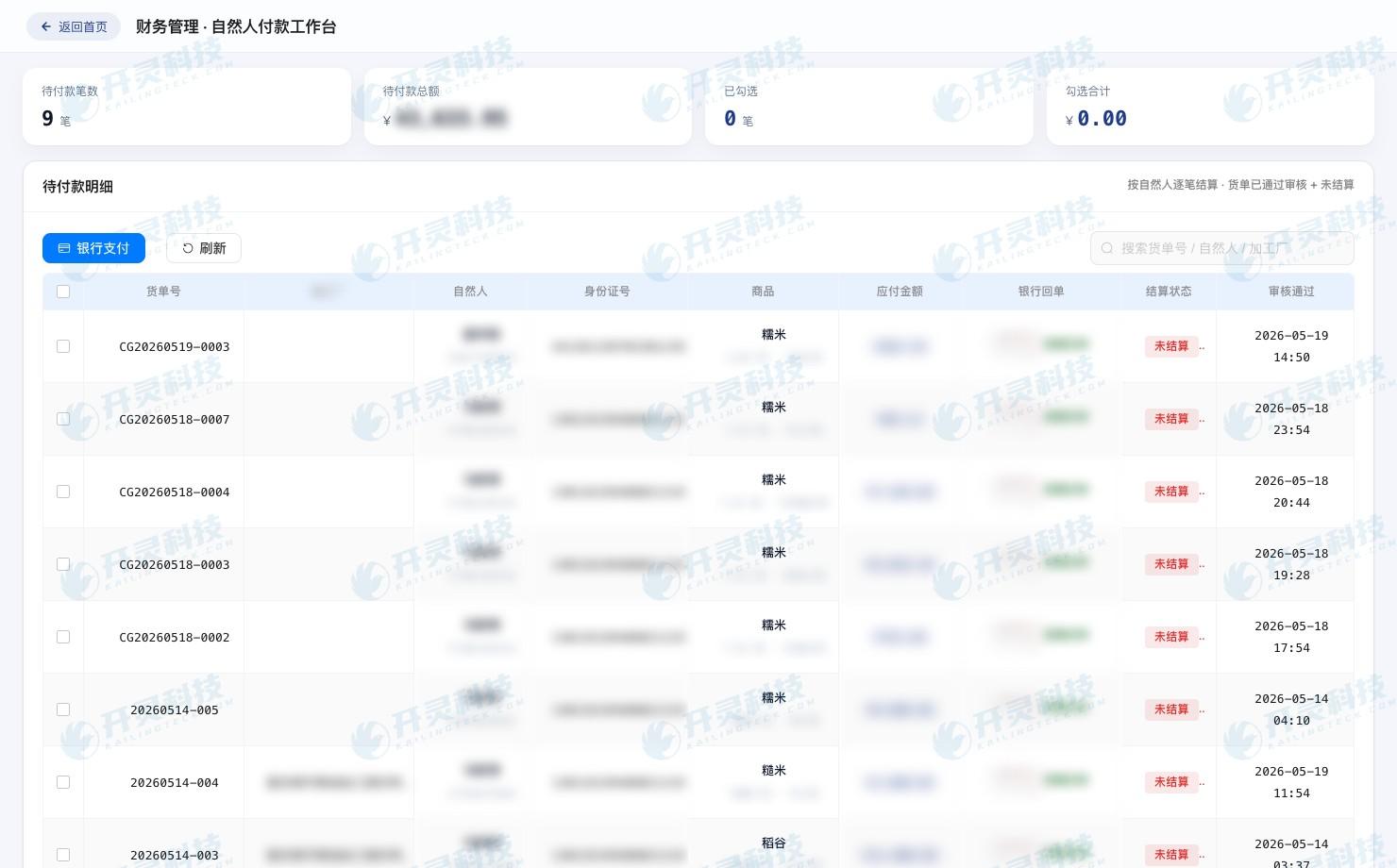
Example of agricultural producer payment workbench
When issuing an agricultural product purchase invoice, it should be based on eligible agricultural producers, the actual purchased category, quantity, and settlement amount, and the seller and transaction information should be filled in truthfully. The handling guidance of the Guangdong tax authority emphasizes issuing invoice by invoice; where consolidated issuance is truly necessary, a purchase list should be attached. Enterprises should also verify the specific local competent tax authority's requirements for invoice types, fields, and out-of-region purchases. After the invoicing result is written back to the source goods note, if returns or price adjustments occur, adjustments and red-letter reversals should be handled according to the actual business; the original acceptance record must not be directly altered.
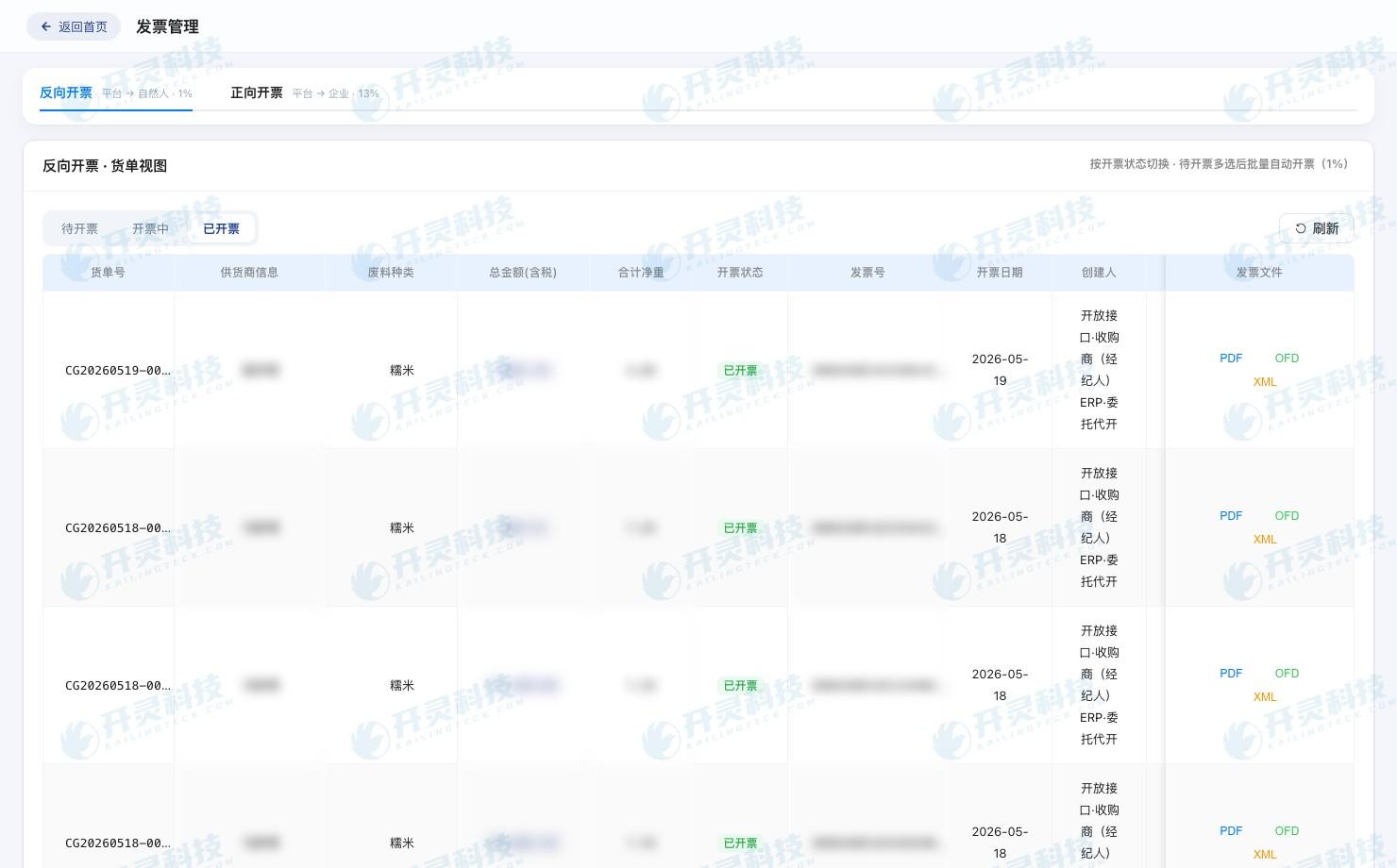
Example of agricultural product purchase invoice goods note view, information has been desensitized
▍Use three boundary samples to accept the scattered farmer scenario
The first is the same farmer making two deliveries, and whether inspection consolidation can still be split back into two acceptance forms; the second is a family member delivering on behalf while the farmer himself receives payment, checking identity and handover materials; the third is multiple households arriving in the same vehicle, checking whether goods and payments are respectively attributed to the correct people. Each is checked back through four entry points: farmer archives, on-site goods orders, bank results, and purchase invoices; when anomalies are found, the responsible position and evidence supplementation actions are recorded immediately.
The core of purchasing from scattered farmers is not moving the invoicing action earlier, but leaving sufficient facts at each delivery. Kailing Technology's agricultural product purchase invoice system can link profile creation, receiving, payment, invoicing, and five-flow archives; actual implementation still requires purchasers, reviewers, and finance to jointly agree on self-production verification and exception handling standards.
▍FAQ
Q: Can a procurement invoice be issued directly with only the farmer's ID card registered?
A: Also confirm that what they sell as agricultural producers is self-produced primary agricultural products, and verify the actual transaction and applicable invoice requirements.
Q: If a farmer's family member delivers goods on their behalf, to whom should the invoice be issued?
A: The actual selling agricultural producer and the delivery-on-behalf relationship should be verified, and the invoice should be filled in based on the genuine transaction, not determined solely by the identity of the on-site deliverer.
Q: Can multiple farmers delivering goods in the same vehicle be merged into one goods note?
A: Shared transport information can be retained, but each farmer's category, quantity, settlement, and invoice-payment attribution should be verifiable separately.
Q: Does five-flow archiving guarantee deductibility?
A: No absolute guarantee can be made. Archiving helps enterprises prove the correspondence between business and materials, but actual deduction remains subject to applicable policies and genuine, compliant vouchers.
Make every purchase from scattered farmers have traceable acceptance and invoice-payment evidence. Learn about the Kailing Technology agricultural product purchase invoice solution: https://www.kailingteck.com/fxncp/ .
As a national high-tech enterprise, Kailing Technology focuses on the digital and intelligent transformation of enterprise business-finance-tax and operations management, providing software products, system integration, implementation and delivery, and operational services for various government agencies, institutions, group enterprises, and SMEs.
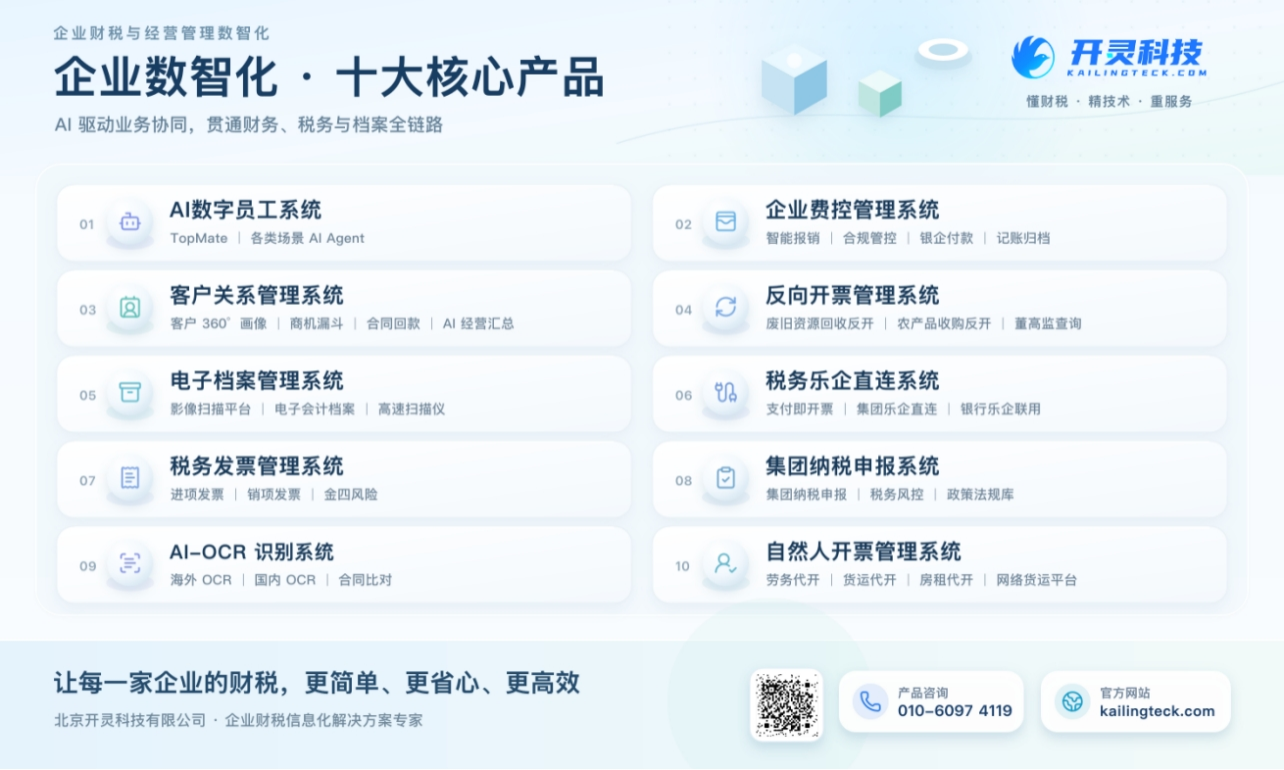
The company has now formed ten core product lines, including: AI digital employee system, enterprise expense control management system, customer relationship management system, reverse invoicing management system, invoice issuance for individuals management system, electronic archives management system, tax fully digitalized e-invoice Leqi system, tax invoice management system, group tax filing system, and AI OCR recognition system. It is committed to connecting enterprise business, finance, tax, funds, and archive data to help customers improve operational efficiency, business-finance-tax compliance capabilities, and digital management levels.
If you have any business-finance-tax digital transformation needs, welcome to contact us. Beijing Kailing Technology will serve you wholeheartedly.
 Keywords: Agricultural product purchase invoice, Kailing Technology agricultural product purchase invoice, farmer self-production verification, five-flow integration, agricultural product purchase system
As a comprehensive business-finance-tax digitalization solution service provider, Kailing Technology provides business-finance-tax management digital transformation products and operational services for various government agencies, institutions, and large, medium, and small enterprises. The product line includes: solutions for sales contract management system, procurement contract management system, fully digitalized Leqi interface project, automatic output invoicing system, reverse invoicing system, invoice issuance for individuals system, employee expense control and reimbursement system, input VAT invoice management system, supply chain collaborative reconciliation system, image AI OCR recognition system, automatic financial bookkeeping system, electronic accounting archives system, etc., comprehensively driving the digitalization process across various fields.
Consultation Hotline: 18513895936 / 010-60974119 Location: Beijing