
Reverse invoicing operating process and precautions: five risk verifications

Reverse invoicing operating process and precautions: use five verifications to avoid 'the invoice exists, but the business chain is broken'
Reverse invoicing by resource recycling enterprises solves the problem of inconvenient invoicing for eligible natural person sellers of scrapped products; it is not a universal channel for all 'buyer issues invoice to seller' scenarios. The risk most likely to arise for enterprises is splitting qualification, personal consent, source of goods, payment, and tax filing on behalf into several unrelated records. During review, a single invoice cannot replace evidence of a genuine transaction.
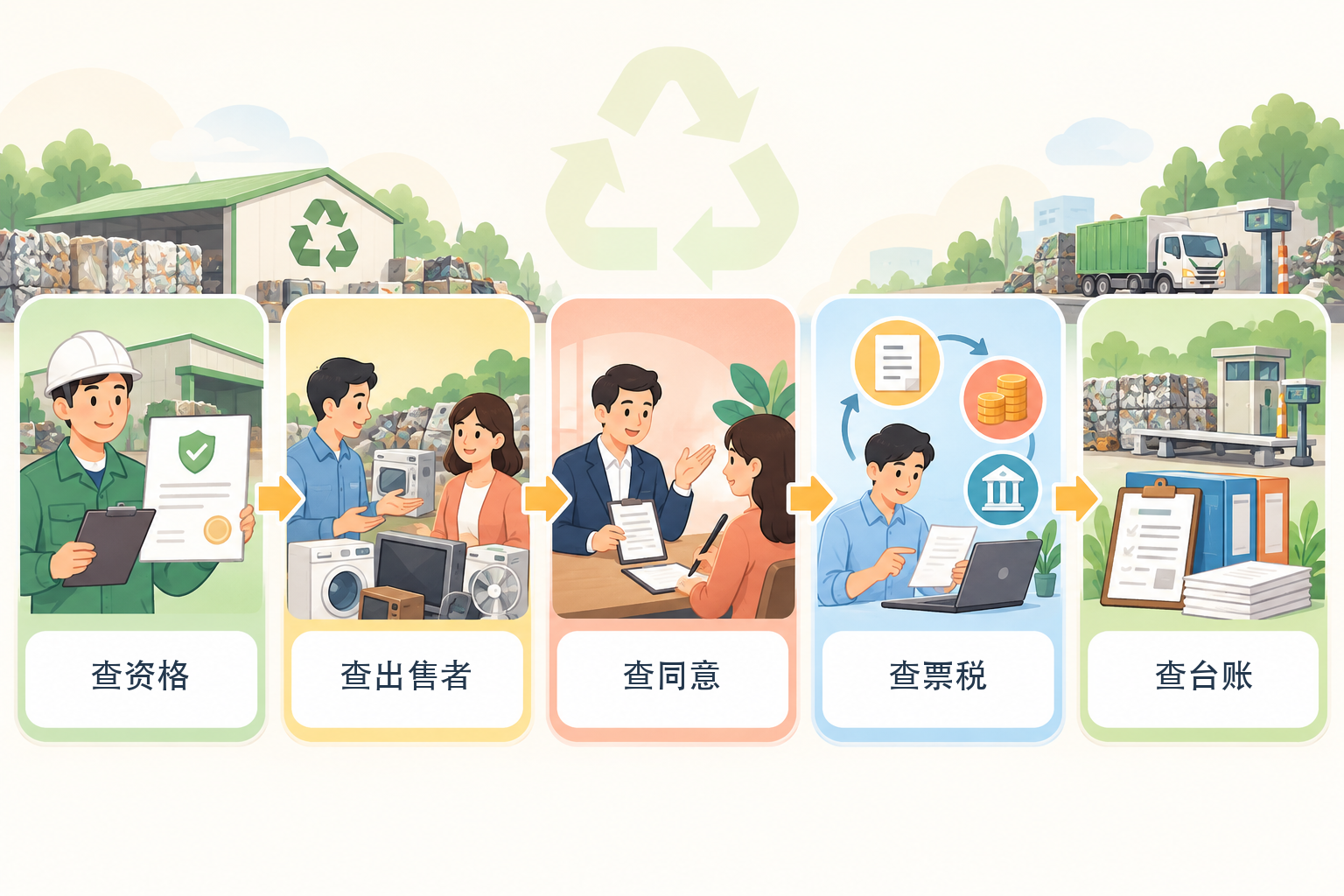
The five verifications should be completed before invoicing and continuously updated: check the enterprise, check the seller, check consent, check invoice and tax, and check the ledger. |
▍1. Check qualification: whether the enterprise truly meets the conditions for reverse invoicing
State Taxation Administration Announcement No. 5 of 2024Clear conditions are set for resource recycling enterprises. Hazardous waste, scrapped motor vehicles, and other renewable resource recycling businesses are subject to different licensing, qualification, or filing requirements, and the enterprise must actually engage in resource recycling business. Having only a software account, a general business scope, or having previously issued a certain type of invoice cannot replace the tax authority's processing result and current qualification status.
▍2. Check the seller: the natural person, scrapped products, and cumulative amount must all match
The seller must fall within the scope of natural persons specified in the announcement, and the transaction subject matter must be scrapped products that have already lost all or part of their original use value. Enterprises should also track the cumulative sales amount of reverse invoicing for no more than twelve consecutive months, stop issuing invoices in this way when the policy boundary is reached, and indicate the subsequent processing path. Verification cannot only look at the ID card; it must also check the person, contact information, source of goods, and acquisition facts.
▍3. Check consent: the first processing must leave provable personal consent
When issuing a reverse invoice to a seller for the first time, the enterprise should obtain their consent for the reverse invoicing and tax filing on behalf matters and retain materials. If the seller does not consent, reverse invoicing must not be carried out. Using the identity of an employee, relative, or other person to replace the genuine seller, or treating a default checkmark as valid consent, may undermine business authenticity. The system should retain the notification version, consent time, handler, and subsequent withdrawal or change records.
▍4. Check invoice and tax: invoice type, red-letter invoice, tax filing on behalf, and follow-up obligations must not be omitted
The invoice types that a resource recycling enterprise may issue in reverse are related to the VAT calculation method applicable to itself; when a sales return, invoicing error, or discount occurs, the red-letter invoice must correspond to the original blue-letter invoice according to regulations. Enterprises must also handle tax filing and payment on behalf within the prescribed period and provide relevant information to the seller. Successful invoicing, successful payment, and completed filing are three different statuses and cannot replace one another.
▍5. Check the ledger: invoices should be traceable back to the contract, goods, transportation, and payment
The policy requires retaining business authenticity materials such as acquisition contracts or agreements, transportation invoices or vouchers, goods weighing slips, and transfer payment records, and establishing a complete acquisition ledger or forming one through existing systems. It is recommended to use a unified business number to associate the seller, goods, weighing, settlement, invoice, payment, and tax filing on behalf, but a 'unified number' is only a management method, not the only technical form mandatory for all enterprises under the policy.
Three boundaries that are easily confused: First, agricultural product acquisition invoices have their own applicable conditions and processing rules and should not be mixed with resource recycling reverse invoicing; second, the announcement took effect on April 29, 2024, and the tax obligation occurrence time of the corresponding business cannot be earlier than the policy implementation date; third, an invoice meeting formal requirements still cannot replace business authenticity, and false materials or false recycling business will bring qualification and tax risks.
What the system can do: Kailing Technology or other systems can serve as tools for processes, material association, status reminders, and audit logs, but must not promise 'automatic qualification acquisition,' 'automatic coverage of all invoice sources,' or 'natural compliance after invoicing.' Project acceptance should cover abnormal samples such as permission expiration, cumulative amount thresholds, non-consent, identity inconsistency, return red-letter reversal, overdue filing, and missing materials, and confirm manual review, export, and service suspension migration mechanisms.
Electronic material archiving should also satisfyCai Kuai [2020] No. 6 noticeRegarding the conditions of authenticity, security and reliability, metadata, review and signature, prevention of duplicate posting, and archive management, "scanning equals archiving" cannot be directly written as already meeting archiving requirements.
(This article is compiled according to current public policy and is only for risk verification; it does not constitute tax advice. For specific qualification, invoice types, and filing handling, please refer to the competent tax authority and the latest policy.)
Keywords: reverse invoicing precautions, resource recycling reverse invoicing, natural person scrapped product seller, reverse invoicing qualification, tax filing on behalf, acquisition ledger, business authenticity, electronic accounting archives
As a comprehensive business-finance-tax digitalization solution service provider, Kailing Technology provides business-finance-tax management digital transformation products and operational services for various government agencies, institutions, and large, medium, and small enterprises. The product line includes: solutions for sales contract management system, procurement contract management system, fully digitalized Leqi interface project, automatic output invoicing system, reverse invoicing system, invoice issuance for individuals system, employee expense control and reimbursement system, input VAT invoice management system, supply chain collaborative reconciliation system, image AI OCR recognition system, automatic financial bookkeeping system, electronic accounting archives system, etc., comprehensively driving the digitalization process across various fields.
Consultation Hotline: 18513895936 / 010-60974119 Location: Beijing