
Detailed explanation of the reverse invoicing operating process: six-step checklist for resource recycling enterprises

Detailed explanation of the reverse invoicing operating process: first confirm the scope of application, then process in six steps
The 'reverse invoicing' referred to in this article specifically means the invoicing by a resource recycling enterprise to a natural person seller of scrapped products as stipulated in Announcement No. 5 of 2024 of the State Taxation Administration. It has clear boundaries for enterprises, sellers, products, and time, and agricultural product acquisition invoices, invoices issued for individuals, or other scenarios cannot be directly applied to it. Software can assist with flow and trace retention, but whether one has the qualification and how to calculate and file taxes should still be subject to the competent tax authority and current policy.
The correct order is: first verify qualification and the genuine business, then obtain consent, issue invoices, file taxes on behalf, and retain the ledger; it is not invoice first and supplement materials later. |
Six-step sequence: Qualification confirmation, obtaining consent, identity verification, business evidence retention, reverse invoicing, tax filing.
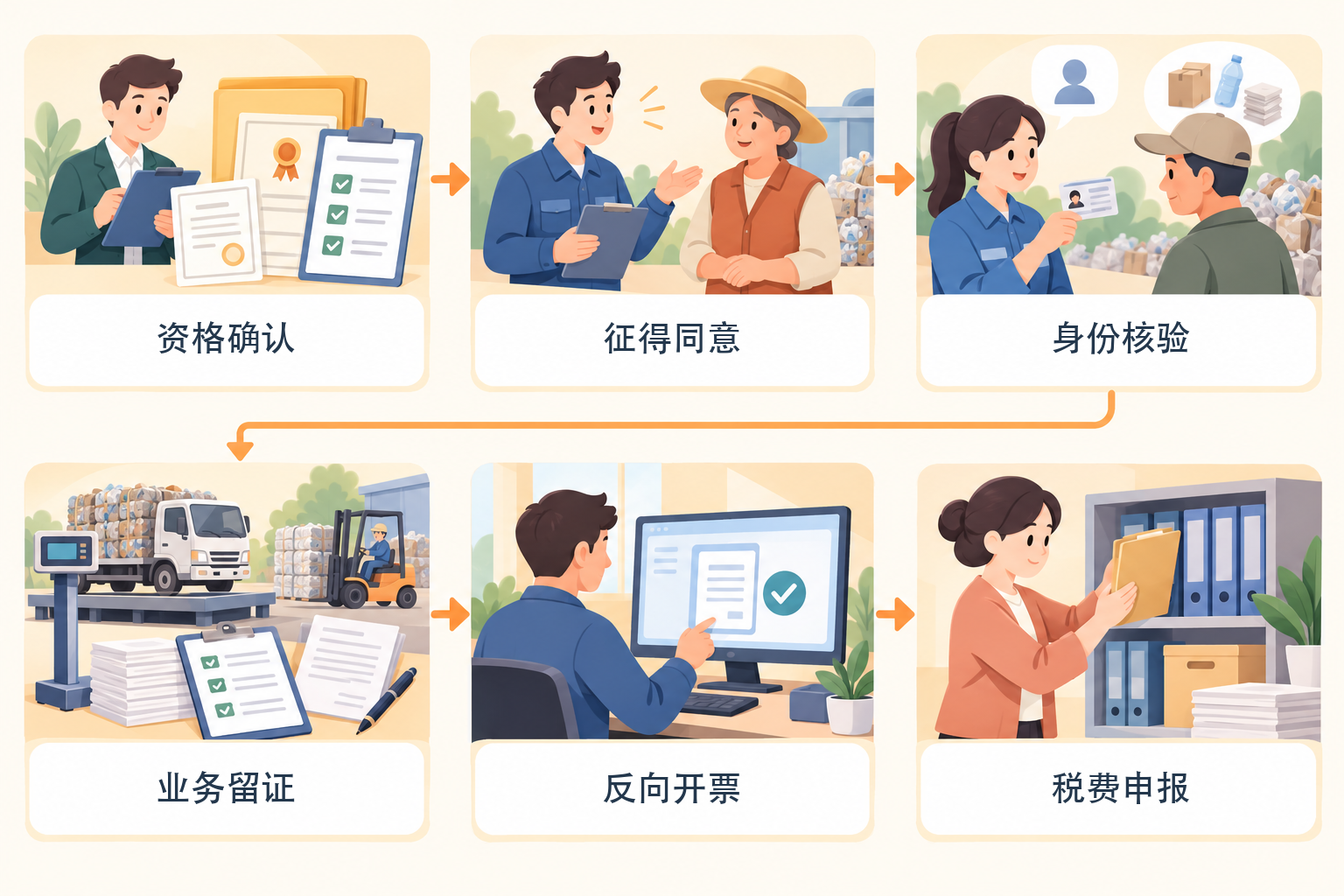
▍Step 1: Confirm the qualification of the resource recycling enterprise
BasisState Taxation Administration Announcement No. 5 of 2024Resource recycling enterprises implementing reverse invoicing shall actually engage in resource recycling business and meet one of the qualification or registration filing conditions listed in the announcement. Hazardous waste collection, end-of-life vehicle recycling and dismantling, and other renewable resource recycling have different corresponding licensing, qualification, or filing requirements. Enterprises shall first handle reverse invoicing matters according to tax authority procedures and cannot judge on their own based solely on the business scope in the business license or software functions.
▍Step 2: Obtain the seller's consent
When an enterprise issues a reverse invoice to a seller for the first time, it should obtain the person's consent for the reverse invoicing and tax filing on behalf matters and retain proof materials. If the seller does not consent, the resource recycling enterprise must not issue a reverse invoice to them, and the seller may apply to the tax authority for invoice issuance in accordance with regulations. The process system should retain the notification content, confirmation time, handler, and material version, avoiding only a checkmark status that cannot be traced.
▍Step 3: Verify the seller and the scope of scrapped products
The seller in the announcement is a natural person who meets the regulations, and scrapped products are products that have already lost all or part of their original use value. The current policy also sets an upper limit on the cumulative sales amount of reverse invoicing by a natural person for no more than twelve consecutive months; once exceeded, the resource recycling enterprise must not continue to issue reverse invoices. Enterprises should verify the person's identity, contact information, source of goods, product attributes, cumulative sales amount, and abnormal list, and must not use employee or other natural person information to issue invoices.
▍Step 4: Collect evidence of the genuine business
The announcement requires retaining materials that can prove the authenticity of the business, including acquisition contracts or agreements, transportation invoices or vouchers, goods weighing slips, transfer payment records, etc., and establishing an acquisition ledger recording the time, place, seller and contact information, name, quantity, price, etc. of each transaction. If existing account books or systems already contain the required content, there is no need to repeatedly create tables for formal compliance, but all materials should be traceable back to the same genuine transaction.
▍Step 5: Issue a reverse invoice according to the applicable rules
Enterprises should issue invoices within the approved invoice types and the current tax system rules, and confirm the invoice types they can issue based on their own VAT calculation method. When a sales return, invoicing error, or sales discount requires a red-letter invoice, it should be handled in correspondence with the original blue-letter invoice according to the announcement requirements. Successful submission in the system does not mean the business is automatically compliant; the product name, quantity, amount, seller, and actual acquisition materials still need manual review.
▍Step 6: File taxes on behalf and provide information to the seller
Resource recycling enterprises should, within the filing period of the month following the reverse invoicing, submit tax filing on behalf materials and pay the taxes filed on behalf according to regulations. The seller also has follow-up business income annual reconciliation obligations, and the enterprise should provide information such as reverse invoicing and taxes paid to them according to regulations. Business-finance-tax personnel need to incorporate invoicing, payment, filing on behalf, tax payment vouchers, and exception handling status into the same to-do chain.
Archive and system acceptance: BasisCai Kuai [2020] No. 6 noticeElectronic accounting vouchers archived electronically must also meet conditions such as legality and authenticity, safety and reliability, complete readability of vouchers and metadata, necessary review and signing, prevention of duplicate posting, and archive management. Scanning, recognizing, or placing attachments in a folder does not equal compliant archiving. If Kailing Technology or other vendors are included as candidates, desensitized samples should be used to verify qualification control, personal consent, cumulative amount prompts, material association, exception return, logs, and data export, and the current version and contract list shall prevail.
(This article is compiled according to current public policy and is only for process verification; it does not constitute tax advice. Policy interpretations, system rules, and enterprise facts may change; please confirm with the competent tax authority before processing.)
Keywords: reverse invoicing, reverse invoicing operating process, resource recycling enterprise, scrapped product seller, reverse invoicing for natural persons, acquisition ledger, tax filing on behalf, business authenticity
As a comprehensive business-finance-tax digitalization solution service provider, Kailing Technology provides business-finance-tax management digital transformation products and operational services for various government agencies, institutions, and large, medium, and small enterprises. The product line includes: solutions for sales contract management system, procurement contract management system, fully digitalized Leqi interface project, automatic output invoicing system, reverse invoicing system, invoice issuance for individuals system, employee expense control and reimbursement system, input VAT invoice management system, supply chain collaborative reconciliation system, image AI OCR recognition system, automatic financial bookkeeping system, electronic accounting archives system, etc., comprehensively driving the digitalization process across various fields.
Consultation Hotline: 18513895936 / 010-60974119 Location: Beijing