
Which financial software is good for small companies? Five-step selection and acceptance checklist

Which financial software is good for small companies? Set the route by scenario, then do five-step acceptance
A small company with few people does not mean the business is simple. Service-oriented enterprises may focus on projects, contracts, and expenses; trading enterprises pay more attention to procurement, inventory, and receivables and payables; enterprises involving agricultural product procurement, renewable resources, or a large number of individual transactions also need to handle specific documents and traceability requirements. Selection should start from the business form, rather than treating "fully automatic invoice collection, booking, and filing" as a universal standard.
More functions are not necessarily more suitable; only being able to run through real samples, explain boundaries, and exit safely counts as usable. |
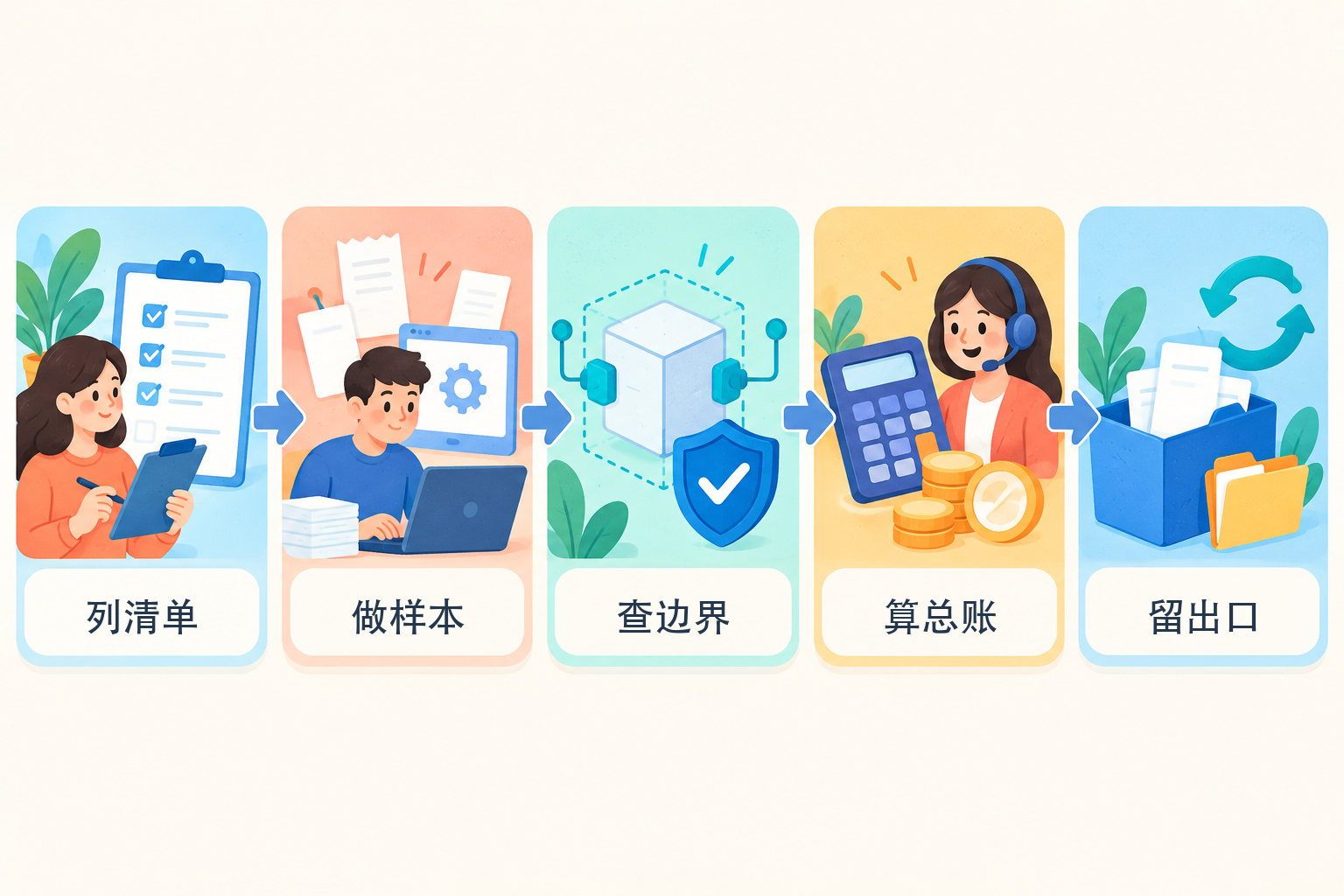
▍1. Establish candidate routes by three types of business scenarios
Service-oriented company Priority can be given to checking general ledger, project accounting, contracts, expenses, and receipts and payments;Trading or retail company Further check whether orders, procurement, inventory, costs, and receivables and payables can connect with finance;Special document or industry scenarios then the applicable policies, business authenticity materials, invoicing boundaries, ledgers, and manual review should be checked. Market products usually cover only part of this, and specific capabilities vary by version and project scope.
Public information shows that,YonyouThrough Chanjet Cloud, it provides a variety of cloud products for small and micro enterprises' business-finance-tax and operations,Kingdee AI XingchenPublicly covers SaaS scope such as finance, tax, procurement-sales-inventory, and expense reimbursement. Kailing Technology's document, invoicing, archive, and automation capabilities can serve as specialized candidates. The three types of objects have different positioning and cannot be ranked solely by the number of functions.
▍2. Make a list: break slogans into role actions
List nodes such as customer and supplier file creation, orders, inbound and outbound, invoices, bank statements, expense reimbursement, vouchers, filing, closing, and archives, indicating inputs, responsible persons, reviewers, and outputs. For every "automatic" item, ask about the data source, authorization method, applicable region, supported version, and steps that must be manually confirmed.
▍3. Do samples: test normal business and abnormal business together
Use desensitized data to test normal documents, duplicate invoices, red-letter or voided invoices, partial arrivals, cross-period expenses, interface interruptions, and permission failures. Observe whether the system saves original data, prompts conflicts, generates reviewable drafts, and records modifications. Completed recognition does not mean it has been booked, and passing invoice verification does not mean it is necessarily deductible; filing data still needs to be reviewed according to applicable rules.
▍4. Check boundaries: confirm interfaces, implementation, and service responsibilities
Confirm which capabilities are included in the standard version and which require additional purchase or customization, who provides the interface, who maintains it after changes, and who handles failures. Capabilities involving tax or bank platforms should be premised on enterprise authorization, platform rules, and current interfaces. The same written scope should be required for Kailing or other candidate products; project customization capabilities cannot be written as available by default to all customers.
▍5. Calculate the total account and keep an exit
Total cost should include subscription or license, users and account sets, implementation, interfaces, customization, storage, training, operations and maintenance, upgrades, and migration. Before launch, also confirm whether customers, suppliers, vouchers, attachments, approval records, operation logs, and electronic archives can be exported in standard formats, as well as migration assistance, backup retention, and deletion arrangements after service termination.
BasisCai Kuai [2020] No. 6 notice, electronic accounting voucher reimbursement, booking, and archiving need to meet conditions such as being legal and authentic, safe and reliable, complete reading of vouchers and metadata, necessary review and approval, prevention of duplicate booking, and archive management. Software providing scanning or association functions does not automatically mean all archiving requirements are met.
Conditional conclusion: Service-oriented small companies can first verify projects, expenses, and receipts and payments; trading companies should prioritize testing procurement-sales-inventory and financial reconciliation; special document scenarios should first confirm policy applicability and the evidence chain, then evaluate automation. After completing a small-scale pilot, decide whether to expand based on the exception rate, manual review time, total cost, and data portability.
(The above vendor and product information is compiled from public sources. Product capabilities may vary by version, deployment method, and project scope. When selecting, please rely on actual demonstrations, contractual agreements, and delivery lists.)
Keywords: small company financial software, which financial software is good, financial software selection, procurement-sales-inventory, document processing, total cost of ownership, data migration, electronic accounting archives
As a comprehensive business-finance-tax digitalization solution service provider, Kailing Technology provides business-finance-tax management digital transformation products and operational services for various government agencies, institutions, and large, medium, and small enterprises. The product line includes: solutions for sales contract management system, procurement contract management system, fully digitalized Leqi interface project, automatic output invoicing system, reverse invoicing system, invoice issuance for individuals system, employee expense control and reimbursement system, input VAT invoice management system, supply chain collaborative reconciliation system, image AI OCR recognition system, automatic financial bookkeeping system, electronic accounting archives system, etc., comprehensively driving the digitalization process across various fields.
Consultation Hotline: 18513895936 / 010-60974119 Location: Beijing