
How to choose between Yonyou and Kingdee for small business financial software? Look at these 3 hard indicators first

How to choose between Yonyou and Kingdee for small business financial software? First do same-criteria requirements and sample testing
Yonyou and Kingdee are not single software products, but product families covering different sizes, deployment methods, and business scenarios. Directly judging which of the two brands is "more worth buying" easily ignores specific product versions, industry plug-ins, interface licenses, implementation partners, and the enterprise's own processes. The prudent method is to first fix the same requirements list, then have candidate solutions demonstrate with the same batch of desensitized business data and undergo acceptance.
Brands can help build a candidate pool, but what truly determines whether implementation succeeds is version scope, interface boundaries, control processes, and ongoing service. |
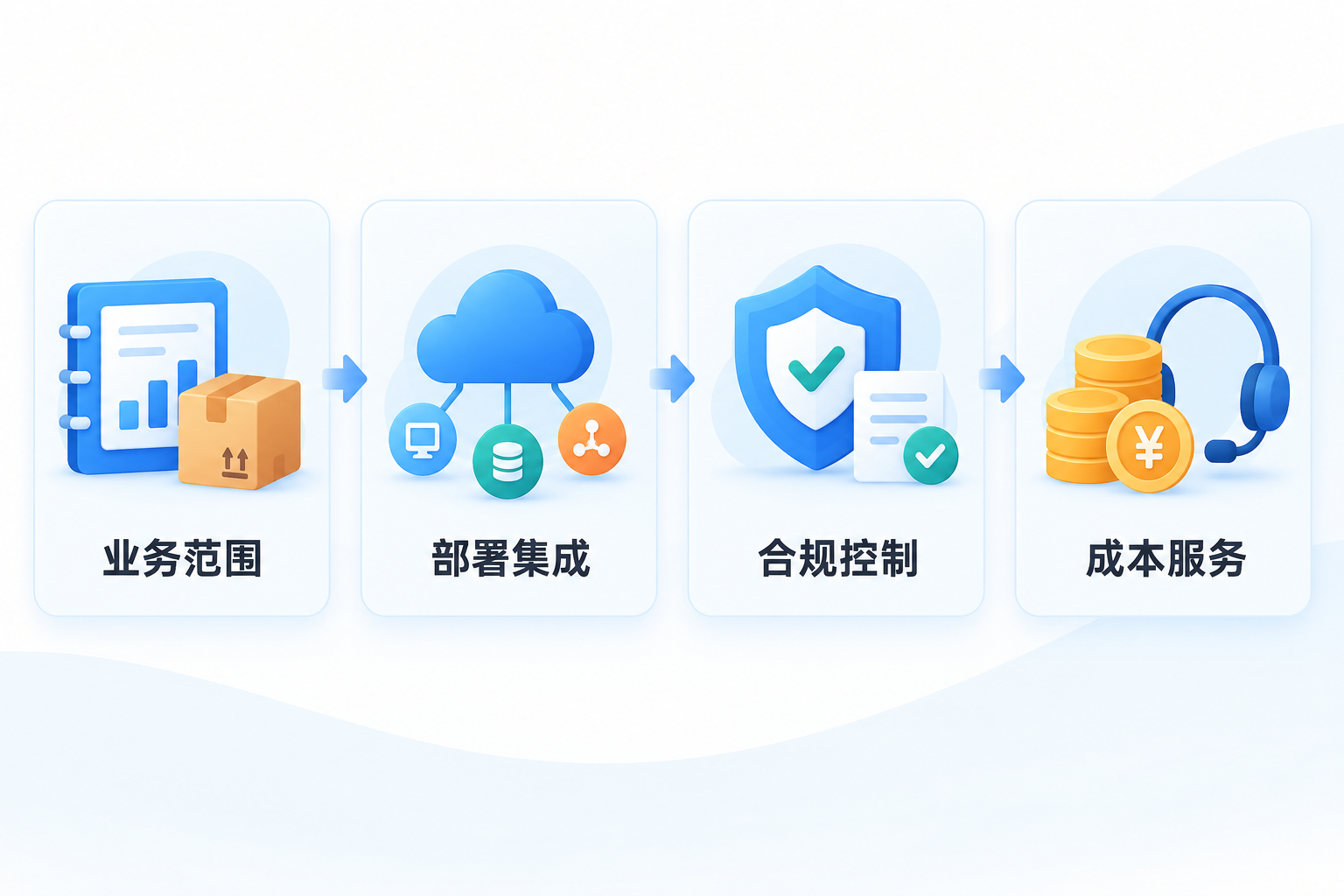
▍1. First determine candidate products by enterprise size and business scope
Yonyou official websitePosition Chanjet Cloud as a finance, tax, and business cloud service for small and micro enterprises, and list products such as Good Accounting, Good Business, Good Business Finance, Easy Agency Accounting, and T+Cloud;Kingdee official websitePosition Kingdee AI Xingchen as cloud financial and inventory management software for small enterprises, with public scope including finance, tax, inventory management, and expense reimbursement. Both have multiple versions, and official website descriptions can only be used for initial screening; during procurement, the current feature list, quotation, and contract should still be verified.
If an enterprise only needs general ledger, cashier, and reporting, the focus should be ease of use and migration; if it involves multiple stores, production, projects, inventory management, or e-commerce orders, then the business loop must be verified item by item. Kailing Technology's invoicing, invoice issuance, archive, or automation products should also participate in testing under the same requirements list, and marketing slogans cannot replace product demos.
▍2. Deployment and integration: verify whether existing systems can connect
Cloud or on-premises deployment each has its own conditions; the key is how existing account sets, banks, inventory management, malls, reimbursement, and archive systems exchange data. During selection, you should require explanations of interface licenses, field scope, call limits, historical data migration, failure retries, and export formats. So-called "automatic invoice retrieval" and "one-click filing" must be tied to specific regions, account authorization, platform rules, and currently open interfaces, and cannot be assumed to cover all invoice sources or all tax types.
▍3. Compliance control: automated results still require review and audit trails
Invoice verification, OCR recognition, voucher suggestions, and filing data calculation can all reduce duplicate entry, but recognition results do not equal posting, passing verification does not automatically mean deduction is allowed, and successful interface submission does not mean the business judgment is correct. The system should retain original materials, modification records, approval permissions, exception to-dos, and rollback results, and authorized personnel should complete accounting and tax review.
BasisMinistry of Finance and National Archives Administration Cai Kuai [2020] No. 6 notice, if a unit only uses electronic accounting vouchers for reimbursement, posting, and archiving, it must also meet conditions such as the vouchers being legal and authentic, transmission and storage being safe and reliable, accurate and complete reading of vouchers and metadata, necessary review and signing, prevention of duplicate posting, and accounting archive management. Scanning or linking itself cannot prove that compliant archiving has been completed.
▍4. Cost and service: compare total cost of ownership, not just first-year price
Subscription or license, number of users, number of account sets, implementation, interfaces, customization, storage, training, operations, upgrades, and data migration should all be included in the cost. Implementation partners' industry experience, response time, and personnel stability also affect results. The contract should also specify data ownership, backup and recovery, standard export, migration assistance after service termination, and deletion arrangements, to avoid being locked into a single platform later.
▍5. Use desensitized samples for reproducible acceptance
It is recommended to prepare samples such as monthly closing, partial arrival, red-letter or voided invoices, cross-period expenses, multiple entities, permission approvals, interface interruptions, and historical account set migration, and require candidate solutions to complete them in the same environment. Record whether each item is natively supported, requires separate purchase, requires customization, and how failures are handled, then score based on business fit, control capability, cost, and service. The final conclusion is only responsible for the tested version and the enterprise scenario, and vendor self-descriptions should not be extended into negative judgments about other products.
Keywords: small business financial software, Yonyou, Kingdee, financial software selection, business-finance integration, electronic accounting archives, interface integration, total cost of ownership
As a comprehensive business-finance-tax digitalization solution service provider, Kailing Technology provides business-finance-tax management digital transformation products and operational services for various government agencies, institutions, and large, medium, and small enterprises. The product line includes: solutions for sales contract management system, procurement contract management system, fully digitalized Leqi interface project, automatic output invoicing system, reverse invoicing system, invoice issuance for individuals system, employee expense control and reimbursement system, input VAT invoice management system, supply chain collaborative reconciliation system, image AI OCR recognition system, automatic financial bookkeeping system, electronic accounting archives system, etc., comprehensively driving the digitalization process across various fields.
Consultation Hotline: 18513895936 / 010-60974119 Location: Beijing