
Contract legal staff read word by word and compare against templates based on experience—slow and prone to omissions? Kailing Technology's AI digital employee performs clause-level comparison and highlights risk points item by item in red.

A contract of dozens of pages is placed before legal counsel; reading it word by word takes one to two hours. After reading, they still have to rely on experience to compare differences against templates and check compliance against regulations. A moment of carelessness can miss a quietly altered payment clause or a reference to a legal provision that has long been invalid. The more contracts there are and the more diverse the signing entities, the more this "slow and leaky" the heavier the anxiety becomes.Kailing Technology's AI digital employee What needs to be done is to replace the contract review checkpoint from "relying on human eyes, memory, and experience" with "relying on templates, regulations, and item-by-item evidence" — as soon as a contract is uploaded, a tireless AI compliance reviewer goes on duty, comparing at the clause level and marking risk points in red one by one.
▍Current state: why contract review is both slow and leaky
Contract review in many enterprises is still stuck at the stage of "relying on people to carry it." Breaking down this slowness and leakage, the pain points are concentrated in four areas:
Read word by word and rely on experience: review quality depends heavily on personal experience and current state, with an obvious gap between senior legal staff and newcomers; the same clause may lead to different conclusions when read by a different person, making standards hard to unify.
Regulations, systems, and templates are scattered in three places: current regulations in one place, enterprise standard templates in another, and internal approval systems in a third. When comparing, you have to flip back and forth, versions are often misaligned, and omissions are almost unavoidable.
There are breakpoints in cross-system transmission: contracts flow from the drafting system to the approval system and then to the archiving system, with many stages and handovers. Key information is easily lost or distorted in transit, and the review opinions from the previous stage are disconnected by the next stage.
Risk opinions scattered and hard to trace: annotations written in emails, opinions sent in group chats, conclusions recorded on personal computers; when trying to review afterward "why was this judgment made at the time," there is often no basis to be found, let alone accumulating experience for reuse.
Stacked together, these four result in slow review, exhausting review, and incomplete review—once a high-risk clause is missed, the loss may far exceed the contract itself.
▍Build goal: from experience-based to evidence-based
To fundamentally cure "slow and leaky", the direction is not to make legal staff read faster, but to change the underlying logic: let every review opinion be able to Pointing to the original template text and legal provisions, making judgments evidence-based, traceable, and reusable. The specific construction goals can be summarized in five statements: contracts are automatically compared upon upload; clauses are highlighted item by item; risks are automatically graded; multi-dimensional verification of compliance, tax, related-party transactions, and payment; abnormal clauses are intelligently dispatched and fully traced.
| "From relying on experience to having a basis—let every review opinion point to the original template text and legal provisions. |
|---|
In other words, legal affairs is no longer the person who reads from beginning to end and relies entirely on memory for templates, but the person who makes the final decision standing on top of the AI review conclusions. AI is responsible for comparing everything that should be compared, marking everything that should be marked, and grading everything that should be graded; people are responsible for making the call at key nodes. The diagram below is the complete closed loop after this goal is implemented.

▍How it's done: the clause-level review capability of Kailing Technology AI digital employees
The objectives sound clear; the real difficulty lies in "how to achieve them." Kailing Technology's AI digital employee breaks down this AI compliance reviewer's capabilities into five interlocking layers:
I. Dual foundation of template library + regulation library. Organize the enterprise's accumulated standard contract templates, together with currently effective laws and regulations, regulatory positions, and internal policies, into a structured knowledge base. When templates are updated or regulations change, only the knowledge base needs to be maintained, taking effect immediately without changing a single line of code—this also turns review standards from "existing in someone's head" into "existing in the system, consistent for everyone."
II. Clause-by-clause comparison. After a contract is uploaded, the digital employee does not simply "take a look" at it, but breaks the contract down to clause granularity and aligns it clause by clause with templates and regulations: which clause was changed, which clause is missing, and which clause conflicts with regulations are all identified one by one. With the reading speed of a large model, a contract that used to take one or two hours to read word by word can be reviewed in a few minutes, equivalent to 20x speed.
III. Risk Grading, Marked in Red Item by Item. The differences identified are not dumped on the legal department all at once; instead, they are graded by high, medium, and low risk, marked in red one by one, and the reasons are stated, so it is clear at a glance which must be changed, which are recommended to be changed, and which are acceptable. Based on the Contract Approval System, the AI digital employee can also automatically reject contracts that touch red lines and list the rejection reasons one by one, explaining "why it was not approved" clearly.
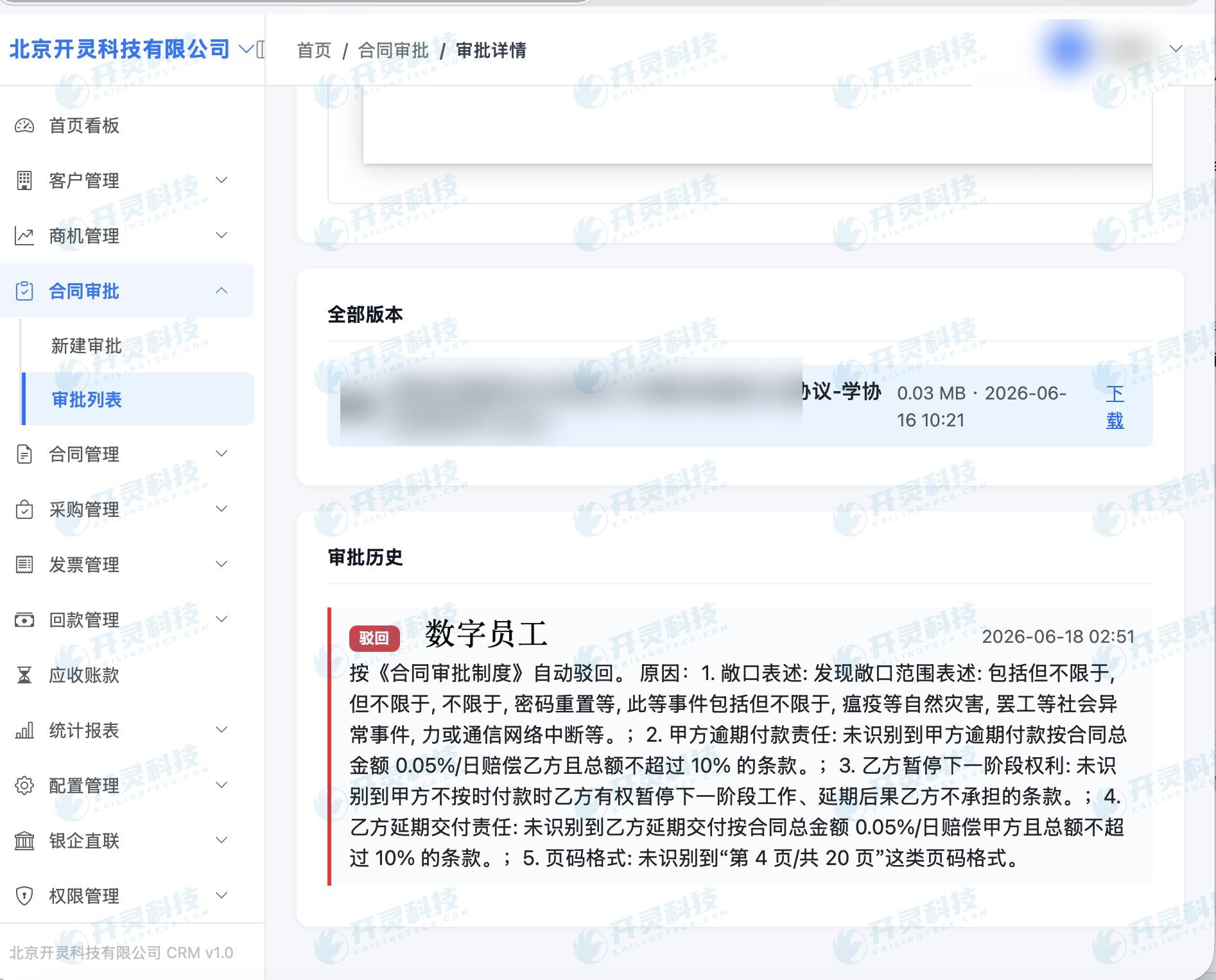
IV. Multi-dimensional verification of compliance, tax, related-party transactions, and payment. Contract risk has never been only about whether it is compliant. The digital employee simultaneously verifies in parallel across multiple dimensions such as compliance clauses, tax treatment, related-party transaction determination, payment rhythm, and payment terms, running all at once the check items scattered across different professional perspectives, avoiding the blind spot where compliance has been reviewed but no one looks at tax.
V. Intelligent dispatch of abnormal clauses, with full-process traceability. For identified high-risk or abnormal clauses, the system automatically dispatches orders to the corresponding responsible persons or professional positions according to rules; who handles it, how it is handled, and what the conclusion is are all retained in the system. Every invocation and judgment is encrypted and traceable, searchable and auditable by contract, by person, and by system, so post-event reviews no longer require digging through emails for records.
The reason all of this can be implemented also depends on two underlying safeguards: first,Private deployment, data does not leave the domain, the model runs on the enterprise's intranet, with sensitive fields desensitized and encrypted, so core materials such as contracts are not transmitted externally; second,Non-intrusive integration, encapsulating existing contract and approval system interfaces and forms into AI-callable tools, with zero-code modification and no touching of the underlying layer, protecting the enterprise's years of IT investment. Humans always retain final responsibility, with mandatory manual confirmation at high-risk nodes, and anomalies can be quickly rolled back and manually taken over.
Once this capability is running, the changes are tangible: no matter how many contracts there are, they are reviewed 7×24 on arrival, without backlogs or queues caused by concentrated signing at month-end; review standards are uniformly embedded in the system, so a newcomer can produce comparison results at the same level as a senior legal counsel on day one; legal staff no longer need to spend large amounts of time on mechanical work such as "word-by-word comparison with templates," but can focus their energy on the few tough clauses that truly require professional judgment. Slowness and omissions—one addressed by speed, the other by evidence—are held down at the same time. This is also exactly Kailing Technology's AI digital employee The change we want to bring to the contract review process — not to make decisions for legal affairs, but to make every decision faster and more confident.

▍FAQ
Q: If a new template is adopted or regulations are updated, does it have to be developed again?
A: No need. Templates and regulations are maintained as a knowledge base, taking effect upon update without code changes, and review standards automatically follow the latest version.
Q: Will AI misjudge and flag clauses that are actually fine?
A: It will be tiered rather than one-size-fits-all. High-risk clauses are handed to humans for secondary confirmation—AI provides the basis, and humans make the decision. Even if anomalies occur, it can quickly roll back and transfer to manual takeover.
Q: Contracts involve trade secrets; is it safe to hand them to AI for review?
A: Secure. It uses private deployment, with the model running on the enterprise intranet and data not leaving the domain; sensitive fields are masked and encrypted, and every operation is fully traced and can connect to auditing.
Q: Does it need to modify the existing contract system or approval system?
A: No. It adopts non-invasive access, encapsulating the original system's interfaces and forms into AI-callable tools, with zero-code modification and no touching of the underlying layer, protecting existing IT investment.
Q: Can AI digital employees directly reject contracts?
A: Yes. It automatically rejects according to the Contract Approval Policy and lists the reasons item by item, but final responsibility is still confirmed by a real person. AI assists decision-making, not makes decisions for people.
If you also want contract review to upgrade from "relying on experience" to "having a basis," freeing legal staff from word-by-word scrutiny and leaving their energy for what truly requires judgment, welcome to discuss implementation solutions with Kailing Technology:www.kailingteck.com。
As a comprehensive business-finance-tax digitalization solution service provider, Kailing Technology provides business-finance-tax management digital transformation products and operational services for various government agencies, institutions, and large, medium, and small enterprises. The product line includes:
Solutions for businesses including sales contract management system, procurement contract management system, fully digitalized Leqi interface project, output automatic invoicing system, reverse invoicing system, invoice issuance for individuals system, employee expense control and reimbursement system, input VAT invoice management system, supply chain collaborative reconciliation system, image OCR recognition system, automatic financial bookkeeping system, and electronic accounting archives system, comprehensively driving the digitalization process across various fields.
If you have any business-finance-tax digital transformation needs, welcome to contact us. Beijing Kailing Technology will serve you wholeheartedly.
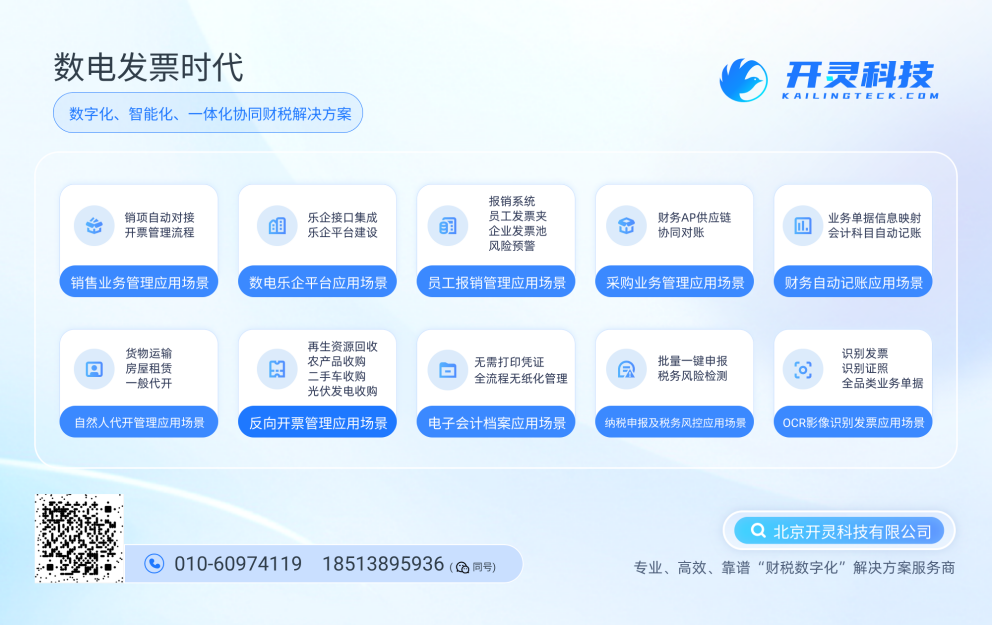
As a comprehensive business-finance-tax digitalization solution service provider, Kailing Technology provides business-finance-tax management digital transformation products and operational services for various government agencies, institutions, and large, medium, and small enterprises. The product line includes: solutions for sales contract management system, procurement contract management system, fully digitalized Leqi interface project, automatic output invoicing system, reverse invoicing system, invoice issuance for individuals system, employee expense control and reimbursement system, input VAT invoice management system, supply chain collaborative reconciliation system, image AI OCR recognition system, automatic financial bookkeeping system, electronic accounting archives system, etc., comprehensively driving the digitalization process across various fields.
Consultation Hotline: 18513895936 / 010-60974119 Location: Beijing