
What are the OEM cooperation conditions for bookkeeping and tax filing software? Must-read before accounting agencies choose a vendor

What are the OEM cooperation conditions for bookkeeping and tax filing software? First see whether it can be verified, delivered and traced
When accounting agencies purchase OEM finance and tax software, they cannot compare only white-label prices and demo pages. What truly affects long-term operations is: whether the product covers the target business, whether data sources and authorization are clear, who maintains the brand and versions, how faults are responded to, and how data is exported after cooperation ends. Electronic tax bureaus, invoice channels, account set environments and interface openness may differ by region, and any promise of "fully automatic", "all invoice sources" or "login-free" should be subject to the written scope and actual integration test results.
The core of OEM selection is not replacing the logo, but writing capability boundaries, responsibility boundaries and exit paths into the contract and getting acceptance through. |
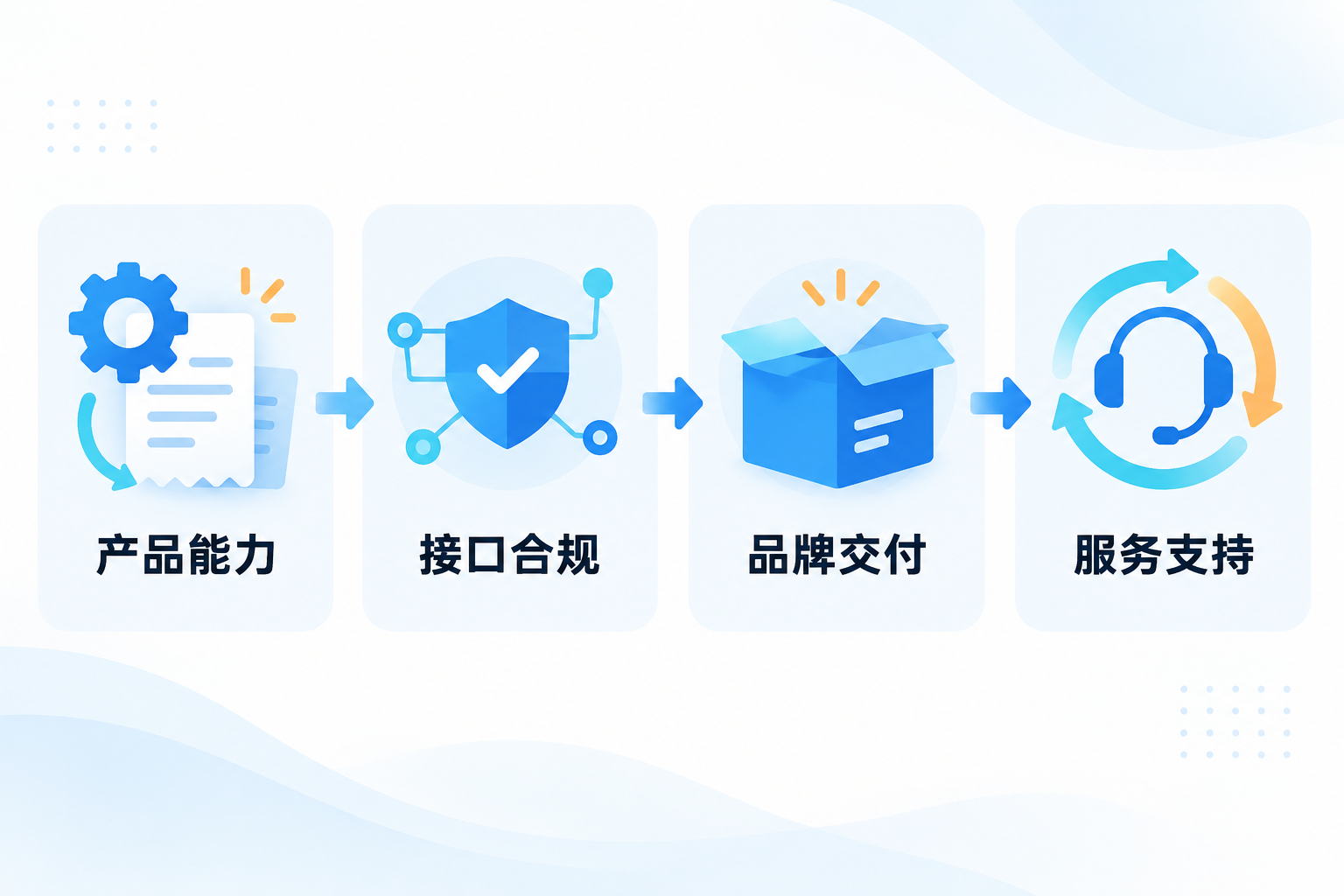
▍1. Product capability: verify with real business, do not replace acceptance with demonstrations
First list the number of account sets, invoice types, accounting systems, filing regions, inventory and archive scenarios that the institution actually needs to handle, then use desensitized samples for proof of concept. It is recommended to cover normal business as well as partial invoice arrival, duplicate invoices, red-letter or voided invoices, cross-period documents, interface interruptions and manual fallback. The system can assist with invoice collection, voucher drafts, task distribution and status tracking, but accounting judgment, tax filing review and final responsibility should still be borne by personnel with authority.
▍2. Interface compliance: find out where the data comes from and on what basis it is processed
Contracts and technical plans should specify data sources, enterprise authorization methods, interface licenses, field scope, retention periods, access logs and subcontractors. For invoices, bank receipts, contracts, reimbursements and customer identity materials, least privilege, account isolation, operation trails and anomaly alerts should be configured. Interface availability changes with platform rules, regions and versions, and suppliers should explain failure retry, manual supplementation, reconciliation and rollback mechanisms; technical connectivity cannot be equated with business compliance.
▍3. Brand delivery: confirm white-label scope, version cadence and intellectual property
OEM delivery should clearly specify the domain name, application name, interface elements, message templates, help center, privacy policy, customer contract entity and intellectual property boundaries. It is also necessary to confirm whether it is an independent instance or a shared service, whether version updates are synchronized, how customized features are billed, and who releases security fixes. Before launch, brand consistency between desktop and mobile should be accepted, while ensuring that third-party trademarks, government logos or the name of tax authorities are not misappropriated.
▍4. Service support: put response standards and evidence delivery into the checklist
Service terms should at least cover the implementation lead, training targets, ticket entry, fault classification, response time, data backup, recovery drills and update mechanisms after policy changes. For automated tasks, it should be possible to view execution batches, failure reasons, reviewers and rerun results. Efficiency figures in marketing materials can only serve as leads, and selection conclusions should be based on the institution's own sample size, staffing structure and acceptance data.
▍5. Price and exit: agree in advance on migration format and handling after service termination
Total cost includes not only licensing fees, but may also include implementation, interfaces, customization, storage, training and subsequent migration. Before cooperation, data ownership, standard export formats, export frequency, migration assistance, account cancellation, backup retention and deletion certificates upon expiration should be agreed. If the supplier cannot explain how to fully export customers, account sets, vouchers, attachments and logs, the institution may be locked into a single platform.
Selection recommendations: Turn product capability, interface compliance, brand delivery, service support and exit mechanisms into an item-by-item acceptance checklist; pilot on a small scale first, then decide on expansion based on acceptance results. Whether Kailing Technology's related products can adapt to specific regions, account sets and interfaces should be subject to the mutually confirmed requirements list, demo environment, written contract and integration acceptance.
Keywords: bookkeeping and tax filing software OEM cooperation conditions, agency bookkeeping software, finance and tax SaaS white-label, interface compliance, brand delivery, service support, data migration, accounting agency digitalization
As a comprehensive business-finance-tax digitalization solution service provider, Kailing Technology provides business-finance-tax management digital transformation products and operational services for various government agencies, institutions, and large, medium, and small enterprises. The product line includes: solutions for sales contract management system, procurement contract management system, fully digitalized Leqi interface project, automatic output invoicing system, reverse invoicing system, invoice issuance for individuals system, employee expense control and reimbursement system, input VAT invoice management system, supply chain collaborative reconciliation system, image AI OCR recognition system, automatic financial bookkeeping system, electronic accounting archives system, etc., comprehensively driving the digitalization process across various fields.
Consultation Hotline: 18513895936 / 010-60974119 Location: Beijing