
How to choose inventory management software? Don't let inventory and invoices fail to reconcile

How to choose inventory management software? First make orders, receipts, invoices, and accounting materials reconcile
The goal of inventory and finance collaboration is not to make inventory, invoices, and vouchers "automatically become the same thing," but to enable purchase orders, goods receipt and warehousing, sales outbound delivery, invoices, payments and receipts, and accounting treatment to be linked, reconciled, and traceable. Inventory quantity changes, invoice issuance, and revenue or cost recognition are respectively constrained by business facts, tax rules, and accounting standards, and their timing may differ; the system must allow discrepancies to exist and provide a review mechanism.
A good integrated system is not one that forces synchronization, but one that can explain discrepancies, locate responsibility, and preserve evidence. |
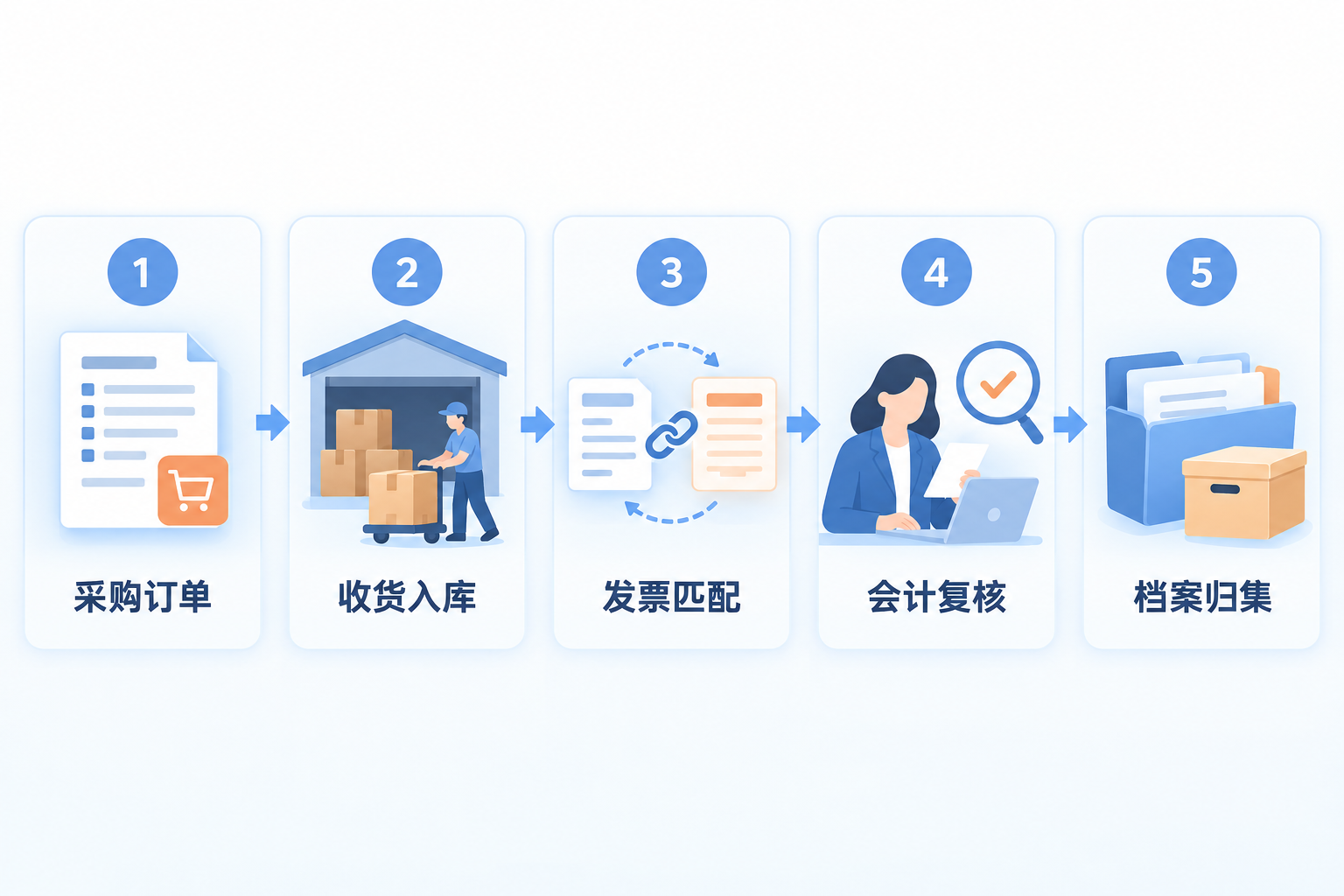
▍1. First distinguish what question each of the five types of records answers
Purchase orders record agreements, goods receipt notes and warehousing notes record actual arrivals, inventory ledgers record quantity and cost changes, invoices record invoicing information, and accounting vouchers record confirmed accounting treatment. They can be linked around the same business number, but cannot replace each other. During selection, check whether the system can retain statuses such as warehousing without invoice, partial arrival, returns, price adjustments, red-letter invoices, and cross-period processing, rather than showing only a single "completed."
▍2. Procurement stage: use matching to find discrepancies, don't let the system replace judgment
Purchase orders, goods receipt or warehousing records, and invoices can undergo two-way or three-way matching, and the system can prompt discrepancies in supplier, item name, quantity, amount, and status. Invoice data in the tax digital account can also only be queried, downloaded, or exported within the scope of enterprise authorization and current interface support. A successful match does not automatically prove that the goods are real, expenses are deductible, or input VAT is deductible; exceptions, provisional estimates, and use confirmation still need to be reviewed by procurement, warehouse, finance, and tax roles according to their responsibilities.
▍3. Sales stage: outbound delivery, invoicing, and revenue recognition are not equivalent
Sales outbound delivery notes can serve as a source for invoice data preparation and business reconciliation, and invoicing tools can also assist with batch issuance, status feedback, and exception to-dos within the scope of authorization and interface support, but invoicing must be based on real transactions and applicable rules. Basis"Accounting Standard for Business Enterprises No. 14 - Revenue", revenue recognition should be judged in combination with conditions such as performance obligations and transfer of control of goods, and cannot be automatically recognized merely because of outbound delivery or invoicing. The system should separately record business, invoice, and accounting statuses.
▍4. Interfaces and rules: test failures, fallbacks, and audits during selection
Data exchange among inventory management, invoicing, finance, and archive systems should clarify master data sources, field mapping, interface frequency, duplicate data handling, and failure retries. It is recommended to use real but anonymized partial arrivals, invoice-goods discrepancies, red-letter returns, and cross-period documents for acceptance testing to confirm whether the system can display original data, modification records, approvers, and interface logs. So-called "integration" should reduce duplicate entry while retaining manual review, segregation of duties, and rollback capability.
▍5. Archiving stage: after linking materials, electronic archive conditions must still be met
BasisMinistry of Finance and National Archives Administration Cai Kuai [2020] No. 6 notice, if a unit uses only electronic accounting vouchers for reimbursement, posting, and archiving, it needs to meet conditions such as the vouchers being legal and authentic, transmission and storage being safe and reliable, accurate and complete reading of vouchers and metadata, necessary review and signatures, prevention of duplicate posting, and compliance with accounting archive management requirements. Archive tools can assist in linking orders, warehousing notes, invoices, receipts, and vouchers, but completion of scanning, recognition, or linking does not mean compliant archiving has been achieved.
Keywords: inventory management software, inventory management system, purchase order, goods receipt and warehousing, invoice matching, accounting review, electronic accounting archives, inventory reconciliation
As a comprehensive business-finance-tax digitalization solution service provider, Kailing Technology provides business-finance-tax management digital transformation products and operational services for various government agencies, institutions, and large, medium, and small enterprises. The product line includes: solutions for sales contract management system, procurement contract management system, fully digitalized Leqi interface project, automatic output invoicing system, reverse invoicing system, invoice issuance for individuals system, employee expense control and reimbursement system, input VAT invoice management system, supply chain collaborative reconciliation system, image AI OCR recognition system, automatic financial bookkeeping system, electronic accounting archives system, etc., comprehensively driving the digitalization process across various fields.
Consultation Hotline: 18513895936 / 010-60974119 Location: Beijing