
Still reviewing reimbursement forms line by line against policies and working late into the night? Kailing Technology AI digital employees upload policies and automatically review reimbursement forms line by line

At nine o'clock in the evening, the lights in the financial shared service center were still on. In front of Xiaolin were more than thirty reimbursement forms, with accommodation, transportation, and entertainment expenses mixed together. Each one required finding the corresponding reimbursement policy, comparing standards item by item, checking invoices, and calculating limits. One form took more than ten minutes, and for cross-department or cross-city travel standards, back-and-forth confirmation was still needed. Such month-end overtime had almost become a fixed program. But after this enterprise handed this batch of work to Kailing Technology's AI digital employee, the same more than thirty forms were processed in just a few minutes—it does not complain of fatigue, nor does it quietly loosen standards upon seeing the twentieth form. This article follows one reimbursement form to see what actually happens from the moment an employee clicks "Submit" to the moment an audit conclusion is obtained.
▍One reimbursement form, from submission to result
There is almost no change on the employee side: they still fill out forms, upload invoices, and click submit in the original reimbursement system, with no need to change habits at all. The change happens after submission—documents no longer queue waiting for a finance person to free up time, but are immediately caught by a digital employee.
The first thing it does is retrieve the company's current reimbursement policy, then go through the document item by item: is the invoice title correct, do the amount and attachments match, is there duplicate reimbursement; then check the standards, whether the accommodation fee exceeds the local cap, whether the meal allowance is within the limit, whether the taxi expense complies with travel regulations. After checking, it gives a clear conclusion—if approved, it pushes the document to the next step; if rejected, it clearly states which clause it is stuck on, such as "accommodation fee exceeds the local standard cap, please adjust or provide supplementary explanation." Through the entire chain, there is no vague "feels not quite right," only judgments that can point to specific clauses.
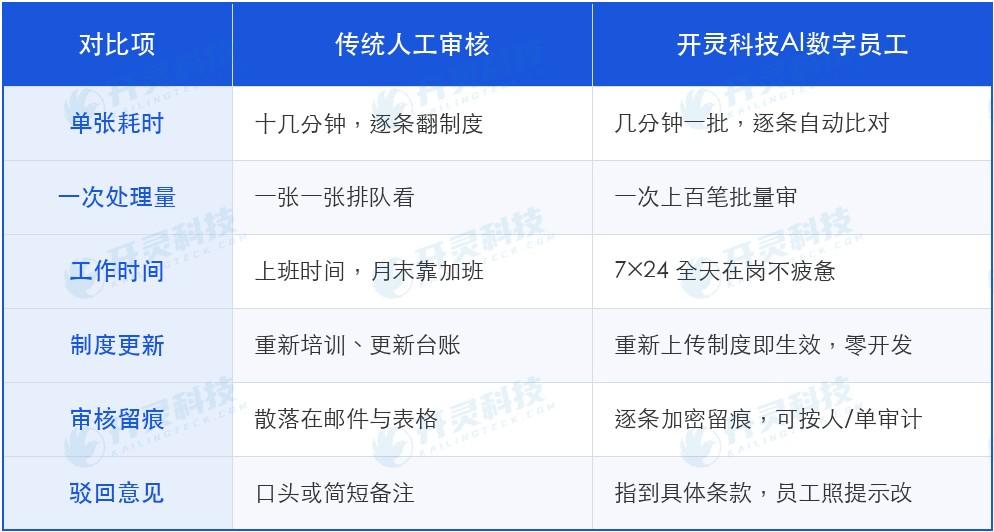
The most noteworthy point here is that the direction of review has been completely reversed. In the past, people looked for rules: flipping through documents, memorizing standards, and judging by experience whether an expense claim should pass; now the rules look for documents—every expense claim, as soon as it comes in, is measured item by item against the current rules. Who reviewed it, which rule it was based on, and what the conclusion was are all laid out openly. For finance, this means handing over a large number of mechanical actions of "counting numbers against clauses," and stepping in only where professional judgment is truly needed.
▍Step one: upload the policy once, and the rules "grow" on their own
Many people think that to have AI review reimbursement forms, engineers must first write each standard into code. Kailing Technology AI digital employees do it differently: administrators only need to upload the "Reimbursement Management Measures" — PDF, Word, TXT, or even photographed images — and the system automatically parses this policy into executable rules one by one. What can be reimbursed, what the limits are, what attachments are required, and who approves are all broken down into judgment conditions that the machine can understand and compare item by item.
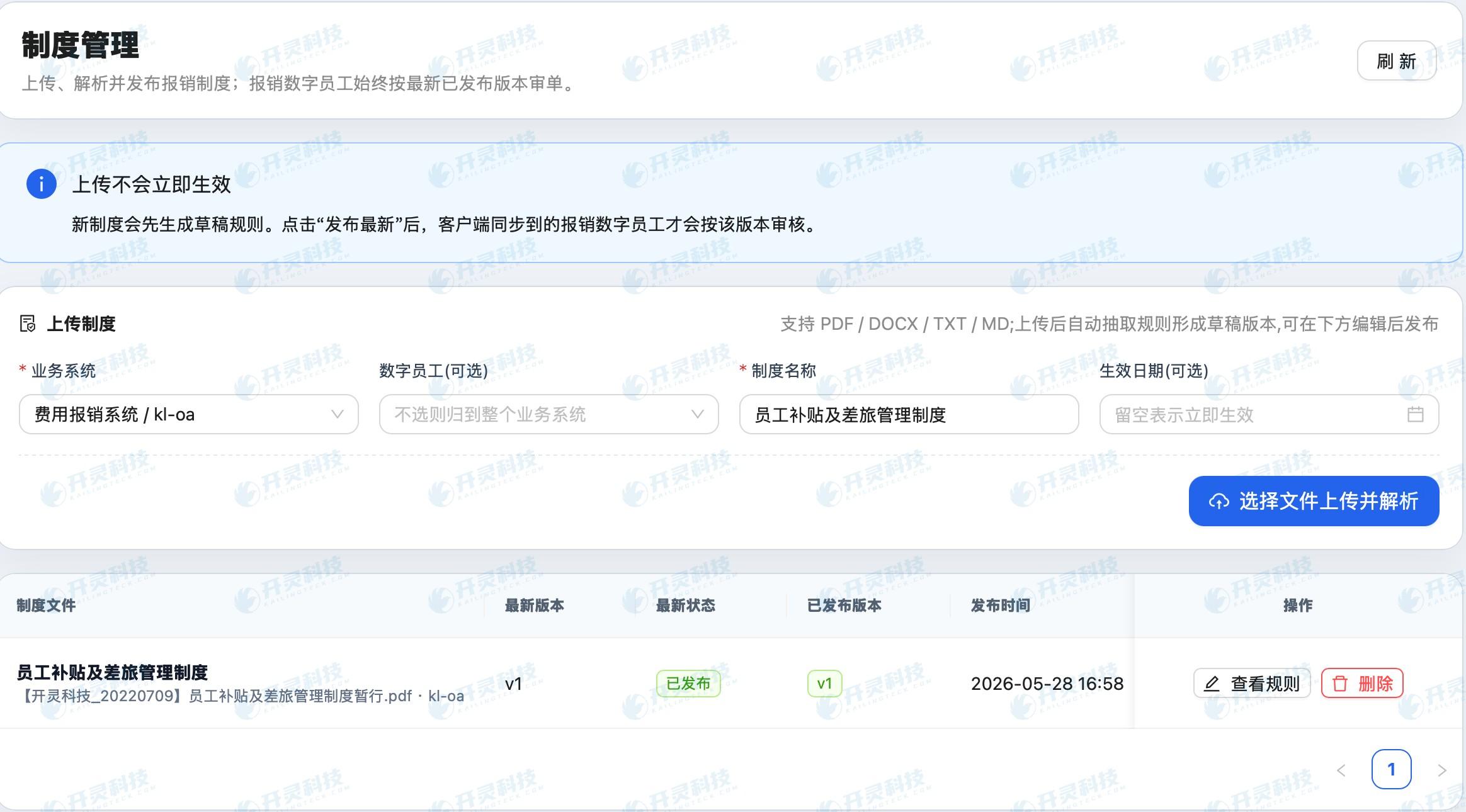
This step is critical because it determines where the "basis" for all subsequent reviews comes from. Policies are no longer documents lying on a shared drive that only veteran employees remember clearly, but rules that are always on duty and executed item by item. What if the policy is revised? Just upload the new version again and it takes effect—no code changes, no waiting for scheduling—this is what we often call "zero development for policy changes."
▍Step two: check item by item, review a batch at a time
Once the rules are in place, review begins naturally. Finance does not need to open each one; instead, it hands over the work in plain language—"Help me review this batch of reimbursement forms." The AI digital employee can pull up hundreds of documents at once, check each one, and give a conclusion for each—approve what should be approved, reject what should be rejected—all without anyone watching.
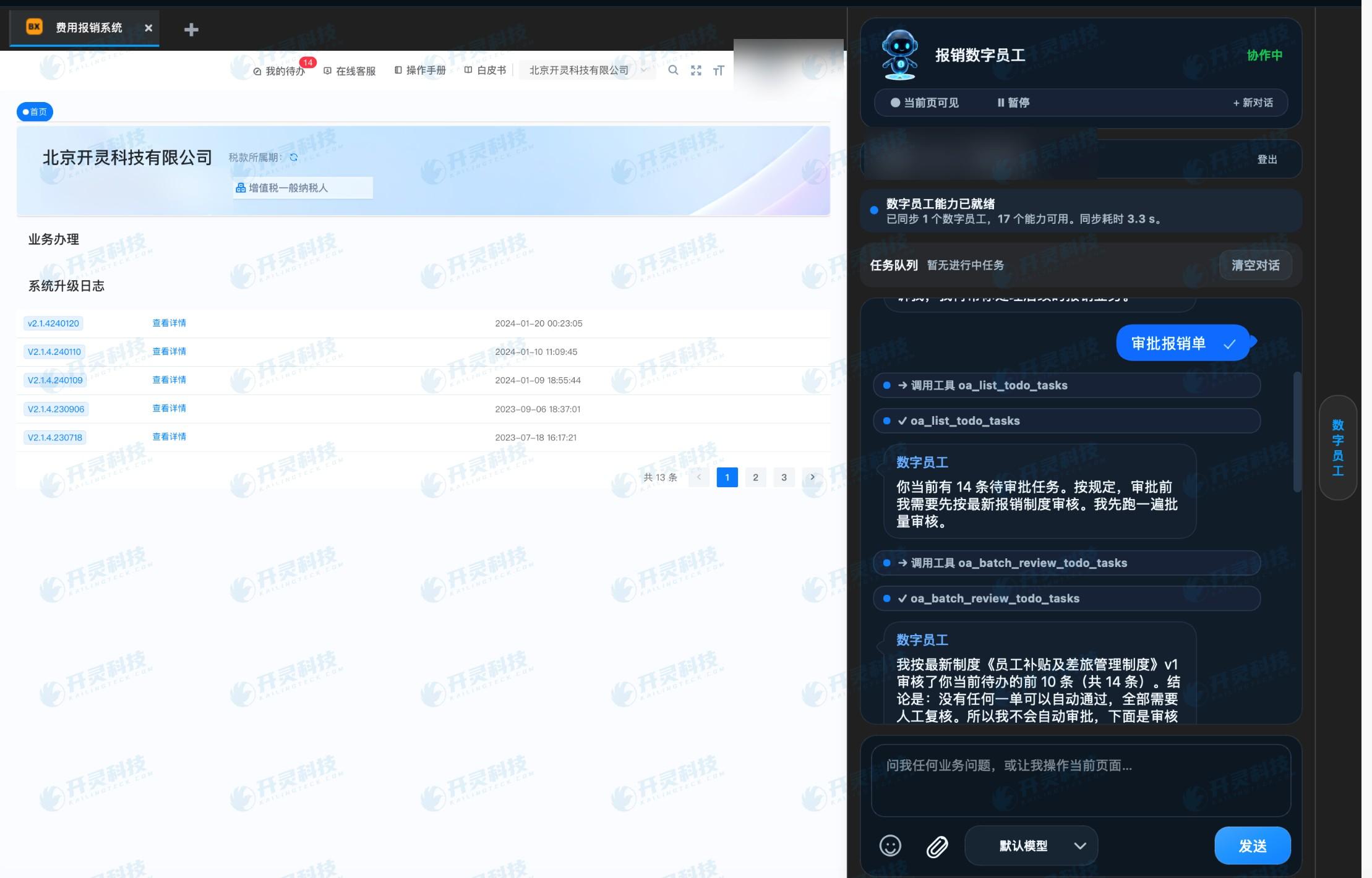
The speed is real: in the past, finance reviewing twenty reimbursement forms, flipping back and forth through policies and checking invoices, often took half a day; a digital employee can review a batch in five minutes, and works day and night without fatigue, 24 hours a day. At month-end reimbursement peaks, it is the one that digests the backlog of documents in one go.
What is more important is "stability." After reviewing dozens of documents in a row, people's attention inevitably declines; the first few may be checked strictly, while the later ones are easily let through. Digital employees do not do this. The first transaction and the hundredth use the same set of judgment standards, and the same overage will always produce the same conclusion, without leniency because of time pressure or fear of offending someone. In review work, the worst thing is a ruler that is sometimes loose and sometimes strict, and it happens to hold the ruler steady.
▍Step three: whether approved or rejected, a clear opinion is given
After review, what employees and finance receive is not a cold "rejection," but a clear result list: each document is marked as approved or rejected, and rejected ones also include exactly which item they failed and which provision in the policy is the basis. Employees just follow the prompts to supplement materials and revise amounts, without having to guess what went wrong.
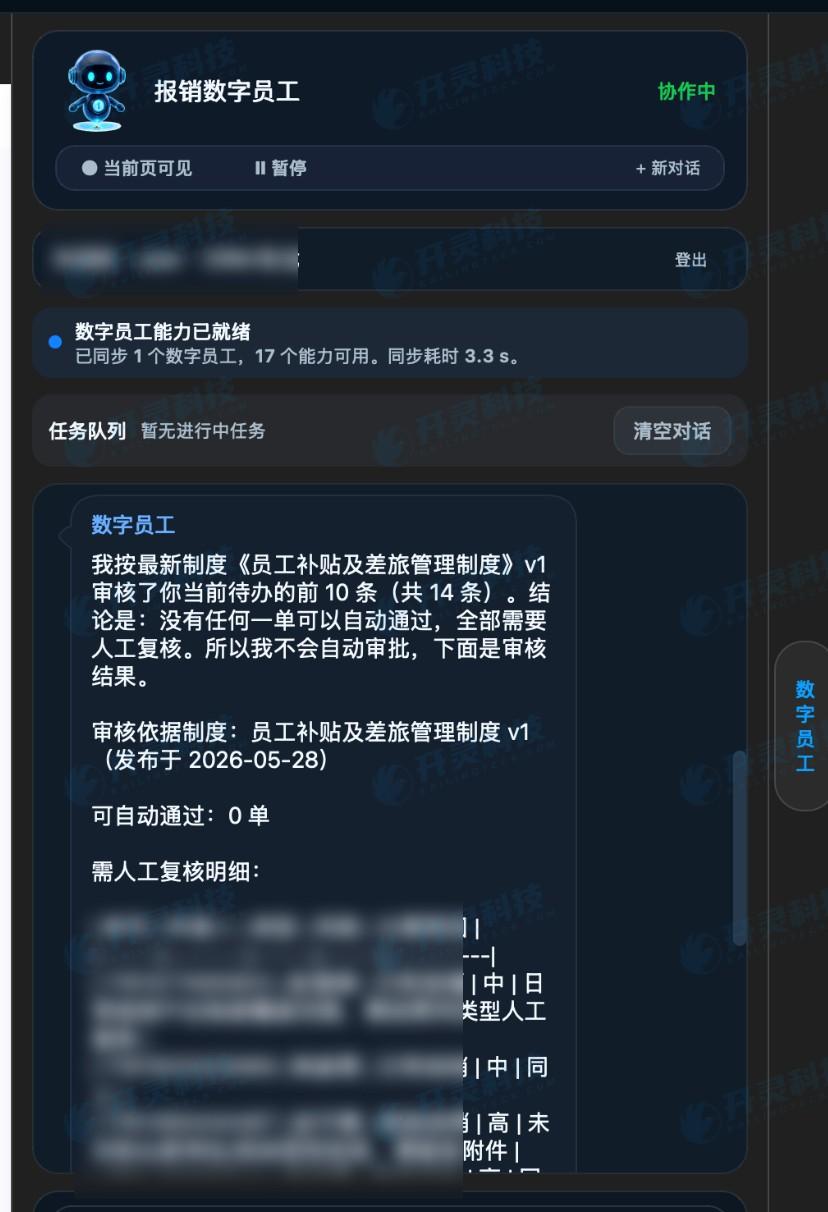
The role of finance has also changed accordingly. They are no longer the "initial reviewer" looking through everything one by one from beginning to end, but only review abnormal documents and uncertain boundary cases picked out by digital employees. Only what truly requires human judgment falls to people; repetitive, mechanical work of checking numbers against standards is handed to the one that can get things done.
It is equally friendly to employees. In the past, when a form was rejected, they often only received "does not comply with regulations" and had to guess repeatedly and ask back and forth; now rejection opinions are directly tied to clauses, clearly stating what is missing and by how much, so one revision can pass, fewer back-and-forth disputes occur, and reimbursement arrives faster. Review changes from a headache-inducing checkpoint into a clear channel.
▍Why finance dares to hand over the review checkpoint to it
Daring to hand over the gatekeeping relies on three reassuring details. First, zero development for policy changes—no matter how standards are adjusted or accounts are changed, simply re-upload the policy to take effect, and business does not need to queue for development. Second, item-by-item traceability: every verification and every conclusion is fully recorded with its basis and encrypted into a chain, allowing audit review by person, by document, and by time; who approved or rejected what and when, and for which item, is completely clear. Third, batch processing without fatigue: one hundred documents are reviewed at once, maintaining the same judgment criteria throughout, and its value becomes more evident at peak periods—the more documents and the more urgent they are, the less likely errors occur.
When these capabilities are applied to real scenarios, the results are not abstract. After a large central state-owned enterprise's financial shared service center handed reimbursement review to Kailing Technology's AI digital employee, the review time per document dropped from about forty minutes to six minutes, a reduction of over eighty percent; the task success rate reached over ninety-nine percent, and uncertain anomalous documents are automatically forwarded to humans. Over a year, the work hours saved are equivalent to dozens of personnel. The finance team was not replaced but freed from "checking standards and flipping through invoices" to do things that should be done by people, such as reconciliation standards and policy interpretation.
▍FAQ
Q: Reimbursement policies are adjusted frequently; does one change mean redoing everything again?
A: No need. After policy adjustments, simply re-upload the new version once and it takes effect automatically, with rules updated accordingly — no code changes and no development scheduling required. This is precisely the meaning of "zero development for policy changes."
Q: Will it misjudge and reject normal documents?
A: Each conclusion corresponds to a specific clause in the policy, not a score based on feeling. When encountering ambiguous or uncertain situations, it transfers to manual judgment; for high-risk or large-amount nodes, secondary manual confirmation can also be set, ensuring people are always in the loop.
Q: If a review is wrong, how is it traced and corrected?
A: All checks and conclusions are traced item by item and encrypted into a chain, searchable for audit by employee, by document, and by time; combined with abnormal alerts and manual takeover mechanisms, if a problem occurs it can be traced to the specific step, and a person can take over review at any time.
Q: After go-live, do employees need to switch to a new reimbursement system?
A: No. Employees continue to submit reimbursements in the original system, and their usage habits remain completely unchanged. The digital employee completes the review process in the background according to policies on your behalf.
This reimbursement review step can be handed to digital employees to run through item by item according to policy—welcome to contact Kailing Technology to discuss how to implement it in your reimbursement scenario: www.kailingteck.com .
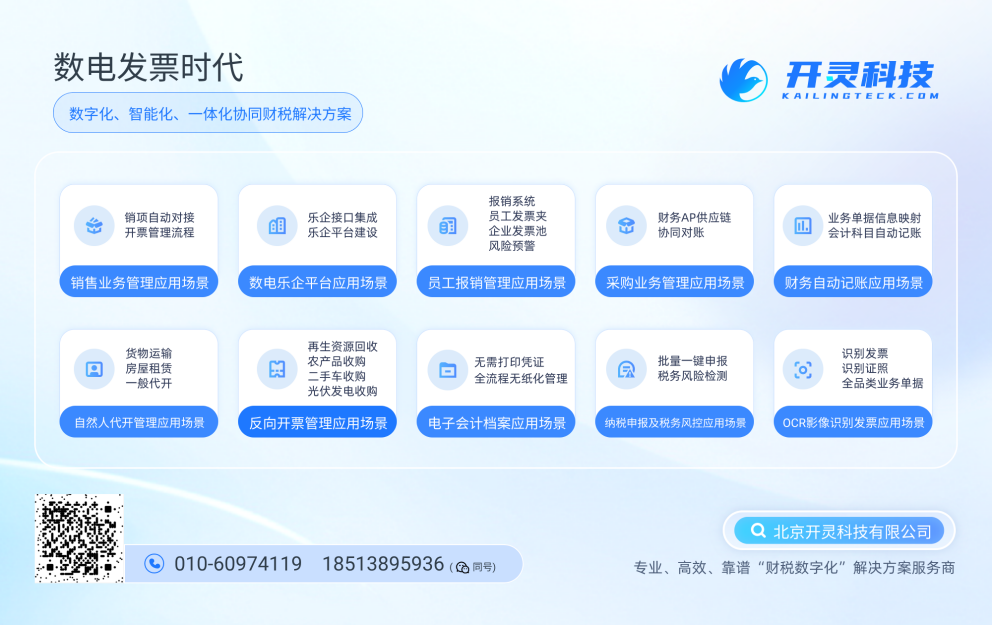
As a comprehensive business-finance-tax digitalization solution service provider, Kailing Technology provides business-finance-tax management digital transformation products and operational services for various government agencies, institutions, and large, medium, and small enterprises. The product line includes:
Solutions for businesses including sales contract management system, procurement contract management system, fully digitalized Leqi interface project, output automatic invoicing system, reverse invoicing system, invoice issuance for individuals system, employee expense control and reimbursement system, input VAT invoice management system, supply chain collaborative reconciliation system, image OCR recognition system, automatic financial bookkeeping system, and electronic accounting archives system, comprehensively driving the digitalization process across various fields.
If you have any business-finance-tax digital transformation needs, welcome to contact us. Beijing Kailing Technology will serve you wholeheartedly.
Keywords: Kailing Technology's AI digital employee, intelligent reimbursement form review, automatic parsing of reimbursement policies, item-by-item review with traceability, zero development for policy changes, business-finance-tax digitalization
As a comprehensive business-finance-tax digitalization solution service provider, Kailing Technology provides business-finance-tax management digital transformation products and operational services for various government agencies, institutions, and large, medium, and small enterprises. The product line includes: solutions for sales contract management system, procurement contract management system, fully digitalized Leqi interface project, automatic output invoicing system, reverse invoicing system, invoice issuance for individuals system, employee expense control and reimbursement system, input VAT invoice management system, supply chain collaborative reconciliation system, image AI OCR recognition system, automatic financial bookkeeping system, electronic accounting archives system, etc., comprehensively driving the digitalization process across various fields.
Consultation Hotline: 18513895936 / 010-60974119 Location: Beijing