
When recycling renewable resources with a 3-point invoice, is reverse invoicing still needed?

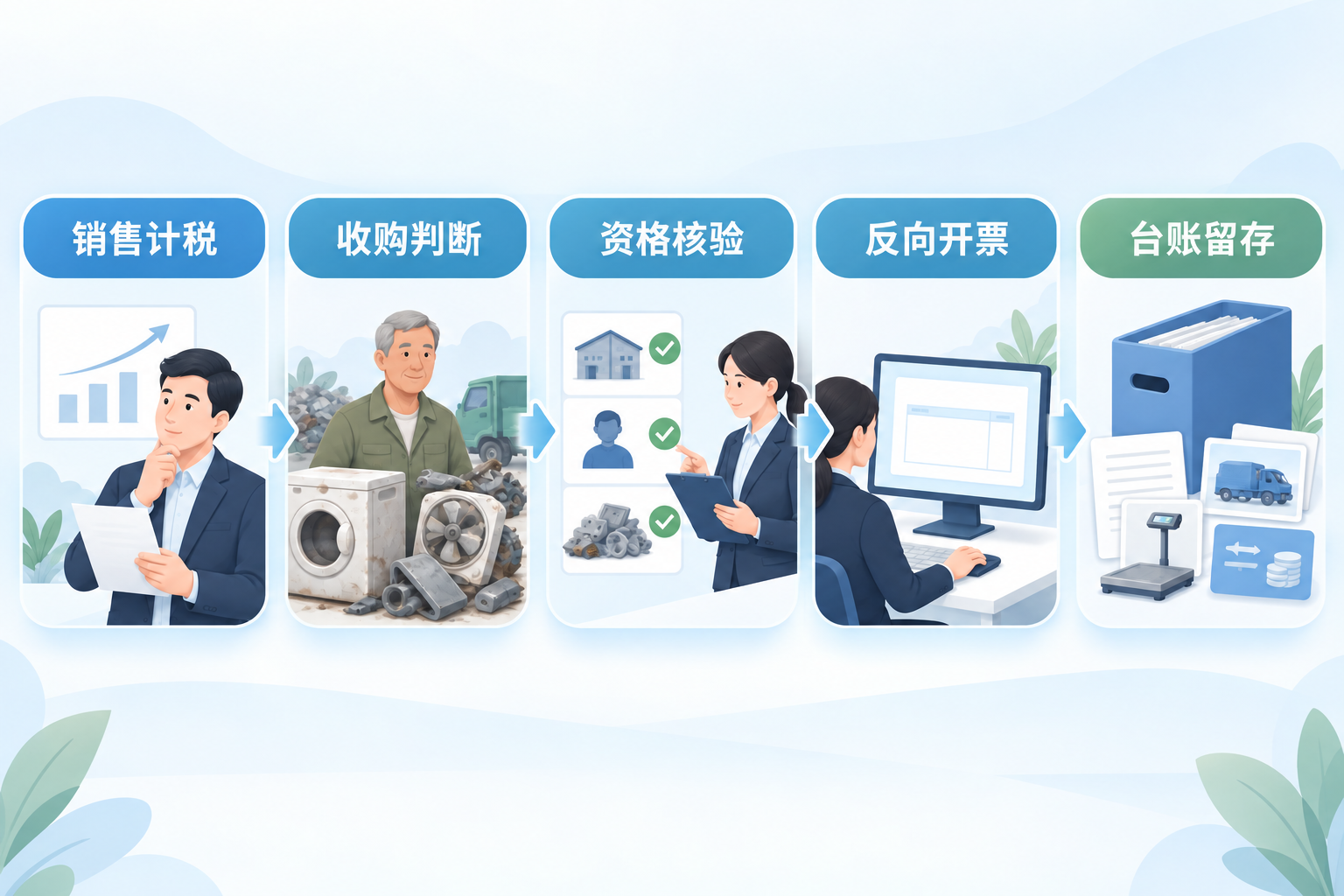
When recycling renewable resources with a 3-point invoice, is reverse invoicing still needed? The answer is not a simple "yes" or "no"; rather, it is first necessary to distinguish that sales-side taxation and obtaining invoices on the purchase side are two separately judged issues."3-point invoice" is a colloquial expression. In 2026, the collection rate applicable to the simplified taxation method is 3%; eligible general VAT taxpayers engaged in renewable resource recycling that sell the renewable resources they have purchased may choose either simplified taxation or general taxation. Reverse invoicing, on the other hand, is an invoicing mechanism that eligible resource recycling enterprises may use when purchasing from individuals selling scrapped products who meet the definition. The choice of taxation method on the sales side does not automatically determine whether reverse invoicing applies to each purchase.
If sales taxation and reverse invoicing are confused, errors may occur in invoice type selection, deduction judgment, or document retention. The processing order should be to first verify the taxation method applicable on the sales side, and then judge whether this purchase simultaneously satisfies the conditions of resource recycling enterprise, individual seller, and scrapped product scope. The system can assist in recording qualifications, transactions, and invoicing status, but it cannot automatically determine transaction authenticity, nor can it treat "purchase means invoicing" as an unconditional rule.
"Taxation on the sales side and reverse invoicing on the purchase side should be judged separately; the two cannot substitute for each other, nor must they occur simultaneously." |
▍1. What exactly do the 3-point invoice and reverse invoicing each govern?
BasisMinistry of Finance and State Taxation Administration Announcement No. 10 of 2026, the currently effective VAT policy on comprehensive resource utilization in Announcement No. 40 of 2021 continues to be implemented from January 1, 2026; the VAT Law stipulates that the simplified taxation collection rate is 3%. Eligible general VAT taxpayers engaged in renewable resource recycling that sell the renewable resources they have purchased may choose simplified taxation or general taxation. BasisState Taxation Administration Announcement No. 5 of 2024Reverse invoicing applies to qualified resource recycling enterprises purchasing scrapped products from natural person sellers who meet the definition. The former is a tax calculation option on the sales side, while the latter is an invoicing mechanism for a specific acquisition scenario; they should be assessed separately.
▍2. Under what circumstances must reverse invoicing be considered?
When the upstream party is an individual scrapped product seller who meets the definition, an approved resource recycling enterprise may consider reverse invoicing, but this is not a mandatory action for all purchases. The enterprise must actually engage in resource recycling business and meet corresponding conditions such as licenses, qualifications, or business entity registration and commerce filing, and submit application materials to the competent tax authority; the seller's cumulative sales amount under reverse invoicing for no more than 12 consecutive months must not exceed the policy limit, and the goods should also fall within the scope of scrapped products. Resource recycling enterprises applying simplified taxation may only issue ordinary invoices in reverse, and may not issue VAT special invoices in reverse; those applying general taxation may issue special invoices or ordinary invoices as required and handle deductions. Agricultural product purchase invoices are subject to a different set of rules and cannot be mixed.
▍3. Why is the five-flow-in-one ledger a prerequisite for reverse invoicing?
The key to reverse invoicing is not the invoicing action itself, but that the real transaction and applicable conditions can be verified. Announcement No. 5 requires retaining materials that can prove the authenticity of the business, including purchase contracts or agreements, transport invoices or vouchers, cargo weighbridge slips, transfer payment records, etc., and establishing a purchase ledger. Enterprises should also, as required, handle VAT and surtax filing and individual income tax filing matters on behalf of sellers. The so-called "five-flow-in-one" can serve as an internal management method, but it is not a slogan to replace statutory conditions, nor does it require different documents to be mechanically consistent at every point in time. Systems and OCR can assist in collecting candidate fields, verifying status, and organizing materials; seller conditions, transaction authenticity, recognition results, and recording and archiving still require personnel review.
▍4. How can recycling enterprises manage invoicing and ledgers clearly?
Enterprises can manage sales invoicing, purchase-side invoices, tax fee agency services, purchase ledgers, and archive materials within linked processes. Within the scope of authorization and interface support, the system can assist with invoicing, status tracking, document linking, and retrieval, but invoicing does not automatically mean it has been recorded, and scanning or OCR recognition does not automatically mean it has been archived. Each transaction should separately record the sales-side taxation method, purchase-side applicable conditions, invoice type, tax fee agency services, and authenticity materials, and complete accounting and archive processing only after review.
Keywords: reverse invoicing, renewable resource recycling, 3% simplified taxation, individual scrapped product seller, resource recycling enterprise, purchase ledger, tax fee agency services, Kailing Technology
As a comprehensive business-finance-tax digitalization solution service provider, Kailing Technology provides business-finance-tax management digital transformation products and operational services for various government agencies, institutions, and large, medium, and small enterprises. The product line includes: solutions for sales contract management system, procurement contract management system, fully digitalized Leqi interface project, automatic output invoicing system, reverse invoicing system, invoice issuance for individuals system, employee expense control and reimbursement system, input VAT invoice management system, supply chain collaborative reconciliation system, image AI OCR recognition system, automatic financial bookkeeping system, electronic accounting archives system, etc., comprehensively driving the digitalization process across various fields.
Consultation Hotline: 18513895936 / 010-60974119 Location: Beijing