
The best method for supplier reconciliation: say goodbye to Excel month-end mismatches

The best method for supplier reconciliation: say goodbye to Excel month-end mismatches, and give discrepancies an accountable person and a basis for closure
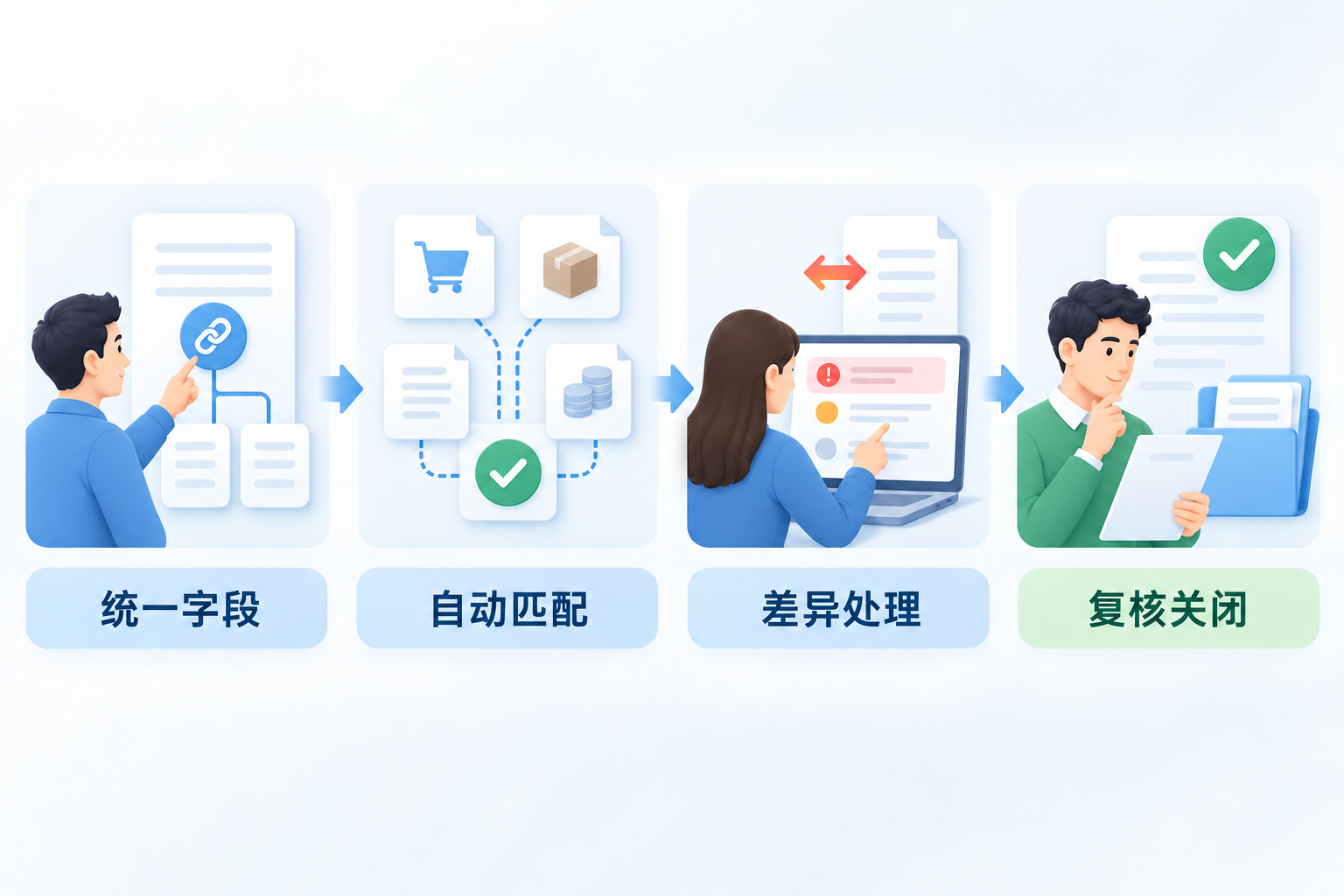
At month-end reconciliation, procurement looks by order, the warehouse looks by receipt, finance looks by invoice, and the supplier looks by its own settlement cycle; with four different definitions, even the most beautiful Excel is just manual stitching. The solution is not to forcibly make the four amounts consistent, but to let orders, receipts, invoices, and payments form reviewable candidate matches under the same set of field definitions, with discrepancies having an accountable person, a status, and a basis for closure. Kailing Technology uses OCR document recognition, input VAT invoice management, and electronic accounting archives as its foundation to help turn reconciliation from a month-end rush into a daily closed loop; matching results and closure conclusions still require review by business, procurement, and finance personnel.
Reconciliation is not about forcibly making four amounts equal, but about proving why consistent items are consistent, why discrepancies exist, and how they are ultimately closed. |
▍1. Why do Excel reconciliation sheets get more and more complicated?
Many enterprises blame reconciliation difficulties on templates not being good enough, so they keep adding columns, formulas, and colors, making things more and more complex. The real problem is that procurement, the warehouse, finance, and suppliers each record different facts, and the formation time, recording scope, and quantity definitions may also differ. Requiring every field to be exactly the same from the start does not conform to all actual transactions. One truckload of goods may be accepted in batches, one purchase may be delivered multiple times, and one invoice may correspond to multiple receipts. Excel can only record results, cannot carry the process, and even less can it route discrepancies to accountable persons. Kailing Technology's approach is to first establish a field dictionary, then design the table, unifying basic fields such as supplier name and code, purchasing organization, order number and line number, material or service, receipt or acceptance date, invoice number, tax-inclusive amount, and tax-exclusive amount, so that all four parties speak under the same set of primary keys.
▍2. Is the best method for reconciliation to first unify field definitions?
How to make a reconciliation statement template: the answer is usually not "make another more complex Excel sheet," but to unify the field definitions of orders, receipts, invoices, and payments, and to give each discrepancy an accountable person, processing status, and basis for closure. Kailing Technology recommends first defining the primary key and cutoff rules: use order number plus line number as the primary key, and clarify the receipt cutoff date, invoice cutoff date, and payment cutoff date. After fields are unified, procurement looks at order execution, the warehouse looks at receipt confirmation, finance looks at invoices and payments, and the supplier looks at the settlement cycle; what all four parties see are different sides of the same transaction, rather than four unrelated tables. Input VAT invoice management can, within the scope permitted by enterprise authorization, interface support, and current platform rules, aggregate invoice data to assist with verification, duplicate checking, and status tracking, providing a pending-review invoice ledger for reconciliation; the system cannot guarantee coverage of all invoice sources, nor can it replace personnel confirmation of the correspondence between invoices and real business.
▍3. When delivery notes, receiving notes, and invoices do not match, how can they be automatically matched?
Delivery notes reflect dispatch or delivery arrangements, receiving notes record the receipt situation actually confirmed by the enterprise, and invoices reflect the corresponding document content. The three are often related, but their formation time, recording scope, and quantity definitions may differ. OCR can organize candidate fields from different formats, assist in finding corresponding details and discrepancies, and reduce manual transcription and searching; recognition results do not automatically mean recording. Business personnel still need to check the originals and explain the real reasons for short receipts, batch deliveries, returns, etc. Reviewed consistent items can be closed according to configured rules, while discrepancy items enter a pending pool, marked with accountable person, status, and basis for closure.
▍4. After the discrepancy loop is closed, how should vouchers and archives be managed?
After the reconciliation discrepancy is closed, it is still necessary to follow enterprise policies and"Specification for Electronic Accounting Archive Management" (DA/T 94-2022)Manage electronic accounting materials and metadata according to applicable requirements. The system can, when authorization, interfaces, and archiving rules meet the conditions, assist in linking reconciliation statements, receiving notes, invoices, and payment vouchers, but scanning or OCR recognition itself does not equal recording, archiving, or forming a complete evidence chain. Agricultural product purchases, reverse invoicing for resource recycling, and invoice issuance for individuals are subject to different policies and must be judged separately based on real business; invoices must not be supplemented merely to eliminate invoice-payment discrepancies. AI tools can assist with document review, contract comparison, follow-up reminders, and report organization, but conclusions are still reviewed by the relevant accountable persons.
Keywords: supplier reconciliation, reconciliation statement template, OCR document recognition, input VAT invoice management, electronic accounting archives, supply chain reconciliation, discrepancy loop closure, review closure
As a comprehensive business-finance-tax digitalization solution service provider, Kailing Technology provides business-finance-tax management digital transformation products and operational services for various government agencies, institutions, and large, medium, and small enterprises. The product line includes: solutions for sales contract management system, procurement contract management system, fully digitalized Leqi interface project, automatic output invoicing system, reverse invoicing system, invoice issuance for individuals system, employee expense control and reimbursement system, input VAT invoice management system, supply chain collaborative reconciliation system, image AI OCR recognition system, automatic financial bookkeeping system, electronic accounting archives system, etc., comprehensively driving the digitalization process across various fields.
Consultation Hotline: 18513895936 / 010-60974119 Location: Beijing