
What to do when input VAT invoices and output VAT invoices do not match? Three ways to clarify business-finance-tax risks

What to do when input VAT invoices and output VAT invoices do not match? Three ways to clarify differences and stabilize business-finance-tax risks
At month-end reconciliation, input VAT invoices and output VAT invoices do not match. The boss is anxious, and the accountant is even more anxious. One missing invoice may trigger additional tax, late fees, or even audit risk. In fact, input-output inconsistency does not necessarily mean noncompliance. The key is to distinguish whether it is a timing gap, a scope difference, or a disconnect between real business and invoices. Kailing Technology uses a combined solution of input VAT invoice management, automated output invoicing system, and tax risk control to help enterprises identify differences and control risks at the front end.
Input-output inconsistency is not scary. What is scary is being unable to explain where the difference lies and being unable to produce a compliant evidence chain. |
▍1. Why do input VAT invoices and output VAT invoices become inconsistent?
Differences commonly arise from different timing between invoicing and business confirmation, different tax treatment scopes, incorrect invoicing or unsynchronized red-letter reversal status, and mismatches among business, accounting, and invoice materials. Based on"Measures of the People's Republic of China for the Administration of Invoices", invoices should be issued truthfully, and invoices inconsistent with actual business operations must not be issued; but this does not mean that invoices, funds, and goods for all transactions must be mechanically consistent at every point in time and for every amount. Risk judgment should return to real business, tax obligations, invoice status, and retained materials, and conclusions cannot be drawn solely from different input-output figures.
▍2. First self-check: is the difference a timing gap or a real risk?
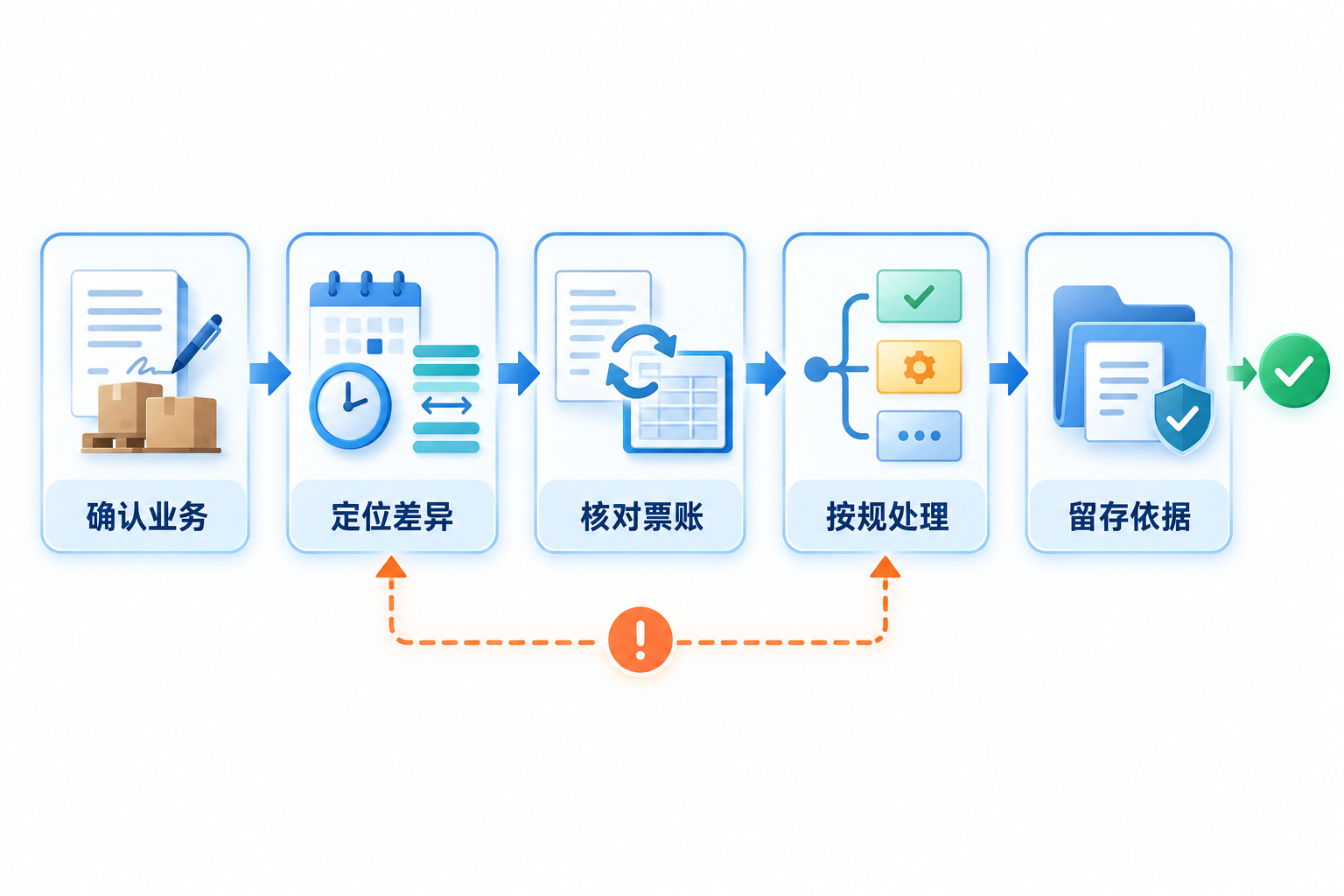
Self-check can proceed by "confirm business - locate differences - verify invoices and accounts": first verify real business materials such as contracts, orders, receipt or delivery or service completion, and payments; then distinguish invoicing time, tax obligations, tax calculation methods, invoice status, and accounting treatment; finally verify invoice details, ledgers, and corresponding filing forms. Neither the input-output ratio nor a large amount in one direction alone can prove hidden income or false input deductions. Within the scope of enterprise authorization and interface support, the system can assist with invoice retrieval, duplicate checking, status tracking, and difference prompts; data still needs review, and invoicing does not automatically mean accounting booking has been completed.
▍3. After differences are confirmed, three compliant handling paths
After confirming differences, handle them according to the specific facts: for timing gaps, review according to applicable accounting policies, the time when tax obligations arise, and input deduction conditions; for tax calculation scope differences, handle according to the corresponding policies and filing columns; when invoice information or business changes require red-letter reversal, handle it according to the invoice type, purpose confirmation status, and current rules, and do not uniformly require red-letter reversal before the cross-period point. The State Taxation Administration'sRed-letter issuance of fully digitalized e-invoicesThere is already a classification explanation. Invoice issuance for individuals applies only to real business and should be applied for through channels currently permitted by tax authorities; it cannot be used as a tool to make up invoices. When uncertain, verify with the competent tax authority or a professional advisor.
▍4. Use the system to turn "cannot reconcile" into "clearly reconciled"
The system can assist in managing input-output differences, but it cannot replace business, accounting, and tax judgment. AI OCR can extract candidate fields from invoices, documents, and contracts, and after personnel review they enter the accounting or archive process; invoice management, accounting, and filing data can form reconciliation lists and difference prompts through authorized interfaces. Prompts are only review clues, not determinations by tax authorities, and the enterprise remains responsible for filing results and retained evidence.
Keywords: input VAT invoice, output VAT invoice, input-output inconsistency, invoice risk, red-letter invoice, filing review, input VAT invoice management, Kailing Technology
As a comprehensive business-finance-tax digitalization solution service provider, Kailing Technology provides business-finance-tax management digital transformation products and operational services for various government agencies, institutions, and large, medium, and small enterprises. The product line includes: solutions for sales contract management system, procurement contract management system, fully digitalized Leqi interface project, automatic output invoicing system, reverse invoicing system, invoice issuance for individuals system, employee expense control and reimbursement system, input VAT invoice management system, supply chain collaborative reconciliation system, image AI OCR recognition system, automatic financial bookkeeping system, electronic accounting archives system, etc., comprehensively driving the digitalization process across various fields.
Consultation Hotline: 18513895936 / 010-60974119 Location: Beijing