
Supply chain company accounting is messy? Build a five-flow integration ledger like this

In supply chain company financial accounting, the difficult part is not the journal entry, but that the four sets of bases for orders, receipts, invoices, and payments do not match
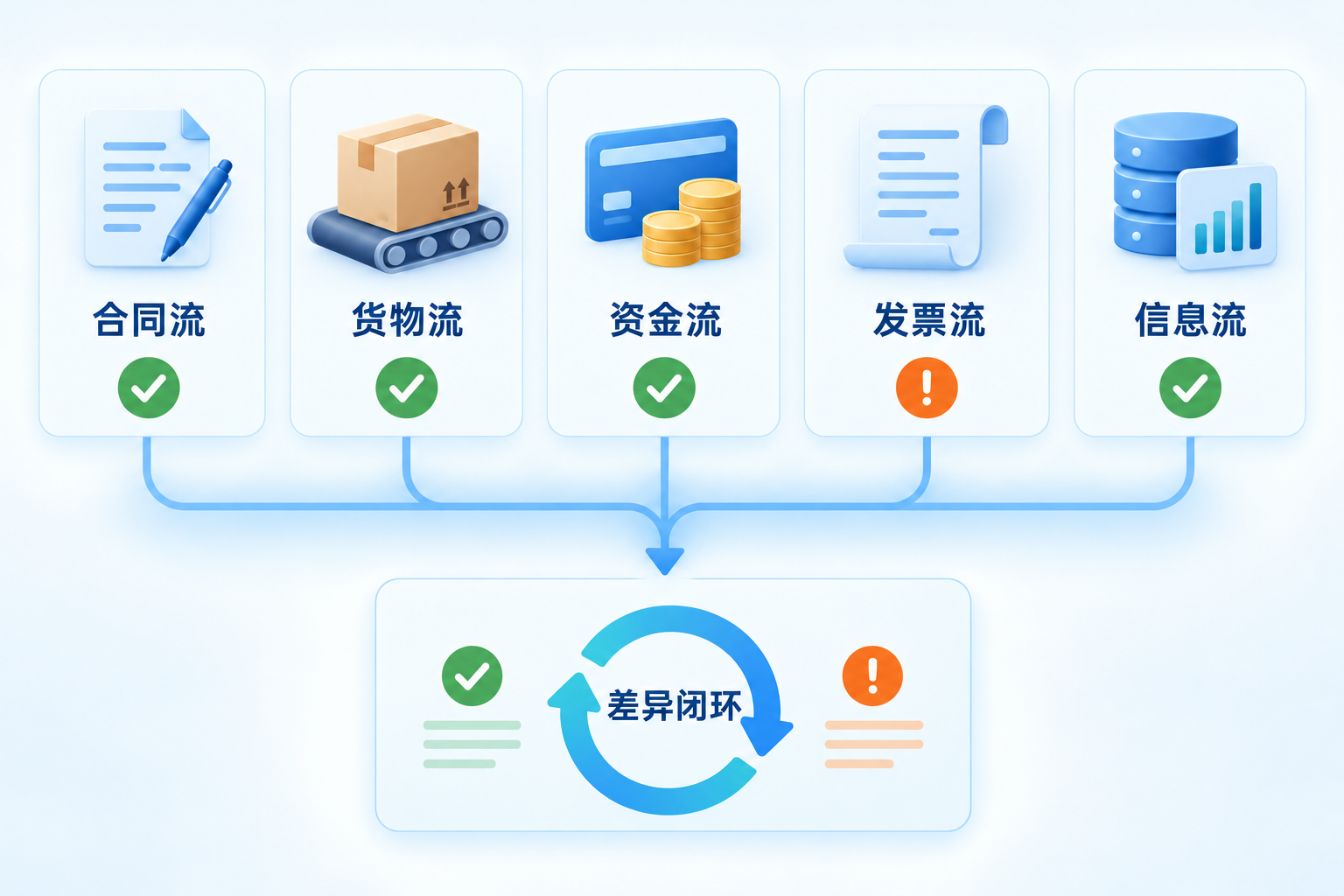
When month-end arrives, procurement looks at orders, the warehouse looks at receipts, finance looks at invoices, and suppliers look at their own settlement cycles. The four parties' numbers each tell their own story, and even the most beautiful Excel is just manual stitching. The solution is not to forcibly change the four amounts to be consistent, but to make orders, receipts, invoices, and payments run within the same set of fields: consistent items are automatically written off, and difference items have owners, statuses, and a basis for closure. Kailing Technology uses AI OCR document recognition, input VAT invoice management, electronic accounting archives, and reverse invoicing five-flow integration ledger as the foundation to help supply chain enterprises turn accounting treatment from a "month-end rush" into a "daily closed loop."
"Accounting treatment is not about changing the four amounts to be equal, but about proving why consistent items are consistent, why differences exist, and how they are ultimately closed." |
▍1. Why does a supply chain company's accounting become more chaotic the more it is reconciled?
Supply chain business naturally involves multiple entities, multiple batches, and multiple settlement cycles: one truckload of goods may be accepted in batches, one procurement may be delivered multiple times, invoices are issued by batch, and payments follow credit terms. Delivery notes reflect dispatch arrangements, receipt notes record the receipt situation actually confirmed by the enterprise, and invoices reflect document content; the three inherently differ in timing and quantity basis. Without a unified primary key and cutoff rules, finance can only manually find correspondences among the four tables, becoming more chaotic the more it reconciles. The correct approach is to first establish a field dictionary - supplier name and code, purchasing organization, order number and line number, material or service, receipt or acceptance date, invoice number, tax-inclusive and tax-exclusive amounts - and then discuss table design.
▍2. Document recognition and input VAT invoices are the first gate of accounting treatment
After fields are unified, entry is still the bottleneck. Kailing Technology AI OCR can assist in recognizing invoices, documents, contracts, licenses, and financial documents, extracting delivery notes and receipt notes in different formats as candidate fields to reduce duplicate entry; OCR results still need to be verified according to confidence levels, original documents, and enterprise policies, and successful recognition does not mean it has been recorded. Whether input VAT invoice data can be automatically collected, queried, downloaded, or verified depends on enterprise authorization, official platform capabilities such as tax digital accounts, interface conditions, and project configuration; the system can assist with verification and duplicate checking within the above scope, but cannot replace verification of transaction authenticity. Business personnel still need to explain the real reasons for short receipts, partial deliveries, returns, etc., and the tool is responsible for laying out the facts clearly.
▍3. The five-flow integration ledger turns reconciliation from a month-end rush into a daily closed loop
The key to reconciliation is not to forcibly change the four amounts to be equal, but to make orders, receipts, invoices, and payments run within the same set of fields. Agricultural product purchase invoices and reverse invoicing by resource recycling enterprises to individuals selling scrapped products are subject to different policies and business conditions and cannot be mixed as a general rule. According toQ&A on the State Taxation Administration's "reverse invoicing" policy for resource recycling enterprises, only qualified resource recycling enterprises may, within the applicable scope, issue reverse invoices to individuals selling scrapped products. The Kailing solution can connect the contract flow, goods flow, capital flow, invoice flow, and information flow according to the business rules actually applicable to the enterprise; invoicing results, OCR recognition results, and archive materials still need to enter the review, accounting, and archiving processes.
▍4. After accounting treatment, how are filing and risks closed out?
Finishing the books does not mean the work is done. Group tax filing can assist with multi-entity data retrieval, calculation, and filing when enterprise authorization, supported filing matters, and interface configuration meet the conditions; tax risk control can perform data checks and risk alerts according to configured rules, but cannot replace taxpayer review, filing responsibility, or the judgment of the competent tax authority. For platform-based supply chain enterprises such as online freight platforms, the online freight platform system provides carrier self-operated and regulatory data reporting, with business data and business-finance-tax data from the same source. If the enterprise needs less manpower input, AI digital employees can handle repetitive actions such as reviewing documents, comparing contracts, chasing receivables, and producing reports, leaving finance's energy for variance analysis and business judgment.
Keywords: Supply chain company accounting treatment, five-flow integration ledger, reverse invoicing, input VAT invoice management, AI OCR document recognition, electronic accounting archives, supplier reconciliation, tax filing
As a comprehensive business-finance-tax digitalization solution service provider, Kailing Technology provides business-finance-tax management digital transformation products and operational services for various government agencies, institutions, and large, medium, and small enterprises. The product line includes: solutions for sales contract management system, procurement contract management system, fully digitalized Leqi interface project, automatic output invoicing system, reverse invoicing system, invoice issuance for individuals system, employee expense control and reimbursement system, input VAT invoice management system, supply chain collaborative reconciliation system, image AI OCR recognition system, automatic financial bookkeeping system, electronic accounting archives system, etc., comprehensively driving the digitalization process across various fields.
Consultation Hotline: 18513895936 / 010-60974119 Location: Beijing