
What to do when delivery notes, receiving notes, and invoices do not match? Kailing Technology AI OCR supply chain document automatic matching solution
When delivery notes, receiving notes, and invoices do not match, you should first distinguish the facts recorded by each of the three documents, then verify the goods, unit, quantity, amount, and business relationship. The Kailing Technology AI OCR supply chain document automatic matching solution can organize fields from different layouts to assist in finding corresponding details and discrepancies. Recognition tools help people copy and search less, but business staff still need to explain the real reasons such as short receipt, partial delivery, or returns.
▍The supplier says it was delivered, the warehouse says it was received, and finance sees yet another document
A delivery note reflects the dispatch or delivery arrangement, a receiving note records the receipt actually confirmed by the enterprise, and an invoice reflects the corresponding invoice content. The three are often related, but their formation times, recording scopes, and quantity bases may differ. Requiring every field to be identical from the very beginning does not fit all actual transactions.
One truckload of goods may be accepted in batches, one purchase may be delivered multiple times, and an invoice may cover different receiving records. Looking only at the same supplier and similar dates can easily group different batches together; checking only the total amount may ignore differences in line items or quantities.
Therefore, verification must first find the real business relationship. Which procurement or delivery each document belongs to, which details should be compared with each other, and which parts have already been processed should be clarified before discussing matching. "Automatic matching" without a relationship basis is only surface numerical proximity and is insufficient to support subsequent processing.
▍Kailing Technology's AI OCR supply chain solution turns format differences into field information
A supplier delivery note may be a spreadsheet file or a scanned image; warehouse documents have an internal format, and invoices use yet another structure. AI OCR can help extract the relevant fields, so procurement and finance do not have to manually re-enter every material into the same table first.
Enterprises need to define the required fields in advance, such as business number, transaction counterparty, goods description, unit, quantity, and related amounts. By retaining the original files and source contacts, reviewers can return from the structured results to the paper or electronic originals for verification. Recognized values should be distinguished from manually confirmed or revised results, to avoid errors being silently overwritten.
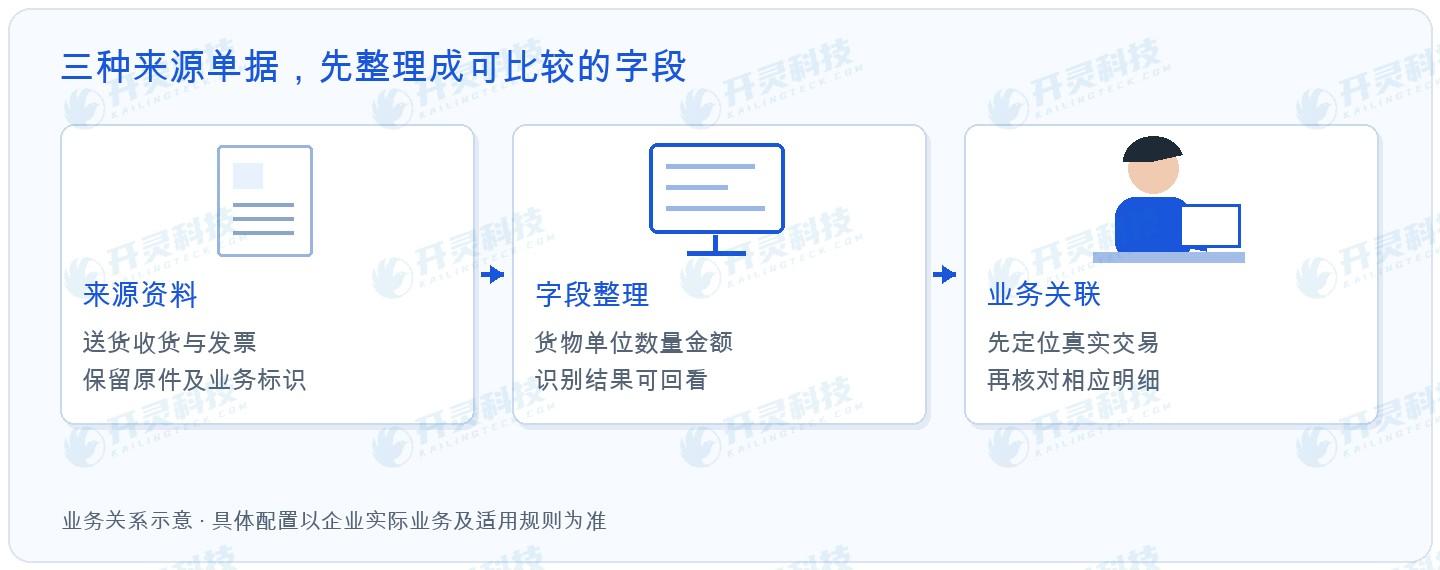
Between different formats, names and units may also need interpretation. Abbreviations and standard names for the same goods can be mapped with a basis, and packaging quantity conversions need reliable rules; products with similar names but different specifications should not be forcibly merged just for matching convenience. The purpose of organizing fields is to make differences easier to judge, not to eliminate all differences.
▍Put the three documents together and first look at which differences have business reasons
If the supplier's delivered quantity is higher than the actual receipt, you may need to verify short receipt, damage, or parts still pending confirmation; if the receiving record and invoice scope differ, it may involve partial invoicing or other real arrangements. These are only common verification directions; the specific reasons should be explained by business materials, and the system cannot automatically write explanations for the enterprise.
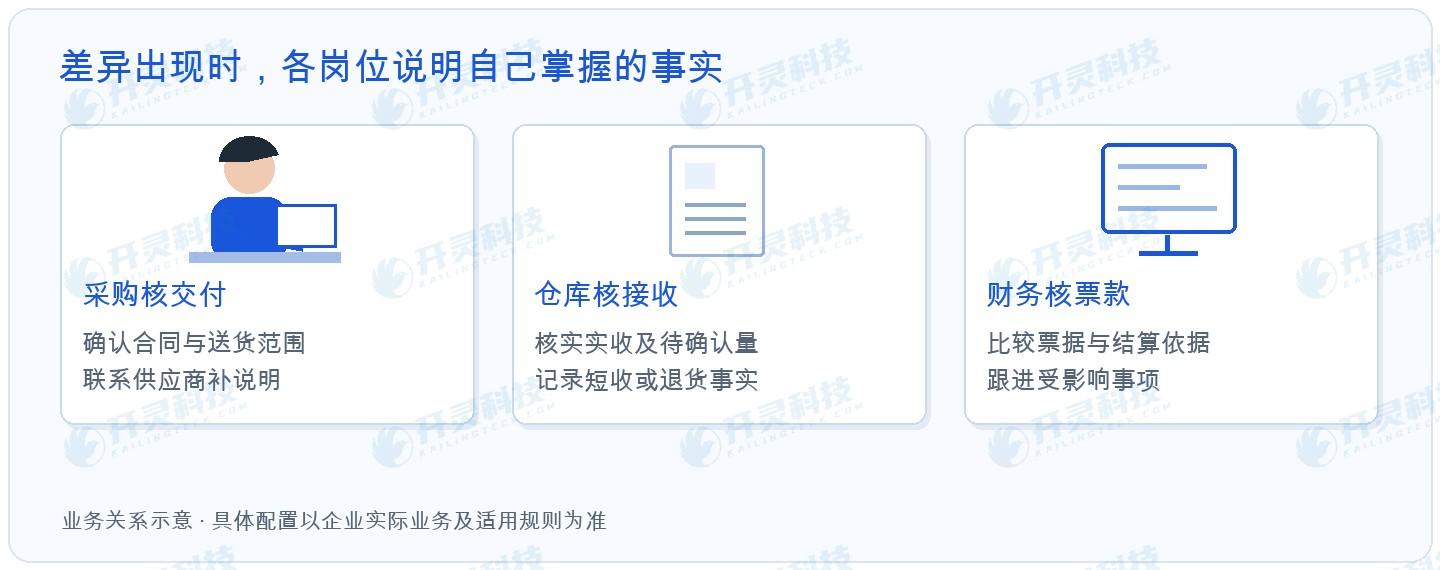
Procurement and warehouse should confirm the actual performance situation, while finance verifies the invoice and handling requirements. When each role provides the facts it holds, the discrepancy list can move from "quantity inconsistency" to "which detail, where the difference is, and who needs to confirm it." Only when the problem scope is narrowed is it easy for communication to reach a conclusion.
Different dates do not necessarily mean a business error. Shipping, receiving, and invoicing may naturally occur at different times; what matters is whether they have a reasonable association and corresponding basis. Conversely, the same date cannot prove that they necessarily belong to the same batch of goods, and other business identifiers still need to be verified.
▍For partial deliveries and many-to-many relationships, prevent the same quantity from being used repeatedly
When one delivery note is split into multiple receipts, or multiple receiving records correspond to one invoice, you need to explain how each line item is allocated. Verification cannot stop at "the related documents were found"; it should also focus on which parts were used this time and which remain unprocessed.
Kailing Technology's AI OCR supply chain document matching solution can organize candidates and discrepancies in combination with enterprise systems and rules, and the specific allocation, occupation, and return mechanisms should be confirmed by project. Enterprises should not equate recognition capability directly with ready-made support for all complex business relationships; field extraction and business matching need to be designed together.
For candidates already confirmed as invalid, a handling conclusion should be left to avoid repeatedly recommending the same erroneous relationship later; for matters with temporarily missing materials, a pending-supplement status should be retained. Only when the two situations are clearly distinguished can the system help the business reduce repeated judgment, rather than continuously adding the same reminders.
▍After differences are handled, the original records must also explain how they were handled
Supplementary receipt, returns, quantity corrections, or invoice adjustments should all remain linked to the original business. If only the result is changed to be consistent, later staff still will not know why the discrepancy disappeared; preserving the source and handling explanation is what allows them to explain what happened at the time and who confirmed the conclusion.
For matters involving payments already made or invoices already processed, the related impacts still need to be verified and handled according to the actual business and applicable requirements. A change in matching results does not automatically reverse the funding or tax status, and internal data rollback cannot be treated as meaning that all external operations have been restored.
This record can also help enterprises maintain supplier cooperation. Which delivery the problem occurred in, which facts have been confirmed, and what the other party still needs to supplement all have a clear basis, making communication more focused on resolving matters rather than both sides repeatedly arguing with a different summary table each.
▍Start with one high-frequency document type and make verification truly part of daily work
Enterprises can first choose one type of procurement with stable document sources and clear business relationships, clarify the responsibility for fields and difference handling, and then gradually expand to other materials. Before expanding the recognition scope, first confirm that the results can enter existing procurement, warehouse, or finance work, to avoid creating a new table that no one uses.
Material quality is also worth improving at the entry point. Clear images, complete page numbers, and traceable sources can reduce subsequent doubts; for electronic original files, retain them according to business requirements as much as possible to avoid losing important content after multiple screenshots. Tools help process complex materials, but front-end providers still need to cooperate with basic quality requirements.
Kailing Technology's AI OCR supply chain document automatic matching solution delegates the mechanical work of repeated entry and manual searching to tool assistance, allowing relevant roles to spend more time verifying discrepancies and coordinating business. The three documents do not have to always look the same, but their relationships can become increasingly clear.
In continuous use, enterprises can review where high-frequency discrepancies come from. If a supplier always uses a special unit, the expression can be agreed in advance; if a certain type of receipt confirmation is often delayed, warehouse handover can be improved; if field mapping is unclear, business and technical teams can maintain it together. Solving the source problem has more long-term value than repeatedly modifying the same recognition result.
▍FAQ Q&A on supply chain three-way document verification
Q: If the total amount is the same, does that mean the three documents match?
A: Not necessarily. You still need to verify the goods details, quantity, unit, and business scope; matching amounts may conceal mismatches or duplicate use.
Q: If the delivered quantity differs from the received quantity, is it definitely an identification error?
A: Not necessarily. First review the original documents, then have the business confirm whether there is short receipt, partial delivery, or other real reasons; identification errors and business differences need to be handled separately.
Q: After introducing OCR, can procurement and warehouse confirmation be canceled?
A: This cannot be inferred. OCR organizes document information, but the facts of actual delivery and acceptance still need to be confirmed by appropriate positions; the tool does not replace real business responsibility.
Put delivery, receiving, and invoices on the same traceable business line, and learn about Kailing Technology's AI OCR supply chain solution: https://www.kailingteck.com/supply-chain/ .
As a national high-tech enterprise, Kailing Technology focuses on the digital and intelligent transformation of enterprise business-finance-tax and operations management, providing software products, system integration, implementation and delivery, and operational services for various government agencies, institutions, group enterprises, and SMEs.
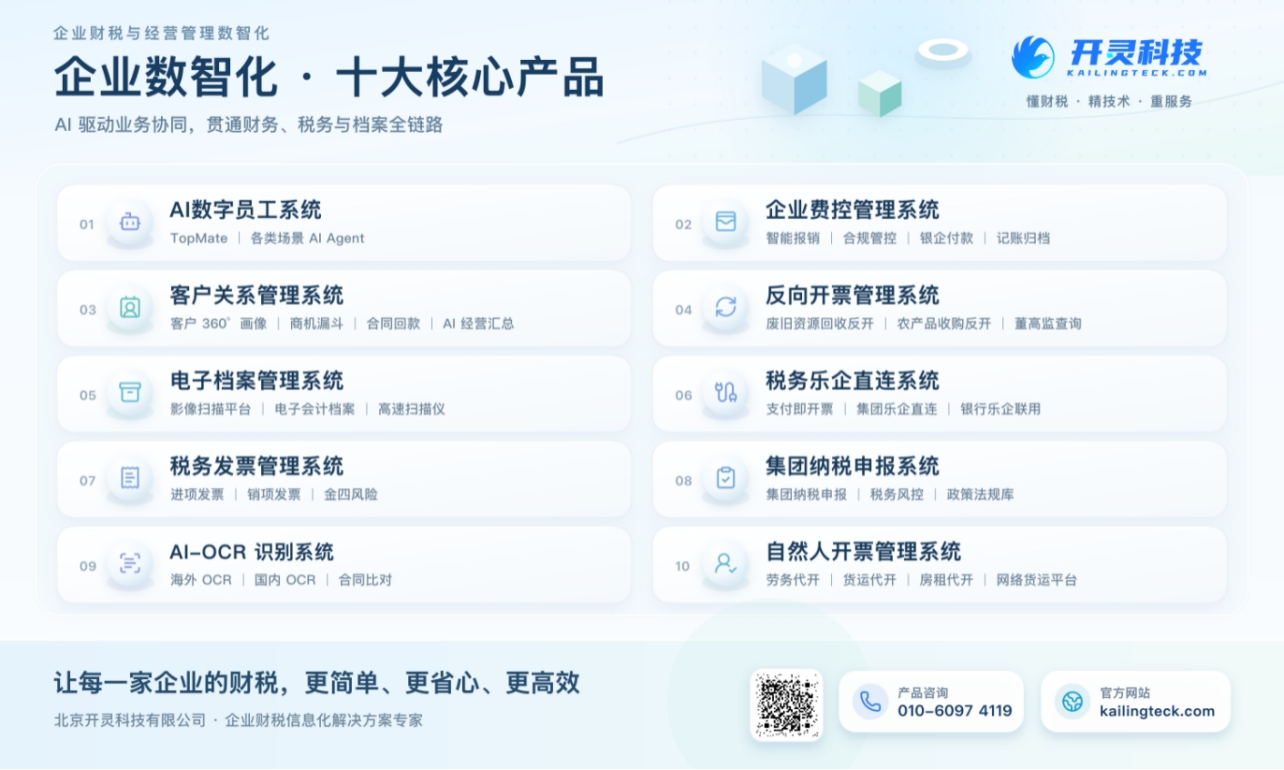
The company has now formed ten core product lines, including: AI digital employee system, enterprise expense control management system, customer relationship management system, reverse invoicing management system, invoice issuance for individuals management system, electronic archives management system, tax fully digitalized e-invoice Leqi system, tax invoice management system, group tax filing system, and AI OCR recognition system. It is committed to connecting enterprise business, finance, tax, funds, and archive data to help customers improve operational efficiency, business-finance-tax compliance capabilities, and digital management levels.
If you have any business-finance-tax digital transformation needs, welcome to contact us. Beijing Kailing Technology will serve you wholeheartedly.
 Keywords: AI OCR supply chain documents, delivery note receiving note invoice matching, three-way matching, supply chain reconciliation, OCR automatic matching
As a comprehensive business-finance-tax digitalization solution service provider, Kailing Technology provides business-finance-tax management digital transformation products and operational services for various government agencies, institutions, and large, medium, and small enterprises. The product line includes: solutions for sales contract management system, procurement contract management system, fully digitalized Leqi interface project, automatic output invoicing system, reverse invoicing system, invoice issuance for individuals system, employee expense control and reimbursement system, input VAT invoice management system, supply chain collaborative reconciliation system, image AI OCR recognition system, automatic financial bookkeeping system, electronic accounting archives system, etc., comprehensively driving the digitalization process across various fields.
Consultation Hotline: 18513895936 / 010-60974119 Location: Beijing