
How to choose a supply chain integration service? Unify fields first, then talk about automation

How to choose a supply chain integration service? Unify fields first, then talk about automation.
Purchasing looks by order, the warehouse looks by receiving, finance looks by invoice, and suppliers look by their own settlement cycle. The four tables remain unreconciled for a long time, usually not because a more complex software suite is missing, but because the primary keys, cutoff rules, and responsibility boundaries have not been unified. The goal of supply chain integration is not to force the system to make amounts consistent, but to ensure that consistent items have a basis and discrepant items have an owner and closing conditions.
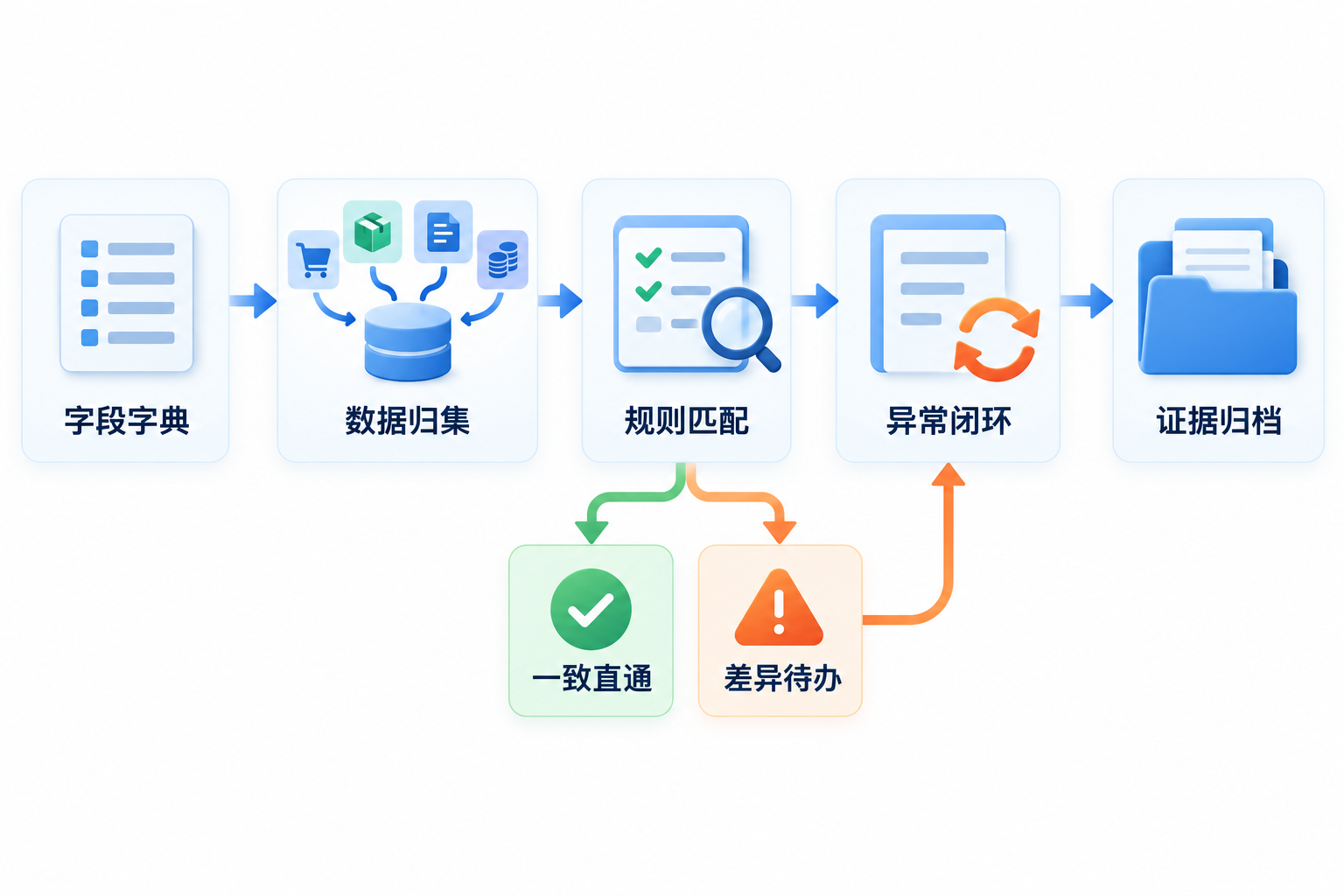
An implementable reconciliation chain should be completed in sequence: field dictionary, data aggregation, rule matching, exception closed loop, and evidence archiving. |
▍1. The field dictionary is the starting point for system integration
Basic fields may include supplier name and code, purchasing organization, order number and line number, material or service, receiving or acceptance record, unique invoice identifier, amount and tax amount, currency, payment terms, reconciliation period, and cutoff date. Each field should also indicate the source system, whether it is required, format, uniqueness, and responsible department. Tax rates, tax amounts, and accounting definitions should come from authentic documents and applicable rules, and cannot be guessed by the integration platform itself.
▍2. Data aggregation must clearly state authorization and coverage scope
Orders, receiving, invoices, and payments may come from ERP, WMS, financial systems, bank receipts, or supplier portals. Service providers should explain whether they use interfaces, file exchange, or manual import, as well as synchronization frequency, failure retries, and permission boundaries. Whether input VAT invoice data can be automatically aggregated, verified, or downloaded depends on enterprise authorization, official platform capabilities, interface conditions, and project configuration, and cannot be broadly advertised as "directly connected to the tax bureau to automatically obtain all invoice sources."
▍3. OCR is only responsible for extracting candidate fields
AI OCR can assist in recognizing invoices, contracts, receiving notes, and other image materials, but it should output confidence scores and retain the original images. Low confidence, abnormal layouts, conflicts in key fields, and duplicate images should go to manual review. "Successful recognition" does not mean it has been recorded, the transaction is authentic, or it can be deducted; accounting treatment, purpose confirmation, and payment approval must still be executed according to enterprise policies.
▍4. Matching rules should separate normal items from abnormal items
The system can establish associations by supplier code, order line, receiving record, and invoice identifier, then check quantity, unit price, amount, date, currency, and status. Consistent items that meet the rules enter subsequent processes; price differences, quantity differences, cross-period issues, missing acceptance, duplicate invoices, or payment status conflicts enter the exception queue. Each type of discrepancy should be configured with an owner, processing time limit, attachment requirements, and closing conditions.
▍5. Interface failures must be able to continue safely
Integration tasks should use unique business identifiers and idempotency rules, recording requests, responses, retry counts, and final status. When the network is interrupted or partial synchronization fails, continue from the unfinished step to avoid duplicate order creation, duplicate invoice aggregation, or duplicate payment triggering. Permissions should be configured minimally by role, and sensitive data transmission, logs, and exports should also be included in security assessment.
▍6. Archiving is not just putting files into a directory
Confirmed reconciliation statements should be linked with orders, receiving acceptance, invoices, payments, approvals, and discrepancy handling materials. Kailing TechnologyInput VAT Invoice Solution、AI OCR recognitionandElectronic accounting archivesIt can assist with aggregation, matching, verification and duplicate checking, and archive association according to enterprise authorization and project configuration; before launch, real samples should be used to verify field completeness rate, exception interception, failure continuation, and retrieval effectiveness.
Keywords: Supply chain integration service, supplier reconciliation, field dictionary, automatic matching, exception closed loop, input VAT invoice management, AI OCR, electronic accounting archives
As a comprehensive business-finance-tax digitalization solution service provider, Kailing Technology provides business-finance-tax management digital transformation products and operational services for various government agencies, institutions, and large, medium, and small enterprises. The product line includes: solutions for sales contract management system, procurement contract management system, fully digitalized Leqi interface project, automatic output invoicing system, reverse invoicing system, invoice issuance for individuals system, employee expense control and reimbursement system, input VAT invoice management system, supply chain collaborative reconciliation system, image AI OCR recognition system, automatic financial bookkeeping system, electronic accounting archives system, etc., comprehensively driving the digitalization process across various fields.
Consultation Hotline: 18513895936 / 010-60974119 Location: Beijing