
How to implement tax invoicing automation? Validate first, then issue

How to implement tax invoicing automation? Validate first, then issue
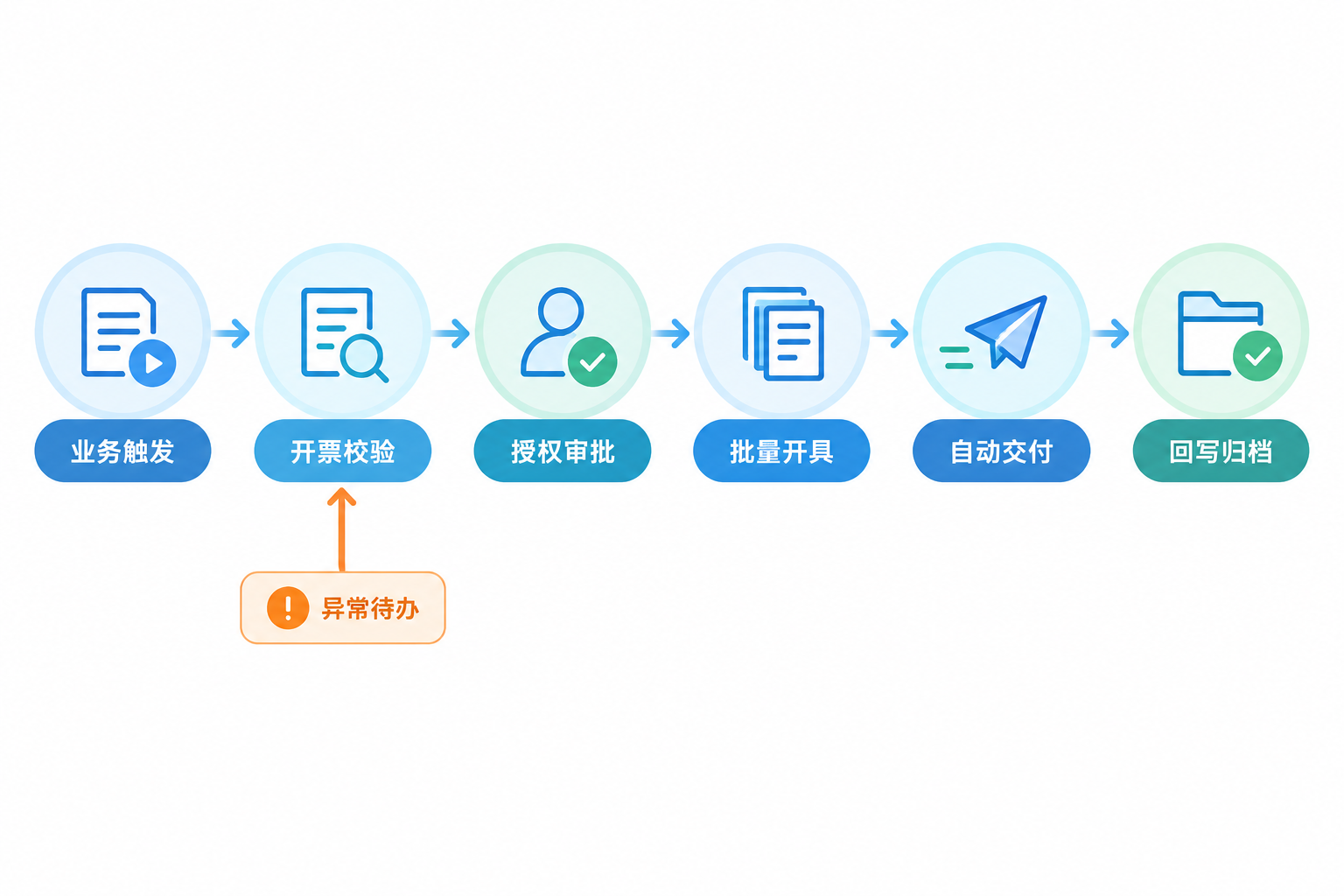
Slow, erroneous, and missed invoicing at month-end is often not because finance does not click fast enough, but because orders, contracts, buyer information, and invoicing rules are not uniformly validated before issuance. A robust automation chain should start from real business triggering, go through data validation and authorization approval, and then execute issuance, delivery, status write-back, and archiving; abnormal data enters the to-do list rather than being forcibly released by the system.
The core of automatic invoicing is not replacing manual clicks with API calls, but ensuring that business data, invoicing rules, and approval permissions are verified before issuance. |
▍1. First clarify the current rules for fully digitalized e-invoices
State Taxation AdministrationAnnouncement No. 11 of 2024Clearly, since December 1, 2024, fully digitalized e-invoices have been officially promoted and applied nationwide. Fully digitalized e-invoices are issued through the electronic invoice service platform; issued fully digitalized e-invoices can be automatically delivered by the platform, or delivered via email, QR code, or download and print. Units and individuals can query, download, print, export, and verify relevant invoice information through the tax digital account.
▍2. Pre-issuance validation determines whether automation is robust
When a business system submits an invoicing request, it should validate the sales entity, buyer name and taxpayer identification number, order or contract, goods or service items, quantity and amount, applicable tax classification code, invoicing quota, duplicate requests, and enterprise authorization. When fields are missing, rules conflict, or status is abnormal, the request enters the to-do list for the responsible person to supplement or confirm; real business and compliance boundaries must not be skipped in pursuit of straight-through rates.
▍3. Every automatic issuance must be traceable and resumable
Batch tasks should set unique business identifiers and idempotency rules, recording requests, validation, approval, issuance results, delivery results, and failure reasons. When the network is interrupted or an interface partially fails, resume from the incomplete step to avoid duplicate issuance or duplicate delivery. Follow-up matters such as red-letter handling, voiding, or reversal should also be written back to the business system so that order, invoice, and receivable statuses remain consistent.
▍4. Delivery and write-back are not the same thing
Automatic delivery by the electronic invoice service platform has a clear policy basis, but enterprises' self-built systems must still record customer receiving channels, delivery results, and business status. The system showing "sent" does not necessarily mean the customer has read it, and showing "issued" does not mean revenue recognition or accounting treatment has been completed. Issuance, delivery, receipt confirmation, booking, red-letter handling, and archiving should be distinguished according to enterprise processes.
▍5. Extending from invoicing to booking and archiving must preserve review boundaries
Kailing TechnologyOutput VAT Invoice Management SystemIt can connect orders or contracts, approval, issuance, delivery, and status write-back based on enterprise configuration;Electronic accounting archivesInvoices and related business materials can be linked. The system can generate pending data or voucher suggestions, but "successful invoicing" does not equal automatic completion of revenue recognition, accounting booking, or tax filing; enterprise accounting policies and approval processes must still be followed.
▍6. Use exception scenarios for acceptance testing before launch
In addition to normal issuance, scenarios such as missing buyer information, duplicate order submission, inconsistent amounts, insufficient quota, approval rejection, API timeout, partial success, delivery failure, and red-letter processing should also be tested. Only when normal items can pass through directly, exceptions can be intercepted, failed tasks can be safely resumed, and the entire process is auditable can tax invoicing automation truly be implemented.
Keywords: tax invoicing automation, automatic output invoicing, batch issuance of fully digitalized e-invoices, pre-issuance validation, automatic delivery, status write-back, electronic accounting archives, Kailing Technology
As a comprehensive business-finance-tax digitalization solution service provider, Kailing Technology provides business-finance-tax management digital transformation products and operational services for various government agencies, institutions, and large, medium, and small enterprises. The product line includes: solutions for sales contract management system, procurement contract management system, fully digitalized Leqi interface project, automatic output invoicing system, reverse invoicing system, invoice issuance for individuals system, employee expense control and reimbursement system, input VAT invoice management system, supply chain collaborative reconciliation system, image AI OCR recognition system, automatic financial bookkeeping system, electronic accounting archives system, etc., comprehensively driving the digitalization process across various fields.
Consultation Hotline: 18513895936 / 010-60974119 Location: Beijing