
How to create a supplier reconciliation statement table? From unified fields to closed-loop discrepancy handling

How should a supplier reconciliation statement table be made so it no longer fails to balance every month?
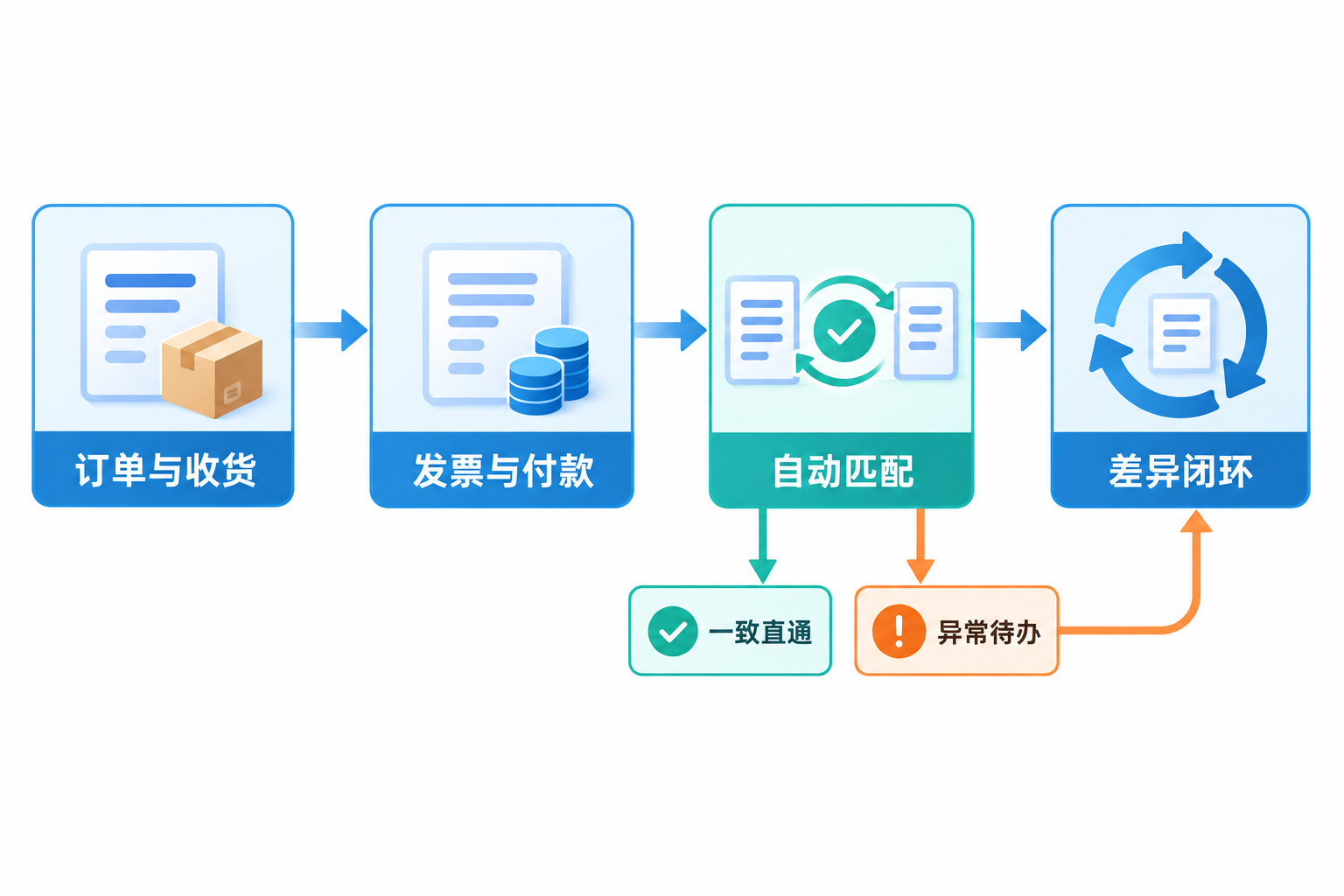
The answer is usually not "make another more complex Excel," but to unify the field definitions of orders, receipts, invoices, and payments, and ensure every discrepancy has a responsible person, processing status, and closure basis. Procurement looks by order, the warehouse looks by receipt, finance looks by invoice, and suppliers look by their own settlement cycle. If the four parties do not have a unified primary key and cutoff rules, even the most polished template is just a manual stitching of four tables.
Reconciliation is not about forcing four amounts to match, but about proving why matching items match, why discrepancies exist, and how they are ultimately closed. |
▍1. Establish a field dictionary first, then design the table
Basic fields may include supplier name and code, purchasing organization, order number and line number, material or service, receipt or acceptance date, invoice number, tax-inclusive amount, tax-exclusive amount, tax amount, currency, payment terms, reconciliation period, and cutoff date. More importantly, indicate each field's source system, uniqueness rules, whether it is required, and the responsible department. Amounts, tax amounts, and tax rates should come from real documents and applicable business rules; the template itself cannot replace tax judgment.
▍2. Put orders, receipts, invoices, and payments into the same ledger
Before automatic matching, the primary key must be determined. A common approach is to base it on supplier code, order number, order line number, and receipt records, then associate invoice and payment information. Paper or image materials can use AI OCR to extract candidate fields, but recognition results should undergo confidence validation and necessary manual review; "successful recognition" does not mean it has been recorded, nor can it prove the transaction is genuine.
▍3. Matching rules should distinguish between consistent straight-through and exception to-do items
The system can first check the entity, order, quantity, unit price, amount, currency, date, and invoice status. Consistent items that meet enterprise rules proceed to subsequent processes; cases such as quantity discrepancies, price discrepancies, cross-period issues, duplicate invoices, missing acceptance, or missing contracts enter the exception queue. Different discrepancies require configured responsible persons, processing deadlines, required attachments, and closure conditions, avoiding verbal confirmation only via email or WeChat groups.
▍4. Every discrepancy must leave reviewable evidence
Quantity discrepancies are usually verified by the warehouse or business department, price discrepancies are confirmed by procurement based on the contract, and invoice and payment discrepancies are reviewed by finance. Adjusted orders, supplementary acceptance records, red-letter handling, discount agreements, or approval records should be stored in association with the original business documents. Reconciliation conclusions must be able to answer: who discovered it, who confirmed it, on what basis, when it was closed, and whether it affects payment, booking, or subsequent filing.
▍5. Confirmed reconciliation statements then enter the archiving chain
Reconciliation statements confirmed by both parties should be linked with contracts or orders, receipt and acceptance records, invoices, payments, and discrepancy handling materials. Kailing TechnologyElectronic accounting archivesandInput VAT Invoice ManagementBased on the enterprise's existing systems and authorization conditions, it can assist with collection, verification and duplicate checking, status tracking, and archive linkage; specific interfaces, automation scope, and accounting treatment remain subject to project configuration, enterprise policies, and current business rules.
▍6. Validate with a small batch of real data before launch
First select one supplier and one complete settlement cycle to validate field completeness rate, automatic matching rate, exception classification accuracy, duplicate interception, and archive retrieval. Expand the scope only after confirming the rules are stable. This can change "concentrated discrepancy hunting at month-end" into "continuous discrepancy handling as business occurs," while preserving manual review and approval boundaries.
Keywords: supplier reconciliation statement table, supplier reconciliation, reconciliation statement template, automatic matching, discrepancy handling, AI OCR, input VAT invoice management, electronic accounting archives
As a comprehensive business-finance-tax digitalization solution service provider, Kailing Technology provides business-finance-tax management digital transformation products and operational services for various government agencies, institutions, and large, medium, and small enterprises. The product line includes: solutions for sales contract management system, procurement contract management system, fully digitalized Leqi interface project, automatic output invoicing system, reverse invoicing system, invoice issuance for individuals system, employee expense control and reimbursement system, input VAT invoice management system, supply chain collaborative reconciliation system, image AI OCR recognition system, automatic financial bookkeeping system, electronic accounting archives system, etc., comprehensively driving the digitalization process across various fields.
Consultation Hotline: 18513895936 / 010-60974119 Location: Beijing