
How to streamline the supplier reconciliation and settlement process? Build a closed loop from six nodes

How to streamline the supplier reconciliation and settlement process? Build a closed loop from six nodes
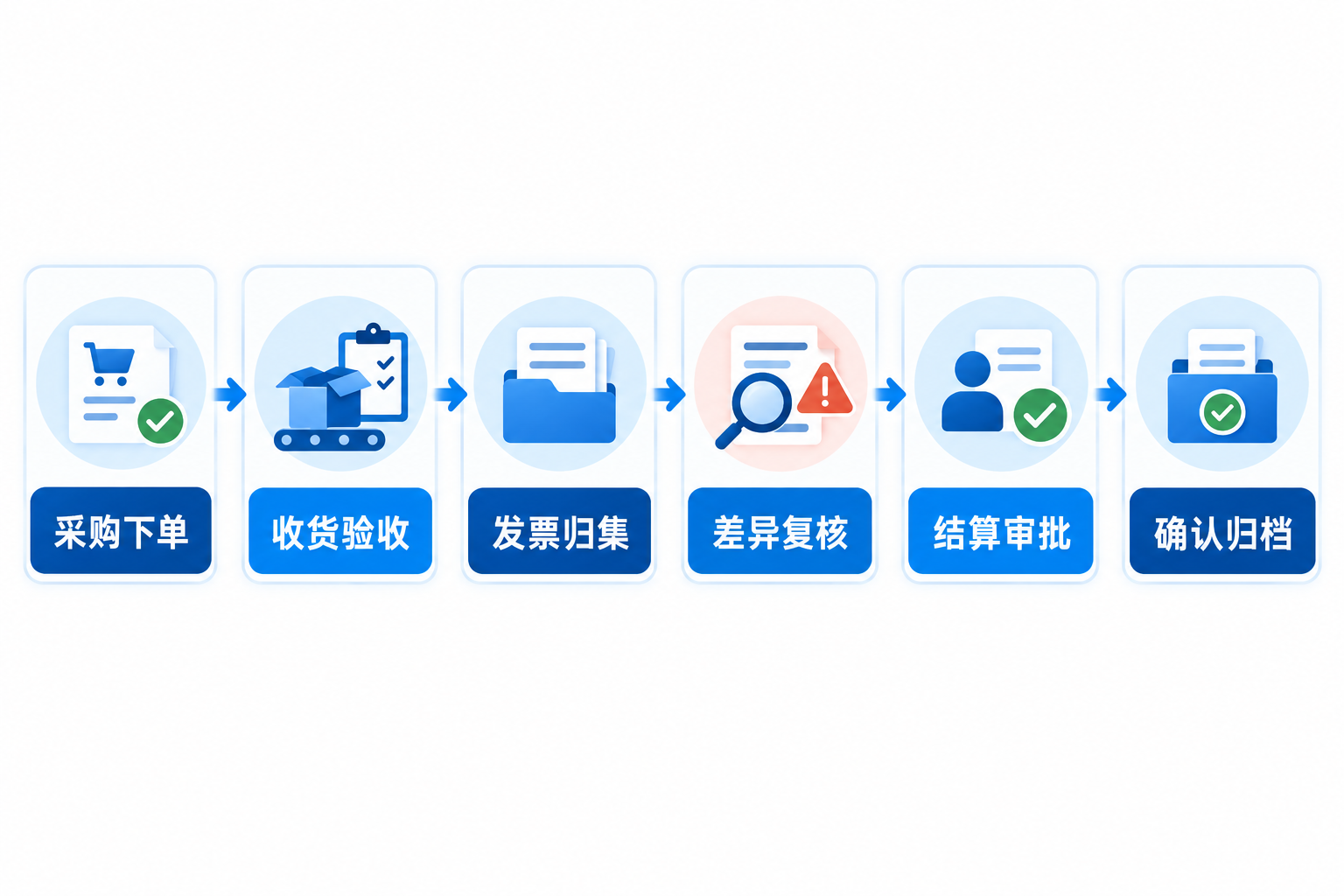
Failing to reconcile at month-end is usually not because finance checked one less time, but because procurement, warehouse, finance, and suppliers are not using the same set of fields, cutoff dates, and difference handling rules. To make supplier reconciliation run stably, procurement ordering, receipt acceptance, invoice aggregation, difference review, settlement approval, and confirmation archiving should be linked into one chain, with normal items advanced according to rules and abnormal items having clear responsibilities and closing conditions.
Reconciliation is not about forcing four amounts to be equal, but about explaining why orders, receipts, invoices, and payments are consistent or have reasonable differences. |
▍1. Purchase ordering: first fix the fields and business definitions
Orders should specify supplier, purchasing organization, materials or services, quantity, tax-inclusive and tax-exclusive amounts, currency, delivery, and payment terms. Enterprises should also unify reconciliation periods, cutoff dates, exchange rate values, accruals, returns, discounts, and rounding difference rules. Field names, sources, types, and whether they are required should form a data dictionary to avoid the same concept having inconsistent meanings across different systems.
▍2. Receipt and acceptance: record the performance facts completely
Physical procurement should be linked to warehousing, quality inspection, returns, and quantity differences, while service procurement should be linked to acceptance or milestones. Receipt records must be traceable to the original order and responsible person, and changes must also retain versions. Kailing TechnologySupply chain collaboration platformCan connect purchase orders, receipt, and supplier collaboration data based on implementation scope; interface boundaries, refresh frequency, and failure compensation need to be confirmed in the project.
▍3. Invoice collection: verify the source first, then participate in matching
Invoices can enter the process through compliant channels authorized by the enterprise, business systems, or file import. AI OCR can assist in extracting candidate fields from paper or image documents, but the results still require completeness, entity, amount, and duplication validation. "Successful recognition" cannot be directly equated with a genuine transaction, payable, or bookable, nor should it unconditionally promise automatic acquisition of all invoice sources.
▍4. Difference review: normal items pass through, abnormal items are routed separately
The system can perform one-to-one, one-to-many, or many-to-one matching by order number, material, quantity, amount, tax amount, supplier, and period. Situations such as missing receipts, duplicate invoices, quantity tolerance exceedances, price changes, cross-period issues, and currency inconsistencies enter the exception queue. Each type of exception should have a responsible department, required materials, handling deadline, and closing conditions, so finance only handles items that truly require judgment.
▍5. Settlement approval: recheck authorization and conditions before payment
Passing reconciliation does not mean payment can be made immediately. At the settlement stage, it is still necessary to check payment terms, prepayments, deductions, payment periods, fund plans, supplier account changes, and approval authority. When bank-enterprise direct connection is required, review, limits, operation trails, and failure handling should be set up. Any automatic payment action should be based on authorized real business and approval results.
▍6. Confirm archiving: retain versions, feedback, and evidence chain
The final reconciliation statement should record the period, version, supplier confirmation, internal review, and subsequent adjustments, and link to orders, receipts, invoices, payments, and exception handling materials. Kailing TechnologyElectronic Accounting Archive Management SystemCan be used to collect related archives and metadata, establish indexes and permissions; the specific archiving scope and retention period should be executed according to enterprise policies and current regulations.
Keywords: supplier reconciliation and settlement process, supplier reconciliation, purchase order, receipt and acceptance, invoice collection, difference review, settlement approval, Kailing Technology
As a comprehensive business-finance-tax digitalization solution service provider, Kailing Technology provides business-finance-tax management digital transformation products and operational services for various government agencies, institutions, and large, medium, and small enterprises. The product line includes: solutions for sales contract management system, procurement contract management system, fully digitalized Leqi interface project, automatic output invoicing system, reverse invoicing system, invoice issuance for individuals system, employee expense control and reimbursement system, input VAT invoice management system, supply chain collaborative reconciliation system, image AI OCR recognition system, automatic financial bookkeeping system, electronic accounting archives system, etc., comprehensively driving the digitalization process across various fields.
Consultation Hotline: 18513895936 / 010-60974119 Location: Beijing