
How is tax automatic invoicing implemented? From business validation to fully digitalized e-invoice delivery

How is tax automatic invoicing implemented? From business validation to fully digitalized e-invoice delivery
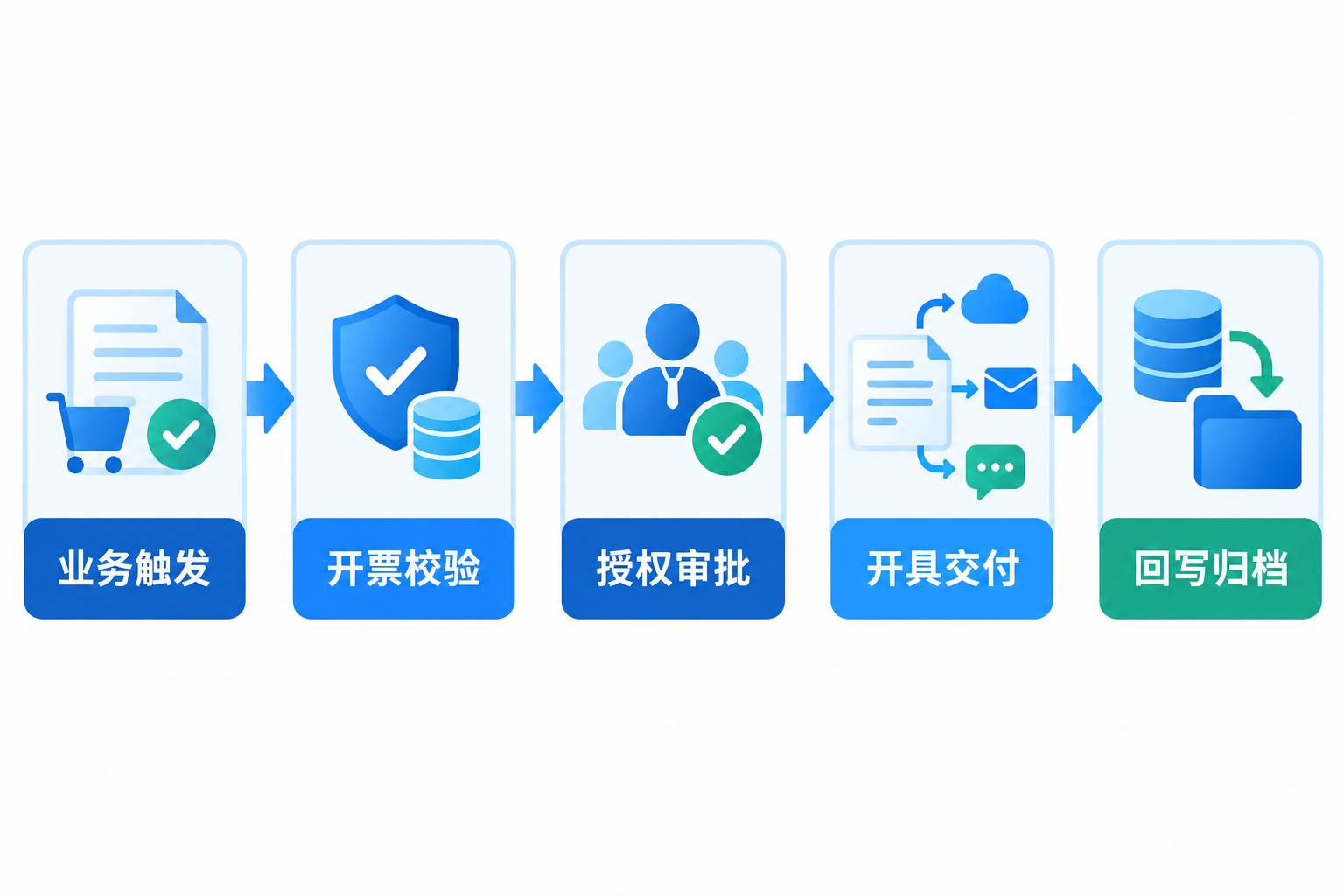
What automatic invoicing really needs to solve is not replacing manual clicks with API calls, but ensuring that orders, contracts, performance, buyer information, invoicing rules, and authorization responsibilities are validated before issuance. A robust fully digitalized e-invoice automation chain should cover business triggers, invoicing validation, authorization approval, issuance and delivery, status write-back, archiving, and exception handling; if any key data is incomplete or rules conflict, it should enter the to-do list rather than be forcibly issued.
Automation can reduce repetitive operations, but it cannot replace real transactions, enterprise authorization, internal controls, and necessary human judgment. |
▍1. First understand the institutional changes of fully digitalized e-invoices, then design the system process
The State Taxation Administration has made clear that from December 1, 2024, fully digitalized e-invoices will be officially promoted and applied nationwide. Fully digitalized e-invoices have characteristics such as no medium, code assignment, and quota assignment, and the invoicing quota is subject to dynamic total quota management; the total quota may also be adjusted monthly, temporarily, periodically, or manually upon taxpayer application. Enterprises therefore no longer design acquisition and custody processes according to the traditional paper invoice approach, but still need to continuously monitor quotas, issuance status, and exceptions. See detailsAnnouncement and interpretation of the State Taxation Administration on promoting the application of fully digitalized e-invoicesandExplanation of total quota adjustment rules。
▍2. Business triggers must come from real, complete transaction data
The system can trigger an invoicing request at nodes such as order completion, service acceptance, reconciliation confirmation, or payment receipt, but the trigger conditions should be consistent with the enterprise's business and tax handling. Fields such as buyer and seller information, goods or service items, quantity, amount, applicable tax rate, discounts, red-letter associations, and invoicing remarks need to be provided by the business system and validated according to rules. When contracts, performance evidence are missing, or buyer information is questionable, processing should be suspended and handed to the responsible person.
▍3. Preserve validation, approval, and authorization boundaries before issuance
The automated process can check conditions such as field completeness, duplicate requests, amount boundaries, quota status, and the relationship between order and invoicing amounts, and route to approval by organization, business type, and risk level. Kailing TechnologyOutput VAT Invoice Management SystemOrders or contracts, approval, issuance, delivery, and status write-back can be connected according to enterprise configuration. The specific degree of automation depends on enterprise authorization, tax channels, interface conditions, and internal controls, and "batch processing" cannot be understood as requiring no review or allowing unlimited invoicing.
▍4. Leqi Direct Connection is not an out-of-the-box channel for all enterprises
Public guidelines from various localities of the State Taxation Administration show that Leqi Direct Connection is intended for enterprises that meet the conditions, have their own information systems and corresponding capabilities, and need to complete application, testing, authorization, and other procedures, and ensure as required that the business data transmitted through the interface is true, accurate, and complete. If an enterprise adopts Leqi Direct Connection, it should evaluate qualifications and construction conditions according to the current guidelines of the competent tax authority; otherwise, it may use compliant channels such as the electronic tax bureau. Reference may be made toShanghai Tax Leqi Self-Use Direct Connection Service Guidelines。
▍5. After issuance, delivery, write-back, and exception closure must also be completed
After a fully digitalized e-invoice is successfully issued, it can be delivered according to enterprise configuration and compliant channels, and the invoice identifier, issuance time, delivery status, and business association can be written back to the order, contract, accounts receivable, or customer file. Issuance failures, insufficient quota, information validation failures, delivery returns, and red-letter processing should all retain the reason and retry records. Completion of invoice issuance does not mean revenue recognition or accounting entry has been completed; subsequent processing should still be executed according to the enterprise's accounting policies, business facts, and approval processes.
▍6. Before go-live, accept with both batch and exception scenarios
It is recommended to prepare desensitized samples such as normal orders, split invoicing, consolidated invoicing, discounts, returns, red-letter invoices, cross-entity, insufficient quota, buyer information changes, duplicate triggers, and delivery failures, and check data validation, authorization approval, issuance results, failure compensation, status write-back, and operation logs. Only when both normal and exception paths are traceable can automated invoicing truly upgrade from "can issue" to "operates stably and controllably."
Keywords: tax automatic invoicing, fully digitalized e-invoice, batch invoicing, output VAT invoice management, Leqi Direct Connection, invoicing quota, invoice delivery, Kailing Technology
As a comprehensive business-finance-tax digitalization solution service provider, Kailing Technology provides business-finance-tax management digital transformation products and operational services for various government agencies, institutions, and large, medium, and small enterprises. The product line includes: solutions for sales contract management system, procurement contract management system, fully digitalized Leqi interface project, automatic output invoicing system, reverse invoicing system, invoice issuance for individuals system, employee expense control and reimbursement system, input VAT invoice management system, supply chain collaborative reconciliation system, image AI OCR recognition system, automatic financial bookkeeping system, electronic accounting archives system, etc., comprehensively driving the digitalization process across various fields.
Consultation Hotline: 18513895936 / 010-60974119 Location: Beijing