
How to choose a supplier statement template? First unify fields, definitions, and discrepancy handling

How to choose a supplier statement template? First unify fields, definitions, and discrepancy handling
Monthly reconciliation failures are often not because the spreadsheet is missing a column, but because procurement, warehouse, finance, and suppliers do not have a unified definition of "how much is payable, when to record it, and which document prevails." Therefore, the value of a supplier statement template is not in a beautiful layout, but in fixing the field dictionary, data sources, matching rules, discrepancy reasons, confirmation responsibilities, and archive versions. The template is only the shell of a business agreement; behind it there must also be a repeatable reconciliation process.
First unify fields and definitions, then automatically match; normal items pass through and exception items are reviewed, which can reduce repeated spreadsheet pulling and verbal confirmation. |
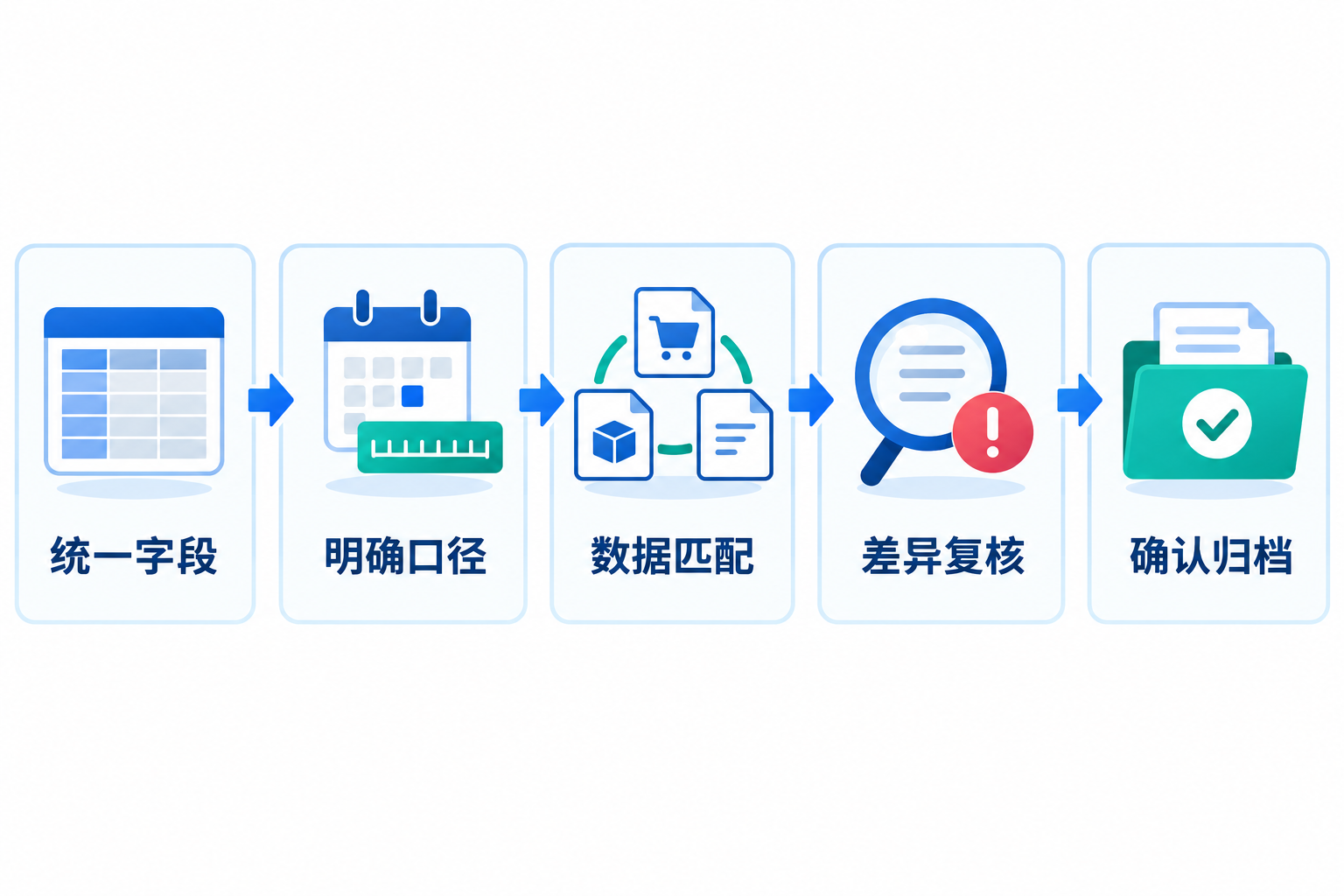
▍1. First list the required fields; do not directly copy the old table
Basic fields usually include supplier, purchasing organization, order number, material or service, receipt or acceptance record, tax-inclusive and tax-exclusive amounts, tax amount, invoice number or unique identifier, payment terms, paid and unpaid amounts, reconciliation period, discrepancy type, processing status, and confirmer. Different businesses should also add fields such as currency, exchange rate, deductions, returns, accruals, and prepayments. Field names, types, sources, and whether they are required should form a maintainable data dictionary to avoid the same concept being called differently in multiple systems.
▍2. Write the "reconciliation definitions" into the template instructions
Before reconciliation, agree on the cutoff date, cross-period rules, tax-inclusive definitions, accrual handling, red-letter or return offsets, exchange rate values, tail difference tolerance, and whether uninvoiced items are included. For example, order amount, receipt amount, invoice amount, and payment amount are not the same indicator, and the four cannot simply be required to always be equal. Only after clarifying the current period's verification objects and discrepancy judgment conditions will subsequent automated matching avoid misjudging normal business as exceptions.
▍3. Make orders, receipt, invoices, and payments traceably linked
Kailing TechnologySupply chain collaboration platformBusiness data such as purchase orders, receipt, and supplier collaboration can be connected according to the enterprise's implementation scope; invoice information can enter the verification process through the enterprise's existing systems, compliant authorized channels, or file import. AI OCR can assist in extracting candidate fields from paper or image documents, but the recognition results still need validation, and "successful recognition" cannot be treated as a conclusion that the transaction is real, the definitions are consistent, or payment can be made directly.
▍4. Matching rules must cover normal paths and exception paths
The system can perform one-to-one, one-to-many, or many-to-one matching based on conditions such as order number, material, quantity, amount, tax amount, supplier, and period; items that hit established rules enter the pending confirmation list, and items such as missing goods receipt, duplicate invoices, quantity out of tolerance, price changes, cross-period, or currency inconsistency enter the exception queue. Enterprises should set a responsible position, supplementary materials, processing time limit, and closing conditions for each type of discrepancy, rather than only outputting a "does not match" result.
▍5. Confirmation and archiving must preserve versions and responsibilities
After the statement is sent to the supplier, it may undergo supplementary documents, price adjustments, returns, or reconfirmation. The system should retain the reconciliation period, sent version, supplier feedback, internal review, final confirmation, and subsequent adjustment records, and control download, modification, and approval permissions. The final archive should not only be Excel or PDF, but should also include the underlying business data, discrepancy handling opinions, and confirmation evidence, facilitating payment review, audit, and dispute tracing.
▍6. When choosing a template, run a round with real samples
It is recommended to select desensitized samples such as normal procurement, partial receipt, split invoicing, prepayments, returns, discounts, cross-period, and historical legacy discrepancies, to verify whether fields are sufficient, whether rules misjudge, whether exceptions can be assigned, and whether versions are traceable. After the template passes sample validation, promote it to more suppliers; if the enterprise uses SAP, ERP, or a supplier portal, the interface boundaries, refresh frequency, and failure compensation should also be written into the implementation plan.
Keywords: supplier statement template, supplier reconciliation, automated reconciliation, procurement reconciliation, three-way matching, discrepancy handling, supply chain collaboration, Kailing Technology
As a comprehensive business-finance-tax digitalization solution service provider, Kailing Technology provides business-finance-tax management digital transformation products and operational services for various government agencies, institutions, and large, medium, and small enterprises. The product line includes: solutions for sales contract management system, procurement contract management system, fully digitalized Leqi interface project, automatic output invoicing system, reverse invoicing system, invoice issuance for individuals system, employee expense control and reimbursement system, input VAT invoice management system, supply chain collaborative reconciliation system, image AI OCR recognition system, automatic financial bookkeeping system, electronic accounting archives system, etc., comprehensively driving the digitalization process across various fields.
Consultation Hotline: 18513895936 / 010-60974119 Location: Beijing